
TLDR
Software engineer salary in Austin is no longer a second-tier conversation. A few years ago, engineers choosing between Austin and San Francisco were essentially trading pay for lifestyle. That trade-off has quietly disappeared.
Austin has turned into one of the most serious tech markets in the country. Apple, Meta, Amazon, and Tesla all have major engineering operations here.
The talent competition is real, and salaries have followed. But most salary data floating around online is either outdated, averaged into meaninglessness, or pulled from a single source that does not reflect what engineers are actually earning across different companies and experience levels — which is exactly why checking a dedicated resource like whatisthesalary.com gives you a more complete picture before you negotiate.
This article fixes that. Whether you are negotiating your first offer, benchmarking a senior role, or building a competitive hiring package in 2026 — everything here is current, verified, and broken down by experience level, company, and specialization so you know exactly where you stand.
Average Software Engineer Salary in Austin, TX
Austin has become one of the most active tech hiring markets in the country. Over the past several years, the city has attracted major players like Tesla, Apple, Amazon, Google, and Oracle — all of which have set up significant operations there. That level of demand has pushed software engineering compensation well above what you’d expect from a non-coastal city.
If you are trying to figure out what an Austin software engineer actually earns in 2026, the honest answer is: it depends on where you look and what you count. Base salary numbers vary across platforms, but when you stack them together, a consistent picture starts to form — and browsing through IT salary data across roles and experience levels helps you cross-reference what the numbers actually mean for your specific situation.
Average Base Salary
Multiple salary platforms report figures for Austin Texas software engineer compensation in 2026, and while the numbers vary slightly, they all point in the same direction.
Glassdoor puts the average software engineer salary in Austin at around $144,848 per year, with the typical range falling between $118,424 at the 25th percentile and $179,705 at the 75th percentile. That data is pulled from over 15,000 anonymously submitted salaries as of March 2026.
ZipRecruiter lands at a similar figure — roughly $146,192 per year, or about $70 per hour. Built In reports an average base of $144,034, with the most common salary band sitting between $170,000 and $180,000. Indeed, which pulls heavily from job postings, comes in a bit lower at $127,895 per year.
The variation between platforms comes down to methodology. Some rely on self-reported data, others on job postings, and some use a blend of both. A realistic mid-range estimate for the average software engineer salary in Austin sits around $135,000 to $146,000 in base pay for 2026.
| Source | Average Base Salary (Austin, TX) | Data Updated |
|---|---|---|
| Glassdoor | $144,848 | March 2026 |
| ZipRecruiter | $146,192 | March 2026 |
| Built In | $144,034 | 2026 |
| Indeed | $127,895 | March 2026 |
| PayScale | $100,835 | 2026 |
| Gusto (Median) | $125,000 | January 2026 |
Total Compensation Breakdown (Base + Bonus + Equity)
Base salary is only one part of the picture. In the tech industry, total compensation typically includes three components: base salary, annual performance bonus, and equity in the form of Restricted Stock Units (RSUs) — a structure you will notice plays out similarly when you look at how software engineer salary in Los Angeles breaks down across major tech employers there.
The base is your steady paycheck. On top of that, most tech companies offer a performance or sign-on bonus, and equity that vests over time — usually over four years with a one-year cliff, meaning you don’t receive any shares until you’ve completed your first full year.

For Austin software engineers specifically, Built In data shows the average additional cash compensation — bonuses and commissions — comes to around $15,791 per year, bringing average total compensation to roughly $159,825.
Levels.fyi, which skews toward mid-to-large tech companies, puts the average total compensation for a software engineer in the Greater Austin area at $182,000, with the full range running from $140,800 to $240,000.
At top-tier companies, those numbers jump significantly higher. Meta, for example, reports an average total compensation of $400,000 for software engineers based in Austin — a figure that reflects heavy RSU grants on top of a competitive base.
Equity vesting schedules vary by employer, but the four-year vest with quarterly distributions after the first year is the most common structure. At high-growth companies, the equity component alone can rival or exceed your base salary over time.
| Compensation Component | Typical Range (Austin, TX) |
|---|---|
| Base Salary | $127,000 – $146,000 |
| Annual Bonus | $10,000 – $25,000 |
| RSU / Equity (annual vest) | $10,000 – $60,000+ |
| Total Compensation (Estimated) | $150,000 – $182,000+ |
How Austin Compares to the National Average
On raw numbers, Austin software engineers earn close to the national average — sometimes slightly above, sometimes slightly below, depending on which dataset you use.
Glassdoor’s broader U.S. dataset puts the national average for software engineers at around $148,764, which makes Austin’s figure of $144,848 roughly 2 to 3 percent below the country-wide average. Other data sources narrow that gap even further.
That difference looks bigger than it actually is in practice. Texas has no state income tax, which immediately adds several percentage points to your effective take-home pay compared to engineers living in California, New York, or Washington state. An Austin software engineer earning $145,000 often keeps more of that paycheck than a San Francisco engineer earning $160,000 once state and local taxes are factored in.
The pay gap between traditional coastal tech hubs and newer markets like Austin continues to narrow in 2026, making cities like Austin increasingly competitive for engineers who want strong pay without the extreme cost of living that comes with the Bay Area or Manhattan.
| Location | Average Base Salary | State Income Tax | Cost of Living |
|---|---|---|---|
| Austin, TX | ~$144,000 | None | Moderate |
| San Francisco, CA | ~$175,000+ | Up to 13.3% | Very High |
| New York City, NY | ~$165,000+ | Up to 10.9% | Very High |
| Seattle, WA | ~$160,000+ | None | High |
| National Average (U.S.) | ~$147,000 – $149,000 | Varies | Varies |
The takeaway is straightforward: Austin salary software engineer numbers may look modest next to coastal cities, but the real value shows up in your bank account at the end of the month.
Software Engineer Salary by Experience Level in Austin, TX
One of the biggest drivers of your paycheck in Austin is where you sit on the experience ladder. The difference between an entry-level role and a senior position is not just a title change — it can mean a $100,000 or more gap in total compensation.
Here is how salaries break down at each stage of the software engineering career path in Austin in 2026 — and if you want to see how these figures compare nationally, the full breakdown of software engineer salary in the United States puts Austin’s numbers into a broader context.

Entry Level Software Engineer Salary
Starting out in Austin is more competitive than most people expect. The Austin entry level software engineer salary varies widely depending on the employer type — a small startup pays very differently from a FAANG-adjacent company.
Glassdoor puts the typical entry-level pay range in Austin between $95,634 and $143,155 per year, with a median closer to $119,000. Salary.com comes in lower at around $82,462, while Indeed reports figures as low as $59,946 — which likely reflects smaller companies or part-time roles mixed into the data.
A safe, realistic estimate for an entry level software engineer salary in Austin at a mid-size or large tech employer lands around $85,000 to $120,000 in base pay for 2026. At big-name employers, that starting number can climb significantly higher.
What helps at the entry level: having internship experience, knowing in-demand languages like Python, JavaScript, or Java, and ideally holding a computer science or related degree from a recognized institution.
| Experience Tier | Estimated Base Salary (Austin, TX) |
|---|---|
| Entry Level (0–2 years) | $82,000 – $120,000 |
| Junior (1–3 years) | $95,000 – $130,000 |
| Mid-Level (3–6 years) | $130,000 – $160,000 |
| Senior (6–10 years) | $165,000 – $250,000 |
| Principal (10+ years) | $217,000 – $330,000+ |
Junior Software Engineer Salary
Junior engineers in Austin are typically one to three years into their career. They are past the entry-level stage but not yet operating independently on complex systems. Built In reports the average junior software engineer salary in Austin at around $80,056 per year, though that figure can run higher at larger tech employers.
In practice, most junior roles at established Austin tech companies pay somewhere between $95,000 and $130,000, depending on the tech stack, company size, and whether equity is part of the package. Junior engineers who specialize in cloud infrastructure, full-stack development, or machine learning can command the upper end of this band even early in their careers.
This is also the stage where mentorship quality and project exposure start to matter. Junior engineers at companies like Dell, Apple, or Oracle Austin often accumulate hands-on experience faster, which accelerates their move to mid-level roles — and a meaningful pay bump — within two to three years.
Mid-Level Software Engineer Salary
The mid-level stage is where things start to get interesting. Engineers at this tier — roughly three to six years of experience — are expected to take ownership of features, review code, and work without close supervision. Austin’s market rewards this level of independence well.
ZipRecruiter puts the average mid-level software engineer salary in Austin at $146,227 per year as of early 2026, with the majority of mid-level salaries falling between $118,900 and $171,500. The top 10 percent of mid-level engineers in Austin are earning over $203,000.
This is the point in the career path where total compensation packages also start to include more meaningful equity grants and larger performance bonuses. Switching jobs at the mid-level stage is also one of the most effective ways to accelerate salary growth — many engineers see 15 to 25 percent pay increases when moving to a new employer with two to four years of experience under their belt.
Senior Software Engineer Salary
Senior roles are where Austin’s software engineering market becomes seriously competitive. The senior software engineer salary in Austin is among the most sought-after data points on any salary comparison, and for good reason — it represents a significant jump from mid-level pay.
Glassdoor puts the average senior software engineer salary in Austin TX at $204,839 per year, with the typical range sitting between $172,005 and $249,074. The top 10 percent of senior engineers in Austin report total compensation reaching $295,000 or more.
Built In data tells a slightly different story, reporting an average base salary of $146,935 for senior engineers in Austin, with total compensation (base plus bonus) averaging $164,135. The spread between platforms here reflects the mix of employers — the Glassdoor figure likely captures more FAANG-tier roles, while Built In’s numbers pull from a broader range of Austin employers including mid-market companies.
The average senior software engineer salary in Austin TX consistently sits above the $160,000 mark in base pay at established tech companies, and well above $200,000 in total compensation at top-tier employers. Six-plus years of experience, a strong specialization, and system design skills are the primary factors that get engineers into this bracket.
Principal Software Engineer Salary
Principal software engineers sit at the top of the individual contributor track. These are engineers who have typically spent ten or more years in the field, drive architectural decisions, mentor multiple teams, and directly influence product and technical strategy.
Glassdoor reports the average principal software engineer salary in Austin at $233,108 per year in base pay, with a typical range of $195,065 to $284,011 and top earners reaching $337,508 at the 90th percentile. Built In puts the average base salary at $165,151 — lower, because it captures a wider range of company types.
PayScale’s figure of $150,693 reflects the lower end of the market, often at companies where the “principal” title is applied at a lower seniority threshold than at larger tech firms.
When you factor in equity and bonus, total compensation for a principal engineer at a well-funded Austin tech company can comfortably land between $300,000 and $450,000 — particularly at companies like Apple, Amazon, or Oracle, which have major Austin engineering hubs.
Software Engineer Salary Ranges in Austin, TX
Understanding the average software engineer salary in Austin is useful, but averages can be misleading. The actual salary range for this role in Austin is surprisingly wide — and knowing where the floor, middle, and ceiling sit helps you benchmark where you should realistically expect to land.
For a useful point of comparison, looking at how the software engineer salary in Boston breaks down across experience levels shows just how differently the same role can pay depending on the market you are in.
Lowest, Median, and Highest Pay Ranges
According to data pulled from multiple platforms in March 2026, here is how the full pay range breaks down for software engineers in Austin:
The lowest end of the spectrum — roughly the bottom 10 to 25 percent of earners — falls between $63,000 and $95,000. These figures typically represent entry-level roles at smaller companies, contract positions, or roles in industries that pay below the tech sector average.
The median and mid-range sits between $127,000 and $146,000 in base pay, which aligns with the figures reported by Indeed, Glassdoor, and ZipRecruiter for the average Austin software engineer.
The top of the range — the 90th percentile and above — pushes past $200,000 in base pay and significantly higher in total compensation. Top earners in Austin, particularly those at companies like Meta, Apple, Amazon, or Tesla, are pulling in $250,000 to $400,000+ in total comp when equity and bonuses are stacked in.
| Pay Tier | Base Salary Range (Austin, TX) |
|---|---|
| Bottom 10–25% | $63,000 – $95,000 |
| Median (50th percentile) | ~$127,000 – $143,000 |
| 75th Percentile | ~$171,000 – $180,000 |
| 90th Percentile | $200,000 – $217,000+ |
| Top Earners (FAANG+) | $250,000 – $400,000+ (TC) |
What Affects Where You Fall in the Range
The salary range for a software engineer in Austin is wide — roughly $65,000 to $325,000 according to Built In — and a lot of factors determine exactly where you land within it. Here are the main ones:
Company size and type matter more than most people realize. Larger companies typically pay significantly more than smaller ones. Data shows bigger companies pay up to 18 percent more than smaller companies for the same software engineering role.
FAANG-tier employers — Meta, Apple, Amazon, Google — sit at the top of the pay spectrum, while mid-market companies and startups fall lower on base but may compensate with equity upside.
Tech stack and specialization directly impact your market value. Engineers with expertise in cloud platforms (AWS, Azure, GCP), distributed systems, machine learning, or cybersecurity consistently command higher salaries than generalists. Austin’s growing AI and semiconductor sectors have also created strong demand for embedded systems engineers and ML engineers specifically.
Years of experience and career trajectory are the most straightforward salary drivers. Each step up the career ladder — from junior to mid-level to senior to principal — brings a meaningful pay increase, often in the range of 20 to 40 percent per transition.
Education still plays a role, though it is less of a hard requirement than it used to be. Engineers with a master’s degree in computer science or software engineering may qualify for higher starting offers and faster promotion tracks, particularly at larger employers.
That said, demonstrated skills and a strong portfolio increasingly outweigh formal credentials in Austin’s startup and mid-market scene.
Industry vertical also shapes your ceiling. Financial services, telecommunications, and retail tech companies in Austin tend to pay more than manufacturing or education-sector employers for the same software engineering skill set.
Top Paying Companies for Software Engineers in Austin, TX
Not all employers in Austin pay the same. The company you work for often matters more than the city itself, especially once you start factoring in equity packages and bonus structures.
Austin has a growing roster of high-profile tech employers, and the gap between the highest-paying and average-paying companies is significant — a pattern that holds true nationally as well, which is why understanding the highest paying companies for software engineers gives you real leverage when evaluating and negotiating offers.
Popular Companies and What They Pay
When it comes to top-paying employers for an Austin software engineer, Meta consistently sits at the top of the list. Levels.fyi data from March 2026 shows Meta offering an average total compensation of $400,000 for software engineers in the Greater Austin area — a figure that includes base salary, RSUs, and annual bonuses.
Other high-paying names in the Austin market include Cruise, Stripe, Roblox, and Roku, all of which rank among the top 10 highest-paying companies for software engineers in Austin according to Glassdoor’s March 2026 data.
On the FAANG tier more broadly, Apple and Amazon both have significant engineering presences in Austin. The apple software engineer salary in Austin typically falls between $172,000 and $200,000+ in total compensation depending on the level, while amazon software engineer salary Austin figures tend to range from $145,000 to $210,000+ in total comp, again depending on the role level and tenure.
The data from H-1B federal filings adds useful context. Microsoft pays software engineers base salaries ranging from $82,971 to $284,000. Google pays from $109,180 to $340,000. Meta’s range is even wider, running from $120,000 to $480,000 at the base level alone — and those figures do not include equity or bonuses.
Outside of FAANG-adjacent companies, strong-paying Austin-based employers include Dell, Oracle, Apple, Tesla, IBM, PayPal, Charles Schwab, and NI (National Instruments). These mid-tier employers typically offer base salaries in the $110,000 to $160,000 range with moderate bonus structures and more limited equity compared to pure tech firms.
| Company | Average Total Compensation (Austin) | Tier |
|---|---|---|
| Meta | ~$400,000 | FAANG |
| $180,000 – $340,000+ | FAANG | |
| Apple | $172,000 – $220,000+ | FAANG |
| Amazon | $145,000 – $210,000+ | FAANG |
| Stripe | $170,000 – $230,000 | Top-Tier |
| Cruise | $165,000 – $210,000 | Top-Tier |
| Oracle | $130,000 – $175,000 | Mid-Tier |
| Dell | $120,000 – $165,000 | Mid-Tier |
| IBM | $100,000 – $150,000 | Mid-Tier |
| Tesla | $130,000 – $180,000 | Mid-Tier |
Top Paying Industries for Software Engineers in Austin
Beyond individual companies, the industry you work in also shapes your paycheck. Glassdoor’s 2026 data for Austin highlights the following as the top-paying industries for software engineers — and if you want to see how industry-level pay differences play out in one of the most competitive tech markets in the country, the breakdown of software engineer salary in San Francisco shows exactly how much industry vertical can move the needle on total compensation.
Human Resources and Staffing leads with a median total pay of $141,310. That figure might seem surprising, but it reflects companies like Crossover for Work, which are known for above-market compensation packages.
Retail and Wholesale comes in second at $136,262 in median total pay — driven largely by companies like Wayfair, Walmart, and H-E-B, all of which have substantial tech teams in Austin. Telecommunications follows at $135,719, with major employers including AT&T, Nokia, and Ericsson.
Financial Services lands at $135,161, with top-paying firms like Optiver, PIMCO, and Dimensional Fund Advisors pulling that average up. Manufacturing rounds out the top five at $132,505 — where companies like Silicon Labs, Cirrus Logic, and Tesla are the primary drivers.
It is worth noting that Information Technology as a vertical, while paying well, actually trails some of these sectors in median total pay for individual contributors — though it offers more equity upside at top-tier companies.
| Industry | Median Total Pay (Austin, TX) | Notable Employers |
|---|---|---|
| Human Resources & Staffing | $141,310 | Crossover for Work, Red Oak Technologies |
| Retail & Wholesale | $136,262 | Wayfair, Walmart, H-E-B |
| Telecommunications | $135,719 | AT&T, Nokia, Ericsson |
| Financial Services | $135,161 | Optiver, PIMCO, Dimensional Fund Advisors |
| Manufacturing | $132,505 | Silicon Labs, Tesla, Cirrus Logic |
Top Paying Locations Near Austin, TX
If you are willing to commute or relocate within the Central Texas region, there are a few nearby cities worth knowing about.
Austin gets most of the attention, but some surrounding areas actually offer competitive or even higher average salaries for software engineers — and if you are open to exploring other Texas markets altogether, the software engineer salary in Houston is worth a look before you make any final decisions about where to plant your career.
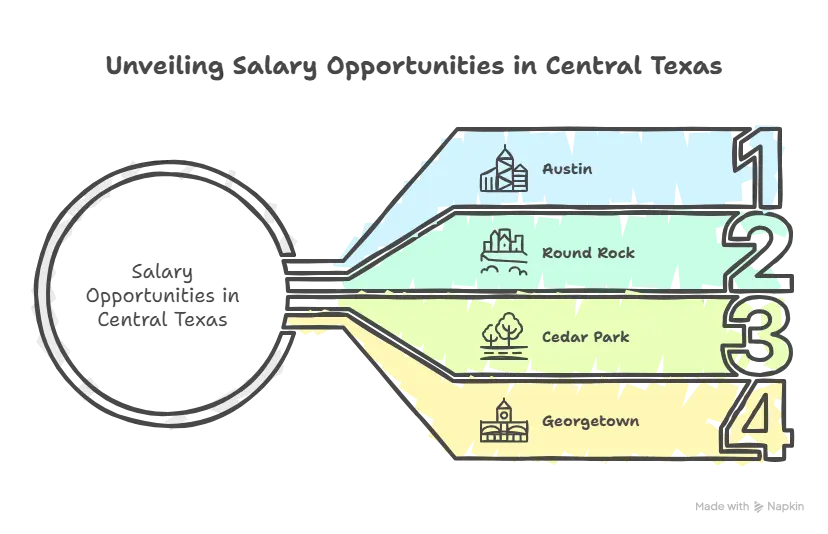
Highest Paying Cities for Software Engineers Near Austin
Bastrop, TX comes in as the highest-paying city near Austin for software engineers, with an average salary of $163,846. That figure is noteworthy given Bastrop’s smaller size — it likely reflects the influence of companies like Siemens and 3M, which have operations in the area and bring large-company pay scales with them.
Taylor, TX is next at $151,664. This is partly driven by Samsung’s massive $17 billion semiconductor plant in Taylor, which has created significant demand for embedded systems and software engineering talent in the area.
Cedar Park sits at $132,935 and functions as a tech satellite community for Austin, with employers like Apple and Oracle maintaining a presence there. Georgetown comes in at $120,988, with IBM and Google both hiring in the area. Round Rock follows at $120,173, best known as the headquarters of Dell Technologies.
| City | Average Software Engineer Salary | Notable Employers |
|---|---|---|
| Bastrop, TX | $163,846 | Siemens, 3M |
| Taylor, TX | $151,664 | Samsung, Dell, Apple |
| Cedar Park, TX | $132,935 | Apple, Oracle |
| Austin, TX | ~$144,000 – $146,000 | Meta, Apple, Amazon, Tesla |
| Georgetown, TX | $120,988 | IBM, Google |
| Round Rock, TX | $120,173 | Dell, Apple |
| New Braunfels, TX | $79,590 | Mixed industries |
Where Can a Software Engineer Earn More Than Austin?
Austin is a strong market, but several U.S. cities pay more in raw base salary. San Jose and San Francisco remain the highest-paying metros for software engineers in the country, with median salaries well above $170,000. Seattle, New York City, and Boston all pay more in nominal terms as well.
That said, the cost-of-living comparison changes the picture considerably. San Jose has a cost of living index of around 272, compared to Austin’s index of approximately 123. This means a software engineer earning $128,000 in Austin often has more real purchasing power than someone earning $180,000 in San Jose once housing, taxes, and day-to-day expenses are accounted for, according to Bureau of Economic Analysis regional price data.
Cities that pay more than Austin in base salary but come closer to parity in real purchasing power include Seattle (no state income tax, but high housing costs) and Denver (moderate cost of living, growing tech scene).
Software Engineer Salaries by State — How Austin Stacks Up
Texas as a whole is a competitive state for software engineering compensation. Austin leads the state, followed by Dallas and Odessa.
The Texas statewide average for software engineers sits around $137,441, putting Austin roughly 6 percent above that mark — though when you stack Texas against the biggest paying state in the country, the gap becomes clear, and the full breakdown of software engineer salary in California shows just how wide that difference can get at every experience level.
At the national level, California consistently ranks highest in base salary, driven by the Bay Area and Los Angeles tech ecosystems. Washington state, Massachusetts, and New York follow. Texas lands in the middle tier nationally — below the coastal hubs in nominal pay but competitive when adjusted for purchasing power and the absence of state income tax.
The pay gap between coastal tech hubs and Southern states like Texas is narrowing. Austin and Dallas are both pulling in more major tech employers each year, and that competition for talent is gradually pushing local salaries upward.
| State | Avg. Software Engineer Salary | State Income Tax |
|---|---|---|
| California | ~$160,000 – $175,000 | Up to 13.3% |
| Washington | ~$155,000 – $165,000 | None |
| New York | ~$150,000 – $165,000 | Up to 10.9% |
| Massachusetts | ~$148,000 – $158,000 | 5% flat |
| Texas (Austin) | ~$144,000 – $146,000 | None |
| Colorado | ~$130,000 – $145,000 | 4.4% flat |
| Florida | ~$120,000 – $135,000 | None |
Software Engineer Salary by Gender in Austin, TX
The gender pay gap in tech is a real and documented issue nationwide, and Austin is not exempt from it. The data available for the Austin market in 2026 shows a measurable difference in compensation between male and female software engineers, though the gap is narrower here than in some other major tech cities.
Gender Pay Gap Breakdown
Built In’s 2026 salary data for Austin provides one of the cleaner comparisons available. The average software engineer salary for women in Austin is $136,413, compared to $144,596 for men. That is a gap of approximately $8,183 — or roughly 5.7 percent.
To put it differently, female software engineers in Austin earn about 94 cents for every dollar earned by their male counterparts in the same role, according to Built In’s data. That figure is slightly better than the broader national gender gap in engineering occupations.
For context, the Society of Women Engineers, citing U.S. Census Bureau data from the 2025 American Community Survey, found that in engineering and computer occupations as a whole, women consistently earn less than men in the same roles across every discipline tracked. The gap in software quality assurance roles was the narrowest at 98 cents on the dollar, while other tech specializations showed wider disparities.
| Gender | Average Software Engineer Salary (Austin, TX) | Difference |
|---|---|---|
| Male | $144,596 | — |
| Female | $136,413 | -$8,183 (-5.7%) |
What the Numbers Say
The gender pay gap in Austin’s software engineering market is not purely a function of discrimination. Research consistently shows that several structural factors contribute to it — including differences in negotiation behavior at the offer stage, concentration in different company types, and the fact that women are underrepresented at the senior and principal levels where the highest compensation is concentrated.
PayScale research adds nuance here. Women under 25 in tech earn 29 percent less than their male counterparts, but that gap narrows significantly with age — dropping to around 5 percent for employees over 50. This suggests that seniority and accumulated experience do close much of the gap over time, though they do not eliminate it entirely.
The representation issue is also relevant. Women make up a smaller share of the software engineering workforce overall — particularly in senior individual contributor and staff engineering roles — which pulls down the average female salary when compared to the broader pool of male engineers who are more evenly distributed across seniority levels.
There is some encouraging momentum. More Austin-based tech employers are conducting pay equity audits, publishing salary bands, and setting internal targets for representation at senior levels. Pay transparency requirements, while not yet law in Texas, are increasingly being adopted voluntarily by large tech firms operating in the state.
The practical takeaway for women entering or advancing in Austin’s tech market: negotiating starting salary from a well-researched baseline, tracking market rate data regularly, and targeting companies with published pay equity commitments are the most actionable steps toward closing this gap at the individual level.
Employee Benefits for Software Engineers in Austin, TX
Salary is only part of what you are negotiating when you take a software engineering role in Austin. The benefits package matters too — and in this market, it can genuinely add $20,000 to $40,000 in real annual value when you account for everything.
Austin’s tech hiring market is competitive enough that companies use benefits to differentiate themselves. Whether you are evaluating an offer from a large employer like Apple or a fast-growing startup on the east side of town, knowing what the standard package looks like helps you spot what is missing.
Common Health Benefits
Health coverage is typically the most closely evaluated benefit for software engineers, and Austin’s major tech employers offer solid options across the board — much like what you will find in other major tech hiring markets, including how employers structure their overall compensation and benefits packages as part of the software engineer salary in Chicago to stay competitive for top talent.
The standard package at mid-to-large tech employers in Austin includes medical, dental, and vision insurance. Most large companies cover 100 percent of the employee premium and offer subsidized or fully covered plans for dependents. Plans usually come in tiered options — PPO, HMO, and High Deductible Health Plan (HDHP) — with the HDHP often paired with an employer-funded Health Savings Account (HSA) or Flexible Spending Account (FSA).
Mental health coverage has moved from a nice-to-have to an expected part of the package. Austin tech employers including Adobe, ServiceNow, and CrowdStrike include dedicated mental health and well-being benefits, therapy platform access, and Employee Assistance Programs (EAPs) as part of their standard offerings.
Short-term and long-term disability insurance is standard at large employers, along with basic life insurance — often set at two to four times the employee’s annual salary. Fertility and family planning benefits are increasingly common at top-tier Austin employers, including adoption assistance and paid parental leave ranging from 12 to 20 weeks.
| Health Benefit | Availability at Large Austin Tech Employers |
|---|---|
| Medical Insurance (PPO/HMO/HDHP) | Standard across all major employers |
| Dental and Vision | Standard |
| HSA / FSA | Widely available, often employer-funded |
| Mental Health Coverage | Increasingly standard |
| Short and Long-Term Disability | Standard |
| Life Insurance | Standard, often 2 to 4 times annual salary |
| Fertility and Family Planning | Available at many top-tier employers |
| Paid Parental Leave | 12 to 20 weeks at most large employers |
Other Perks and Non-Salary Compensation
Beyond health benefits, Austin’s tech companies compete on lifestyle perks, financial benefits, and professional development offerings.
Retirement savings are a meaningful part of the overall package. Most large employers offer a 401(k) with employer matching between 3 and 6 percent of base salary. Some companies, including Dell, IBM, and Charles Schwab, go above the standard match or add profit-sharing contributions. Charles Schwab is particularly notable for offering a 28-day paid sabbatical after every five years of service for eligible roles.
Paid time off varies by employer. Many of Austin’s startup and mid-size tech companies now offer unlimited PTO, while larger employers like Apple and Oracle use structured accrual-based policies starting at 15 to 20 days per year. Remote and hybrid work flexibility has effectively become a baseline expectation — most Austin tech employers now operate on a hybrid model of two to three days in office, and some are fully remote.
Professional development benefits are worth paying attention to as a software engineer. Tuition reimbursement, conference attendance budgets, internal learning platforms, and certification sponsorships are common at large employers. IBM, in particular, builds structured career development programs into its engineering roles, including access to learning tools and internal mobility pathways.
Equity participation through RSU awards and Employee Stock Purchase Plans (ESPPs) adds additional upside at publicly traded companies. Apple, Dell, and Oracle all offer ESPP programs that let employees purchase company stock at a discount, which can represent meaningful additional income over time.
| Perk or Benefit | Details |
|---|---|
| 401(k) Match | 3 to 6 percent at most large employers |
| PTO | 15 to 20 days structured, or unlimited at many startups |
| Sabbatical | Available at select employers |
| Remote and Hybrid Work | Hybrid standard; fully remote available at some firms |
| Tuition Reimbursement | Widely available at large employers |
| ESPP and Stock Discounts | Available at Apple, Dell, Oracle, and others |
| Wellness Stipends | Available at Adobe, ServiceNow, CrowdStrike |
| Emergency Backup Childcare | Offered at Adobe, CrowdStrike, and ServiceNow |
Related Job Titles and How Pay Compares in Austin, TX
The software engineer title covers a wide range of specializations, and some closely related roles pay significantly more.
If you are weighing a specialization or a career pivot, knowing how adjacent roles are compensated in Austin is useful data — and for a broader view of where the real money is across the entire industry, the full guide on the highest paying software jobs in the US is one of the more comprehensive resources available on the topic.

Also read: Software Engineer Salary in the United States (2026 Guide)
Top 5 Best Paying Related Software Engineer Jobs in Austin
Technical architects sit at the top of the individual contributor pay ladder in Austin, outside of principal engineering roles. Technical architects design system-wide architecture and guide technology selection across large engineering organizations. The average salary for this role in Austin is $171,524 per year.
Machine learning engineers come in second at an average of $169,321. Austin’s expanding AI and semiconductor ecosystem — with employers including Apple, IBM, Qualcomm, and a growing number of AI-focused startups — has made ML engineering one of the most in-demand and highest-compensated specializations in the city.
The supply-demand gap in this role is real: there are far fewer qualified ML engineers than open positions in Austin right now, and that drives compensation up accordingly.
Security engineers average $155,536 in Austin. The cybersecurity sector has grown significantly here, with companies like CrowdStrike, Palo Alto Networks, and several defense contractors hiring actively for security-focused engineering talent.
Site Reliability Engineers (SREs) average $147,810. As more Austin companies move infrastructure to cloud platforms, the demand for engineers who manage production reliability at scale has pushed SRE salaries consistently above the general software engineering baseline.
DevOps engineers average $135,305, with top earners at companies like Apple and IBM in Austin pulling significantly higher. The role’s overlap with cloud infrastructure, CI/CD pipelines, and Kubernetes has made it one of the most transferable and consistently hired specializations in the market.
| Related Job Title | Average Salary in Austin, TX |
|---|---|
| Technical Architect | $171,524 |
| Machine Learning Engineer | $169,321 |
| Security Engineer | $155,536 |
| Site Reliability Engineer | $147,810 |
| Software Engineer (General) | $144,000 to $146,000 |
| DevOps Engineer | $135,305 |
| Cloud Engineer | $146,725 |
| Systems Engineer | $137,829 |
How Similar Professions Get Paid in Austin, TX
Comparing the austin software engineer salary against adjacent roles shows that specialized technical tracks tend to pay more than generalist positions, though the software engineering baseline remains competitive across the board.
Product managers in Austin average $151,679. It is not an engineering role in the traditional sense, but it draws heavily from engineering backgrounds and is a common career transition for experienced software engineers — particularly those who enjoy working at the intersection of technology and business strategy.
Cloud engineers, which is a distinct role from general software engineering, average $146,725 in Austin — sitting right alongside the general software engineering figure. This reflects the growing expectation that software engineers already possess cloud platform knowledge, which has narrowed the compensation gap between the two titles.
Software developers, which is a role that overlaps significantly with software engineering, earn a median of around $117,596 in Austin according to Glassdoor’s 2026 data. The lower figure compared to software engineers reflects the broader pool of professionals captured under that title, including more junior and non-specialized positions.
QA and software testing engineers generally earn in the $85,000 to $120,000 range, though senior automation engineers with strong scripting and CI/CD skills can push toward the lower end of the mid-level software engineer pay band.
Full-stack engineers tend to sit close to the general software engineer average, with senior full-stack roles at product companies trending higher due to the breadth of skill required.
What Does a Software Engineer Do?
Understanding what the role actually involves is worth covering — especially for readers who are evaluating whether software engineering is the right career path or comparing it against adjacent roles.
The scope of software engineering has expanded considerably in recent years, and what companies expect from engineers in 2026 goes well beyond writing code. If you are still building a full picture of the profession itself, the detailed overview of the software engineer career path covers everything from day-to-day responsibilities to long-term progression in one place.
Software Engineer Job Description
A software engineer is responsible for designing, developing, testing, and maintaining software applications and systems. The role applies principles from computer science and engineering to build software that solves real problems — whether that is a consumer-facing mobile app, an internal analytics tool, or a large-scale cloud infrastructure platform.
What has changed is the scope of ownership. In 2026, most Austin tech employers expect engineers to own the full software development lifecycle (SDLC). That includes requirements analysis, system design, implementation, testing, deployment, and ongoing maintenance. Engineers are not handed a spec and told to code — they are expected to engage upstream and downstream from the code itself.
The Bureau of Labor Statistics projects that employment for software developers will grow 16 percent through 2034, which is significantly faster than the average for all occupations. That growth, combined with Austin’s tech expansion, means demand for software engineering talent in Austin Texas is not slowing down.
Key Responsibilities
The day-to-day responsibilities of a software engineer in Austin vary by seniority, team, and company type. That said, a consistent set of core functions appears across job descriptions in 2026.
Designing and developing software is the primary function. Engineers write clean, well-documented code, build features that meet both technical and user requirements, and contribute to architecture decisions as they gain seniority.
Testing and debugging is equally central. This includes writing unit and integration tests, participating in code reviews, and working within CI/CD pipelines to catch issues before they reach production. Automated testing is an expected skill at most Austin tech employers, not an optional one.
Cross-functional collaboration is a daily reality. Engineers work with product managers, UX designers, data teams, DevOps, and business stakeholders. Translating business requirements into technical solutions — and explaining technical constraints back to non-technical colleagues — separates effective engineers from ones who stay siloed.
Documentation, performance optimization, security practices, and incident response round out the picture. Engineers at cloud-native companies are increasingly expected to understand how their code behaves in production and to participate in on-call rotations when things go wrong.
| Core Responsibility | What It Involves |
|---|---|
| Software Design and Development | Write, review, and maintain production-grade code |
| Testing and Debugging | Unit testing, integration testing, CI/CD participation |
| System Architecture | Design scalable, reliable software systems |
| Cross-Functional Collaboration | Work with product, design, data, and ops teams |
| Documentation | Maintain technical docs and code comments |
| Performance Optimization | Improve efficiency, scalability, and reliability |
| Security Practices | Follow secure coding standards, identify vulnerabilities |
| Incident Response | Participate in on-call rotations and postmortems |
Skills a Software Engineer Needs
Software engineering requires both technical depth and non-technical ability. Neither set alone is sufficient — engineers who write excellent code but cannot communicate across teams tend to hit career ceilings earlier than those who develop both.
On the technical side, proficiency in at least one major programming language is the baseline. Python, Java, JavaScript, and C++ are the most frequently requested languages in Austin job postings in 2026. Data structures and algorithms knowledge remains essential — both for passing technical interviews and for writing efficient production code.
Cloud platform experience has shifted from a nice-to-have to a near-requirement at most mid-to-large Austin tech employers. AWS, Azure, and Google Cloud Platform (GCP) come up constantly in job postings. Containerization with Docker and Kubernetes, version control with Git, and familiarity with CI/CD tools are standard expectations at this point.
Database management — both relational (SQL) and non-relational (NoSQL) — is another technical baseline. Engineers who work on data-intensive systems are expected to understand query optimization, schema design, and data pipeline fundamentals.
On the soft skills side, problem-solving and analytical thinking are non-negotiable. Software engineering is a continuous cycle of identifying problems and designing solutions, often under time pressure. Attention to detail matters across all of it — a single error in production code can cause a cascading failure that affects thousands of users.
Communication and collaboration complete the picture. The ability to work across functional boundaries, explain technical concepts clearly, and contribute to team decision-making is increasingly what separates mid-level engineers from senior ones in Austin’s market.
| Skill Category | Examples |
|---|---|
| Programming Languages | Python, Java, JavaScript, C++, Go, TypeScript |
| Cloud Platforms | AWS, Azure, GCP |
| DevOps Tools | Docker, Kubernetes, Jenkins, GitHub Actions |
| Databases | SQL, PostgreSQL, MongoDB, Redis |
| Frameworks | React, Node.js, Django, Spring Boot |
| Soft Skills | Communication, problem-solving, collaboration, attention to detail |
| Methodologies | Agile, Scrum, CI/CD, TDD |
How to Hire a Software Engineer in Austin, TX
Hiring a software engineer in Austin in 2026 is not a passive process. The market is competitive, the best candidates are rarely actively job hunting, and Austin’s tech boom means more companies are competing for the same talent pool than ever before.
That said, Austin is attracting a steady inflow of engineers relocating from higher cost-of-living markets like San Francisco and Seattle. If your hiring process is tight and your offer is well-researched, you can compete effectively even against larger employers.
What to Look For When Hiring
Technical ability is the baseline — but it rarely separates a good hire from a great one.
Look for production-grade experience with your actual tech stack, not just familiarity with the right buzzwords. Cloud platform experience — AWS, Azure, or GCP — has become a near-requirement at most Austin tech employers. Security-aware coding is increasingly a baseline expectation too, not a specialist skill.
AI tool proficiency is now a legitimate hiring criterion. You want candidates who can critically evaluate AI-generated code, not just ones who know how to prompt it. An engineer who cannot spot a logic error or security hole introduced by an AI tool is a genuine risk.
Beyond technical skills, communication and collaboration matter more than most hiring managers weigh them. The best engineers in Austin’s market can explain complex technical decisions to non-technical stakeholders — a daily requirement in cross-functional teams. Learning agility rounds out the picture. Technology moves fast enough that what a candidate knows today matters less than whether they consistently pick up new skills.
| Hiring Criteria | What to Evaluate |
|---|---|
| Technical Stack Fit | Production experience with your languages and cloud platforms |
| AI Tool Proficiency | Ability to critically evaluate AI-generated code |
| Security Awareness | Proactive thinking about vulnerabilities |
| Communication Skills | Clarity with technical and non-technical stakeholders |
| Learning Agility | Track record of adapting and upskilling quickly |
| Cultural Alignment | Values, work style, and long-term team fit |
Software Engineer Interview Questions to Ask
A well-structured interview combines technical assessment, system design, and behavioral questions. Here is a practical set worth using — and if you want a more exhaustive bank of questions organized by category and difficulty level, the full guide on software engineer interview questions is a solid resource to work through before your next hiring round.
Walk me through a recent project you are proud of — what was the problem, how did you approach it, and what would you do differently now? This reveals technical depth, ownership, and self-awareness all at once.
How do you approach debugging a production issue you have never seen before? The answer tells you whether a candidate has a systematic, calm process — or tends to react without a plan.
Walk me through how you would design a system to handle a specific scale challenge relevant to your product. You are not looking for a perfect answer — you are looking for structured thinking, tradeoff awareness, and consideration of failure modes.
Tell me about a time you disagreed with a technical decision made by someone above you. This surfaces how they navigate organizational dynamics and whether they can commit to a direction even when they disagree.
Why this specific role at this specific company? Candidates who cannot answer this question specifically are worth noting regardless of technical performance.
Always leave time for the candidate to ask questions. What they ask reveals as much about their seriousness and priorities as anything they said during the interview itself.
| Interview Question | What It Reveals |
|---|---|
| Walk me through a recent project you are proud of | Technical depth, ownership, self-awareness |
| How do you debug a production issue you have never seen? | Problem-solving process, composure under pressure |
| Design a system to handle X at scale | Architectural thinking, tradeoff awareness |
| Tell me about a time you disagreed with a technical decision | Communication, diplomacy, ability to commit |
| Why this role at this company specifically? | Research, motivation, cultural alignment |
| What do you look for when reviewing someone else’s code? | Collaboration, quality standards, mentorship mindset |
Frequently Asked Questions
What is the average software engineer salary in Austin, TX?
The average software engineer salary in Austin, TX sits between $127,000 and $146,000 in base pay depending on the platform and data source. Glassdoor reports $144,848, ZipRecruiter puts it at $146,192, and Indeed comes in lower at $127,895. When bonuses and equity are included, total compensation typically ranges from $150,000 to $182,000 for most mid-to-large tech employers in Austin.
Is Austin a good city for software engineers?
Yes, Austin is one of the stronger markets for software engineers in the United States right now. The city has no state income tax, a lower cost of living compared to coastal tech hubs, and a growing roster of major employers including Apple, Amazon, Meta, Tesla, Google, and Oracle. The combination of competitive pay and lower day-to-day expenses means engineers in Austin often take home more in real purchasing power than counterparts earning more in San Francisco or New York.
What is the entry level software engineer salary in Austin?
The Austin entry level software engineer salary typically ranges from $82,000 to $120,000 in base pay at mid-to-large tech employers. Salary.com puts the average at $82,462 while Glassdoor’s data for junior engineers in Austin shows figures closer to $95,000 to $119,000 depending on the employer. At FAANG-tier companies, entry level starting salaries can push above $120,000 even for new graduates.
What is the senior software engineer salary in Austin, TX?
The senior software engineer salary in Austin TX averages around $204,839 per year in base pay according to Glassdoor’s March 2026 data, with a typical range of $172,000 to $249,000. Built In reports a slightly lower average base of $146,935 for senior roles, reflecting a broader mix of employer types. When equity and bonuses are factored in, total compensation for senior engineers at top-tier Austin companies regularly exceeds $200,000.
How much does Apple pay software engineers in Austin?
The Apple software engineer salary in Austin generally falls between $172,000 and $220,000 or higher in total compensation, depending on the role level and tenure. Apple has a significant engineering presence in Austin, particularly at its campus in North Austin, and is known for competitive RSU packages on top of strong base salaries. Senior and principal engineers at Apple Austin can earn considerably more once equity vesting is factored in.
How much does Amazon pay software engineers in Austin?
The Amazon software engineer salary in Austin typically ranges from $145,000 to $210,000 or more in total compensation. Amazon uses a heavy equity weighting in its comp structure, meaning the base salary alone does not tell the full story. Senior engineers and those with specialized cloud skills — particularly in AWS-related roles — tend to sit at the higher end of that range.
Final Thoughts
Austin has earned its place as one of the most competitive software engineering markets in the country, and the numbers back that up. The average software engineer salary in Austin sits between $127,000 and $146,000 in base pay, with total compensation pushing well past $180,000 at top-tier employers once bonuses and equity are in the picture.
What makes Austin genuinely compelling is not just the salary figure itself — it is what that salary is worth after taxes and cost of living are factored in. No state income tax, a housing market that is still more accessible than San Francisco or New York, and a city that keeps attracting major employers means the value proposition for software engineers here is real and growing.
The range is wide, though. An entry level software engineer salary in Austin looks very different from what a senior software engineer salary in Austin TX commands. Company type, years of experience, technical specialization, and the ability to negotiate confidently are the primary levers that determine where you land within that range.
Whether you are an engineer benchmarking your current compensation, a recent graduate evaluating your first offer, or a hiring manager trying to build a competitive package in this market — the most important thing is to work from verified, current data rather than outdated averages. Salary data shifts faster than most people realize, and being even one year behind on market rates can cost you significantly at the negotiation table.
Austin’s tech scene is still growing. Demand for skilled software engineers in Austin Texas is not slowing down, and the employers moving into the city are bringing with them the kind of compensation structures that were previously only available on the coasts.
If you are a software engineer weighing your options, Austin deserves serious consideration. And if you are already here, it is worth regularly checking where your current compensation sits relative to the market — because in this city, the market moves fast.

Shahzada Muhammad Ali Qureshi (Leeo)
I’m Shahzada — a software engineer by education and an SEO professional by trade. I built WhatIsTheSalary.com to go beyond just showing salary numbers — every page is manually researched across sources like BLS, Glassdoor, LinkedIn Salary, and PayScale to give you the full picture in one place. If you found what you were looking for here, that’s exactly the point.