TL;DR
Google Software Engineer Jobs promise L5 comp hitting $450K+, but 95% of applicants crash out at LeetCode screens or ghosted referrals. Spent months grinding system design while L3 roles stay hidden?
The solution: This 2026 guide reveals 50+ live openings across Google Cloud ($280K+), AI/ML, SRE, and DeepMind – exact levels, interview processes, and salary breakdowns (L3: $190K to L6: $500K+ TC). “whatisthesalary.com“
Your cheat code: Skip generic applications, target Engineering Productivity roles, master Google’s 4-stage process. From new grad to Staff Engineer, land the Google offer that changes everything.
Current Google Software Engineer Job Openings
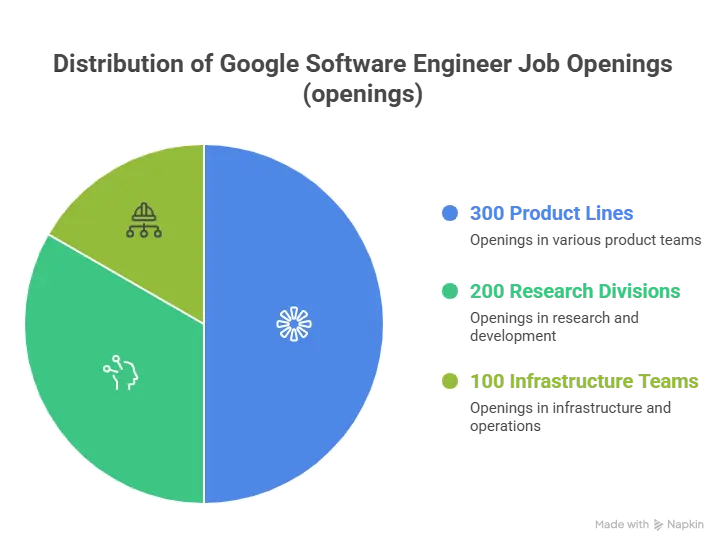
If you’re exploring google software engineer jobs in 2026, you’re targeting one of the most competitive — and rewarding — engineering ecosystems in the world. Google consistently ranks among the best companies to work for as a software engineer, and its job board reflects that ambition. At any given time, there are hundreds of active google software engineer openings across product lines, research divisions, and infrastructure teams.
Software Engineer III (Google Home, Cloud, Workspace)
The Software Engineer III role (also written as SWE III or L3/L4) is the primary entry point for full-time hires — including google new grad software engineer candidates straight out of university. These google software engineer positions exist across three major product pillars:
These are among the most sought-after google software engineer roles for engineers early in their careers. Typical requirements include a bachelor’s or master’s degree in Computer Science, proficiency in at least one systems language (C++, Java, or Go), and demonstrated experience with data structures and algorithms.
For engineers wondering how a software engineer differs from a software developer, Google’s SWE III role emphasizes deep engineering ownership — you’re not just writing features; you’re designing systems.
Senior/Staff Software Engineer (Infrastructure, SRE)
The google senior software engineer (L5) and Staff Software Engineer (L6) levels are where Google’s most impactful technical contributions happen. These professionals lead architecture decisions, mentor L3/L4 engineers, and drive multi-quarter technical roadmaps.
Senior and Staff engineers working in Infrastructure and Site Reliability Engineering (SRE) are responsible for the systems that keep Google’s global network — Search, YouTube, Maps, and Cloud — running with five-nines availability. This is the definition of best software engineer jobs for engineers who want both challenge and compensation.
If you’re evaluating the software engineer career path, reaching L5 at Google typically takes 5–8 years of professional experience and a proven track record of cross-functional technical leadership.
Specialized Roles (AI/ML, Web3, Confidential Computing)
Among the most rapidly expanding google software engineer openings in 2026 are specialized engineering positions that sit at the frontier of technology:
These are among the highest paying jobs software engineer tracks at Google, often commanding L5+ compensation packages even for candidates with niche domain expertise.

Google Engineering Roles & Specializations
Google’s engineering organization is one of the most structurally sophisticated in the industry. Understanding how google software engineer roles are organized — and what each specialization actually does day-to-day — is essential before applying. Whether you’re browsing best job sites for software engineers or going directly to Google Careers, knowing the internal structure helps you target the right team.
Engineering Productivity (SWE, Test Engineer)
Engineering Productivity (EngProd) is a unique Google specialization that sits at the intersection of software engineering and developer experience. EngProd engineers don’t typically ship user-facing features — instead, they build and maintain the internal tools, CI/CD infrastructure, testing frameworks, and build systems that every other Google engineer depends on.
EngProd is an exceptional career path for engineers who love developer tools. It also tends to be one of the more accessible entry points for a google junior software engineer who has strong testing or DevOps backgrounds.
Site Reliability Engineering (SRE)
Google essentially invented the SRE discipline, and its internal SRE organization remains the gold standard for production engineering. Google SREs are software engineers first — they write substantial amounts of code — but they focus exclusively on reliability, scalability, and operational excellence.
Key SRE responsibilities at Google include:
For engineers considering the software engineer profession broadly, the SRE track at Google is one of the most technically rigorous — and financially rewarding — paths available anywhere in the industry.
Google Cloud, AI/ML, Infrastructure Teams
Three of Google’s largest and fastest-growing engineering organizations are:
Google Cloud and AI/ML together represent the largest share of google software engineer positions being posted in 2026, making them the highest-volume hiring areas for anyone seriously pursuing google software careers.
Google Software Engineer Salaries by Level
One of the most common questions from engineers evaluating software engineer careers google is straightforward: what does it actually pay? Google is consistently cited among the best software engineering companies to work for partly because its total compensation packages are among the richest in the industry — especially when you account for RSUs, annual bonuses, and benefits.
For a broader look at highest paid software jobs across the industry, see our top software pay jobs guide. For country-specific data including international Google offices, our Switzerland tech salaries report covers European compensation benchmarks.
L3 to L6 Total Comp (Base + Stock + Bonus)
The following table reflects 2026 compensation estimates based on aggregated data from Levels.fyi, Glassdoor, and public offer disclosures. Figures reflect U.S. (primarily Bay Area/NYC/Seattle) total compensation:
| Level | Role | Base Salary | RSU/Year | Bonus | Total Comp (est.) |
| L3 | Software Engineer III | $130K–$155K | ~$45K | ~$15K | $190K–$215K |
| L4 | Software Engineer IV | $160K–$195K | ~$80K | ~$25K | $265K–$300K |
| L5 | Senior Software Engineer | $200K–$240K | ~$120K | ~$40K | $360K–$400K |
| L6 | Staff Software Engineer | $250K–$300K | ~$200K | ~$60K | $510K–$560K |
| L6+ | Principal/Distinguished | $300K+ | $250K+ | $75K+ | $625K+ |
Note: RSU vesting at Google typically follows a 1-year cliff, then monthly vesting over four years. New grad offers often include a signing bonus of $20K–$50K to bridge the gap before the first RSU vest.
Latest Salary Submissions & Vesting Schedule
Google’s 2026 compensation packages reflect both market pressure from Meta, Apple, and Amazon, and Google’s own internal leveling adjustments made after the 2023–2024 restructuring period.
For engineers evaluating google engineer careers against other top employers, compensation alone rarely tells the full story — Google’s learning culture, internal mobility, and access to cutting-edge technology represent significant non-monetary value.
Google Research Engineering Roles
Google Research is one of the most prolific and respected industrial research organizations in the world. For engineers with a PhD or deep research backgrounds, google software engineer careers within the research division represent a unique opportunity to work on problems that are 5–10 years ahead of what ships to users.
Foundational ML, Algorithms, Quantum AI
Google Research engineers working on foundational areas span three major domains:
The Software Engineer, PhD role is the primary entry point for research-track engineers. These positions are among the most selective — and most intellectually demanding — google software engineer openings available.
AI Systems & Responsible AI Development
Beyond foundational research, Google Research houses two critically important applied research teams:
For engineers passionate about choosing the right programming languages for AI/ML development, Google Research engineers primarily work in Python (JAX/TensorFlow), C++, and increasingly Julia for performance-critical research code.
Google DeepMind AI Engineer Positions
Since the formal merger of Google Brain and DeepMind in 2023, Google DeepMind has operated as Alphabet’s primary frontier AI research and deployment organization. In 2026, it is one of the most desirable destinations for AI engineers globally — making it a true dream company for software engineers specializing in artificial intelligence.
State-of-the-Art AI Models & Global Impact
Google DeepMind AI Engineers in 2026 work on some of the most consequential technology being built anywhere:
DeepMind positions are part of the google software engineer early career pipeline for PhD candidates, but experienced L5/L6 engineers with strong ML backgrounds are also actively recruited. These roles represent some of the best places to be a software engineer for those who want their work to have global scientific and social impact.
Google Interview Process
Understanding the Google interview process is non-negotiable if you’re seriously pursuing any jobs google software engineer listing. The process is rigorous, structured, and largely consistent across roles — though the technical depth scales with the target level (L3 vs L5 vs L6).
Initial, Skills, Final Interviews & Offer Stages
The Google interview process in 2026 follows four main stages:
Stage 1: Recruiter Screen (30 min)
A Google recruiter conducts an initial phone screen to assess background, motivation, and basic eligibility. This is also where they clarify your target level and team preferences. Mention your interest in specific google software engineer roles here — it helps the recruiter route your application appropriately.
Stage 2: Technical Phone Screen / Coding Assessment (1 hour)
Either a live coding interview with a Google engineer or an automated coding assessment via Google’s internal platform. You’ll typically solve 1–2 medium/hard LeetCode-style problems in a shared editor. Focus on optimal time and space complexity — brute force solutions are rarely sufficient.
Stage 3: Virtual Onsite (4–5 Rounds)
The core of the Google interview, conducted over a single day (usually virtual). Rounds typically include:
Stage 4: Hiring Committee Review & Offer
After the onsite, your interview packet goes to a Hiring Committee (HC) composed of senior engineers who weren’t involved in your interviews. The HC reviews all feedback holistically and makes a hire/no-hire recommendation. If approved, you enter team matching — where you interview briefly with potential teams before an offer is finalized.
Before applying, make sure your application materials are strong. Our guide on writing a compelling software engineer cover letter can help you stand out during the initial screening phase.
Google Software Engineer Career Growth
One of the most compelling reasons engineers consider google software engineer careers over competitors is the depth of career development infrastructure Google has built. Internal mobility, learning programs, and mentorship at Google are genuinely exceptional — making it one of the best places to work as a software engineer for long-term career investment.

EngProd Career Progression & Development
The Engineering Productivity (EngProd) track offers a distinct but highly rewarding career progression:
EngProd also offers strong internal transfer paths into SRE, Cloud, or product engineering for engineers who want to explore different google software engineer roles over the course of their careers.
For a comprehensive view of progression timelines and specialization decisions, our software engineer career path guide covers the full journey from entry level through staff and beyond.
Application Resources
Preparing to apply for google software engineer positions requires more than just a strong LeetCode score. The application package — resume, cover letter, and online presence — all play a role in getting past the initial recruiter screen.
Resume Tips, Job Post Requirements, Skills Needed
Here’s what Google’s recruiters and hiring committees look for in 2026:
Resume Best Practices:
Core Google Software Engineer Requirements (2026):
Where to Find Google Job Postings:
The primary source for google software engineer openings is Google Careers (careers.google.com). However, the best job search sites for software developers — including LinkedIn, Levels.fyi, and Blind — also surface Google postings and provide invaluable salary and culture context.
For broader context on the tech job market, our overview of the top software engineering companies to work for helps you benchmark Google against Microsoft, Meta, Apple, and Amazon.
Whether you’re a google early career software engineer just graduating, a mid-career engineer targeting the google senior software engineer track, or a researcher pursuing a google software engineer apprenticeship pathway, the fundamentals of a strong application remain consistent: demonstrate impact, show depth of engineering judgment, and be specific about why Google — and which part of Google — is the right fit for you.
FAQ: Google Software Engineering Jobs
-
What is the difference between a Google L3 and L4 software engineer?
L3 (Software Engineer III) is Google’s entry-level full-time software engineer role, typically targeted at new graduates or engineers with 0–2 years of experience. L4 is the next step up — engineers at this level are expected to operate with greater autonomy, own larger scopes of work, and begin demonstrating early signs of technical leadership. Compensation jumps significantly between L3 and L4, both in base salary and RSU grants.
-
How long does the Google interview process take from application to offer?
From initial application submission to receiving a formal offer typically takes 6–12 weeks. The timeline breaks down roughly as: 1–2 weeks for recruiter review, 1 week for the phone screen, 2–3 weeks to schedule the virtual onsite, and then 2–4 weeks for Hiring Committee review and team matching. Google’s process is thorough — this timeline reflects the rigor of the HC review, not inefficiency.
-
Can I apply to Google as a software engineer without a CS degree?
Yes. Google explicitly accepts “equivalent practical experience” in lieu of a formal CS degree for most Software Engineer III and IV roles. Candidates without degrees are expected to demonstrate equivalent depth through work history, open-source projects, coding competition results, or self-taught expertise. The Google Software Engineer Apprenticeship program is also designed specifically for non-traditional candidates who want a structured pathway into a full-time SWE role.
-
What programming languages does Google prefer for software engineer interviews?
Google allows candidates to use their language of choice during coding interviews — Python, Java, C++, Go, and JavaScript are all accepted. However, interviewers tend to probe more deeply if they share your language expertise, so picking a language where you can write clean, idiomatic code under pressure is more important than matching any perceived Google preference. For production roles on Google Cloud and infrastructure teams, C++ and Go are the dominant languages.
-
What is the Google Software Engineer Apprenticeship program?
The Google Software Engineer Apprenticeship (sometimes listed under STEP — Student Training in Engineering Program) is a structured internship and apprenticeship pathway for candidates from non-traditional backgrounds, historically underrepresented groups, and early-career engineers without CS degrees. Apprentices work on real projects within Google teams, receive mentorship, and are evaluated for conversion to full-time L3 roles upon completion. Applications typically open in the fall for the following summer cycle.
Conclusion
In 2026, Google remains one of the most prestigious and rewarding destinations for software engineers worldwide. Whether you’re a new graduate targeting L3 roles, a mid-level engineer aiming for Senior/Staff positions, or an AI specialist looking to join Google DeepMind, Google offers unmatched scale, impact, technical challenges, and compensation.
With competitive salaries ranging from $190K to $625K+, rapid growth in AI/ML, Cloud, and SRE, and a strong engineering culture, Google continues to set the standard for software engineering careers. Success demands strong problem-solving skills, solid system design knowledge, and genuine passion for building at global scale.
If you’re ready to take on the challenge, start preparing today — polish your coding skills, build impactful projects, and apply directly through Google Careers. The opportunity to work on technology that shapes billions of lives is worth the effort.

Shahzada Muhammad Ali Qureshi (Leeo)
I’m Shahzada — a software engineer by education and an SEO professional by trade. I built WhatIsTheSalary.com to go beyond just showing salary numbers — every page is manually researched across sources like BLS, Glassdoor, LinkedIn Salary, and PayScale to give you the full picture in one place. If you found what you were looking for here, that’s exactly the point.