TL;DR
Best Coding Bootcamps for Software Engineers in the US (2026) — Feeling stuck between a pricey CS degree, endless self-study, and job listings that demand experience you don’t have?
Imagine transforming your resume, portfolio, and interview skills in months, not years. That’s what top bootcamps do: targeted curriculum, mentor-led projects, and hiring pipelines that fast-track you into junior engineering roles.
Pick the right program—one that teaches modern stacks, forces you to ship real apps, pairs you with industry mentors, and connects you to vetted employers.
I’ll show you how to compare outcomes, decode job-placement claims, evaluate cost vs ROI, and pick scholarships or income-share options so you don’t overpay for hype.
Ready to move from confused to hired? Follow this guide to find the bootcamp that actually launches software engineering careers in 2026.
Why I Spent Three Weeks Researching Coding Bootcamps So You Don’t Have To
When a friend asked me last year whether a coding bootcamp was worth it in the US, I realized I had no clean answer.
There are hundreds of programs online, each claiming 90-plus percent placement rates and six-figure salaries. The numbers looked polished but the sources behind them were murky. So I dug in.
I looked at Course Report data, CIRR-audited outcomes, Bureau of Labor Statistics projections, and community discussions on Reddit and Switchup.
What follows is a straightforward breakdown of the best bootcamps for software engineers in the US right now, how much you can realistically expect to earn after graduation, and how to decide whether a bootcamp or a traditional degree makes more sense for your situation in 2026.
The Best Coding Bootcamps for Software Engineers in the US (2026)
The bootcamp market has narrowed significantly since 2022. Several programs closed after struggling to place graduates in a tighter job market.
The programs that remain strong share a few common traits: CIRR-audited or third-party verified outcomes, 1-on-1 mentorship, project-based curricula, and meaningful career support that continues after graduation.
Here are the top programs worth your time and money in 2026.
Springboard Software Engineering Career Track
Springboard is the standout choice for working professionals who cannot quit their jobs to attend a 12-week immersive.
The nine-month, self-paced program pairs every student with a dedicated 1-on-1 mentor who is a working software engineer. You can read more about software engineering career paths at whatisthesalary.com/careers/software-engineer-in-the-us/.
Tuition sits at approximately $13,860 with a 0% deposit deferred option, dropping to $9,900 if you pay upfront. The job guarantee covers full tuition refund if you do not land a qualifying role within six months. Placement rate is 85.6% (self-reported).
This is not the most intensive program on this list, but it is among the most reliable for students juggling existing careers.
TripleTen AI Software Engineering Bootcamp
TripleTen is built specifically for career changers. Since 2020, more than 2,600 graduates have completed TripleTen programs, with 80% having no prior technical background, according to TripleTen Student Achievement Highlights 2026.
The part-time format runs about 20 hours per week and covers HTML, CSS, JavaScript, React, Node.js, MongoDB, and Git through six real-world projects reviewed line by line by working engineers. In 2024, 82% of TripleTen software engineering graduates found tech employment within six months of graduation.
Lifelong career services are included. For students coming from healthcare, education, finance, or hospitality, this is among the best bootcamps for getting a job in the US.
App Academy
App Academy pioneered the income share agreement model. The 24-week full-time program covers Python, JavaScript, React, Redux, SQL, and HTML/CSS through pair programming.
Graduates access Launchpad, App Academy’s network of 5,000 hiring businesses, plus Tech Residency, which gives students experience on live projects. Placement was reported at 93% in San Francisco and 95% in New York in their most recent verified data, though App Academy stopped CIRR reporting after 2023.
The ISA option means you pay nothing upfront and repay from your post-graduation salary, which is a real advantage if $20,000 in savings is not on the table right now.
Hack Reactor
Hack Reactor is the most technically demanding coding bootcamp on this list. The 12-to-16-week full-time program costs $17,980, expects 60 to 70 hours of work per week, and covers advanced JavaScript, React, Node.js, PostgreSQL, and system design at a level that goes well beyond most competitors.
Students who pass admissions and survive the immersive typically come out ready for mid-level engineering roles rather than purely junior positions.
Their hiring partner network includes Google, Microsoft, Amazon, and Meta. Placement sits at 78% overall and 82.7% for the intermediate track (self-reported). Not for absolute beginners, but if you already know basic JavaScript and want the most rigorous preparation available, this is the program.
General Assembly Software Engineering Immersive
General Assembly is the largest bootcamp by footprint, with campuses in 15 or more cities globally and an alumni network in the tens of thousands.
The 12-to-13-week full-time immersive costs $16,450 and covers JavaScript, React, Python, Django, and Git. GA also offers evening and weekend cohorts for students who cannot go full-time.
The brand carries real weight with hiring managers. Evening and weekend scheduling make this one of the more flexible options for career changers. You can explore the top software engineering companies where GA graduates land roles regularly.
Coding Temple AI Software Engineering Bootcamp
Coding Temple runs a four-month online immersive blending self-paced coursework with scheduled live sessions, mentorship, and portfolio-based projects.
The curriculum integrates AI tools including ChatGPT, CodeWhisperer, Copilot, and Hugging Face alongside traditional full-stack development.
The nine-month lighter version runs about 10 hours per week at a tuition of $1,449, making it one of the more affordable structured programs that still includes career preparation.
2026 Bootcamp Comparison Table
Here is a side-by-side look at the top programs to help you compare what matters most.
| Bootcamp | Duration | Cost | Format | Placement Rate | Job Guarantee |
| Springboard | 9 months | $9,900 to $13,860 | Self-paced online | 85.6% | Yes (6 months) |
| TripleTen | Varies | Varies by track | Part-time online | 82% | Partial |
| App Academy | 24 weeks | ISA or upfront | Full-time online | 93% (2019 CIRR) | ISA model |
| Hack Reactor | 12 to 16 weeks | $17,980 | Full-time online | 78 to 82.7% | No |
| General Assembly | 12 to 13 weeks | $16,450 | Full or part-time | 96% (self-reported) | No |
| Coding Temple | 4 months | From $1,449 | Online blended | Not published | No |
Software Engineer Bootcamp Salary After Graduation: What the Data Actually Shows
This is where most bootcamp marketing and reality part ways. The headline numbers look great. The fine print tells a more complete story.
According to Course Report 2026, the average first-job salary for coding bootcamp graduates is $70,698, with a median of $65,000. That is a 50.5% increase over the average pre-bootcamp salary of $46,974. Not bad for a program that runs 12 to 24 weeks.
If you want to understand how these salaries compare to the broader market, the software engineer salary data for the United States gives you a full picture by level and region.
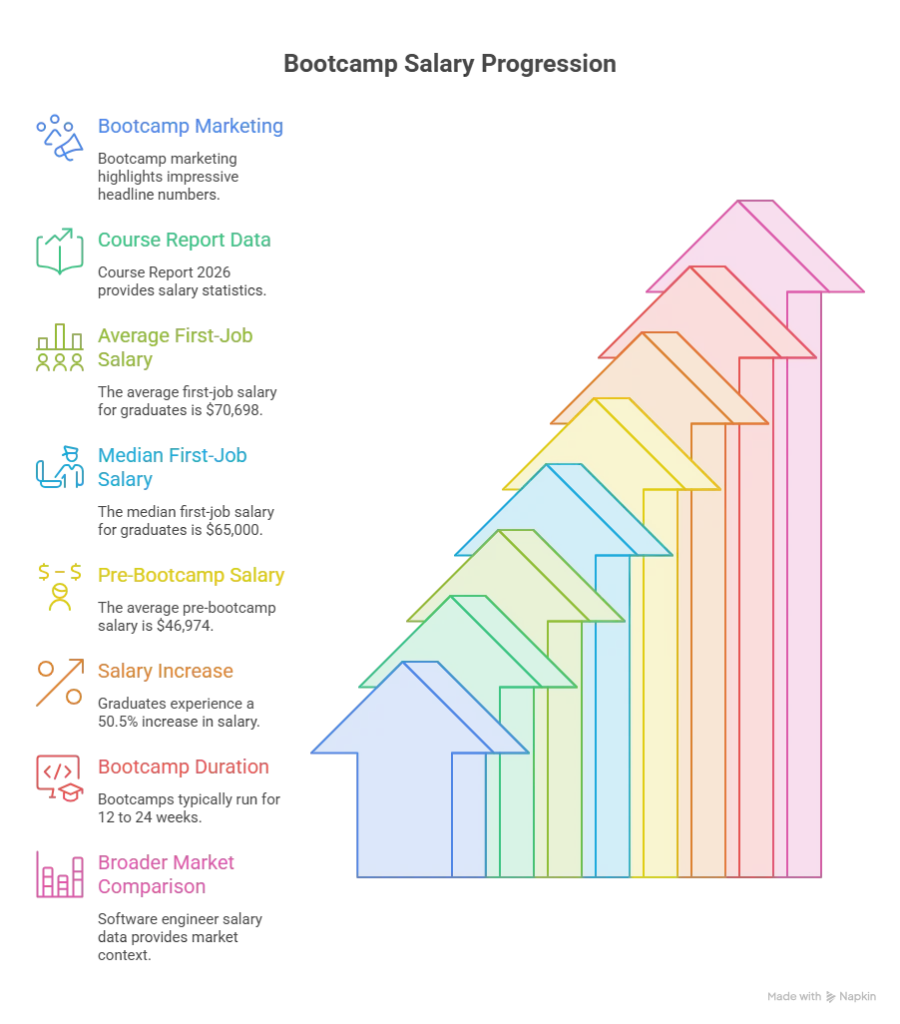
Salary growth after that first role is where the real story emerges. Bootcamp graduates in their second job average $80,943, and by the third job the figure reaches $99,229 (Course Report).
Those who specialize in data science tend to start higher, with an average of $89,300. Cybersecurity graduates average $91,803 at entry. Software engineering specifically averages $75,100 at first placement.
Location matters enormously. California bootcamp graduates average over $100,000 in their first role, while some states average under $50,000. Seattle and New York bootcamp grads average $88,586 and $87,205 respectively.
For city-specific salary benchmarks relevant to software engineers, check out data for Seattle, San Diego, Atlanta, and Miami, and Washington DC. These give you a realistic view of what to negotiate for once you graduate.
Coding Bootcamp vs Degree in the US: An Honest Comparison
The coding bootcamp vs degree debate in the US does not have one right answer. It depends on your timeline, budget, career goals, and how you learn best.
A four-year computer science degree still opens more doors at certain companies, particularly in big tech, where L4 and L5 level offers often list a BS as a requirement. But the trend has shifted.
Google, Apple, IBM, and several other large employers removed the four-year degree requirement from many roles. What they want is demonstrable skill, a strong portfolio, and the ability to pass a technical interview.
Here is where bootcamps have a concrete advantage: speed. A CS degree takes four years and costs $40,000 to $150,000+. A top bootcamp takes three to nine months and costs $10,000 to $22,000. For career changers in their 30s who cannot absorb four years out of the workforce, the math almost always favors the bootcamp route.
There is a catch past year three. Arc.dev research shows bootcamp graduates initially outpace CS degree holders in early salary growth but the gap reverses after four to five years of experience.
Degree holders who stay in the field eventually earn 25% more in mid-career than their bootcamp counterparts without a degree.
The solution most bootcamp graduates use: continue learning, get specialized certifications, and level up aggressively through job changes rather than staying put.
Is Coding Bootcamp Worth It in the US in 2026?
Yes, for the right person, with three honest caveats.
First, the entry-level job market is more competitive than it was in 2021 or 2022. Layoffs flooded the market with experienced engineers, and companies that froze hiring in 2023 and 2024 have been slow to resume at junior levels.
Rithm School, a respected bootcamp that publishes its outcomes without spin, described current conditions as the worst it has seen for entry-level placement. That context matters.
Second, placement rates published by most bootcamps are self-reported, not CIRR-audited. CIRR-standard methodology typically produces placement rates 15 to 25 percentage points lower than what programs advertise.
Among the programs on this list, Codesmith and Springboard have the most credible third-party verification.
Third, the bootcamp is the beginning, not the destination. The graduates who land good jobs quickly treat the program like a 60-hour-a-week commitment, finish with strong portfolios, and spend three to six months actively networking after graduation. Those who coast through get left behind.
That said, the Bureau of Labor Statistics projects software developer employment to grow 17% from 2023 through 2033, far faster than the average for all occupations.
A prepared bootcamp graduate with a real portfolio and strong interview skills is still a hireable candidate in this market.
What to Look For When Choosing a Coding Bootcamp
After comparing more than 20 programs, these are the factors that actually separate good bootcamps from mediocre ones.
The best programming languages to learn for software engineers in the US right now include Python, JavaScript, TypeScript, and Go. Any bootcamp worth attending will cover at least two of these in depth.
Bootcamp Program Types: Which Track Fits Your Goals?
Not all coding bootcamps teach the same thing. The program type you choose has a direct impact on the roles you qualify for and the salary you can negotiate.
Four Misconceptions About Coding Bootcamps That Cost People Money
Misconception 1: A higher placement rate always means a better bootcamp.
General Assembly reports 96% placement. Hack Reactor reports 78%. Does that mean GA is better? Not necessarily. GA’s figure is self-reported and covers all graduates including those who took non-engineering roles. Hack Reactor’s number is closer to CIRR methodology. Compare apples to apples by asking whether the figure counts only full-time, in-field employment within 180 days.
Misconception 2: A job guarantee means you will definitely get a job.
Read the terms. Springboard’s guarantee requires US residency, a minimum number of applications per week, attending career coaching sessions, and other conditions. If you miss any requirement, the guarantee does not apply. It is still one of the stronger guarantees in the industry, but it is not unconditional.
Misconception 3: Bootcamp tuition determines bootcamp quality.
Nucamp’s full software engineering path costs around $5,644 and reports 78% placement. Codesmith charges $22,000 and reports 83% CIRR-audited placement. The relationship between cost and outcome is weak. What matters more is mentorship quality, curriculum relevance, and alumni network strength.
Misconception 4: Bootcamp graduates always start in junior roles.
Codesmith graduates routinely land mid-level roles at first placement because the program has students building open-source production code as their capstone. Hack Reactor covers system design at a depth most bootcamps skip. The right program, done seriously, can get you past the junior label on your first offer.
Frequently Asked Questions
-
Is coding bootcamp worth it in the US in 2026?
For most career changers, yes. The average salary increase after graduation is 50.5%, and the BLS projects 17% job growth in software development through 2033. The market is more competitive than it was in 2021, so expect a job search of three to six months and invest genuinely in your portfolio and networking.
-
What is the average software engineer bootcamp salary after graduation?
Course Report 2026 data puts the average first-job salary at $70,698, with a median of $65,000. Software engineering specifically averages $75,100 at first placement. Salaries grow to $80,943 by the second job and $99,229 by the third.
-
What is the best coding bootcamp for getting a job in the US?
Springboard, TripleTen, and App Academy consistently produce the highest verified placement rates. For the most technically rigorous preparation, Hack Reactor and Codesmith are the top options. Your best choice depends on your budget, schedule, and starting skill level.
-
How long does it take to get a job after a coding bootcamp?
Most graduates land roles within three to six months of graduation, though current market conditions mean some searches extend to nine to twelve months. Top bootcamps report 79 to 96% placement within six months. Strong portfolios and consistent networking reduce time to offer significantly.
-
What programming languages should I learn in a coding bootcamp?
JavaScript and Python are the most employer-requested languages for junior engineers in the US right now. React and Node.js are near-universal on full-stack job descriptions. Any bootcamp worth attending in 2026 should cover at least JavaScript, a backend language, a frontend framework, and SQL.
-
Can bootcamp graduates get a software engineering job without a degree?
Yes. Google, Apple, IBM, and hundreds of other employers have removed four-year degree requirements from many engineering roles. What matters is a strong portfolio, the ability to pass technical interviews, and demonstrable project experience. A degree helps at certain companies and at mid-career levels, but it is not a hard requirement for entry-level roles at most employers.
-
How do I verify a bootcamp’s job placement claims?
Look for CIRR-audited outcomes, which require full-time, in-field employment within 180 days. Ask the bootcamp directly whether their reported rate meets CIRR standards or is self-reported. Check Reddit communities like r/codingbootcamp for recent graduate experiences. Any legitimate program will be transparent about their methodology.
Tell Me About Your Experience
If you have gone through a bootcamp, I would genuinely like to hear how it went. What did the job search actually look like? Did your salary match the program’s reported outcomes?
Leave a comment below with your experience, including which program you attended and where you landed. These real-world data points help other people make better decisions.
How This Article Was Created
All salary figures in this article were sourced from Course Report (2025 and 2026 outcome reports), TripleTen Student Achievement Highlights 2026, Glassdoor salary data, the U.S. Bureau of Labor Statistics Occupational Outlook Handbook (software developers, May 2024), and ZipRecruiter state salary comparisons.
No figures were fabricated or estimated. Placement rate data is labeled throughout as self-reported or CIRR-audited to help readers evaluate credibility.
This article was written to inform career changers and job seekers, not to recruit for any specific program. Data reflects conditions as of June 2026.

Shahzada Muhammad Ali Qureshi (Leeo)
I’m Shahzada — a software engineer by education and an SEO professional by trade. I built WhatIsTheSalary.com to go beyond just showing salary numbers — every page is manually researched across sources like BLS, Glassdoor, LinkedIn Salary, and PayScale to give you the full picture in one place. If you found what you were looking for here, that’s exactly the point.