TL;DR
Highest Paying Cybersecurity Specializations separate a $75,000 salary from a $250,000 one, and most people in this field never figure out which side of that line they are standing on. You can spend five years as a generalist security analyst and still earn less than someone two years into cloud security or AI security. Same industry, same threat landscape, wildly different paychecks.
Here is the problem. Job titles in cybersecurity look interchangeable from the outside, so most professionals pick a specialization based on whatever posting they saw first, not based on what actually pays. That one early decision quietly caps their income for years.
The fix is simpler than it sounds. Once you know which specializations command the biggest premiums in 2026 and why, you can steer your certifications, your projects, and your next job search toward the roles that actually pay like it. That is exactly what this guide breaks down, specialization by specialization, using the same research approach behind our full library of cybersecurity and IT salary guides.
Why Cybersecurity Salaries Vary So Much by Specialization
Cybersecurity is not one job, it is a cluster of different disciplines wearing the same job family. A SOC analyst triaging alerts and a cloud security architect designing access controls across a multi cloud environment need different skill sets and honestly different personalities.
Employers pay for scarcity and blast radius. Roles where a mistake can cost millions, like cloud architecture or incident response, command a premium. Roles that are easier to staff, like tier one monitoring, sit lower on the scale.
For the full picture of how average pay breaks down across the entire field before narrowing into a specialization, our cybersecurity salary guide for the US covers the national averages this article builds on.

Highest Paying Cybersecurity Specializations in 2026
Here is how the top paying specializations stack up right now, based on the most recent data available from major compensation platforms.
| Specialization | Average / Median Total Comp (2026) | Typical Range | Primary Source |
| CISO (Chief Information Security Officer) | $256K – $385K | up to $450K+ at senior level | Salary.com / BLS |
| Cloud Security Architect | $175K – $195K | $150K – $294K | Glassdoor / PayScale |
| Security Architect (general) | $201K – $225K | $169K – $531K | 6figr |
| AI Security Engineer | $150K – $250K | up to $700K+ (staff/principal) | infosec.qa |
| Offensive Security / Red Team | $167K – $208K | $133K – $265K | Glassdoor |
| Cloud Security Engineer | $153K – $169K | $135K – $265K | Glassdoor / ZipRecruiter |
| Application Security (AppSec) Engineer | $165K – $185K | $138K – $264K | Glassdoor |
| Detection Engineering | $151K – $183K | $151K – $218K | KORE1 / recruiter data |
| Incident Response (senior) | $185K – $200K+ | $118K – $224K | KORE1 |
| Cybersecurity Consultant | $99K – $150K | varies by client mix | Glassdoor |
| Penetration Tester | $93K – $136K | up to $200/hr freelance | Industry data |
| SOC Analyst (entry level) | $65K – $95K | $46K – $100K | Industry data |
Numbers move depending on company size, industry, and location, so treat these as directional rather than exact.
Chief Information Security Officer (CISO): Still the Top of the Chart
Security leadership compensation peaks at the CISO level, and 2026 data confirms it. Salary.com puts the average CISO salary at $385,165 as of April 2026, while broader industry projections put the median closer to $256,000, with senior CISOs at large enterprises passing $450,000 in total compensation.
Part of the reason CISO pay stays high is turnover. Annual turnover in the role sits around 11 percent, low compared to other executive positions, so when a seat does open, companies often pay a steep premium, sometimes a 31 percent jump over the previous holder’s pay, to fill it quickly. If you are mapping out what it actually takes to reach this level, our CISO salary guide breaks down the full path and pay bands by company size.
Cloud Security Architect and Cloud Security Engineer
Cloud security has become one of the most reliably high paying tracks in the field, and it is not close to slowing down. Glassdoor reports an average salary of $194,853 for Cloud Security Architects, with the top 10 percent earning up to $293,733. Cloud Security Engineers average $169,173 on Glassdoor, with a typical range of $135,000 to $215,000.
The premium exists because few people can write a tight IAM policy, lock down a Service Control Policy, or configure Conditional Access without breaking production. Every company that moved workloads to AWS, Azure, or GCP now needs someone who understands cloud infrastructure and security architecture together, and that combination is still short in supply.
Application Security (AppSec) and AI Security Engineer Roles
Application Security, or AppSec, has grown into its own well paid lane rather than a side task for developers. Glassdoor lists the average Application Security Engineer salary at $165,368, with senior AppSec engineers averaging $185,302 and lead level roles reaching $200,119.
The bigger story in 2026 is the rise of the AI security engineer, a distinct discipline covering prompt injection defense, model exfiltration risk, jailbreak testing, and agent hijacking.
According to 2026 hiring data from infosec.qa, total compensation for AI security engineers ranges from about $150,000 for junior roles to $700,000 or more for staff and principal positions, with specialists focused on agentic AI safety commanding a 20 to 30 percent premium over engineers handling traditional LLM application security.
Employers increasingly care less about certifications here and more about published research, CTF wins, and open source red teaming contributions.
Offensive Security, Red Team, and Detection Engineering
Offensive security, commonly grouped under red team work, pays a wide range depending on employer and seniority. Glassdoor reports an average of $208,134 for Red Team Security Engineers and $167,337 for the broader Security Engineer, Red Team title, with the typical spread running from roughly $133,000 to $265,000.
Freelance penetration testers and bug bounty specialists can bill $100 to $200 an hour on top of that. If offensive security interests you but you are unsure it is the right fit, our penetration tester salary guide walks through pay by certification and experience level.
On the defensive side, detection engineering has quietly become one of the more specialized, better paid corners of security engineering. Detection engineers build and tune the rules that catch adversary behavior across endpoints, identity, network, and cloud.
Recruiter data from KORE1 places this work inside the broader security engineer band of roughly $151,000 to $218,000, median near $183,000, and notes detection pipeline work is one of the harder skill sets to hire for right now.
Incident Response and Security Architecture
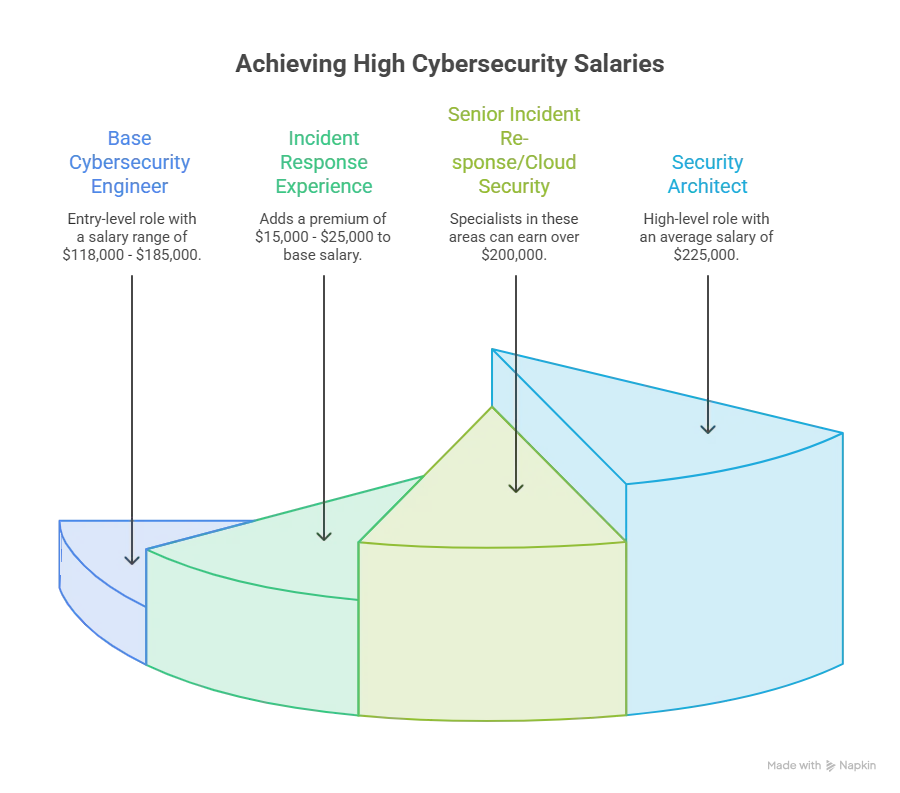
Incident response experience is one of the strongest salary levers in the field, and it is not close. KORE1’s 2026 recruiter data shows cybersecurity engineers who have actually run a ransomware response or a supply chain compromise to closure under executive pressure command a $15,000 to $25,000 premium over peers with only tabletop exercise experience.
Base pay for cybersecurity engineers overall sits between $118,000 and $185,000, with senior incident response and cloud security specialists clearing $200,000.
Security architecture sits at a similar level. Data aggregated from workplace salary profiles shows Security Architects averaging around $225,000 in total compensation, ranging from $169,000 to $531,000 depending on company size and how much of the role is leadership versus hands on design.
Where Experience Fits In
Every specialization on this list follows the same pattern. Entry level roles start modestly, typically $65,000 to $95,000 for a SOC analyst, then climb quickly once you have two or three years of real incident exposure behind you. Our cybersecurity analyst salary by experience level guide breaks that curve down year by year, and our SOC analyst salary guide covers what to expect in that entry point role specifically.
The jump from mid level to senior is usually where specialization starts paying off. Two analysts with similar years of experience can end up tens of thousands apart once one has picked a lane like cloud security or detection engineering and the other has stayed generalist.
What Actually Moves These Salaries Up
Hands on experience beats certifications, but certifications still matter, especially early on. CISSP, CISM, CEH, and OSCP remain the credentials employers filter for, and CISSP or OSCP alone can add $15,000 to $30,000 to an offer. Our breakdown of the best cybersecurity certifications covers which ones are worth the study time for each specialization.
Beyond certifications, three things consistently move offers higher: specializing in a scarce skill like cloud security or AI security instead of staying generalist, choosing an employer in a high risk, high budget sector, and being able to speak to specific incidents you have handled rather than just tools you know.
Building Toward These Roles Without Starting Over
You do not need a computer science degree to land in most of these specializations, and plenty of working professionals get there through certifications and hands on labs instead. Our guide on becoming a cybersecurity analyst without a degree lays out how that path works in practice.
If you are earlier in the decision process, our cybersecurity career path guide maps entry level through leadership, so you can see which specialization fits the work you enjoy, not just the highest headline number. And if you are weighing a faster route in, our comparison of a cybersecurity bootcamp versus a degree covers the real tradeoffs in time, cost, and hiring outcomes.
Industry and Employer Still Matter
Specialization sets your ceiling, but industry and employer decide how close you get to it. Pay for the same title can differ significantly between sectors. Our comparison of cybersecurity salary in finance versus healthcare shows how wide that gap runs depending on regulatory pressure and budget.
Company choice matters just as much. Our cybersecurity salary by company guide breaks down how pay differs across major employers, and if variety appeals to you more than a single employer, our cybersecurity consultant salary guide covers what consulting pays across multiple clients and industries.

Remote Work and the 2026 Pay Map
Remote demand keeps climbing, with roughly half of new postings in 2026 offering remote or hybrid arrangements according to CyberSeek data. That matters for pay because it lets specialists in lower cost of living areas compete for salaries once limited to major metros. Our list of remote cybersecurity jobs in the US covers which specializations are actually hiring remote right now.
Frequently Asked Questions
-
What is the highest paying cybersecurity specialization in 2026?
CISO remains the highest paid role overall, with average total compensation between roughly $256,000 and $385,000 depending on company size, and senior CISOs at large enterprises passing $450,000.
-
Is AI security engineer a good career move in 2026?
Yes. Total compensation ranges from about $150,000 for junior roles to $700,000 or more at staff and principal level, and demand is outpacing supply, especially for agentic AI safety work.
-
Does cloud security pay more than general cybersecurity engineering?
Generally yes. Cloud Security Architects and Cloud Security Engineers average $169,000 to $195,000 on Glassdoor, higher than most generalist security engineer roles at similar experience levels.
-
Do certifications matter more than experience for higher pay?
Experience matters more, but certifications still add value. CISSP and OSCP can each add $15,000 to $30,000 to an offer and often get your resume seen in the first place.
-
What is the fastest way to move into a higher paying specialization?
Pick a scarce skill area. Cloud security, detection engineering, and AI security are strong options right now. Then build proof through labs, home projects, or real incident exposure rather than certifications alone.
Share Your Experience
If you have negotiated an offer in one of these specializations, gotten lowballed, or made a jump into a new track and seen your pay shift, we would genuinely like to hear about it. Real numbers from real offers are what keep guides like this one honest and useful for the next person doing this same research.

Shahzada Muhammad Ali Qureshi (Leeo)
I’m Shahzada — a software engineer by education and an SEO professional by trade. I built WhatIsTheSalary.com to go beyond just showing salary numbers — every page is manually researched across sources like BLS, Glassdoor, LinkedIn Salary, and PayScale to give you the full picture in one place. If you found what you were looking for here, that’s exactly the point.