
TLDR
Is your cybersecurity job safe from AI, or are you one automation rollout away from a much harder job search? That question is spreading through Slack channels and Reddit threads faster than any CVE alert right now, and the honest answer is more layered than the panic suggests.
Layoffs at hyperscalers, entry level postings barely growing, and headlines claiming AI is quietly replacing analysts make it easy to assume the whole field is shrinking. That fear is based on half the picture, and reacting to half the data can cost you real money the next time you negotiate an offer.
This guide breaks down what is actually happening in 2026, role by role and salary by salary, using verified data instead of guesswork. For the full national picture across every IT specialty before you dig into this one, check our complete salary guide library.
Is AI Actually Taking Cybersecurity Jobs?
If you are worried, you are not imagining things. A July 2026 ISC2 survey found that 56% of security professionals say AI has somewhat or significantly reduced the need for entry level positions over the past year. That is a real number, and it lines up with what recruiters are seeing on the ground.
But here is the part that gets left out of most doom and gloom headlines. Advertised cybersecurity roles rose 9.5% across G7 countries for the six months ending in March 2026, based on the AI Workforce Consortium analysis. Close to a third of those postings, 28.5%, required AI skills. That points to a field that is changing shape, not one that is shrinking.
The pain is concentrated at the bottom of the ladder, not spread evenly across every role. If you want the full national picture before drilling into any specific role, our guide on cybersecurity salary in the US is the right starting point.

The Real 2026 Numbers
The headline BLS figure for information security analysts sits at a median annual wage of $129,180 as of May 2025, with the occupation still projected to grow 21% to 33% through the mid 2030s depending on which release you check, and roughly 14,100 openings a year on average.
Entry level pay in this category typically starts between $69,660 and $95,000, while the top 10% of earners clear $186,000 or more.
That is not a field in decline. ISC2 also reports a global workforce gap between 3.4 million and 4.8 million unfilled positions, which tells you the shortage has not disappeared just because AI tools got better at flagging alerts.
Cybersecurity Salary Snapshot, 2026
| Role | Typical Base Range | Reported Median | Source |
| SOC Analyst / Information Security Analyst | $69,660 to $186,000+ | $124,910 to $129,180 | BLS, Glassdoor |
| Cybersecurity Engineer | $118,000 to $185,000 | approx $148,000 | KORE1 2026 data |
| Security Engineer (general) | $105,000 to $215,000 | $152,000 to $170,000 | KORE1 2026 data |
| AI Security Engineer | $150,000 to $240,000; up to $700,000+ at staff level | approx $153,000 to $190,000 | ZipRecruiter, Glassdoor |
| Cybersecurity Analyst (CySA+ aligned) | Varies by level | $123,260 | CompTIA |
| CISO | $250,000 and up | Executive band | Industry salary surveys |
Where the Squeeze Is Actually Happening
The pain point is specific. Tier one triage, the part of the SOC analyst job built around staring at a queue of alerts and deciding which ones matter, is exactly what security automation platforms now do well.
Gartner’s 2026 trends analysis estimates that more than 60% of organizations rely on AI augmented security automation, up from under 20% in 2023.
That does not eliminate SOC analyst jobs. It shifts the work toward alert validation, escalation judgment, and tuning the automation itself. For a breakdown of how pay changes as you move from junior to senior in this exact role, see our guide to cybersecurity analyst salary by experience level.
The New Roles AI Is Creating
While entry level triage work shrinks, entirely new job categories are opening up. AI Security Engineer postings alone command a documented salary premium, and titles like AI governance lead, LLM security specialist, and AI red teaming specialist barely existed three years ago.
These roles focus on problems that are genuinely new: defending against prompt injection attacks on production language models, building threat intelligence programs that account for AI generated attacks, and writing incident response playbooks for autonomous agents that can call APIs and execute code on their own.
Cybersecurity Engineer postings that mention AI agents specifically, not just generic AI skills, now carry a documented pay premium and appear in a growing share of active listings.
The practical takeaway is that AI skills inside a traditional title often pay better than chasing a brand new AI-only job title. An engineer who adds AI governance and LLM security to an existing skill set is usually better positioned than someone starting from zero.
Pay Still Depends Heavily on Company and Industry
Even with AI reshaping the field, where you work still moves your number more than almost anything else. The information sector, which includes major tech employers, pays a median well above the overall cybersecurity average, and regulated industries are not far behind.
If you are weighing offers across employer types, our comparison of cybersecurity salary in finance vs healthcare breaks down how those two regulated industries differ in practice, and our guide to cybersecurity salary by company shows how specific employers stack up against each other.
Specialization Is the New Job Security
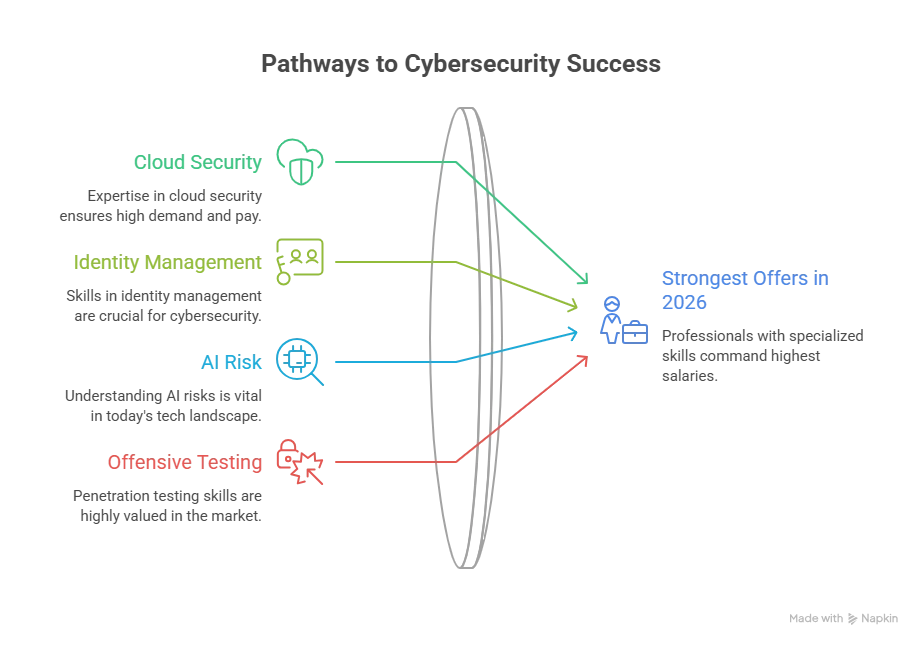
Generalist titles are getting squeezed from both directions, automation below and specialization above. The professionals commanding the strongest offers in 2026 are fluent in a specific lane: cloud security, identity, AI risk, or offensive testing.
If offensive security is your path, our penetration tester salary in the US guide breaks down current pay by experience level. If advisory work across multiple clients appeals more, our cybersecurity consultant salary in the US page covers how that track compares.
The Skills and Certifications That Actually Protect You
Certifications alone will not save a career, but the right ones still move the needle. CompTIA reports a median of $123,260 tied to CySA+ aligned analyst roles, and credentials like CISSP or OSCP continue to add $15,000 to $30,000 on top of base pay at the senior end.
The certifications that matter most right now are tied to skills employers cannot easily automate: incident response leadership, threat modeling, and hands on cloud security work. Our full breakdown of the best cybersecurity certifications for the current market covers which credentials are worth the time and money in 2026.
Breaking In When Entry Level Is Shrinking
This is the hardest part of the current market, and it is worth being honest about it. If you are trying to break in for the first time, the traditional Security+ and apply everywhere approach is not landing the way it used to.
That does not mean the door is closed, it means the path in looks different. Our guide on becoming a cybersecurity analyst without a degree walks through how people are getting hired on skills and demonstrated projects, and our comparison of cybersecurity bootcamp vs degree lays out the real tradeoffs given how fast the entry level bar is moving.
Building a Career Path That Survives Automation
The professionals who come out ahead stop thinking of themselves purely as tool operators. Moving from playbook executor to playbook designer, or from alert triager to someone who supervises and validates what the AI system flags, is the actual career move happening across the industry right now.
Roles like cloud security architect, identity governance engineer, and GRC engineer are all growing because they combine judgment with technical depth in ways that are hard to automate. For a fuller roadmap of this progression over five to ten years, our guide to the cybersecurity career path lays out the stages in detail.
Does Remote Work Help or Hurt Your Job Security?
Remote roles are not disappearing, but they compete against a wider candidate pool than local roles do, which changes the negotiation dynamic.
Some employers are also more selective about remote hires for roles touching sensitive infrastructure, which favors candidates with a clearance or a strong specialization. Our guide to remote cybersecurity jobs in the US covers which roles are staying remote friendly and which are quietly pulling back to hybrid or onsite.
The Executive Track Is Still the Safest Seat
At the top of the ladder, job security looks different. CISOs and other security leaders face a new problem entirely: governing AI adoption across an organization while still running a traditional security program. That is not a job AI is going to absorb soon, and pay reflects it, with executive compensation running well over $250,000 in most reports.
If leadership is the long term goal, our CISO salary guide covers what that band looks like once you account for bonus structure and company size.

Common Misconceptions About AI and Cybersecurity Jobs
“AI is going to replace SOC analysts entirely.” Automation is absorbing routine alert triage, not the judgment calls around what to escalate, contain, or investigate further.
“Entry level cybersecurity jobs are gone.” They are growing slower, not disappearing. The 5.9% growth figure is still growth, just far behind the senior tier.
“You need a computer science degree to survive this shift.” Certifications, demonstrated projects, and hands on automation experience are carrying more weight than a specific degree right now.
“Only jobs with AI in the title are safe.” Traditional titles that absorb AI governance and LLM security skills are often paying a premium without requiring a full career pivot.
Frequently Asked Questions
-
Is cybersecurity still a good career in 2026?
Yes. Job openings and median pay are both still rising, though the growth is uneven between entry level and senior roles.
-
Will AI replace SOC analysts?
Not entirely. AI is automating routine alert triage, but investigation, escalation judgment, and tuning the automation itself still require a human in the loop.
-
What is the average cybersecurity salary in 2026?
It depends heavily on role and level. For SOC and entry level analyst roles specifically, our SOC analyst salary in the US guide has the full current breakdown.
-
Which cybersecurity jobs are safest from AI disruption?
Roles centered on AI governance, incident response leadership, and specialized offensive or cloud security work are currently the most resilient.
-
Do I need to learn AI to stay employable in security?
Not to enter the field, but adding AI governance or LLM security knowledge to an existing specialty is producing a measurable pay premium in current postings.
-
Is it harder to get an entry level cybersecurity job now than a few years ago?
Yes, based on current hiring data. Entry level postings are growing far slower than senior postings, which means competition for junior roles has increased.
Share Your Experience
If you have seen this shift firsthand, whether that is an offer that came in higher because of AI governance skills, a junior role that got harder to land, or a pivot into a title that did not exist two years ago, we would genuinely like to hear about it. Real data points from real job searches are what keep guides like this one accurate.
The Bottom Line
Cybersecurity is not becoming less secure as a career. It is becoming more selective about where the value sits. The safest place to stand in 2026 is not a specific job title, it is the combination of judgment, specialization, and comfort working alongside automation rather than being replaced by it.

Shahzada Muhammad Ali Qureshi (Leeo)
I’m Shahzada — a software engineer by education and an SEO professional by trade. I built WhatIsTheSalary.com to go beyond just showing salary numbers — every page is manually researched across sources like BLS, Glassdoor, LinkedIn Salary, and PayScale to give you the full picture in one place. If you found what you were looking for here, that’s exactly the point.