TLDR
You can ace every SQL question and still walk out underpaid. The mistake rarely happens in the technical round. It happens around minute eight of the recruiter call, when someone asks for your salary expectations and you guess.
Most data analyst interview questions guides stop at sample answers and ignore that second test. Candidates rehearse joins and window functions, then name a number that anchors the whole negotiation too low.
Here is the fix: prepare for both at once. Below, I pair the questions you will hear with 2026 pay data from the Bureau of Labor Statistics, Glassdoor, and ZipRecruiter, plus scripts you can use word for word. For more pay research, browse the IT salary guides at WhatIsTheSalary.
How the Data Analyst Interview Process Works in 2026
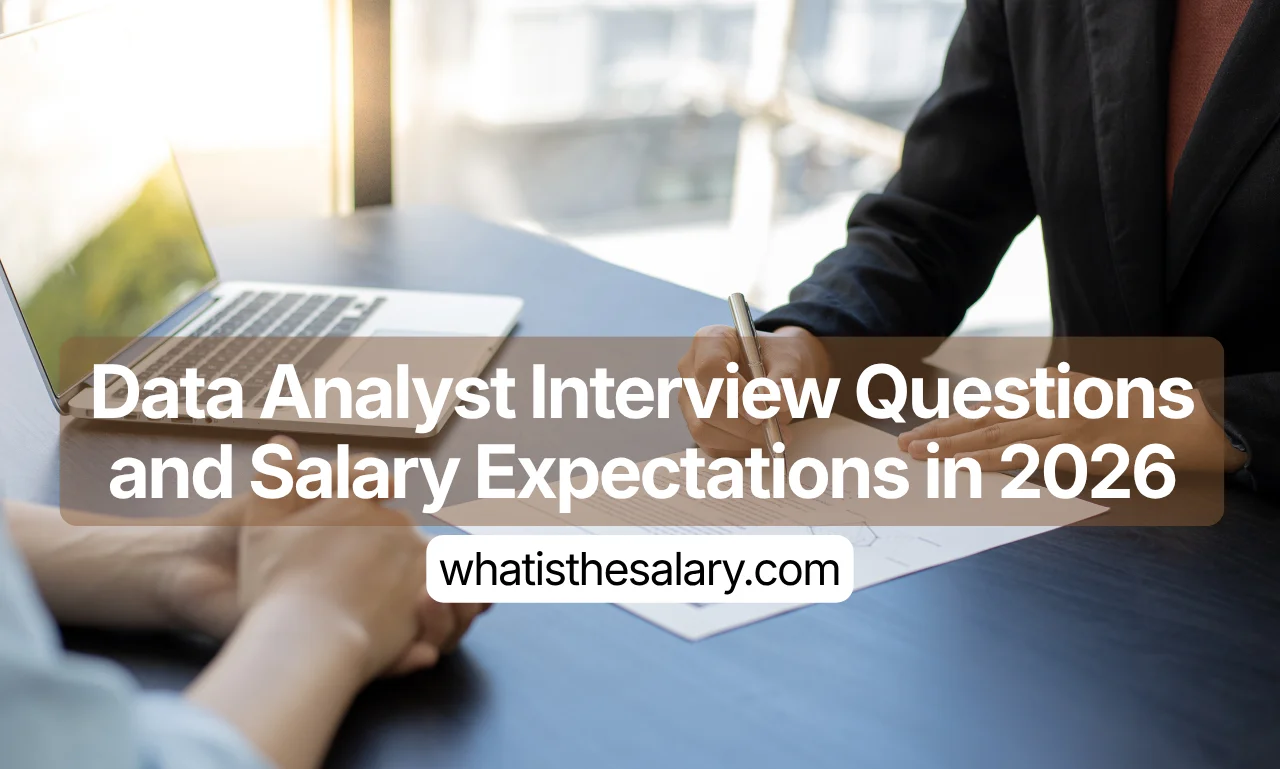
Most hiring loops follow the same shape. DataCamp’s 2026 interview guide describes a recruiter screen first, then a hiring manager interview, then technical questions. The recruiter call is where your salary expectations get tested, long before anyone asks you to write a join.
KORE1, a tech staffing firm, describes a four-round loop that includes a 60-minute case interview with the hiring manager. The firm also argues that many analyst interviews still test 2019 skills, such as SQL puzzles, instead of stakeholder translation and business judgment. Prepare for both.
Still deciding whether this career fits? The data analyst career path guide shows how titles and pay change from junior analyst to manager.
Data Analyst Interview Questions You Will Hear in 2026
Behavioral and Stakeholder Questions
KORE1 says five questions belong in nearly every analyst loop. Walk me through a recent project. Tell me about a stakeholder conflict. Describe a data quality problem you caught. Explain a metric definition you had to defend. Describe a request you pushed back on.
I would answer each in three beats. State the business problem, describe the decision your analysis drove, and finish with a number. “I rebuilt the weekly churn dashboard and cut reporting time from two days to two hours” lands better than a list of tools.
SQL and Technical Questions
Technical screens still lean on SQL. Expect joins, GROUP BY versus window functions, removing duplicates, handling NULL values, and writing a CTE for retention or running totals.
Take this prompt: “How would you find duplicate customer records?” A strong answer names the key you would group on, uses COUNT with HAVING greater than one, then explains the next step, such as checking which record is newest before deleting anything.
Case and AI-Assisted Analytics Questions
DataCamp flags AI tools, data validation, and how you communicate insights as 2026 themes. A typical case sounds like this: “Orders dropped 8 percent last week. What do you check first?” I would start with data quality, such as a broken tracking tag or a delayed pipeline, then segment by channel, device, and region before blaming demand.
Another question gaining ground: “How do you verify analysis produced by an AI assistant?” Say you run the code on a small sample, reconcile row counts against a known report, and check join logic by hand. Interviewers want proof that you treat AI like a fast junior colleague.

Data Analyst Salary Expectations in 2026: What the Sources Say
Googling the average data analyst salary has one problem. Every site reports a different number, and every number measures something different. Glassdoor uses self-reported pay and includes estimated extras such as bonuses. ZipRecruiter estimates from job postings. Indeed averages posted ranges over roughly three years. PayScale tracks self-reported base pay.
| Source | 2026 figure | What it measures |
| Salary.com | $97,717 | Modeled average salary |
| Glassdoor | About $86,500 | Self-reported pay with estimated extras (March 2026 snapshot) |
| Indeed | $86,558 | Average from postings over 36 months |
| ZipRecruiter | $82,640 | Job postings and estimates (June 2026) |
| PayScale | $70,478 | Self-reported base pay |
| BLS (data scientists, related role) | $112,590 median | Government wage survey (May 2024) |
That gap of about $27,000 between PayScale and Salary.com is why I never quote a single figure. I quote a range and name the source.
The BLS number belongs to data scientists, a neighboring role, but it shows where an analyst can end up after specializing. The BLS also projects data scientist employment to grow 34 percent from 2024 to 2034, against 3 percent for all occupations.
Want the city and industry detail? Read the complete data analyst salary guide for the US next.
Data Analyst Salary by Experience Level
Entry Level (0 to 2 Years)
A September 2026 compilation of Glassdoor, LinkedIn Salary Insights, and PayScale data from StylingCV puts entry-level analyst pay at $55,000 to $70,000. KORE1 reports higher base pay for entry-level hires, $72,000 to $98,000. The gap likely comes from location and employer type, which is why you should check postings in your own market.
Starting from zero experience or without a degree? My guides on entry-level data analyst salary and becoming a data analyst without a degree show what portfolios and certificates employers accept.
Mid-Level (3 to 6 Years)
The same compilation shows $75,000 to $100,000 for mid-level analysts. Interviewers stop asking what you know and start asking what you changed. Bring two projects where your analysis moved a budget, a roadmap, or a forecast, and use them to justify the top half of your range.
Senior (7 or More Years)
Senior analysts land at $105,000 to $135,000 in the compilation. KORE1 reports $92,000 to $135,000 in base pay for senior hires, with analytics engineers and marketing analysts in tech metros earning another 15 to 30 percent on top.
Manager and Director Level
Glassdoor figures published by Coursera in March 2026 list analytics managers at $131,202 and directors of analytics at $184,828. At this level, bonus and equity often matter as much as base.
How to Answer “What Are Your Salary Expectations?”
Employers ask because they need to know whether you fit the budget. Ask far above market and you look unprepared. Ask too low and you leave money behind, because the first number often becomes the anchor.
Here are three scripts I would use.
Early recruiter call, range unknown. “I’d like to understand the scope first. Could you share the range budgeted for this role?”
You must give a number. “Based on 2026 market data for mid-level analysts in this area, I’m targeting $85,000 to $95,000 in base pay, and I’m open to discussing total compensation.” Make the bottom of your range a number you would happily accept.
You are changing careers. “I’m looking at the entry-level range for analysts, around $60,000 to $70,000, with room to grow as I take on more.”
Think in total compensation. Base pay is one line. Add the annual bonus, 401(k) match, equity if offered, health insurance cost, remote flexibility, and paid time off before you decide a number is high or low.
Salary Questions in Applications, Emails, and Pay Transparency
Some employers ask for salary expectations in a web form or an email. StylingCV suggests replying within 24 hours with a researched answer. I agree, because speed shows interest and research shows seriousness.
The rules are also shifting. In several states, including California, New York, and Colorado, employers cannot ask for your current salary. Several states also require pay ranges in job postings. Use the posted range as your anchor, and where salary history questions are banned, steer back to your target for the new role.
Remote roles add another wrinkle. Some employers pay by location, others pay one national band. My guide on remote data analyst jobs in the US shows how pay and availability look in 2026.

What Moves Your Data Analyst Salary
Skills move pay faster than extra years in one seat. Coding Temple’s 2026 analysis estimates mid-level analysts earn about $78,000 with SQL alone, $89,000 after adding Tableau or Power BI, $104,000 with Python, and $118,000 with dbt or analytics engineering skills. Treat these as directional estimates, but the order of the steps is the useful part.
Industry and employer matter too. Finance, healthcare, and retail pay analysts differently, and I broke that down in data analyst salary in finance vs healthcare vs retail. Individual employers vary as well, so check data analyst salary by company before you name a number.
Education matters less than people think once you have two years of experience. Weighing a degree against faster routes? Read data analyst bootcamp vs degree, and look at the best certifications for data scientists if you plan to move into modeling later.
Job changes move pay more than raises. Careery reports that internal raises average 3 to 5 percent a year, and that the biggest jumps usually come from changing employers.
Four Salary Myths Data Analysts Believe
Myth 1: Entry level means six figures. Careery’s 2026 guide puts entry-level pay at $55,000 to $75,000. Most first jobs start below $100,000.
Myth 2: The average is my number. Averages blend interns, managers, and different cities. PayScale and Salary.com sit about $27,000 apart for the same title, so build your range from your level and your metro.
Myth 3: Base salary is the whole offer. Glassdoor includes estimated bonuses and profit sharing in some figures, while PayScale tracks base. Compare like with like, or you will think a fair offer is low.
Myth 4: AI is ending analyst jobs. The BLS projects 34 percent growth through 2034 for the closely related data scientist role. Employers still pay for people who frame business questions and explain findings. The work is shifting toward judgment.
When to Stop Researching and Start Negotiating
At some point, more research is just polite stalling. Once you have three sources, a range for your level, and one posted range from a similar job, you know enough. Here is what I would do next.
- Let them name the range first when you can. It protects you from anchoring too low.
- Negotiate after the written offer. Say: “I’m excited about this role. Based on my research and the scope, I was hoping for $X. Is there flexibility?”
- Use a competing offer honestly. Share the real number and the real deadline, and never invent one.
- Negotiate the whole package: signing bonus, annual bonus, equity, remote days, start date, and a salary review at six months.

Where Analyst Pay Goes Next
Pay grows fastest when you add a specialty. Analytics engineering, product analytics, and data science sit one step above general reporting work. The BLS median for data scientists is $112,590, across about 245,900 jobs in 2024 and roughly 23,400 openings a year. If that route appeals, start with how to become a data scientist, then compare the data scientist career path, entry-level data scientist salary, and data scientist salary by city.
Some analysts move sideways into security. If that interests you, read about becoming a cybersecurity analyst without a degree, the cybersecurity career path, and what the top of that ladder pays in the CISO salary guide.
Whichever route you pick, anchor your numbers in the data analyst salary in the US 2026 guide and adjust as you learn what your market pays.
Frequently Asked Questions
-
What are good salary expectations for a data analyst in 2026?
Most 2026 sources put the average between roughly $70,000 and $98,000, depending on the platform and whether it reports base or total pay. Entry-level roles start near $55,000 to $70,000, and senior analysts reach $105,000 to $135,000 in a September 2026 compilation of Glassdoor, LinkedIn, and PayScale data.
-
How do I answer salary expectations in a data analyst interview?
Ask for the budgeted range first. If pressed, give a researched range for your level and city, put a number you would accept at the bottom, and mention that you are open to discussing total compensation.
-
What is the starting salary for a data analyst?
One 2026 compilation shows $55,000 to $70,000 for analysts with 0 to 2 years of experience. KORE1 reports base offers of $72,000 to $98,000 at some tech employers.
-
What questions are asked in a data analyst interview?
Expect stakeholder and behavioral questions, SQL and technical questions, case studies, and newer questions on AI tools and data validation. Recruiters also ask about salary expectations in the first call.
-
Is data analyst a good career in 2026?
Pay is solid and demand looks healthy. The BLS projects 34 percent growth for the related data scientist role through 2034. Entry-level pay is rarely six figures, so adding Python, BI, and communication skills early makes the biggest difference.
Share Your Experience
I would love to hear how your last interview went. Did a recruiter ask for your number in the first five minutes? Drop your offer story, your best script, or your salary surprise in the comments so the next analyst walks into data analyst interview questions and salary expectations prepared.
How This Article Was Created
Salary figures come from the Bureau of Labor Statistics (May 2024 wages and 2024 to 2034 projections), ZipRecruiter (June 2026), and 2026 reports citing Glassdoor, PayScale, Salary.com, and Indeed, plus KORE1, DataCamp, Careery, Coding Temple, StylingCV, and Coursera. Sources were published between February and September 2026, except the BLS wage data. No figures were invented, and numbers that could not be traced to a source were left out. I wrote this to inform job seekers, not to recruit or advertise.

Shahzada Muhammad Ali Qureshi (Leeo)
I’m Shahzada — a software engineer by education and an SEO professional by trade. I built WhatIsTheSalary.com to go beyond just showing salary numbers — every page is manually researched across sources like BLS, Glassdoor, LinkedIn Salary, and PayScale to give you the full picture in one place. If you found what you were looking for here, that’s exactly the point.