TL;DR: Quick Scoop on Software Engineer Salary in Germany
Here’s the gist:
Thinking about building your software career here and wondering about software engineer salary in germany? With a strong tech ecosystem, high demand for engineers,”what is the salarly” and competitive pay, it’s one of Europe’s top spots. In 2026, the average hits around €74,100 gross per year, while senior engineers at top companies can snag €111,800+. But hey, who wants to code broke because of surprise taxes?
Salary figures alone don’t cut it. Taxes, cost of living, city differences, and weak negotiation can slash your take-home pay. Many engineers jump in blind—and end up pinching pennies or regretting the move.
This guide fixes that mess. You’ll get breakdowns by experience, city, and tech stack, plus taxes, benefits, and tips to negotiate like a boss. No fluff—just handy insights to land you in the black. Let’s roll.
Overview of Germany’s Tech Job Market
Germany’s tech world is solid. Big players like SAP and Siemens mix with startups in Berlin. The country needs skilled hands in AI and automotive software. Shortage of talent means good chances for you. In 2026, the market’s growing, especially in fintech and e-commerce. Jobs are plenty in major cities.
Why Germany Attracts Software Engineers
Why pack your bags for Germany? High pay, sure, but also the vibe. Four weeks vacation minimum, strong unions, and public transport that actually works. Plus, English is common in tech. For non-EU folks, the EU Blue Card makes it easier. It’s not all perfect – bureaucracy can be a headache, like waiting for your visa while your coffee gets cold. But hey, the quality of life? Worth it.

Understanding the Software Engineer Role
What Does a Software Engineer Do?
You build stuff. From apps to systems, you code, test, debug. It’s problem-solving with a keyboard. In Germany, roles often include agile teams and cloud tech.
Software Engineer vs. Software Developer Distinction
Engineer sounds fancier, right? But in practice, engineers focus on big-picture design, while developers code the details. In Germany, titles blur, but engineers might earn a bit more in complex fields like DevOps.
Average Software Engineer Salary in Germany
| Category | Salary / Insight (Germany, 2026) |
|---|---|
| Average Software Engineer Salary | €74,100 per year |
| Median Salary Range | €65,000 – €80,000 |
| Year-over-Year Trend | Increase compared to 2025 |
| Key Growth Driver | AI, machine learning, and automation demand |
| Market Outlook | Strong and stable |
| Remote Work Impact | Pushing salaries higher, especially for senior roles |
| Overall Tech Landscape | Competitive compensation due to digital transformation |
Salary Breakdown by Experience Level for software professionals in Germany
Entry-Level Software Engineers
Entry-Level Software Engineers typically start with a base salary ranging from €41,000 to €55,000. This bracket applies primarily to fresh university graduates or those who have recently completed intensive coding bootcamps. At this stage, the focus is on “learning by doing.”
You will likely be assigned modular tasks, such as bug fixes or basic JavaScript developments, while working under the close supervision of a mentor. To maximise your starting offer, focus on building a strong GitHub portfolio or completing internships at established firms in tech hubs like Berlin or Munich.
Junior Software Engineers (1-3 Years)
For Junior Software Engineers, salaries generally rise to between €50,000 and €65,000. At this level, you have moved past the initial learning curve and are expected to contribute independently to the codebase.
Specialising in high-demand frameworks like React, Vue.js, or Python significantly increases your market value. Employers look for developers who can not only write clean code but also understand the software development lifecycle (SDLC) and participate in agile ceremonies like daily stand-ups and sprint planning.
Mid-Level Software Engineers (4-7 Years)
Mid-Level Software Engineers command salaries between €65,000 and €85,000. This is the “sweet spot” of the German job market, where you possess enough experience to take ownership of entire features or full-stack projects.
At this stage, you may begin mentoring juniors or leading small feature teams. Beyond technical skills, your value is tied to your ability to make architectural decisions and manage system integrations. Proficiency in DevOps tools (Docker, Kubernetes) often pushes pay toward the higher end of this bracket.
Senior Software Engineers (8+ Years)
The most experienced Senior Software Engineers earn €85,000 to €120,000, with niche experts and Principal Engineers at “Big Tech” firms or successful scale-ups exceeding €130,000. At this level, you are no longer just a coder; you are a strategic asset.
You are expected to solve complex system design challenges, oversee cloud engineering infrastructure (AWS/Azure), and ensure long-term code maintainability. In 2026, senior roles often include additional benefits such as Stock Options (VSOPs) or performance-related bonuses that can significantly increase total compensation.
Pay Progression and Career Growth
Pay Progression and Career Growth in Germany are influenced by both technical upskilling and strategic career moves. While German corporate culture traditionally values loyalty, “job-hopping” every 2–3 years remains the most effective way to secure a 15–20% salary increase. In 2026, moving into specialized fields like Artificial Intelligence or Cyber Security can accelerate your earnings even faster.
To plan your career path and compare live data, you can use the StepStone Salary Planner or research specific company benchmarks on Levels.fyi to ensure your compensation aligns with current market standards.
Salary by Technology Stack
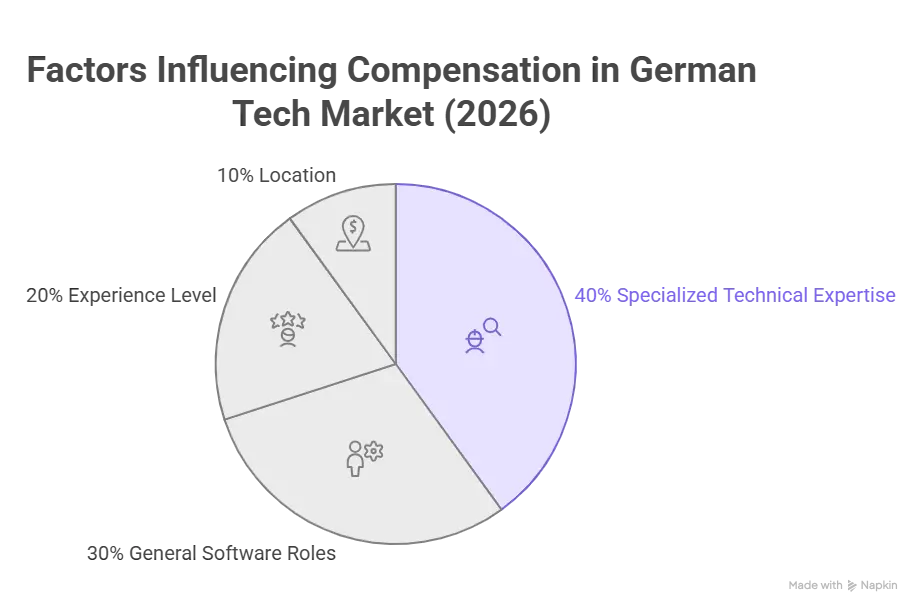
In 2026, the German tech market has become increasingly specialized. While general software roles remain stable, specific technical expertise now commands significant premiums. Here is an expanded look at the factors influencing compensation.
Programming Languages and Frameworks Impact
The specific Programming Languages and Frameworks Impact on your salary cannot be overstated. While foundational languages like Java, Python, and JavaScript continue to rule the market due to their massive enterprise footprints, framework-specific mastery is the primary driver for salary bumps.
If you are an expert in Spring Boot (essential for German banking and automotive sectors) or Django (favoured by data-heavy startups), you can often add an additional €10,000 to your base offer. In 2026, we are also seeing a “niche premium” for languages like Rust and Go, which are increasingly used for high-performance cloud infrastructure and can push salaries even higher than standard Java roles.
High-Paying Technical Skills
The demand for High-Paying Technical Skills has shifted toward automation and intelligent systems. AI Engineers and Machine Learning professionals are currently at the top of the charts, with mid-level roles frequently starting at over €90,000.
Similarly, the “infrastructure as code” movement has made DevOps Engineers—specifically those with Kubernetes and Terraform mastery—some of the most expensive hires for German firms. Furthermore, as data regulations tighten across the EU, Cybersecurity experts who can navigate both technical hardening and compliance (like GDPR) are seeing record-high offers, often rivaling AI salaries.
Frontend Engineers
- Average Salary: €60,000.
- Expansion: While the average remains stable, the ceiling for Frontend specialists has risen significantly due to the complexity of modern web applications. Engineers mastering Next.js, TypeScript, or advanced state management (like Redux or Recoil) can reach €75,000–€80,000. In cities like Berlin, high-growth startups are paying a premium for “Product Engineers” who combine frontend expertise with UX/UI sensibility.
Backend Engineers
- Average Salary: €70,000.
- Expansion: Backend roles often outearn Frontend due to the critical nature of data security and server reliability. Specializing in the Java/Spring Boot ecosystem—standard in Germany’s massive automotive and finance sectors—can push salaries toward €85,000. In 2026, proficiency in Go (Golang) or Rust for microservices architecture is a major differentiator, with some senior roles exceeding €95,000.
Full-Stack Engineers
- Average Salary: €75,000.
- Expansion: Full-stack developers are the “Swiss Army knives” of the German market, particularly in Munich and Hamburg where mid-sized firms (Mittelstand) value versatility. By 2026, “Full-Stack” increasingly implies a “Full-Cycle” developer—someone who can not only bridge the gap between UI and Database but also manage their own deployments. Python-based Full-Stack roles are currently seeing the highest growth due to their overlap with AI-driven products.
DevOps/SRE Engineers
- Average Salary: €80,000+.
- Expansion: DevOps and Site Reliability Engineers (SREs) remain the highest-paid technical contributors below the executive level. With the 2026 push toward “Industry 4.0” and cloud-native sovereignty, experts in Kubernetes, Terraform, and AWS/Azure are in extreme shortage. Senior DevOps positions in hubs like Berlin and Munich frequently reach €100,000–€115,000, especially when combined with security expertise (DevSecOps).
Salary by Major Cities In Germany
Here is an expanded look at the tech salaries in Germany’s major economic hubs, including the all-important balance of cost of living.
Munich
Average Salary: €68,000–€73,000+.
- Expansion: Munich consistently offers the highest average salaries in Germany, a result of having major corporate headquarters like BMW, Siemens, and Allianz. The engineering and automotive sectors are particularly strong here. However, Munich is also Germany’s most expensive city to live in. While you earn more, the high cost of rent means that a software engineer in Berlin might have 16% more purchasing power than one in Munich on a comparable gross salary.
Berlin
Average Salary: €60,000–€67,000.
- Expansion: As Germany’s vibrant “startup capital,” Berlin offers a dynamic tech ecosystem with numerous job opportunities, many of which operate entirely in English. Salaries are slightly lower on average than in the South, but the cost of living, particularly housing, is significantly lower than in Munich or Frankfurt. This often makes Berlin a more financially attractive option for entry and mid-level engineers seeking a high quality of life relative to their expenses.
Frankfurt
Average Salary: €65,000–€69,000.
- Expansion: The financial heart of Germany and the EU, Frankfurt‘s tech scene is dominated by FinTech, banking, and business services companies. Salaries are highly competitive, driven by the lucrative financial sector. The city attracts professionals seeking a corporate environment and high-paying roles in cybersecurity and financial software, though it also comes with a high cost of living.
Hamburg
Average Salary: €63,000–€65,000.
- Expansion: A major port city, Hamburg has a strong presence in logistics, media, and e-commerce. The city offers solid salaries and a strong economy. While salaries are slightly behind the top three, Hamburg offers an excellent balance of career opportunities, a robust local economy, and a slightly more manageable cost of living than Munich or Frankfurt.
Stuttgart
Average Salary: €65,000–€69,000.
- Expansion: Stuttgart’s tech market is heavily driven by its world-renowned automotive and engineering industries (Mercedes-Benz, Porsche). The demand for embedded software engineers and mobility tech specialists is exceptionally high, leading to competitive salaries that rival Frankfurt’s. The region of Baden-Württemberg consistently ranks among the highest-paying states in Germany, though the cost of living reflects this economic strength.
When evaluating offers, it’s crucial to consider the purchasing power of your salary in the specific city. A lower gross salary in
Berlin might leave you with more disposable income than a higher one in
Munich after accounting for housing costs and taxes.
Regional Cost of Living Considerations
Software Engineer Salary vs. Rent by City (2026)
| City | Average Annual Salary (Gross) | Estimated Monthly Rent (1-bed) | Dominant Tech Sectors |
|---|---|---|---|
| Munich | €73,296 | ~€1,500 – €1,800 | Automotive, Insurance, Aerospace |
| Berlin | €67,152 | ~€1,200 – €1,400 | Startups, E-commerce, FinTech |
| Frankfurt | €69,564 | ~€1,300 – €1,500 | FinTech, Banking, Cybersecurity |
| Stuttgart | €69,180 | ~€950 – €1,300 | Automotive, IoT, Engineering |
| Hamburg | €63,912 | ~€1,100 – €1,350 | Logistics, Media, AdTech |
Remote Work Compensation Trends
Remote software engineer? €72,900 average. Hybrid models common, no pay cut usually.
Industry and Company Factors
Startups vs. Established Tech Giants
Startups offer equity but lower base, €60,000. Giants like Google Germany: €110,000+ for seniors.
Top-Paying Companies in Germany
SAP, Siemens, BMW Group, Mercedes-Benz, Volkswagen. Amazon Germany, Microsoft Germany pay premium.
Company Size Impact on Compensation
MNCs: Higher, €80,000+. Small firms: €55,000.
International Companies and Premium Salaries
US firms in Germany add 20% premium.
Sector-Specific Variations (Fintech, Automotive, Enterprise, etc.)
Fintech: €75,000. Automotive software: €70,000. AI sector: €90,000.
Total Compensation Structure
In 2026, the Total Compensation Structure for software engineers in Germany has evolved beyond a simple monthly paycheck to include complex performance and retention incentives.
Base Salary Components
The Gross salary includes holiday pay as a legal standard. In Germany, your base salary is typically divided into 12 or 13 monthly installments. If your contract specifies a “13th-month salary,” this is often paid in November to cover holiday expenses. Under German law, you are entitled to a minimum of 20 days of paid vacation, though the tech industry standard is significantly higher, usually ranging from 28 to 30 days.
Bonus and Additional Cash Compensation
A 10-20% bonus common for mid-to-senior level roles. These performance-based bonuses are usually tied to a mix of individual KPIs and overall company profitability. Some firms also offer “signing bonuses” ranging from €5,000 to €10,000 for high-demand roles like DevOps or AI, though these often come with a “clawback” clause if you leave within the first year.
Stock Options and Equity
Tech giants offer RSUs (Restricted Stock Units) as a primary tool for long-term retention. While US-based giants like Google or Amazon provide liquid stocks, German startups typically offer VSOPs (Virtual Stock Option Plans). These grant you a “shadow share” in the company’s value, providing a significant cash payout during an “exit” event, such as an IPO or acquisition.
Common Benefits and Perks Package
Beyond the base, companies offer a Health insurance, pension, and bike lease (JobRad) package. In 2026, the “Deutschlandticket” (subsidised nationwide transit) is a standard perk. Many offices also provide high-end hardware, professional development budgets of €1,500+, and free lunches—ranging from catered schnitzel days to fully stocked healthy kitchens—to encourage office-based collaboration.
Freelance vs. Full-Time Employment
Salary Comparison
Freelance software engineer: €63,000 annual invoice. Full-time: €74,000.
Pros and Cons of Each Path
Freelance: Flexible, but no paid sick days. Full-time: Stable, benefits.
Contract Rates and Considerations
Hourly rate: €80 in Munich. Daily: €500-700.
Understanding German Taxes and Take-Home Pay
Tax Structure in Germany
Progressive: 0% up to €12,348, then 14-45%. Solidarity surcharge 5.5%.
Post-Tax Salary Estimates
€70,000 gross? Net around €45,000.
Net vs. Gross Salary Calculations
Use calculators. Social security takes 20%.
Cost of Living Analysis
Living Expenses by City
Berlin: €5,402/month for comfort. Munich 11% pricier.
Salary-to-Cost-of-Living Ratio
In Leipzig, better ratio than Düsseldorf.
Quality of Life Considerations
Great healthcare, parks. But winters? Bring a coat.
Skills and Qualifications for Success
Essential Technical Competencies
Coding bootcamps help. Know Docker, AWS certification.
In-Demand Programming Languages and Tools
Golang, TypeScript, Node.js.
Soft Skills That Increase Earning Potential
Communication, teamwork. Germans value directness.
Certifications and Educational Requirements
Computer science degree preferred. Azure certification boosts pay.
How to Increase Your Software Engineer Salary
Strategies for Salary Growth
Learn high-paying skills like AI.
Skill Development Priorities
Focus on cloud engineer paths.
Career Advancement Tactics
Network on LinkedIn. Job portals like Indeed.
Negotiation Best Practices
Ask for more – worst they say is nein.
Getting Hired as a Software Engineer in Germany
Job Search Strategies
Use Glassdoor, StepStone.
Application Process Overview
CV in German? Sometimes. Tech assessments common.
Work Visa and Relocation Considerations
Skilled Worker Immigration Act helps non-EU. Relocation packages from big firms.
Interview Preparation Tips
Practice coding interviews. Be on time – German style.
Gender and Diversity in Tech Salaries
Pay Gap Analysis
Unadjusted gender pay gap: 23% in tech. Women in tech earn less.
Industry Initiatives for Fair Compensation
EU directives push transparency by 2026.
Future Outlook and Career Prospects
Salary Trends and Projections
Up 2% yearly to 2030. AI job market booms.
Emerging Opportunities in German Tech Sector
HealthTech, cybersecurity.
Long-Term Career Growth Potential
From junior to lead software engineer in 10 years.

Also read: How To Become A Software Engineer Without A Degree In 2026
FAQs
Is Germany Good for Software Engineers?
Yeah, Germany rocks for software engineers in 2026. Tech jobs are booming with over 100,000 open IT spots. Average salary hits €74,750 gross, plus killer work-life balance – think 30 vacation days and no burnout culture. English works in hubs like Berlin. Sure, taxes bite, but great healthcare and stability make up for it. If you hate paperwork, it might annoy you like a stubborn bug.
Highest Paying Tech Jobs in Germany
AI engineers and machine learning pros top the list, often over €90,000-€120,000 gross. Cybersecurity experts and cloud architects follow close, around €80k-€100k. Data scientists and software architects at big firms like SAP pull similar. Hot skills in AI boom pay premiums – specialize and cash in!
Software Engineer Salary After Tax
For €70,000 gross yearly (solid mid-level), expect around €43,000-€46,000 net after taxes and social contributions – that’s about €3,600 monthly take-home. Depends on tax class (single? married?), kids, and state. Use a calculator for exacts; taxes hit 35-45%, but perks like health cover soften it.
Living Cost vs Salary Germany
In Berlin, €70k gross salary covers comfy – rent €800-€1,200, food/utilities €400, transport €50. Net €45k leaves room for savings and fun. Salary stretches further than Munich’s pricier vibe. Overall ratio’s strong; many expats save €1k/month easy while enjoying parks and beer.
Can Foreigners Work as Software Engineers in Germany?
Absolutely – non-EU folks snag jobs easy with demand. Get EU Blue Card if salary €45,934+ (lower for IT shortages). Need job offer first; many firms sponsor. Prove skills/experience. Process takes months, but 2026 rules eased it. English gigs plenty in Berlin. Go for it!
Is Germany Worth It for Software Engineers?
Let’s be honest – packing up for Germany as a software engineer? It’s a solid yes for most folks I’ve chatted with over the years. You’ve got that sweet work-life balance with 30+ vacation days, no crazy overtime, and healthcare that doesn’t bankrupt you. Pay’s decent too, averaging €74k, and the tech scene’s buzzing with over 770,000 IT jobs open.
Europe’s biggest expat hub, per stats, means you’ll fit in easy if you’re from abroad. Sure, salaries might not match Silicon Valley’s flash, but factor in low education costs and easier visas compared to the US. Plus, innovation in AI and cybersecurity keeps things exciting. If you dig efficient trains, beer gardens, and not burning out, it’s worth it. But if bureaucracy bugs you – like endless paperwork for that Blue Card – it might feel like debugging legacy code. Ha, we’ve all been there.

Shahzada Muhammad Ali Qureshi (Leeo)
I’m Shahzada — a software engineer by education and an SEO professional by trade. I built WhatIsTheSalary.com to go beyond just showing salary numbers — every page is manually researched across sources like BLS, Glassdoor, LinkedIn Salary, and PayScale to give you the full picture in one place. If you found what you were looking for here, that’s exactly the point.