TLDR
What Is a Software Engineer and why does this role seem to control the future of everything around us? From the apps on your phone to the banking systems that move billions in seconds, software engineers quietly design the digital backbone of modern life. Yet many people still confuse the title with basic coding or IT support, missing the real impact behind the profession.
The problem is simple: most career advice barely scratches the surface. It doesn’t explain what software engineers actually build, how they solve real-world problems, or why businesses compete fiercely to hire them.
Here’s the truth. A software engineer is a problem solver who turns complex challenges into scalable digital solutions. If you understand that, you unlock not just a job title, but a gateway to one of the most powerful and future-proof careers in the world.
What Is a Software Engineer? (The 2026 Definition)
If you search “what is a software engineer,” you’ll get a hundred versions of the same answer: someone who builds software. But that definition is getting more outdated by the month.
A software engineer is someone who applies engineering discipline to the full lifecycle of a digital system — from requirements and design, all the way through deployment, observability, and long-term maintenance. The word “engineering” in the title is intentional. It signals rigor, method, and accountability, not just the ability to write code.
Think of it this way. A plumber fixes pipes. A civil engineer designs the water system for an entire city. A software engineer is closer to the latter. The discipline draws from computer science, systems thinking, and practical problem-solving to build software that works reliably at scale.
In 2026, that definition has expanded even further. The global software industry now touches every sector — healthcare, finance, logistics, agriculture, defense. There are an estimated 28.7 million software developers worldwide, and that number is projected to jump to 45 million by 2030 just to keep pace with demand. Software engineering is, by most measures, the backbone of the modern economy.
The bigger shift, though, is internal. The role has moved from “write the code” to “design the system.” Engineers today are expected to understand trade-offs, think in distributed architectures, guide AI pipelines, and translate business problems into technical strategy. That’s a different job than it was even five years ago.
Defining the Software Engineer Role
What Exactly Do Software Engineers Do?
The job starts well before anyone opens a code editor. Software engineers are involved from the moment a product idea is on a whiteboard.
That means sitting in requirement analysis sessions, asking the right questions — what does success look like, what are the edge cases, who are the users? It means working with product managers, designers, and stakeholders to define scope before committing to architecture. It means writing technical specs that a team of five can execute without constant clarification.
The development cycle today is also increasingly “human-in-the-loop,” meaning engineers are orchestrating AI agents and automated pipelines, not just writing all the logic themselves. An engineer in 2026 might write the framework, set the guardrails, and let a code-generation tool fill in the boilerplate — then review, test, and refactor to production quality.
Beyond the Keyboard: Day-to-Day Tasks
Anyone who thinks software engineering is mostly typing has never been on a real engineering team.
A typical week might include code reviews (reading more code than you write), sprint planning meetings, incident post-mortems, architecture discussions, documentation reviews, and mentoring sessions with junior engineers. For senior engineers and above, a large portion of the week is communication, not code.
Then there’s the operational side. Modern engineers manage CI/CD pipelines, monitor system observability dashboards, respond to on-call alerts, and maintain the health of distributed services in production. In teams working with AI tools, managing automated agents and reviewing AI-generated pull requests is becoming part of the regular workflow.

What Do Software Engineers Work On?
The scope is enormous. Software engineers build:
SaaS platforms (think Salesforce, Notion, Figma), mobile applications for iOS and Android, distributed cloud systems on AWS, GCP, or Azure, embedded software for IoT devices, enterprise backends handling millions of transactions per day, and increasingly, AI-powered pipelines and agentic systems that automate complex business logic.
No two companies use the same stack or solve the same problems. That variety is part of what makes the career compelling — and why generalist thinking is as valuable as deep specialization.
Skills and Tools of the Trade
The Core Pillars: What an Engineer Must Know
The fundamentals haven’t changed. Data Structures and Algorithms (DSA) remain the foundation of every technical interview and every production system that needs to scale. Understanding time complexity, memory management, and algorithmic trade-offs is what separates an engineer who “makes it work” from one who “makes it work under load.”
SOLID principles — Single Responsibility, Open/Closed, Liskov Substitution, Interface Segregation, Dependency Inversion — guide how you write code that other humans can actually read and maintain six months from now.
What’s new for 2026: system observability is now a core skill, not an afterthought. Engineers are expected to understand distributed tracing, logging pipelines, alerting frameworks (Datadog, Prometheus, OpenTelemetry), and how to debug systems across microservices when there’s no obvious stack trace.
Additionally, prompt engineering for developers — the ability to craft structured, auditable inputs for LLMs as part of production workflows — has moved from “nice to have” to an expected competency at AI-forward companies.
The Modern Tech Stack
Most engineers work daily in a combination of these tools:
IDEs and AI Coding Assistants: VS Code remains dominant, but Cursor (an AI-native code editor) has grown rapidly among engineers who want tighter LLM integration into their workflow. GitHub Copilot is now embedded in most enterprise environments.
Version Control: Git is non-negotiable. GitHub, GitLab, and Bitbucket are the platforms where pull requests, code reviews, and branch strategies live.
CI/CD: GitHub Actions and Jenkins handle automated testing and deployment pipelines. Engineers who can build and maintain these pipelines are highly valued.
Cloud Platforms: AWS, Google Cloud, and Azure are the big three. Kubernetes for container orchestration and Terraform for infrastructure-as-code are now standard for platform and cloud roles.
The Python Powerhouse
Python’s dominance in 2026 is not accidental. Its readable syntax made it the first language for beginners; its ecosystem made it indispensable for professionals. Data science, machine learning, AI pipelines, scripting, automation, and API development — Python is the connective tissue of the modern tech stack.
For AI engineers specifically, Python is the only serious choice. Libraries like LangChain, LlamaIndex, PyTorch, and Hugging Face Transformers are all Python-native. If you want to build RAG (Retrieval-Augmented Generation) pipelines, fine-tune LLMs, or deploy agentic workflows, Python is where that work happens.
Software Development Kits (SDKs) Explained
An SDK — Software Development Kit — is a packaged set of tools, libraries, and documentation that lets developers integrate with an external service or platform without rebuilding everything from scratch. Think of the Stripe SDK for payment processing, or the OpenAI SDK for accessing GPT models via API.
Engineers both use SDKs (to build products faster) and build them (to enable third-party developers to use their platform). Designing a good SDK is actually a product problem as much as a technical one — it requires thinking about developer experience (DX), backward compatibility, versioning, and documentation. As companies scale, SDK design becomes a serious engineering discipline.

Types of Software Engineers (The Specialized Tracks)
Software engineering is not one job. It’s a family of related disciplines. Here’s how they break down in 2026:
Full Stack Engineer: The Swiss Army Knife. Full stack engineers work across the entire application layer — frontend (React, Vue, Angular), backend (Node.js, Python, Go), and often database design. In 2026, many startups expect full stack engineers to also understand basic cloud infrastructure. They’re generalists by design and usually the backbone of early-stage product teams.
Platform and Cloud Engineer: The Modern Infrastructure Pro. These engineers build the systems that other engineers build on. Kubernetes clusters, CI/CD pipelines, internal developer platforms, and cloud cost optimization are their domain. It’s one of the highest-paying specializations — mid-level platform engineers can earn between $182,000 and $225,000 according to 2026 salary data from Motion Recruitment.
AI/ML Engineer: Designing Intelligence. This is the hottest track in the market right now. AI/ML engineers build the systems that train, fine-tune, deploy, and monitor machine learning models. In 2026, much of this work is less about training models from scratch and more about system design — how context flows, how RAG pipelines are structured, how agentic systems are evaluated and kept reliable in production. Mid-level AI engineers earn between $135,000 and $240,000 depending on location, according to current market data.
QA and Quality Engineering: Ensuring Reliability. Quality engineers design the testing systems that catch bugs before users do. In an environment where AI tools generate significant amounts of code, QA is more important than ever — not less. Test automation, chaos engineering, and shift-left testing practices are core skills here.
Firmware vs. Software: Where the Metal Meets the Code. Firmware engineers write low-level code that runs on hardware — microcontrollers, embedded systems, IoT sensors, medical devices. This is a specialized and often underrated track. The languages are different (C, C++, Rust), the constraints are different (memory, power, real-time requirements), and the stakes are often higher.
Data Engineer vs. Software Engineer: Handling the “Oil” of Tech. Data engineers build and maintain the pipelines that move, transform, and store data at scale. They’re less focused on user-facing products and more focused on the infrastructure that makes analytics, ML models, and reporting possible. Tools like Apache Kafka, Spark, dbt, and Airflow are their bread and butter.
Education and Career Path
The 2026 Education Mix: Degrees, Bootcamps, and Self-Taught
A computer science degree from a reputable university is still a strong signal — especially at large tech companies and enterprise employers. It builds the theoretical foundation (algorithms, OS concepts, compilers, networking) that’s hard to replicate otherwise.
But it’s no longer the only path, and for many companies it’s not even a requirement. Coding bootcamps, self-taught engineers with strong portfolios, and open-source contributors have broken into top companies for over a decade now. The 2026 job market cares about what you can build and what you understand — less about the credential you hold.
The more nuanced truth: a CS degree still opens doors faster. But once you’re past the first few years, what you’ve shipped matters far more than where you went to school.
Career Progression: From Junior to Staff Engineer and Architect
The typical progression looks something like this:
Junior Software Engineer (0–2 years): Focused on learning the team’s codebase, shipping features under guidance, and developing professional software habits. Entry-level salaries in the US range from $75,000 to $105,000.
Mid-Level Engineer (2–5 years): Working more independently, owning features end-to-end, mentoring interns or junior engineers. US salaries typically range from $100,000 to $150,000.
Senior Engineer (5+ years): Owning technical decisions, leading projects, designing systems, and setting quality standards. This is where most engineers spend the majority of their careers. Salaries range from $150,000 to $200,000+ depending on company and location.
Staff Engineer / Principal Engineer / Architect: These are senior individual contributor roles that involve cross-team influence, long-term technical strategy, and organization-wide impact. Top-tier staff engineers at FAANG companies can earn $300,000+ in total compensation including stock.
For those who prefer people management, the transition to Engineering Manager and then Director or VP of Engineering is a parallel track. Both paths are respected; neither is universally better.
Top Industries Hiring Engineers Today
HealthTech is one of the fastest-growing sectors for software engineers — telemedicine, AI-assisted diagnostics, and health data infrastructure all need strong engineering talent. FinTech continues to pay some of the highest salaries for engineers, driven by the complexity of financial systems and regulatory demands.
GreenTech and climate tech are emerging categories, building software for renewable energy management, carbon tracking, and smart grid infrastructure. Defense and government tech also saw significant hiring momentum in 2025–2026.
For a detailed breakdown of software engineer and IT salaries by industry and specialization, the IT Salaries is worth bookmarking.
Software Engineering: Art, Science, or Engineering?
Is Software Engineering “Real” Engineering?
This is a debate that’s been going on since the term “software engineer” was coined by Margaret Hamilton during the Apollo 11 missions. Her argument: if we’re building systems that people’s lives depend on, we should treat it like engineering — with rigor, methodology, and professional responsibility.
In many countries, the title “engineer” is legally protected and requires licensure. In the US, it’s largely unregulated for software, which has prompted ongoing discussions about professional accountability — especially as AI systems and autonomous software make consequential decisions in healthcare, transportation, and critical infrastructure.
The honest answer in 2026: software engineering shares the discipline and systematic thinking of traditional engineering, but the field’s licensing standards lag behind its real-world stakes. That gap is likely to close as software becomes more deeply embedded in safety-critical systems.
Software Engineer vs. Programmer: Clearing the Confusion
A programmer writes code. A software engineer designs systems.
A programmer solves the immediate problem in front of them. A software engineer asks: what are the failure modes? How does this scale? How will someone else maintain this in three years? Will this component need to integrate with two other systems we haven’t built yet?
The title “engineer” carries a big-picture weight. It implies ownership of the system’s behavior over time, not just the code’s behavior today. That distinction is increasingly meaningful as teams manage complex distributed systems with AI-generated components and automated pipelines.
The Reality Check: Challenges and Rewards
Is Software Engineering Hard?
Yes — but probably not for the reason people expect.
The technically hard parts (algorithms, architecture, debugging complex distributed failures) are real. But they’re learnable. What’s genuinely difficult is the continuous learning tax. The landscape shifts fast. A framework you mastered two years ago might be on its way out. A tool that didn’t exist last year might be expected knowledge for your next job interview.
Beyond that, technical debt is a constant. Every production codebase has corners that nobody wants to touch. Managing that debt — knowing when to refactor and when to ship — is a judgment call that takes years to develop.
Burnout is also real in software engineering, particularly in on-call rotations and at high-growth startups where “move fast” is a cultural default rather than a deliberate trade-off. Engineers who survive long careers are usually the ones who learn to pace themselves and say no to unnecessary complexity.
The 10x Software Engineer: Myth or Reality?
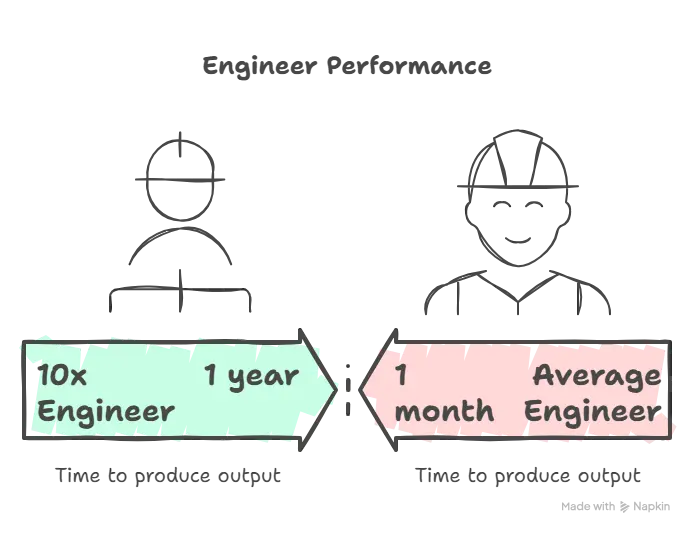
The idea that one great engineer can outperform ten average ones has some truth in it — and a lot of mythology around it.
In 2026, a high-impact engineer is not someone who writes 10x more code. They’re someone who deletes unnecessary code, designs systems that require less maintenance, makes decisions that unblock five other engineers, and asks the question that prevents a three-week mistake. That kind of leverage is real.
AI tools have actually expanded this concept. An engineer who can effectively orchestrate LLM agents, review AI-generated code with precision, and build reliable automated pipelines can produce output that would have taken a team a year — in a month. The 10x engineer today is less about raw coding speed and more about system-level thinking and AI literacy.
Salary and Compensation (2026 Global Data)
What Do Software Engineers Make? (General Benchmarks)
In the United States, the average software engineer salary sits at approximately $147,524 per year as of early 2026, according to ZipRecruiter data. The typical range falls between $120,000 (25th percentile) and $173,000 (75th percentile), with top earners clearing $205,000.
Glassdoor puts the average at $148,263 based on over 700,000 salary submissions, with a typical pay band of $118,309 to $188,304.
Entry-level engineers in the US typically earn between $75,000 and $105,000. Mid-level professionals fall between $100,000 and $150,000. Senior engineers and specialists — especially those in AI, cloud, and distributed systems — routinely earn $150,000 to $200,000+.
The “Big Tech” Premium: Salaries at Google, Meta, and OpenAI
Large tech companies operate in a different compensation universe. Levels.fyi data puts the median software engineer total compensation (base + stock + bonus) at $190,000, with significant variance by level and company.
At OpenAI and Anthropic, mid-to-senior engineers earn between $350,000 and $550,000 in total compensation. At Palantir, forward deployed engineers (elite hybrid roles) average $238,000 in total comp, with staff-level roles clearing $630,000+. These are outliers, but they illustrate how much the market rewards AI expertise and specialized impact.
Regional Spotlight: South Africa, Europe, and Remote US Trends
Outside the US, salary figures differ significantly — but so does cost of living.
In the UK, average AI engineer salaries are around £75,000 and rising. In Western Europe (Germany, Netherlands, Sweden), senior software engineers typically earn €80,000–€130,000 depending on company size and specialization. In South Africa, software engineering salaries are considerably lower in local currency terms, but remote work has created a meaningful arbitrage opportunity for South African engineers working for US and European companies. For more on IT compensation in specific regions and roles, check our guides.
Remote work for US-based salaries remains available, but has narrowed in 2025–2026 as many large employers have pushed return-to-office mandates. The engineers who’ve maintained remote US-rate roles are typically senior specialists with rare skill sets or strong performance track records.
Hourly vs. Salaried: The Freelance Market for Engineers
The freelance market for software engineers is active but segmented. Top-tier freelancers with AI, cloud, or specialized domain expertise charge between $150 and $300 per hour on platforms like Toptal and through direct client relationships.
Mid-level freelancers working on contract through platforms like Upwork or Contra typically earn $60–$120 per hour. The freelance path offers flexibility and income upside, but trades away job security, benefits, and the compounding equity growth that comes with long-term salaried roles at growth-stage companies.

Also Read: Software Engineer Salary in Norway: Complete Guide (2026)
Frequently Asked Questions (FAQs)
-
What is a software engineer, in simple terms?
A software engineer is a professional who uses engineering principles to design, build, test, and maintain software systems. It goes beyond writing code — it’s about understanding problems deeply and building reliable solutions for them.
-
How much does a software engineer make in 2026?
In the US, the average is roughly $147,000–$148,000 per year. Entry-level roles start at $75,000–$105,000, while senior engineers and AI specialists at large companies can earn well over $200,000 in total compensation. For a full breakdown, check the IT salary data at whatisthesalary.com.
-
Do I need a degree to become a software engineer?
A CS degree is still the most common path and opens doors faster, especially at large companies. But bootcamp graduates and self-taught engineers with strong portfolios are regularly hired across the industry. Skills and demonstrated ability increasingly matter more than credentials.
-
What’s the difference between a software engineer and a software developer?
The terms are often used interchangeably, but “software engineer” implies a broader, systems-level responsibility — architecture, design decisions, long-term maintainability. “Developer” tends to refer more narrowly to the act of building and coding.
-
Will AI replace software engineers?
Not in any near-term horizon — and probably not in the way most people imagine. AI is automating specific coding tasks and accelerating production, but engineers who can design systems, evaluate AI-generated code, and orchestrate automated pipelines are more valuable than ever. The role is changing, not disappearing.
-
What skills do software engineers need in 2026?
Core fundamentals (DSA, system design, SOLID principles) remain essential. New additions include AI/LLM integration, prompt engineering, system observability, and cloud infrastructure knowledge. Python, Git, and CI/CD tools are expected baseline competencies.
-
What are the highest-paying software engineering specializations?
Platform engineering, AI/ML engineering, and security engineering consistently command the highest salaries in 2026. Platform engineers can earn $182,000–$225,000 at mid-level. AI engineers at top labs clear $300,000+ in total compensation. For salary guides by specialization, visit our guides.
-
Is software engineering a good career in 2026?
Yes — by almost any measure. Strong salaries, high job satisfaction (software engineering has a 3.97/5 job satisfaction rating on PayScale), broad industry applicability, and continued demand make it one of the most resilient and rewarding career paths available.
Conclusion: The Future of the Craft
Software engineering in 2026 is not under threat — it’s under transformation.
The engineers who are worried are often the ones who defined their identity around writing code. The ones who are thriving have redefined it around solving problems, and they see AI as the most powerful tool in history for doing exactly that.
The fundamentals still matter. Data structures, system design, clean code, clear communication — none of that is going away. But layered on top of those fundamentals is a new set of skills: AI literacy, prompt engineering, context engineering, and the ability to reason about systems that include both human and machine decision-making.
The BLS projects software development to grow by 26% through 2032. That’s 410,000 jobs added. For a field supposedly being “replaced by AI,” the numbers tell a different story.
The craft is evolving. The opportunity has never been bigger. And the engineers who treat 2026 as a time to deepen their fundamentals while embracing the new toolset are the ones who will still be in high demand in 2030.

Shahzada Muhammad Ali Qureshi (Leeo)
I’m Shahzada — a software engineer by education and an SEO professional by trade. I built WhatIsTheSalary.com to go beyond just showing salary numbers — every page is manually researched across sources like BLS, Glassdoor, LinkedIn Salary, and PayScale to give you the full picture in one place. If you found what you were looking for here, that’s exactly the point.