
TLDR
Computer Science & IT Salary in Australia can completely rewrite your future. Picture earning AUD 120K–250K+ as a software engineer while enjoying stunning beaches, world-class cities, and a relaxed lifestyle most tech professionals only dream about.
Yet thousands of graduates and professionals settle for average pay, trapped in generic IT roles or unaware of the hidden high-paying opportunities in AI, cloud, and cybersecurity. “whatisthesalary.com“
The game-changing solution? This guide uncovers the exact salaries, in-demand skills, and proven strategies that top earners use to land premium offers fast. Your Australian success story starts here.
Why a Computer Science Degree Still Pays Well in Australia
The short version is that Australia has a structural shortage of tech talent that is not going away any time soon. The country needs an estimated 312,000 additional tech workers by 2030 and produces approximately 7,000 IT graduates annually. That gap keeps demand high and salaries elevated across nearly every CS career path.
Australia’s IT industry is projected to reach AUD 146.85 billion in 2025, with the software sector growing at 13.4% to AUD 45.85 billion. The government is projecting a 22.6% increase in software engineering positions between 2023 and 2028 — roughly 58,000 new roles. Across the entire tech sector, the Hays FY25/26 Salary Guide found that tech salaries grew 9.6% in the last year, faster than inflation.
The practical result is that a CS graduate entering the Australian job market in 2025–2026 has strong employment prospects across multiple career paths, with salaries that sit substantially above most other degree fields from day one.
Software Engineer: The Benchmark Path
Software engineering is the reference point for all other CS career salaries because it is the most common outcome for CS graduates and the most widely tracked.
Indeed Australia puts the national average for software engineers at AUD 109,601 per year as of March 2026, based on over 2,000 salary reports. Glassdoor puts it at AUD 130,000. The difference reflects company type — Glassdoor skews toward larger tech employers, Indeed captures a broader cross-section.
By experience:
Software engineering is the entry point and the baseline. Every other specialist role on this list either diverges from this path or is a specialisation within it.
Data Engineer: High Demand, Strong Pay
Data engineers build the pipelines, infrastructure, and systems that make data usable at scale. As organisations accumulate more data and rely more heavily on it for decisions, the demand for engineers who can architect and maintain that infrastructure has grown consistently.
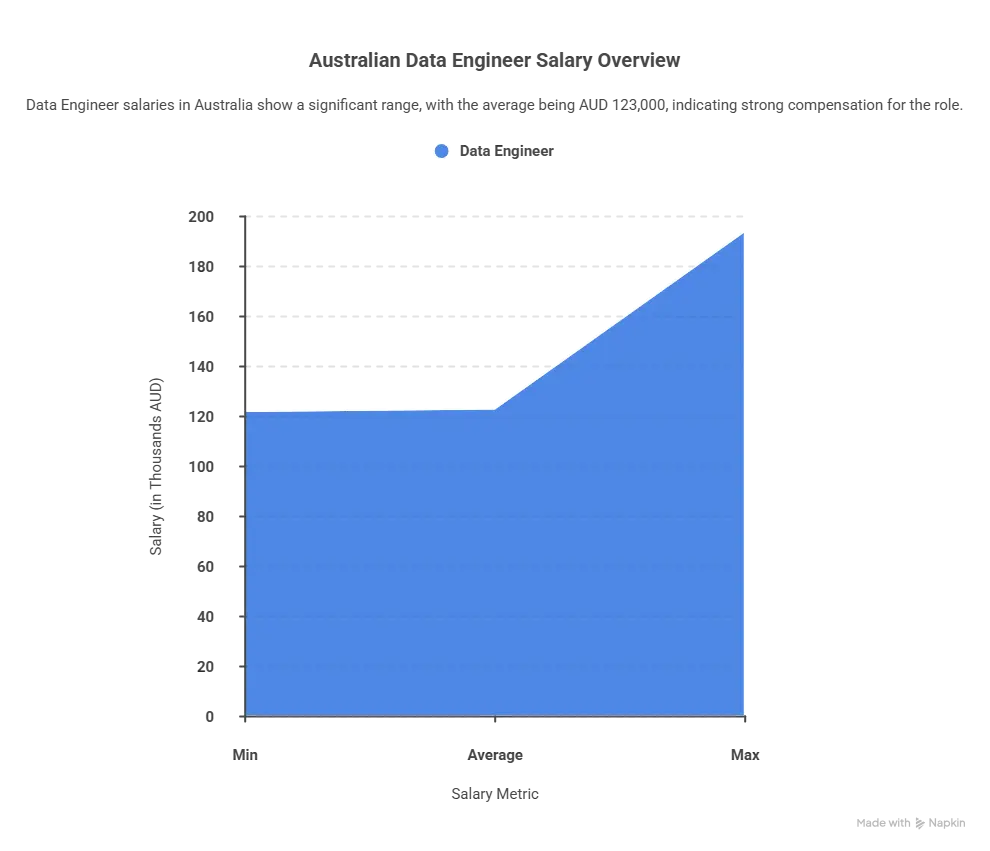
Data engineer salaries in Australia range from AUD 122,000 to AUD 194,000, with the national average sitting at AUD 123,000 according to Talent.com data drawing on 10,000 salary reports. This puts data engineering above the general software engineering average.
By experience:
Data engineering appears on LinkedIn’s Jobs on the Rise list — one of the fastest-growing job titles in Australia over the past five years. Strong Python skills, experience with cloud data warehouses (Snowflake, BigQuery, Redshift), and knowledge of orchestration tools (Airflow, dbt) are the technical foundation employers look for.
Data Scientist: Research Meets Commercial Application
Data scientists interpret data to solve business problems, build predictive models, and generate insights that influence commercial decisions. The role sits between data engineering (infrastructure) and ML engineering (model production), often with a heavier analytical and statistical focus.
The Think and Grow 2025–26 Australian Tech Salary Guide reports that those working in data and AI in Australia earn an average of AUD 157,000 annually. This is consistent with Glassdoor data showing data scientists in Australia averaging AUD 115,000–145,000 across experience levels, with senior roles pushing to AUD 170,000+.
By experience:
A master’s degree or PhD is more commonly expected in data science than in software engineering. According to LinkedIn data, approximately 84% of machine learning engineers (the closest cousin role) hold a master’s degree or higher. For data scientists targeting research or advanced modelling roles, postgraduate study is a genuine salary differentiator.
Cybersecurity Engineer: Consistent Premium, Growing Demand
Cybersecurity is one of the most consistently premium-paying specialisations across all of Australian IT. Financial services, government, defence, and critical infrastructure all face mandatory compliance requirements and ongoing threat landscapes that make experienced security engineers genuinely difficult to replace.
Security architect salaries in Australia range from AUD 179,000 to AUD 217,000, with the average sitting at AUD 155,000 based on PayScale data. This is for a senior, specialist role — the architecture and design of security systems, not just implementation.
Broader cybersecurity engineering roles span:
According to multiple 2025–2026 salary surveys, senior cybersecurity-focused engineers routinely clear AUD 160,000–170,000, with some specialists in financial services and defence clearing AUD 190,000+. Companies are paying up to a 19% premium above standard senior engineering rates just to fill these roles in competitive hiring markets.
The most in-demand cybersecurity certifications in Australia for 2025–2026 are CISSP, CISM, AWS Security Specialty, and AZ-500 (Microsoft Azure Security). These certifications, combined with three or more years of hands-on experience, are sufficient for mid-level candidates to reach the upper portion of the AUD 130,000–155,000 range.
Cloud Architect and Cloud Engineer
Cloud has become the infrastructure backbone of Australian enterprise tech. Nearly every major company in Australia has undergone at least partial cloud migration over the past five years, and the demand for engineers who can architect, manage, and optimise that infrastructure at scale is high across all industries.
Cloud architects sit at the top of the cloud specialisation ladder. Senior cloud architects in Australia earn AUD 150,000–180,000, with some specialists above AUD 200,000. AWS solutions architects specifically report packages between AUD 236,990 and AUD 386,830 at senior levels based on 2025 compensation data.
AWS developers broadly earn between AUD 143,725 and AUD 214,058. Multi-cloud specialists — engineers comfortable across AWS, Azure, and GCP simultaneously — earn AUD 145,254–183,478 across experience levels, with senior positions reaching AUD 275,218.
The cloud premium over general software engineering is approximately 20–35% at senior levels. Certifications in cloud — AWS Solutions Architect Professional, Google Cloud Professional Cloud Architect, or Microsoft Azure Solutions Architect Expert — consistently show up as salary-linked credentials in Australian job market data.
Full-Stack Developer: Volume Career, Solid Pay
Full-stack development is the most common career path for CS graduates who enjoy building products rather than specialising in infrastructure, security, or data. It is also one of the most flexible — full-stack skills are in demand at virtually every Australian tech company, startup, bank, and consultancy.
Full-stack developers in Australia average AUD 110,000–130,000 at mid-level, with senior full-stack developers at well-funded product companies earning AUD 140,000–175,000. At the junior level, strong React or Vue.js skills combined with Node.js, Python, or Ruby on Rails are sufficient to land roles in the AUD 75,000–95,000 range.
The full-stack path does not carry the same specialist premium as ML engineering or cloud architecture, but it offers broader job market access — the number of available roles is much larger, which improves negotiating leverage and makes career moves easier.
IT Manager and Tech Lead: The Management Track
Not every CS graduate wants to stay on the individual contributor path. The management and leadership track through IT has its own salary progression.
According to the Think and Grow 2025–26 Australian Tech Salary Guide, the mean CTO salary in Australia is AUD 248,000, with a range up to AUD 500,000 at the most senior levels. The principal product manager role is the highest-paid within software engineering on that survey, with a mean of AUD 222,000.
Tech leads — engineers who combine technical delivery with team leadership — typically earn AUD 155,000–190,000. Engineering managers (responsible for a team of engineers, not necessarily writing code themselves) earn AUD 160,000–220,000 at mid-sized companies and AUD 200,000–300,000+ at top tech companies.
The management track pays well at senior levels but requires a different set of skills to develop. Many engineers make the move to tech lead or engineering manager and find it rewarding. Others return to the individual contributor path — and at staff or principal level in Australia, the IC path pays comparably to management anyway.
IT Programmer and General Developer: The Broad Market
Beyond the specialist roles, the broad market for programmers and developers in Australia covers everything from internal enterprise tools to government systems to small business websites. Salaries in this segment are lower than specialist roles but still above the national average.
The national average salary in Australia across all occupations is approximately AUD 89,000–95,000 per year. A general programmer or developer role in Australia starts at AUD 65,000–80,000 at entry level and reaches AUD 100,000–130,000 at senior level without specialist skills. With specialist skills in a high-demand area, the ceiling is significantly higher.
The practical message is that a CS degree in Australia, even without specialisation, produces starting salaries that are above the national average and career trajectories that improve substantially with the addition of in-demand technical skills over time.
The Highest-Paying CS Roles in Australia (2026 Summary)
Here is a consolidated view of where the top salaries in Australian computer science sit, from highest to lowest based on 2025–2026 market data:
| Role | Average/Mid-Level AUD | Senior Level AUD | Top Earners |
|---|---|---|---|
| AI Director / Head of AI | AUD 200,000–236,000 | AUD 250,000+ | AUD 300,000+ |
| Cloud Architect (Senior) | AUD 165,000–200,000 | AUD 200,000–275,000 | AUD 386,000+ |
| Principal ML Engineer | AUD 180,000–220,000 | AUD 220,000–280,000 | AUD 350,000+ |
| Security Architect | AUD 155,000–180,000 | AUD 180,000–217,000 | AUD 250,000+ |
| Senior AI/ML Engineer | AUD 145,000–175,000 | AUD 175,000–198,000 | AUD 280,000+ |
| Senior DevOps Engineer | AUD 140,000–160,000 | AUD 160,000–180,000 | AUD 220,000+ |
| Senior Software Engineer | AUD 140,000–165,000 | AUD 165,000–185,000 | AUD 230,000+ |
| Senior Data Engineer | AUD 145,000–170,000 | AUD 170,000–194,000 | AUD 210,000+ |
| Senior Data Scientist | AUD 140,000–165,000 | AUD 165,000–180,000 | AUD 220,000+ |
| Full-Stack Developer (Senior) | AUD 130,000–155,000 | AUD 155,000–175,000 | AUD 200,000+ |
Which Specialisation Should You Choose?
If you are early in your career and deciding which direction to take, here is a practical framework.
Maximise salary ceiling and don’t mind deep technical investment: AI/ML engineering or cloud architecture. Both require consistent investment in skills but offer the clearest path to AUD 200,000+ in Australia.
Want broad job market access and flexibility: Full-stack development or general software engineering. More employers, more roles, easier to move between companies and cities.
Interested in research and advanced analytics: Data science. A master’s degree helps significantly. The overlap with ML engineering means strong long-term career flexibility.
Want a role with government and enterprise stability: Cybersecurity. The demand from regulated industries (finance, health, government) provides strong job security and consistent premium pay.
Want to move into leadership: Tech lead or engineering management track. Build strong communication and people skills alongside your technical foundation. The CTO salary ceiling of AUD 248,000–500,000 reflects that this path has a very high upside for the right person.
What Determines Your Starting Salary
Within any of these career paths, the same factors determine where you land in the salary range.
Internship experience consistently pushes starting offers AUD 8,000–15,000 above equivalent candidates without it. High-demand technical skills (AI, cloud, security) add a further premium at entry level. City matters — Sydney pays the most, Melbourne close behind, Brisbane and Perth catching up.
Company type matters as much as city — Atlassian and Canva both start graduates at AUD 85,000–90,000 versus AUD 65,000–75,000 at smaller employers.
The structural advantage of a CS degree in Australia is that it opens multiple well-paying paths. You do not have to make an irrevocable specialisation choice at graduation. Most engineers spend their first two to three years building general software engineering experience before naturally gravitating toward the area where their skills and interests align. The market rewards that depth when it arrives.
For a detailed look at how software engineering salaries specifically progress through each level, from junior to principal, read our full guide on software engineer salary in Australia.

Also read: What is The Software Engineer Salary in Australia: Complete Guide for 2026
Frequently Asked Questions
-
What is the average Computer Science & IT salary in Australia?
The average salary for software engineers and IT professionals in Australia ranges from AUD 105,000 to 130,000 per year. Senior and specialist roles often exceed AUD 160,000–250,000+.
-
What is the highest salary for Computer Science graduates in Australia?
Top earners in software engineering, AI/ML, cybersecurity, or cloud architecture can reach AUD 200,000–250,000+ at senior or leadership levels, especially in Sydney and Melbourne.
-
What is the entry-level salary for Computer Science in Australia?
Fresh graduates typically start between AUD 70,000–90,000 per year. Strong performers at top companies can secure offers above AUD 95,000.
-
Is Computer Science a good degree for salary in Australia?
Yes. CS & IT roles pay significantly above the national average salary of ~AUD 89,000 and deliver one of the strongest returns on investment for any university degree.
Conclusion
A Computer Science or IT career in Australia offers outstanding earning potential, lifestyle benefits, and long-term growth. Whether you’re a fresh graduate or an experienced professional, targeting in-demand skills like AI, cloud, and cybersecurity can help you unlock six-figure salaries and exciting opportunities down under. Start planning your move today.

Shahzada Muhammad Ali Qureshi (Leeo)
I’m Shahzada — a software engineer by education and an SEO professional by trade. I built WhatIsTheSalary.com to go beyond just showing salary numbers — every page is manually researched across sources like BLS, Glassdoor, LinkedIn Salary, and PayScale to give you the full picture in one place. If you found what you were looking for here, that’s exactly the point.