TL;DR
How to become a computer programmer is one of the most searched career questions online right now, and for good reason. The average software developer in the US earns over $120,000 a year, remote work is standard, and demand keeps climbing. But most guides throw a list of programming languages at you and call it a day.
That’s the problem. “whatisthesalary.com“
Nobody tells you the actual order of steps, what to learn first, or how to land your first job without a CS degree. Whether you’re starting from zero or switching careers, this guide cuts through the noise and gives you a clear, honest path from beginner to employed programmer.
What Computer Programmers Do and Why Choose This Career
Core Responsibilities and Daily Work
A computer programmer writes, tests, and maintains the code that powers software applications. On any given workday, a programmer might write new functions, debug broken features, collaborate with software engineers and designers, review a teammate’s code, and document processes for future use. The exact scope varies by specialization.
A backend programmer focuses on server-side logic and database management. A game programmer builds physics engines, character behavior, and game mechanics. A CNC programmer writes machine instructions for computer-controlled manufacturing tools.
A PLC programmer works with programmable logic controllers in industrial and automation settings. Despite these differences, all programming roles share one foundation: learning to think logically through code.
Below is a snapshot of what a typical programmer’s workday includes:
| Daily Task | Description | Common Tools Used |
| Writing code | Building new features, apps, or scripts | VS Code, PyCharm, IntelliJ IDEA |
| Debugging | Identifying and fixing errors in programs | Chrome DevTools, GDB, Xcode |
| Code review | Checking quality of teammates’ code | GitHub, GitLab, Bitbucket |
| Documentation | Writing usage guides and technical notes | Confluence, Notion, Google Docs |
| Testing | Verifying that software works correctly | Jest, Selenium, Pytest, JUnit |
| Team collaboration | Working with designers, PMs, engineers | Slack, Jira, Trello, Linear |
Benefits: High Salary, Flexibility, and Freelance Options
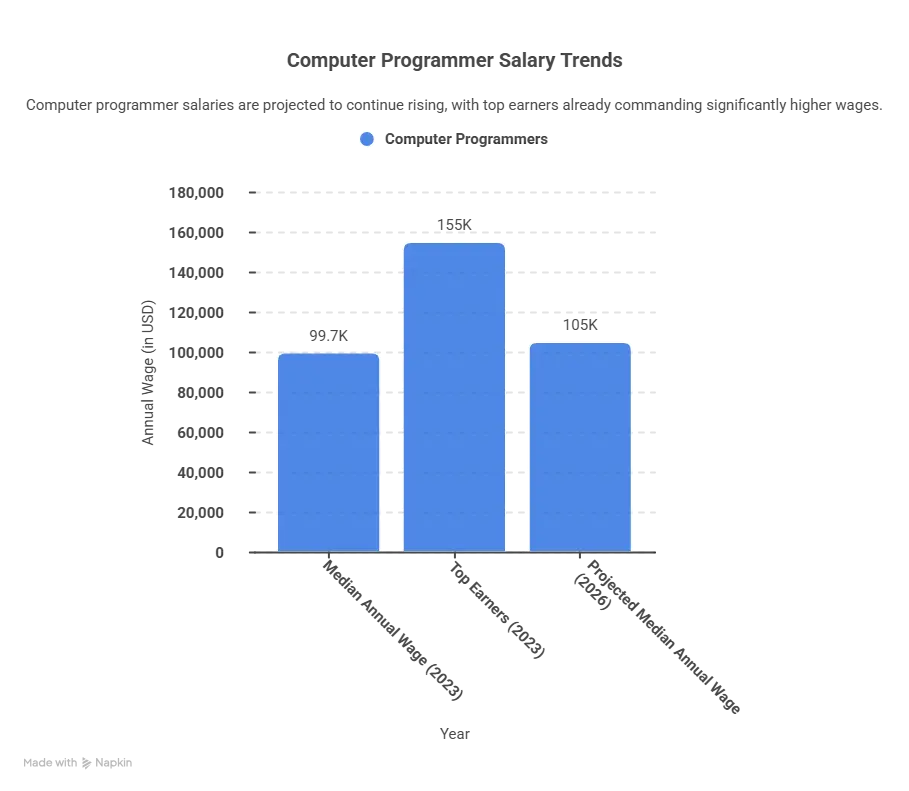
The financial rewards of a programming career are significant. According to the U.S. Bureau of Labor Statistics, the median annual wage for computer programmers in the United States was $99,700 in 2023, with top earners surpassing $155,000. In 2026, those numbers continue to rise, especially in artificial intelligence, cloud infrastructure, and cybersecurity roles.
Beyond salary, programming offers genuine flexibility. Many roles are fully remote or hybrid, and the skills transfer across industries including finance, healthcare, e-commerce, defense, and entertainment. If you are exploring how to become a freelance programmer, the market for independent contractors and consultants remains strong in 2026, with platforms like Toptal, Upwork, and Contra offering access to high-paying clients worldwide.
For a broader view of where this career can take you, see our guide on software engineer career options.
Step-by-Step Guide to Become a Programmer
Step 1: Choose Your First Programming Language (Python or JavaScript Priority)
The most important decision for any beginner is picking the right first language. Trying to learn too many languages at once slows progress. In 2026, Python and JavaScript remain the two strongest starting points for most learners.
Python programming for beginners is widely recommended because of its clean and readable syntax. It is used extensively in data science, machine learning, automation, and backend development. JavaScript is equally powerful and is the only language that runs natively in web browsers, making it essential for front-end and full-stack development.
If your goal is to become an AI programmer, Python is your starting point. If you want to build websites or web apps, start with JavaScript.
| Language | Best For | Difficulty | 2026 Job Demand |
| Python | AI, data science, backend, automation | Beginner-friendly | Very High |
| JavaScript | Web development, full-stack, front-end | Beginner-friendly | Very High |
| Java | Enterprise apps, Android development | Intermediate | High |
| SQL | Databases, data engineering, analytics | Beginner-friendly | High |
| C++ | Game development, systems programming | Advanced | Moderate |
| Swift | iOS and macOS app development | Intermediate | Moderate |
See the full breakdown in our guide on the best programming languages to learn for a software career.
Step 2: Education Paths — Bachelor’s Degree vs Associate Degree vs Self-Taught
One of the most common questions is how to become a programmer without a degree. The honest answer is that a degree is no longer a strict requirement. Many working programmers today are self-taught or bootcamp graduates. Here is how each path compares in 2026:
A bachelor’s degree in computer science or a related field typically takes four years and provides deep theoretical grounding, including algorithms, data structures, operating systems, and discrete mathematics. It remains the most recognized credential for roles at large companies like Google, Amazon, or IBM.
An associate’s degree takes two years and is significantly more affordable. It covers programming basics, database fundamentals, and introductory software development. It is a solid entry point into programming internship opportunities and junior roles.
Self-taught programming is increasingly respected in 2026. With platforms like freeCodeCamp, The Odin Project, Coursera, edX, and MIT OpenCourseWare, you can build real skills at zero or low cost. The key is discipline, consistency, and building a strong portfolio.
Step 3: Build Skills Through Coding Challenges and Projects
Theory alone does not make you a programmer. You need practice, and the most effective practice comes through solving real problems. Coding challenges practice is one of the fastest ways to sharpen logic skills and prepare for technical interviews.
Platforms like LeetCode, HackerRank, Codewars, and Exercism offer thousands of challenges ranging from beginner to advanced. Aim to solve at least three to five problems per week when starting out. As your confidence grows, increase the difficulty and start practicing under timed conditions to simulate programming interview preparation.
Alongside challenges, work on programming projects for your resume. Build things you would actually use. A budget tracker, a weather app, a portfolio website, a basic API, or a task management tool all demonstrate applied skills far better than a list of courses completed.
Step 4: Gain Practical Experience and Build Your Portfolio
To build a programming portfolio, you need more than personal projects. Look for programming internship opportunities at local companies, startups, or through remote platforms. Even unpaid or low-paid internships in the early stages of your career can unlock paid opportunities later.
Open source contribution is another excellent strategy. Contributing to projects on GitHub demonstrates collaboration, code quality, and initiative to hiring managers. Sites like Good First Issue and Up For Grabs list beginner-friendly open source tasks across many languages.
Your portfolio should include at minimum three to five projects with clean code, a live demo or screenshot, and a brief description of what problem the project solves and what technologies you used. Host your portfolio on GitHub Pages, Vercel, or Netlify.
For tips on presenting yourself professionally, see our software engineer cover letter guide.
Step 5: Network and Land Your First Job
Networking for programmers is often underestimated. A significant portion of developer jobs, especially at startups and mid-sized companies, are filled through referrals and personal connections. Attend local meetups, join online communities on Discord, LinkedIn, and Reddit, and participate in hackathons.
For junior developer job requirements, most companies in 2026 expect proficiency in at least one language, familiarity with version control systems like Git, and the ability to write clean, readable code. A strong portfolio can compensate for a lack of formal degree in most cases.

Apply to entry level programming jobs through LinkedIn, Indeed, Wellfound (formerly AngelList Talent), and Hired. Tailor your resume to each role and be ready to complete a technical assessment or coding screen as part of the hiring process.
For a structured look at where the career goes from here, read our software engineer career path guide.
Programming Education Requirements
Degree Programs vs Coding Bootcamps vs Self-Taught
Choosing how to become a coder without a degree, or deciding between a bootcamp and a university, depends largely on your timeline, budget, and career goals. Here is a direct comparison:
| Path | Duration | Average Cost | Best For | Employer Acceptance |
| Bachelor’s Degree | 4 years | $40,000–$120,000 | Deep CS theory, big tech roles | Very High |
| Associate’s Degree | 2 years | $8,000–$25,000 | Affordable entry, community college | High |
| Coding Bootcamp | 3–6 months | $10,000–$20,000 | Fast transition, practical skills | High (rising) |
| Self-Taught | 6–24 months | $0–$2,000 | Flexible learning, strong portfolio | Moderate (portfolio-dependent) |
| Online Certifications | 1–6 months | $200–$2,000 | Supplementing existing skills | Moderate |
Coding bootcamp vs self-taught is a decision that comes down to structure. Bootcamps provide a curriculum, deadlines, instructors, and career services, which helps many people stay on track. Self-teaching requires more discipline but offers more flexibility and lower cost. Both paths have produced successful, employed programmers in 2026.
Top Certifications for Programmers
Computer science certifications can strengthen a resume, especially for self-taught programmers who lack a degree. In 2026, the following certifications carry strong recognition:
| Certification | Issuing Body | Best For | Approximate Cost |
| AWS Certified Developer | Amazon Web Services | Cloud and backend development | $300 |
| Google Associate Cloud Engineer | Google Cloud | Cloud infrastructure roles | $200 |
| Microsoft Azure Developer | Microsoft | Enterprise and cloud development | $165 |
| Certified Kubernetes Application Developer | CNCF | DevOps and containerization | $395 |
| Meta Front-End Developer Certificate | Meta (Coursera) | Web development beginners | $49/month |
| IBM Data Science Professional Certificate | IBM (Coursera) | Data and AI programming paths | $49/month |
| CompTIA Linux+ | CompTIA | System-level and backend roles | $338 |
Programming Specializations and Career Paths
Backend, Full-Stack, Mobile, and Game Development
Once you have learned the basics, you need to choose a specialization. Each path has distinct technical requirements and job market conditions in 2026.
A backend programming career focuses on server-side logic, APIs, databases, and infrastructure. Languages like Python, Java, Go, and Node.js dominate this space. Backend developers are among the highest-paid programmers, and demand remains strong in fintech, healthcare tech, and SaaS.
The full stack developer roadmap combines both front-end and backend skills. Full-stack developers are especially sought after by startups and small teams that need engineers who can handle all aspects of an application. The most common full-stack combination in 2026 is React on the front end with Node.js or Django on the backend.
The mobile app programming path divides primarily between iOS development using Swift and Android development using Kotlin. Cross-platform frameworks like Flutter and React Native are also widely used and allow developers to target both platforms with a single codebase.
A game programmer path requires knowledge of game engines like Unity (C#) or Unreal Engine (C++), along with a strong understanding of mathematics, physics simulation, and performance optimization. Learning how to become a game programmer requires focused study of real-time systems and interactive design.
Data Engineering and Other Specializations
Beyond these four core tracks, several specialized paths are growing rapidly in 2026:
See how these roles compare in our software engineer vs software developer guide.
Technical Skills for Computer Programmers
Programming Languages Comparison: Python, SQL, JavaScript, Java
Knowing which languages to prioritize can save months of misdirected effort. Here is how the four most in-demand languages compare for someone learning how to become a software programmer in 2026:
| Language | Primary Use Case | Learning Curve | Average Salary (US, 2026) | Top Employers |
| Python | AI, data, backend, automation | Low | $115,000–$145,000 | Google, Meta, Netflix |
| JavaScript | Web, full-stack, front-end | Low-Medium | $105,000–$135,000 | Airbnb, Shopify, LinkedIn |
| Java | Enterprise software, Android | Medium | $110,000–$140,000 | IBM, Oracle, JPMorgan |
| SQL | Database management, analytics | Low | $90,000–$120,000 | Microsoft, Salesforce, AWS |
Core Technical Skills and Tools
Beyond language proficiency, hiring managers in 2026 look for a range of technical competencies. These form the foundation of any strong programmer’s profile:
| Skill Area | Why It Matters | Tools to Learn |
| Version Control | Tracking code changes, team collaboration | Git, GitHub, GitLab |
| Data Structures & Algorithms | Core to technical interviews and efficient coding | LeetCode, CS50 |
| Databases | Storing and querying application data | PostgreSQL, MySQL, MongoDB |
| APIs & REST | Connecting software systems | Postman, Swagger |
| Command Line / Bash | Working efficiently in server environments | Linux terminal, Zsh |
| Cloud Basics | Deploying apps and working in modern stacks | AWS, Azure, GCP |
| Testing & Debugging | Ensuring code quality and reliability | Jest, Pytest, Selenium |
| DevOps Fundamentals | CI/CD, containers, deployment pipelines | Docker, GitHub Actions |
Soft Skills and Job Market Preparation
Portfolio Building and Networking Strategies
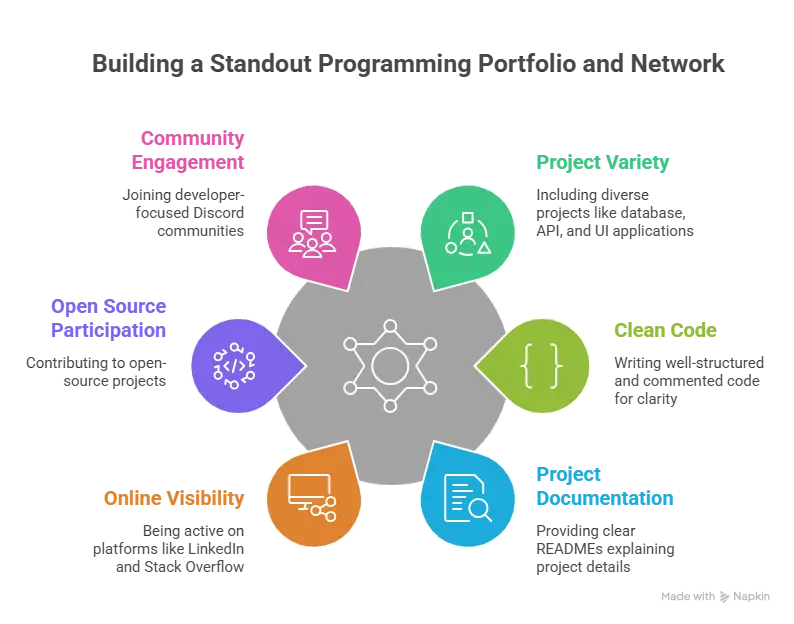
To build a programming portfolio that stands out in 2026, follow these principles. First, show variety — include at least one project that uses a database, one that consumes an external API, and one that involves a user interface.
Second, write clean, commented code. Hiring managers often review your GitHub repository directly. Third, document each project with a clear README explaining what the project does, why you built it, and what technologies it uses.
Networking for programmers does not have to feel forced. Start by being visible online. Write short posts on LinkedIn about what you are learning. Answer questions on Stack Overflow. Participate in open source projects. Join developer-focused Discord communities. These actions compound over time and lead to referrals, mentorships, and job leads.
Job Search and Interview Preparation
Programming interview preparation in 2026 typically involves three stages: a recruiter screen, a technical assessment or take-home project, and a final interview with behavioral and system design questions. Prepare for all three.
For the technical screen, practice data structures and algorithms problems on LeetCode and NeetCode. Focus on arrays, hash maps, binary search, trees, and dynamic programming. For the system design round, study how large-scale systems are built — load balancers, databases, caching, and microservices. For behavioral questions, prepare stories from your past projects using the STAR method (Situation, Task, Action, Result).
Junior developer job requirements in most companies include comfort with at least one programming language, basic Git usage, understanding of how web applications work, and the ability to communicate technical decisions clearly. Meeting these requirements paired with a strong portfolio significantly increases your chances of landing your first role.
To understand what top companies are looking for, explore our list of top software engineering companies.
Computer Programmer Salary Expectations
Entry-Level to Senior Pay Ranges
How long does it take to become a programmer and start earning? Most dedicated learners are job-ready within 6 to 18 months. Here is what you can expect to earn once you land that first role:
| Experience Level | Years of Experience | Average Annual Salary (US) | Typical Role Titles |
| Entry Level | 0–2 years | $55,000–$80,000 | Junior Developer, Associate Programmer |
| Mid Level | 2–5 years | $85,000–$115,000 | Software Developer, Programmer II |
| Senior Level | 5–10 years | $120,000–$155,000 | Senior Developer, Lead Engineer |
| Staff / Principal | 10+ years | $155,000–$200,000+ | Staff Engineer, Principal Developer |
| Freelance (Mid-Level) | Varies | $60–$150/hour | Contract Developer, Consultant |
Salaries vary significantly by location, specialization, and company size. Programmers in San Francisco, New York, and Seattle earn considerably more than the national average, while remote roles at global companies offer competitive pay regardless of location.
For a full salary breakdown by role and company type, read our guide on top software pay jobs.
Top Companies for Programmers
ADP, IBM, TEKsystems, Appen, Capgemini
When it comes to employment stability, learning opportunities, and competitive compensation, these five companies consistently rank among the best places for programmers in 2026:
| Company | Known For | Programming Roles Available | Notable Benefit |
| ADP | HR and payroll technology | Backend, full-stack, data engineering | Strong stability, global presence |
| IBM | AI, cloud, and enterprise software | AI programming, cloud dev, systems | Research opportunities, IBM certifications |
| TEKsystems | IT staffing and managed services | Contract and full-time dev roles | Wide placement options across industries |
| Appen | AI training data and machine learning | Data annotation, AI developer roles | Remote-first, global projects |
| Capgemini | Consulting and digital transformation | Full-stack, mobile, DevOps | International mobility, varied project exposure |
For a deeper look at hiring companies and culture, visit our software engineer guide.

Also read: Top Software Engineering Companies to Work For (2026 Guide)
FAQs: Becoming a Computer Programmer
-
How do I become a computer programmer with no experience?
Start with a free platform like freeCodeCamp or The Odin Project, learn Python or JavaScript, complete small projects, and build a GitHub portfolio. No prior experience is needed to begin.
-
How long does it take to become a programmer?
Most self-taught learners are job-ready in 6 to 18 months with consistent daily practice. Bootcamp graduates typically take 3 to 6 months. Degree programs take 2 to 4 years.
-
Can I become a programmer without a degree?
Yes. Many companies in 2026 hire based on portfolio and skills rather than credentials. A strong GitHub profile and two or three solid projects often matter more than a diploma.
-
What is the best first programming language to learn?
Python is the most beginner-friendly and versatile choice. JavaScript is the best option if your goal is web development. Both are in extremely high demand in 2026.
-
How do I become a freelance programmer?
Learn a marketable skill, build a portfolio, create profiles on Upwork, Toptal, or Fiverr, and start with small projects. Most freelancers begin part-time alongside a full-time role or studies.
-
What companies hire junior programmers with no degree?
Startups, digital agencies, staffing firms like TEKsystems, and tech-forward companies like Appen and Capgemini regularly hire junior programmers based on demonstrated skills rather than formal education.
-
Is programming a good career in 2026?
Yes. Programming offers high salaries, remote work flexibility, strong job security, and diverse career paths across industries. The U.S. BLS projects 17% growth in software-related jobs through 2033, making it one of the most future-proof careers available.
Conclusion
Learning how to become a computer programmer in 2026 is more accessible than at any previous point in history. The resources are free or affordable, the job market is strong, and the barriers of entry — while real — are not insurmountable. Whether you pursue a four-year degree, enroll in a coding bootcamp, or teach yourself through online platforms, the key ingredients remain the same: consistent practice, real projects, and a willingness to keep learning.
Start with Python or JavaScript, build something you are proud of, put it on GitHub, and begin applying for programming internship opportunities and junior roles within six to twelve months of serious study. How do you become a computer programmer? One line of code at a time.
Continue your research: Software Engineer Career Path | Top Software Engineering Companies | Best Programming Languages

Shahzada Muhammad Ali Qureshi (Leeo)
I’m Shahzada — a software engineer by education and an SEO professional by trade. I built WhatIsTheSalary.com to go beyond just showing salary numbers — every page is manually researched across sources like BLS, Glassdoor, LinkedIn Salary, and PayScale to give you the full picture in one place. If you found what you were looking for here, that’s exactly the point.