TL;DR
How to Move from Software Engineering into Cybersecurity in Australia (2026 Guide) — Stuck in an engineering role but craving the thrill, impact, and pay of cybersecurity?
Imagine swapping predictable sprints for high-stakes hunts: locating hidden threats, securing critical systems, and becoming the defender every company pays top dollar to hire.
This quick roadmap shows the exact pivot steps that work in Australia now: the mindset shift, must-have skills, fastest certifications, where to network, and how to package your software background into a cyber advantage.
Ready to convert your coding experience into a security career that commands respect and salary? Start with one focused move and watch opportunities follow.
Why Software Engineers Are Well-Positioned for This Move
I talk to a lot of software engineers who assume they need to start from scratch to break into cybersecurity. That assumption is wrong, and it costs people months of unnecessary delay.
The truth is that your existing background puts you ahead of most people entering this field. You know how software is built, which means you understand exactly how it can be broken.
That is a significant advantage over someone coming from a purely theoretical background or a completely unrelated field.
Australia’s cybersecurity sector is facing a structural shortage. The country is short more than 30,000 cybersecurity professionals, and demand is accelerating as government, finance, healthcare, and critical infrastructure sectors all face mounting compliance requirements and threat exposure.
ISACA’s 2025 to 2026 State of Cybersecurity report found that 55 percent of organisations say their cyber teams are understaffed, and 65 percent say it takes three to six months just to fill an entry-level role.
The market needs you. The question is how to position yourself correctly to walk through the door.

Skills That Transfer Directly from Software Engineering
Before looking at what you need to learn, it helps to understand what you already bring to the table. A lot of cybersecurity content ignores this, which leads engineers to underestimate their starting position.
Your Python, Java, or scripting knowledge is immediately useful in security operations. SOC analysts write automation scripts. Penetration testers use Python constantly for custom exploits and tooling.
AppSec engineers review code for vulnerabilities, which requires actually understanding the code.
Networking fundamentals and an understanding of TCP/IP, DNS, HTTP/HTTPS, and API architecture are all things most software engineers pick up naturally.
These map directly to skills required for threat detection, incident response, and vulnerability assessment.
Systems thinking is the big one that doesn’t get mentioned enough. Understanding how software fails, how dependencies create risk, and how system architecture shapes attack surfaces is something you develop over years of engineering work.
That kind of thinking is exactly what separates a strong security professional from someone who just passed a certification exam.
Tools like Git, CI/CD pipelines, and cloud platforms like AWS, Azure, or GCP are things you likely already use. Cloud security is one of the highest-paying specialisations in Australian cybersecurity right now, and engineers with hands-on cloud experience have a genuine head start.
Cybersecurity Roles, Salaries, and Certifications at a Glance
Use this table as a reference when deciding which path fits your background and income expectations. Salary data is drawn from ERI, PayScale, and Terratern’s 2026 Australia cybersecurity salary reports.
| Role | Entry Salary | Mid Salary (3-5 yrs) | Senior Salary (7+ yrs) | Best Cert |
| SOC Analyst | AUD 80K-95K | AUD 110K-130K | AUD 135K-155K | CompTIA Security+ |
| AppSec Engineer | AUD 95K-115K | AUD 130K-150K | AUD 160K-185K | GWEB / CSSLP |
| Security Engineer | AUD 100K-120K | AUD 135K-160K | AUD 170K-200K | CISSP / AZ-500 |
| Penetration Tester | AUD 99K-115K | AUD 130K-155K | AUD 160K-200K+ | OSCP / CEH |
| Cloud Security Arch. | AUD 115K-130K | AUD 155K-185K | AUD 200K-280K+ | AWS Security Spec. |
| Security Architect | AUD 120K-140K | AUD 160K-185K | AUD 179K-217K | CISSP / CISM |
Note: Salaries in government and defence roles (particularly in Canberra) trend 15 to 25 percent higher. Security clearance holders with 5+ years of experience can reach AUD 250K to 275K in those markets.
The Best Entry Points for Software Engineers
Application Security Engineer
This is, in my view, the single best first role for a software engineer moving into security. It uses your coding skills directly.
You will be doing secure code reviews, integrating SAST/DAST tools into CI/CD pipelines, working with developers on vulnerability remediation, and running application-level penetration tests.
Because you already understand software development, you can earn trust with engineering teams faster than most security hires.
Salaries start at AUD 95K to 115K and move quickly to AUD 160K or more at mid-senior level, according to multiple 2026 Australian salary surveys.
For more on how engineering skills translate across specialisations, see the breakdown of
For more on how engineering skills translate across specialisations, see the breakdown of software engineering skills in demand in Australia.
SOC Analyst (Level 1 to 2)
A Security Operations Centre analyst is the most common entry point into cybersecurity across the industry. You monitor alerts, investigate incidents, and document what you find. It is structured and learnable.
The beauty of SOC roles for former engineers is that your scripting ability and systems knowledge make you faster at the job from day one.
You will move through Level 1 to Level 2 quicker than most, which is where the more interesting work and the better pay begins. Starting salaries sit at AUD 80K to 95K, climbing to AUD 110K to 130K at mid-level.
Security Engineer
If you have three or more years of software engineering experience and want to skip the entry-level monitoring work, a Security Engineer role is worth targeting directly.
You will be building secure systems, writing security tooling, automating threat detection, and contributing to architecture decisions.
This path suits engineers who enjoy building things more than investigating alerts. Salaries range from AUD 100K to 120K at entry and AUD 170K to 200K at senior level, based on ERI’s 2026 Australia compensation data.
To understand how this fits into broader career paths in Australian software, the
To understand how this fits into broader career paths in Australian software, the software engineer career path guide for Australia covers progression timelines and levelling in detail.
Which Certifications Actually Matter in Australia
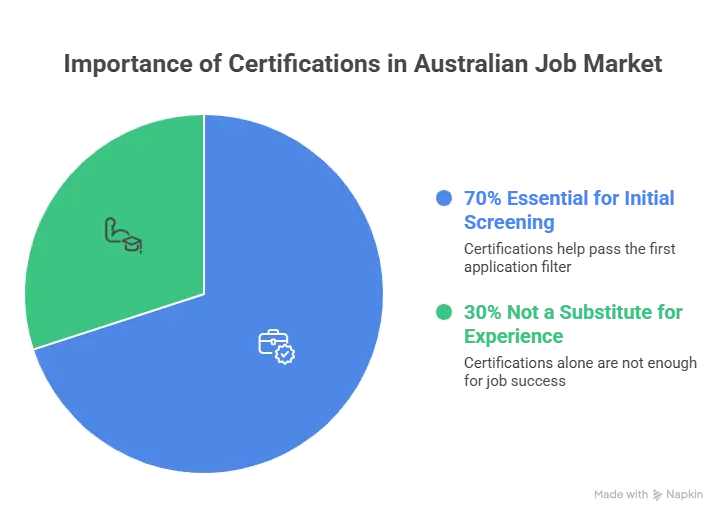
Certifications are not a substitute for experience, but in a market where hiring managers are screening hundreds of applications, the right credential gets you past the first filter. Here is what I consistently see Australian employers asking for.
CompTIA Security+ (Starting Point)
This is the baseline credential for anyone new to cybersecurity. It is vendor-neutral, widely recognised, and takes three to four months to prepare for with a software background.
It proves you understand core security concepts: threat detection, network security, compliance, and basic cryptography. Holders see average base salaries of AUD 100K or more in Australia, according to XCD IT’s 2026 certification market report.
OSCP (For Penetration Testers)
The Offensive Security Certified Professional is considered the gold standard for hands-on penetration testing. It is not an exam you can pass by memorising answers. It is a 24-hour practical test where you break into a series of machines.
If penetration testing is your goal, this credential signals real competence in a way that most certifications do not. OSCP-certified professionals in Australia command 25 to 35 percent higher salaries according to Terratern’s 2026 salary report.
CISSP (For Security Architects and Senior Roles)
The Certified Information Systems Security Professional is the senior-level credential. It requires five years of security experience across two or more domains, so it is not where you start, but it is where you aim.
CISSP holders in Australia add roughly AUD 20K to their base salary, and the credential opens doors to architect and CISO-track positions.
AWS Security Specialty / AZ-500
Given how much of Australia’s enterprise infrastructure runs on AWS or Azure, cloud security credentials carry serious weight. AWS Certified Security Specialty and Microsoft’s AZ-500 are the two most requested.
Engineers with a cloud background can move directly into cloud security roles, often bypassing the typical SOC analyst entry route entirely. These credentials add AUD 15K to 25K to base salary in Australian cloud security roles according to multiple 2026 salary reports.
A Realistic Timeline for Making the Switch
One thing most articles skip is being honest about how long this takes. Here is a grounded timeline for someone currently working as a software engineer.
- Months 1 to 3: Foundation building. Study for CompTIA Security+ while working your current job. Use TryHackMe or Hack The Box to get hands-on exposure. Review OWASP Top 10 and understand how the vulnerabilities you have seen in code reviews map to real attack vectors.
- Months 3 to 6: Build a security portfolio. Document a CTF (Capture the Flag) challenge, write up a home lab project, or contribute to open-source security tooling. Hiring managers in AppSec and Security Engineer roles look for demonstrated interest, not just a cert.
- Months 6 to 9: Start applying. Target AppSec Engineer and Security Engineer roles that explicitly mention software development experience. Reframe your resume around security-relevant work you have already done: input validation, access control, dependency management, API security.
- Month 9 to 12: First role. Most software engineers with a genuine effort at this pace land their first cybersecurity role within 9 to 12 months. From there, salary progression is consistent. Moving from SOC Analyst to Security Engineer typically takes two to three years, with senior roles paying AUD 150K or more achievable within five years.
For context on how software engineering career timelines typically work before you make this pivot, the
For context on how software engineering career timelines typically work before you make this pivot, the software engineer roles guide for Australia is worth reviewing first.
Where to Find Cybersecurity Roles in Australia
Sydney and Melbourne lead in private sector cybersecurity hiring, particularly in finance, tech, and healthcare. Canberra is the outlier: government and defence roles there pay 15 to 25 percent above the national average, and security clearance holders can reach AUD 250K to 275K at the top end.
Brisbane is growing quickly, with a projected 20 percent increase in cybersecurity vacancies according to recent market analysis. Remote work has also expanded the pool.
Engineers no longer need to relocate to Sydney or Melbourne to access competitive salaries.
SEEK, LinkedIn, and CyberCX’s careers page are the main channels. For government roles, AusJobs and the Australian Signals Directorate’s own careers portal are worth bookmarking.
The Australian Information Security Association (AISA) also runs networking events that have historically led to direct hiring referrals.
The
The software engineering job market in Australia shares a lot of structural similarities with cybersecurity hiring, so if you understand one, you will navigate the other more effectively.
What AI and DevSecOps Are Changing About This Transition
This is a gap that most transition guides published even a year ago do not cover properly. The rise of AI-driven threats and the shift to DevSecOps practices has changed what Australian employers actually want from security hires in 2026.
Security roles now expect engineers to integrate security into the development pipeline, not just review it after the fact. If you know how CI/CD works and you understand SAST, DAST, and dependency scanning tools, you are already thinking in DevSecOps terms.
That framing is attractive to hiring managers who are tired of security being treated as a handoff at the end of a sprint.
AI is also changing the threat landscape fast. CompTIA released SecAI+ in February 2026, a new certification specifically covering AI-driven threat vectors.
Hiring managers in enterprise security are beginning to ask about this. You do not need the cert to mention this in interviews, but understanding the intersection of AI and security is worth reading into now.
Australian software engineers who have worked with AI tools will find this easier than most. For context on how Australian engineers are already using AI in their current roles, see this piece on
Australian software engineers who have worked with AI tools will find this easier than most. For context on how Australian engineers are already using AI in their current roles, see this piece on Australian software engineers using AI.
How Cybersecurity Pay Compares to Software Engineering in Australia
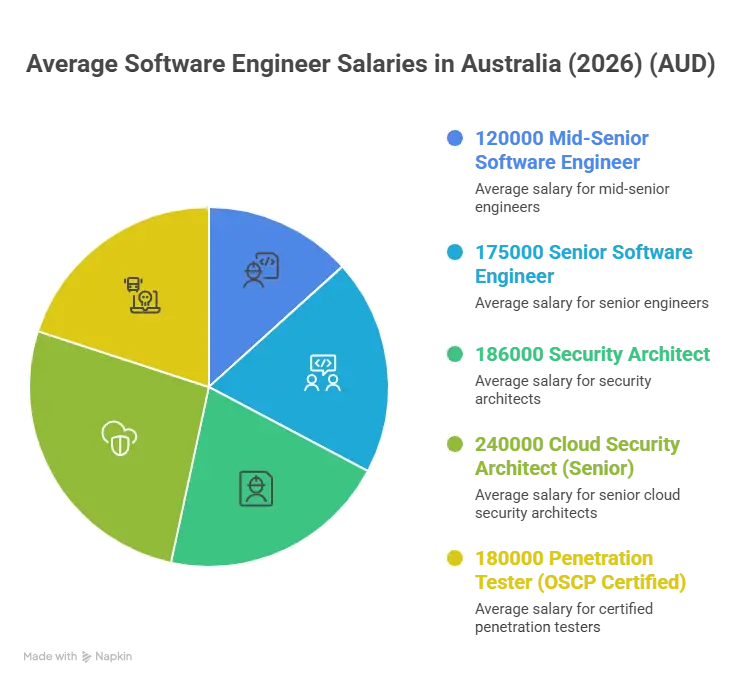
The honest answer is that at the mid-senior level, cybersecurity matches and often beats general software engineering pay, particularly in specialised areas.
The average software engineer salary in Australia sits at AUD 110K to 130K in 2026, according to SEEK and Glassdoor. Senior engineers clear AUD 150K to 200K. The
highest-paying software engineer specialisations in Australia for 2026 show AI and cloud roles at the top, with cybersecurity engineering not far behind.
Security architects in Australia average AUD 155K to 217K according to PayScale and ERI data. Cloud security architects at senior level can reach AUD 200K to 280K at major enterprise employers.
Penetration testers with OSCP certification and five-plus years of experience regularly earn AUD 160K to 200K, with Canberra-based government roles pushing even higher.
The salary ceiling in cybersecurity, when you account for consulting fees and specialised government work, sits meaningfully above most general software engineering tracks.
If work-life balance is part of what you are weighing in this decision, the
If work-life balance is part of what you are weighing in this decision, the software engineer work-life balance guide for Australia covers what to expect across different employer types and roles.
Common Misconceptions About This Career Switch
Myth 1: You Need a Cybersecurity Degree
Most Australian cybersecurity professionals entered the field without a dedicated security degree. Your computer science or software engineering degree is sufficient.
Employers care far more about certifications, hands-on portfolio work, and relevant experience than whether your degree title says cybersecurity.
Myth 2: You Have to Start at the Bottom
Someone moving from software engineering is not the same as a career changer with no technical background. AppSec Engineer and Security Engineer roles routinely hire directly from software development.
You do not need to spend two years as a Level 1 SOC analyst if your background is strong.
Myth 3: The Best Certifications Are the Hardest Ones
CISSP is prestigious but it requires five years of security experience to sit the exam. Starting there is not possible.
The right certification sequence is Security+ first, then a role-specific credential like OSCP for offensive work or AZ-500 for cloud security, and then CISSP once you have the experience.
Myth 4: Cybersecurity Is Only About Stopping Hackers
A large portion of cybersecurity work in Australia involves governance, risk management, compliance, and security architecture.
If you are not drawn to offensive security or incident response, there are well-paid paths in GRC (governance, risk, and compliance), cloud security, and DevSecOps that suit engineers who prefer building and designing over investigating.
Practical Tools to Learn Before Applying
Employers will expect you to have some hands-on exposure before your first security interview. These are the tools that come up most often in Australian job listings for entry and mid-level cybersecurity roles.
The
The best programming languages for security work covers which languages complement security knowledge best if you want to prioritise your learning.

Also read: Software Engineer Salary Australia 2026: $75K–$200K+ Complete AUD Guide
Where This Career Can Take You
Cybersecurity is one of the few tech disciplines in Australia with clear upward mobility and no sign of the demand slowing. Once you are in, the paths branch in genuinely interesting directions.
Offensive security professionals can move toward red team work, specialised penetration testing consulting, or bug bounty programs.
Top Australian penetration testers running freelance engagements and bug bounty programs earn well above AUD 200K in total income.
Defensive security professionals can progress toward security architecture, cloud security leadership, or CISO tracks.
A CISO at a major Australian financial institution or government agency earns AUD 250K to 350K or more in total compensation.
For those who enjoy the strategy side, GRC consulting is a well-paid path with strong demand in finance, healthcare, and critical infrastructure. Consultants at senior level regularly bill AUD 200 per hour or more.
The
The software engineering career guide covers how this kind of pivot fits into broader tech career strategy in Australia if you want a wider perspective before committing.
Frequently Asked Questions
-
Can a software engineer switch to cybersecurity without starting over?
Yes. Software engineers typically qualify for Application Security Engineer, Security Engineer, and even mid-level SOC Analyst roles directly, skipping the entry-level reset that career changers from non-technical fields face. Your coding and systems knowledge is already in demand.
-
What is the fastest way to get into cybersecurity in Australia?
Get CompTIA Security+ certified, build a hands-on portfolio using TryHackMe or Hack The Box, and target AppSec Engineer roles that mention software development experience. Most software engineers can make this transition within 9 to 12 months of focused effort.
-
Is cybersecurity in demand in Australia in 2026?
Strongly yes. Australia is short more than 30,000 cybersecurity professionals in 2026. Government, finance, healthcare, and critical infrastructure are all actively hiring and struggling to fill roles. The shortage is expected to persist well into the 2030s.
-
Do I need a cybersecurity degree to get a job in Australia?
No. A computer science or software engineering degree is sufficient for most employers. Certifications, hands-on experience, and a demonstrable portfolio carry more weight in hiring decisions than whether your degree title says cybersecurity.
-
How much can a software engineer earn after switching to cybersecurity?
At entry level, expect AUD 80K to 120K depending on your role. Mid-level professionals earn AUD 110K to 160K. Senior roles in cloud security, penetration testing, and security architecture regularly pay AUD 170K to 280K, with government and defence roles in Canberra reaching higher for cleared professionals.
-
Which cybersecurity certification should I get first?
CompTIA Security+ is the recommended starting point for most software engineers. It is vendor-neutral, broadly recognised by Australian employers, and achievable in three to four months of study alongside full-time work. After that, choose a specialisation-specific certification based on your target role.
-
Is Python useful for cybersecurity in Australia?
Very much so. Python is used for scripting in SOC automation, custom penetration testing tools, malware analysis, and threat intelligence. If you already write Python fluently, that is a genuine advantage in security interviews and on the job.
Share Your Experience
If you have made this move, are currently in the middle of it, or have a specific question about where your background fits in the Australian cybersecurity market, I would like to hear about it.
Drop your experience in the comments. Real stories from people who have navigated this transition are genuinely useful for others doing the same research you just did.
How This Article Was Created
Salary data in this article was sourced from ERI Economic Research Institute, PayScale, Terratern’s 2026 Australia Cybersecurity Salary Report, SEEK, Glassdoor, and internal research from WhatIsTheSalary.com.
No salary figures were fabricated or estimated. All figures reflect data published or updated between late 2025 and May 2026.
Certification and market demand information was sourced from CompTIA Australia, ISACA’s State of Cybersecurity 2025 to 2026 report, the University of Melbourne Online, and UNSW Online’s cybersecurity career resources.
This article was written to inform tech professionals considering a career pivot, not to recruit or advertise on behalf of any employer or training provider.

Shahzada Muhammad Ali Qureshi (Leeo)
I’m Shahzada — a software engineer by education and an SEO professional by trade. I built WhatIsTheSalary.com to go beyond just showing salary numbers — every page is manually researched across sources like BLS, Glassdoor, LinkedIn Salary, and PayScale to give you the full picture in one place. If you found what you were looking for here, that’s exactly the point.