TLDR
Best Programming Languages to Learn in 2026 feels overwhelming. There are hundreds of options, every YouTube video swears by a different one, and one wrong choice can cost you months of wasted effort.
Here is the truth most guides skip: the language matters less than the match. The right language for your goal gets you hired faster, pays better, and keeps you relevant as AI reshapes the entire tech industry. “whatisthesalary.com“
This guide cuts through the noise. Based on real 2026 data from TIOBE, Stack Overflow, and GitHub Octoverse, you will find the top 15 languages ranked by job demand and salary, a career-by-career breakdown, and a clear answer to the one question that actually matters: which language should YOU learn first?
Introduction to Programming Languages
What Is a Programming Language?
A programming language is a formal set of instructions that tells a computer what to do. Think of it like a recipe: you write steps in a language the machine can understand, and it executes them precisely. Every app you use, every website you visit, every AI model that writes back to you, all of it runs on code written in one language or another.
There are hundreds of programming languages out there. Some are general-purpose and can do almost anything. Others are niche, built specifically for a domain like web browsers, embedded hardware, or statistical analysis. Knowing which one to learn first makes a huge difference in how fast you get results.
Major Types of Programming Languages
Programming languages generally fall into a few categories. High-level languages like Python and JavaScript are easier to read and write because they are closer to human language. Low-level languages like C and Assembly sit closer to hardware and are harder to write but run faster.
Then there are domain-specific languages like SQL for databases, HTML/CSS for web structure, or Swift for iOS apps. The best coding language to learn depends heavily on what you want to build.

Why Learn Multiple Languages?
Most working developers know two to four languages. You might write backend logic in Python, query your database with SQL, and manage cloud infrastructure with Go. The good news is that once you learn one language well, the next becomes much easier. The syntax changes, but the logic, algorithms, and problem-solving mindset carry over.
If you are just getting started, read our full guide on how to become a computer programmer to understand the roadmap before picking a language.
Top 15 In-Demand Programming Languages 2026 (Ranked)
This ranking is based on TIOBE Index (March 2026), GitHub Octoverse 2025, Stack Overflow Developer Survey 2025, and real US job posting data from Indeed and Glassdoor. These are the most popular coding languages measured by usage, job demand, and salary.
| # | Language | Best For | Difficulty | Avg US Salary (2026) | Job Demand |
| 1 | Python | AI, Data Science, Automation | Easy | $112k – $180k | ★★★★★ |
| 2 | JavaScript | Web Dev (Frontend + Backend) | Easy-Med | $105k – $171k | ★★★★★ |
| 3 | Java | Enterprise, Android, Backend | Medium | $117k – $150k | ★★★★☆ |
| 4 | C++ | Games, Systems, HFT | Hard | $116k – $155k | ★★★★☆ |
| 5 | C# | Enterprise, Unity, .NET | Medium | $120k – $160k | ★★★★☆ |
| 6 | TypeScript | Large-scale Web Apps | Medium | $130k – $316k | ★★★★★ |
| 7 | SQL | Databases, Data Engineering | Easy | $90k – $130k | ★★★★★ |
| 8 | Go (Golang) | Cloud, Microservices, Backend | Medium | $120k – $175k | ★★★★☆ |
| 9 | Swift | iOS, macOS, Apple Apps | Medium | $125k – $165k | ★★★☆☆ |
| 10 | Kotlin | Android, Cross-platform | Medium | $115k – $155k | ★★★★☆ |
| 11 | Rust | Systems, Security, Cloud | Very Hard | $130k – $235k | ★★★☆☆ |
| 12 | PHP | Web Backends, CMS (WordPress) | Easy-Med | $80k – $120k | ★★★☆☆ |
| 13 | C | Embedded, OS, IoT | Hard | $100k – $140k | ★★★☆☆ |
| 14 | Ruby | Web Dev (Rails), Startups | Easy | $110k – $150k | ★★★☆☆ |
| 15 | HTML/CSS | Web Design, Frontend Base | Easy | $65k – $100k | ★★★★☆ |
Sources: TIOBE March 2026, Stack Overflow Dev Survey 2025, Glassdoor & Indeed (US, Jan 2026), Levels.fyi
1–5: Python, JavaScript, Java, C++, C#
Python holds the #1 spot on TIOBE, PYPL, and most major indexes in 2026. It is the go-to language for AI, machine learning, data science, automation, and backend development. Libraries like TensorFlow, PyTorch, and Pandas make it the backbone of nearly every AI product being built right now. If you want the best way to learn coding in a language that is both beginner-friendly and career-proof, Python is the answer.
JavaScript is on 98–100% of all websites and remains the most-used coding language by working professionals, with 69% of developers using it per Stack Overflow’s 2025 survey. It powers everything from your browser to server-side apps via Node.js. React, Vue, and Next.js have made it the foundation of modern full-stack engineering.
Java is not trendy, but it is timeless. Banks, insurance companies, and major enterprises rely on Java for their core systems. Android development still runs heavily on Java, and with Spring Boot it remains a dominant backend tool. Java teaches you rock-solid fundamentals that translate well to every other language.
C++ is the language of performance. Game engines like Unreal, high-frequency trading systems, autonomous vehicles, and operating systems all run on C++. It is hard to learn, but if raw speed matters, nothing beats it. C++ developers command strong salaries and work on some of the most technically interesting problems in tech.
C# won TIOBE’s Language of the Year for 2025 for the second time in three years. Backed by Microsoft, it powers enterprise software, the Unity game engine, and cross-platform apps through .NET. If you want stable, well-paying corporate jobs, C# is one of the safest bets.
6–10: TypeScript, SQL, Go, Swift, Kotlin
TypeScript is the #1 language by repository count on GitHub Octoverse 2025. Think of it as JavaScript with guardrails: it catches errors before they happen. In 2026, more companies are hiring full-stack engineers with TypeScript experience than ever before, and it offers a 10–15% salary premium over plain JavaScript.
SQL is not glamorous but it is non-negotiable. Every serious data role, from data analyst to data engineer, requires SQL. It is one of the easiest programming languages for beginners to pick up, and it integrates with almost every other technology stack. Do not overlook it.
Go (Golang) was built by Google for cloud-scale backend systems. It handles concurrency brilliantly, making it ideal for microservices, APIs, and distributed systems. Companies like Uber, Dropbox, and Netflix use Go. Average Golang developer salaries in the US sit around $120,000 to $175,000.
Swift is Apple’s primary language for iOS and macOS development. If mobile app development on the Apple ecosystem is your target, Swift is the best way to learn coding for that path. It is clean, modern, and has seen growing adoption beyond mobile into server-side development as well.
Kotlin is the preferred language for modern Android development, officially endorsed by Google. It is more concise and less error-prone than Java, and with Kotlin Multiplatform gaining traction, it is becoming a serious option for cross-platform mobile development as well.
11–15: Rust, PHP, C, Ruby, HTML/CSS
Rust is the hardest programming language on this list, but it pays the best. It has been the most admired language in Stack Overflow surveys for several consecutive years, and in 2026 it is moving into mainstream production at Microsoft, Amazon, and Meta. Median US salaries for Rust engineers hit $185,000 this year per reports from Hired, Stack Overflow, and Levels.fyi.
PHP powers roughly 77% of all websites whose server-side language is known, largely because WordPress runs on it. It is not the hottest language in dev circles, but the job market for PHP remains steady, and it is one of the easiest programming languages to learn for web backend work.
C is the grandfather of most modern languages. Learning C gives you a deep understanding of how computers actually work, memory management, pointers, system calls. It is widely used in embedded systems, operating systems, and IoT devices. Not beginner-friendly, but foundational.
Ruby peaked with the Ruby on Rails framework and remains a solid choice for startup web development. Rails is still used by companies like GitHub, Shopify, and Airbnb. It emphasizes developer happiness and rapid development speed. If you want to get a web app running fast, Ruby is still a strong contender.
HTML and CSS are technically markup and stylesheet languages, not programming languages, but every web developer needs them. They are the easiest place to start if you want to see something visual on a screen within hours. Consider them your entry point into the web, before adding JavaScript on top.
Languages by Career Specialization
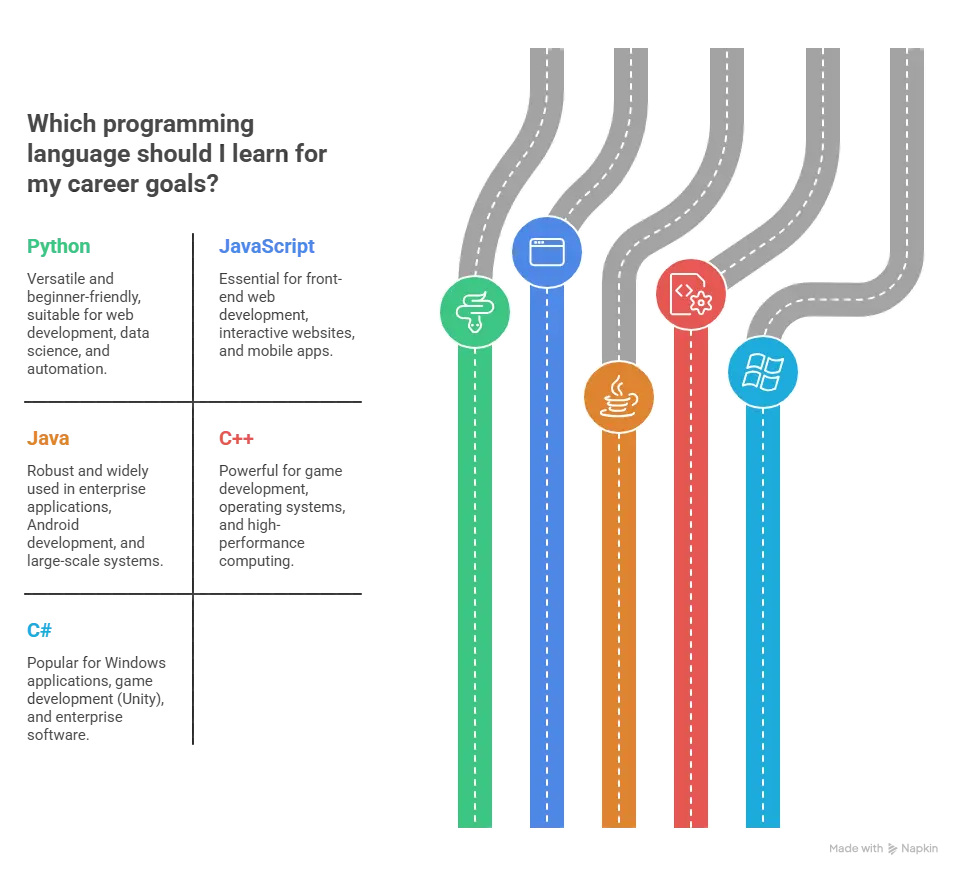
The best programming language for beginners is not always the best language for every job. Here is how the most popular programming languages map to specific career paths.
Web Development Languages
Web development is one of the most accessible career paths in tech. The core stack is HTML/CSS for structure and design, JavaScript for interactivity, and TypeScript for larger applications. On the backend, you can use Node.js (JavaScript), Python with Django or Flask, PHP, or Ruby on Rails. If you want to learn more about the career itself, check out the software engineer career path guide.
Mobile Development Languages
For iOS apps, Swift is the clear choice. For Android, Kotlin is Google’s recommended language. If you want to build for both platforms at once, Flutter (using the Dart language) and React Native (using JavaScript) are the leading cross-platform frameworks in 2026. Kotlin Multiplatform is also gaining real adoption for shared business logic across iOS and Android.
Data Science and AI/ML Languages
Python dominates here, full stop. Libraries like NumPy, Pandas, Scikit-learn, TensorFlow, and PyTorch run the world’s AI models. R is still used in academic and statistical research. SQL is essential for any data role because you need to query and manage databases. Julia is a niche language growing in scientific computing. If you are pursuing the best Python training path, focus on these libraries alongside core Python fundamentals.
If you are aiming for an AI/ML engineer role, read about the top software engineering companies that are hiring heavily in this space right now.
Game Development Languages
C++ powers the Unreal Engine, the industry standard for AAA game development. C# is the language behind Unity, which is widely used for indie games and mobile titles. If you are learning game development on a budget, starting with C# in Unity is the most practical approach. Python is used for scripting and prototyping in game pipelines as well.
Cloud, DevOps, and Backend Languages
Go is purpose-built for cloud-native development. Kubernetes, Docker tooling, and many AWS/GCP services are written in Go. Python handles automation, scripting, and infrastructure-as-code (Ansible, Terraform integrations). Rust is growing fast in security-critical cloud infrastructure. Java and C# remain dominant in enterprise backend systems.
Embedded Systems and IoT Languages
C and C++ are the workhorses of embedded systems and IoT. They run directly on hardware with minimal overhead. Python (via MicroPython) is being used on lower-resource microcontrollers. Rust is being adopted for safety-critical embedded systems because of its memory-safety guarantees without needing a garbage collector.
Language Selection Guide
Easiest Coding Languages for Beginners
If you are looking for the easiest programming language to learn first, here is the honest answer: Python, then JavaScript, then Ruby or PHP.
Python reads almost like English. There are no semicolons, no complex memory management, and the error messages are relatively friendly. Universities around the world use it as the introductory language for a reason. You can write a working script in under an hour.
JavaScript is a close second because you can run it directly in your browser. No setup, no installs, just open a console and start coding. That immediate feedback is incredibly motivating for beginners.
Once you have a language in mind, your next step is understanding the best way to start coding. Having a structured plan makes the difference between giving up in week three and landing your first job.
Hardest and Most Complex Languages
On the other end of the spectrum, Rust, C, and C++ are widely considered the hardest programming languages to learn. Rust requires you to understand concepts like ownership, borrowing, and lifetimes that simply do not exist in higher-level languages. C and C++ require manual memory management, where one mistake can crash an entire program.
Assembly language is the most complex of all but is rarely needed in day-to-day software development. Haskell and Prolog are academically challenging due to their purely functional and logic-based paradigms respectively. These are worth learning eventually, but they are not where you start.
Highest Paying Programming Languages
If salary is your primary driver, here is what the data shows for US-based developers in 2026:
The pattern is clear: languages used in AI, cloud infrastructure, security, and high-performance systems pay the most. But raw language choice is only part of the equation. Specialization, domain expertise, and years of experience matter more than which language you know.
For a deeper look at compensation, our guide on software engineer salary and career options breaks down pay by specialization, seniority, and company size.
Languages with Best Job Security
Future-proof programming languages are the ones tied to problems that will not go away. Based on 2026 trends, these are the safest long-term bets: Python (AI is not slowing down), JavaScript/TypeScript (the web is not going anywhere), Java (enterprises move slowly and their Java systems will need maintenance for decades), SQL (data is everything), and Go (cloud infrastructure is only growing).
Programming job security is less about the language itself and more about the ecosystem it lives in. A language tied to a growing industry has built-in job security. A language tied to legacy systems can also be surprisingly stable since few people know it and companies are stuck with it.
Rarely Used and Declining Programming Languages
Some languages are fading from mainstream use: Perl was once dominant in text processing and web scripts but has largely been replaced by Python. ColdFusion is still used in old enterprise systems but rarely appears in new projects. VBScript, COBOL (outside banking), and ActionScript are rarely taught or hired for today. That said, COBOL developers in banking and government still earn very well due to the scarcity of people who know it.
Learning Path and Resources
How Long Does It Take to Learn a Language for Hiring?
This is the most common question from people exploring the best way to learn coding online. Here is a realistic breakdown:
These timelines assume 2–4 hours of daily practice with real projects. Tutorials alone will not get you hired. Building things that actually run and solve real problems is what separates job-ready developers from tutorial completers.
For a more detailed timeline, check out our guide on how long it takes to become a software engineer.
Self-Taught vs Bootcamp vs Degree
All three routes are working in 2026. Bootcamps report 70–96% placement rates for graduates, though those numbers vary by program quality. A CS degree is still preferred at some large companies, but Google, Apple, and many top tech firms have dropped the degree requirement entirely.
The self-taught route works best when combined with a strong portfolio, open-source contributions, and networking. The degree route gives you depth in computer science theory that helps with system design, algorithms, and senior-level interviews.
If you are considering skipping the degree, read our honest take on how to become a software engineer without a degree before making your decision.
Testing Your Existing Skills
Before diving into new material, it is worth taking stock of what you already know. Platforms like HackerRank, LeetCode, and Codewars let you test practical coding skills by language. GitHub activity is increasingly used by hiring managers as a portfolio signal. If you are preparing for interviews, review common patterns across data structures and algorithms in your language of choice.
Brush up on what to expect in technical screenings with our list of software engineer interview questions that are commonly asked in 2026.
Best Ways to Learn Coding Online
The best way to learn coding online in 2026 depends on your style. For structured, project-based learning, platforms like Codecademy, freeCodeCamp, and The Odin Project are strong free options. For best Python training specifically, Real Python, Python.org’s official docs, and Kaggle’s free courses are excellent starting points.
Paid options like Pluralsight, Udemy, and LinkedIn Learning cover advanced topics well. For AI/ML, Coursera’s DeepLearning.AI specializations are considered the industry standard. The best coding language to learn first matters less than consistently practicing it in real projects.
Once you’re ready to apply, make sure your application materials are sharp. Our software engineer cover letter guide covers what hiring managers actually want to see.

Also read:
Frequently Asked Questions
-
What is the most useful programming language in 2026?
Python. It sits at #1 on the TIOBE Index for March 2026, is the top language in AI/ML, data science, and automation, and is consistently the most-requested language in job postings. For beginners and experienced developers alike, Python offers the best return on learning investment.
-
Which programming languages are most future-proof?
Python, JavaScript/TypeScript, Go, and Rust are the safest long-term bets. Python is the language of AI, which is only growing. JavaScript is the language of the web, which is not going anywhere. Go and Rust are tied to cloud infrastructure and systems programming, both of which are expanding. SQL will remain essential as long as data matters.
-
Can I get hired knowing just one programming language?
Yes, especially early in your career. Many junior developers get hired knowing just Python or just JavaScript. What matters more than knowing multiple languages is building real projects, understanding the ecosystem (frameworks, libraries, tools) around your language, and demonstrating problem-solving ability. Most companies will train you on additional languages once you are hired.
-
Can I get programming jobs without a CS degree?
Yes. Many tech companies, including Google and Apple, have removed degree requirements. Bootcamp graduates and self-taught developers land software roles every day in 2026. Your portfolio, GitHub profile, and interview performance matter far more than a diploma. Read the full breakdown in our guide on becoming a software engineer without a degree.
-
What is the easiest programming language to learn for beginners?
Python is the easiest programming language to learn for most beginners. Its syntax is close to plain English, the community is massive, and the learning resources are abundant. HTML/CSS is technically even simpler but is limited to web structure. JavaScript is the second easiest and has the advantage of running instantly in a browser, which provides fast feedback.
-
What is the best coding language to learn first for jobs?
Python if you want AI, data science, or automation jobs. JavaScript if you want web development or full-stack roles. Java if you want enterprise backend positions. All three have large job markets, strong communities, and clear learning paths. Avoid starting with Rust, C, or C++ unless you have a specific systems programming goal in mind.
-
What is the difference between a software engineer and a software developer?
The titles are often used interchangeably, but there are subtle differences in scope and responsibility. Our guide on software engineer vs software developer covers this in detail including salary differences and role expectations.
Conclusion
Choosing the best programming language to learn in 2026 is less about picking a winner and more about matching a language to your goals. If you want to get into AI or data science, Python is your move. If you want web development, start with JavaScript and add TypeScript when you are ready. If you want a high-paying niche, Go or Rust are worth the investment.
The most popular programming languages all have large communities, strong job markets, and years of runway left. Stop overthinking the choice. Pick one, build something real, and commit to it for at least six months. That is the best way to start coding, regardless of which language you choose.
Ready to take the next step? Explore your full software engineer career path and see where the right language can take you.

Shahzada Muhammad Ali Qureshi (Leeo)
I’m Shahzada — a software engineer by education and an SEO professional by trade. I built WhatIsTheSalary.com to go beyond just showing salary numbers — every page is manually researched across sources like BLS, Glassdoor, LinkedIn Salary, and PayScale to give you the full picture in one place. If you found what you were looking for here, that’s exactly the point.