
TL;DR
Software Engineering Best Practices aren’t just buzzwords—they’re the difference between shipping blazing-fast features and drowning in production fires.
Problem: 78% of teams miss deadlines due to technical debt, failed deploys spike 40% without DORA metrics, and AI hype leaves codebases brittle. You’re building faster but breaking more. “whatisthesalary.com“
Solution: Master CI/CD pipelines, TDD lifecycles, and zero-trust DevSecOps. Track deployment frequency, MTTR, and CSAT to hit elite performance. Embrace IaC and AI-assisted refactoring for 2026-ready teams.
This guide delivers 10 battle-tested sections—from metrics alignment to engineering leadership—that transform chaos into continuous delivery dominance. Ready to optimize?
Why Software Engineering Best Practices Matter in 2026
Software teams are under more pressure than ever. Release cycles are shorter, user expectations are higher, and the cost of a production failure has never been steeper. In this environment, following software engineering best practices is not a nice-to-have, it is the difference between teams that ship with confidence and teams that spend every sprint firefighting.
The best practices in software engineering in 2026 are built around four core benefits: faster delivery, higher code quality, reduced technical debt, and better team performance. When you combine structured coding practices in software engineering with the right metrics and tooling, you get a compounding return. Teams spend less time on rework and more time building value.
Whether you are a software engineer just starting out or an engineering leader managing multiple squads, this guide covers every layer of the stack, from discovery to deployment, from code quality to team culture.
Foundations: Planning and Discovery
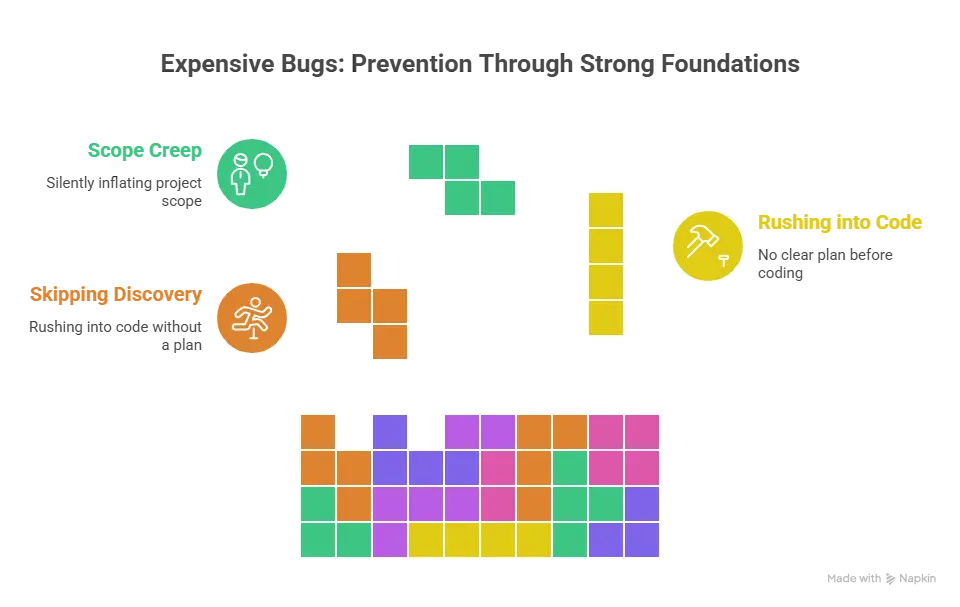
The most expensive bugs are the ones that never needed to exist. They come from skipping discovery, rushing into code without a clear plan, or letting scope creep silently inflate a project. Strong foundations prevent all three.
Discovery is the first step. Before writing a single line of code, teams should run a proper product discovery process. This means defining deliverables clearly, identifying user needs, mapping technical constraints, and aligning on success metrics. Discovery is not bureaucracy. It is risk management done early, when it costs almost nothing to fix a misunderstanding.
Requirements gathering and analysis should use structured elicitation techniques: user stories, use cases, and written requirement specs. The goal is requirements that are clear, complete, consistent, and testable. Ambiguous requirements are the number one cause of project failure.
Once requirements are solid, define success metrics upfront. What does “done” look like? How will you measure it? This aligns engineering work with business outcomes and prevents the classic gap between what was built and what was actually needed.
Agile project management works well here, but only when paired with real good software engineering practices. Agile without engineering discipline, what Robert Martin calls “Flaccid Scrum”, leads to lower productivity and mounting debt over time.
Use software project estimation to forecast effort realistically. Pair that with prototyping and design-before-coding habits. Wireframes, mockups, and system design sessions catch architectural mistakes before they get baked into the codebase. Avoid the temptation to push too many features. A focused product built well beats a bloated one built fast.
Coding Standards and Quality Practices
Code is read far more often than it is written. That simple fact is the entire argument for coding standards in software engineering. When your team follows consistent software engineering coding standards, onboarding is faster, reviews are smoother, and bugs are easier to find.
Readability and clean code come first. Use meaningful names for variables and functions. Maintain consistent formatting. Follow your language’s style guide. Use a linter to catch style issues automatically. These habits do not slow teams down. They speed them up by reducing the cognitive load of reading unfamiliar code.
The four core principles every software developer should internalize are:
Beyond principles, actively manage technical debt. Refactor regularly. Do not let complexity accumulate silently. A codebase that grows without refactoring becomes harder to test, harder to extend, and harder to secure. Set aside time in every sprint for debt reduction, not as a luxury, but as a health practice.
Use design patterns and modular design to keep systems understandable. Smaller, independent modules are easier to test in isolation and easier to replace when requirements change. That said, do not over-modularize upfront. Premature abstraction is its own form of technical debt.

Testing and Quality Assurance
If there is one good coding practice in software engineering that pays back the most, it is testing. Writing tests is not extra work. It is the work. Code without tests is not finished code; it is a liability.
Test-Driven Development (TDD) flips the usual sequence. You write the test first, then write the code that makes it pass. The TDD lifecycle, red (failing test), green (passing code), refactor, forces you to think about behavior before implementation. Teams that practice TDD consistently produce fewer bugs and refactor with more confidence.
Automated testing is the backbone of unit testing in software engineering. A solid test suite covers:
Shift-left testing means moving testing earlier in the development cycle. Catch bugs during code review, not after deployment. The earlier a bug is found, the cheaper it is to fix. This is one of the most impactful best practices in software engineering a team can adopt.
Pair automated testing with strong debugging practices. Reproduce bugs in isolation, write a failing test that captures the bug, then fix it. That test stays in your suite permanently, preventing the same bug from returning.
Version Control, Collaboration, and Code Reviews
Version control is non-negotiable. Every team, regardless of size, should use Git. But using Git well is a practice in itself. Commit frequently with clear, descriptive messages. Use feature branches for every new piece of work. Keep the main branch stable and deployable at all times.
Branching strategies like GitHub Flow or trunk-based development help teams ship faster while reducing merge conflicts. The right strategy depends on your release cadence, but the principle is the same: small, short-lived branches merge faster and break less.
Code reviews are a quality gate and a learning tool at the same time. Pull request (PR) review time is actually one of the key DORA-adjacent metrics. Long PR review cycles create bottlenecks that slow down the entire team. Aim to review PRs within four hours of submission.
Effective code reviews are not about finding fault. They are about catching bugs, sharing knowledge, and maintaining engineering best practices software-wide. Keep reviews focused, constructive, and specific.
Documentation is often the most neglected part of collaboration. Auto-generate API docs where possible. Write clear README files. Keep architecture decision records (ADRs). Teams that invest in documentation spend less time explaining things repeatedly and more time building.
Key Metrics to Track Best Practices
You cannot improve what you do not measure. The continuous integration in software engineering journey requires tracking the right numbers at every stage. DORA metrics, developed by Google’s DevOps Research and Assessment team and drawing on data from over 36,000 professionals worldwide, are the industry gold standard for measuring software delivery performance.
Elite teams on DORA metrics deliver software 973 times more frequently than low performers while maintaining higher stability. That is not a small gap. It is the difference between a competitive business and a struggling one.
11 Essential Metrics for Software Engineering Teams
| Metric | What It Measures | Elite Benchmark | Why It Matters |
| Deployment Frequency | How often code ships to production | Multiple times/day | Reflects CI/CD maturity and team agility |
| Lead Time for Changes | Time from commit to production | < 1 hour | Shorter = faster value delivery to users |
| Change Failure Rate | % of deployments causing failures | 0–5% | Indicates code quality and testing depth |
| MTTR (Recovery Time) | Time to restore after failure | < 1 hour | Shows resilience and incident response quality |
| Availability / Uptime | System availability percentage | > 99.9% | Critical for user trust and SLA compliance |
| Cycle Time | Time from work start to delivery | Hours to days | Exposes bottlenecks in your workflow |
| Time to Market | Idea-to-production speed | Days to weeks | Tied directly to competitive advantage |
| Throughput | Features/fixes shipped per sprint | Consistent + growing | Measures team productivity over time |
| PR Review Time | Time for pull requests to be reviewed | < 4 hours | Long PR times slow down the entire team |
| Work in Progress (WIP) | Concurrent tasks per developer | 1–3 items max | High WIP = context switching, more bugs |
| Customer Satisfaction (CSAT) | User experience score | Above baseline | Connects engineering output to real impact |
Use these metrics across four maturity stages: Initial (establish baselines), Improvement (identify and fix bottlenecks), Optimization (automate and scale), and Continuous (measure business impact and iterate). The table above maps each metric to what it measures and what elite teams target.
CI/CD, DevOps, and Infrastructure
Continuous integration in software engineering means every code change is automatically built, tested, and validated. Continuous deployment extends this by automating the release to production. Together, CI/CD pipelines eliminate manual bottlenecks, reduce human error, and dramatically shorten time to market.
Secure CI/CD is now a baseline requirement. Every pipeline should include automated security scans: SAST (static application security testing) to catch issues in code, DAST (dynamic testing) to test runtime behavior, and SCA (software composition analysis) to flag vulnerable dependencies. Builds should fail on critical security issues, not just code errors.
Infrastructure as Code (IaC) using tools like Terraform or CloudFormation, ensures environments are reproducible, auditable, and version-controlled. IaC eliminates the “works on my machine” problem entirely. Configuration management becomes part of the codebase, not a manual process in someone’s head.
Feature flags enable progressive delivery. You can ship code to production without exposing it to all users. This decouples deployment from release, letting teams test in production safely and roll back instantly if something breaks.
Deploy in small batches. The smaller the deployment, the easier it is to identify what broke. Large, infrequent releases accumulate risk. Small, frequent releases distribute it.
On architecture, the choice between microservices and monoliths depends on your team size, complexity, and scalability needs. Top-paying software jobs increasingly require cloud-native and microservices experience. Microservices offer flexibility and scalability but come with operational complexity. A well-structured monolith often outperforms a poorly designed microservices setup.
DevSecOps integrates security into every stage of development. It moves security left, embedding threat modeling, secure coding standards, and automated vulnerability scanning into the development workflow rather than tacking them on at the end.
Maintain separate staging and production environments. Never test in production without feature flags. And always have a tested backup and disaster recovery plan in place. Availability is a competitive advantage.
Security, Performance, and Optimization
In 2026, secure software is not a bonus feature. It is the baseline. Every developer is a frontline security practitioner whether they know it or not. Good software design practices now include security by default.
Apply the principle of least privilege everywhere: in code, in infrastructure, in access controls. Use zero trust architecture. Do not assume anything inside the network is safe. Verify every request.
Run penetration testing and security audits regularly. Use CodeQL or SonarQube to catch what manual review misses. Audit your dependencies with SCA tools. Supply chain attacks are real, common, and expensive in 2026.
On the performance side, common optimization techniques include:
Track bugs systematically. Use an issue tracker. Prioritize by severity and impact. A well-managed bug backlog is a sign of a healthy engineering culture, not a broken one.
Audits, Compliance, and Standards
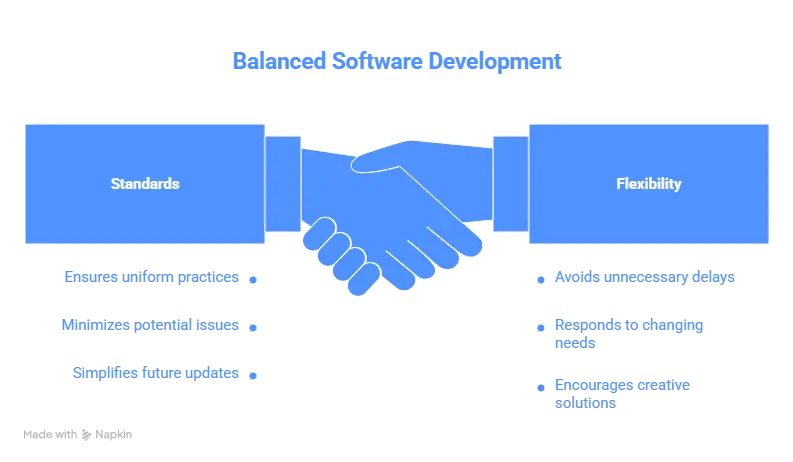
Software development standards exist for good reason. They create consistency, reduce risk, and make systems easier to maintain over time. But standards need to be balanced. Overly rigid standards slow teams down; no standards at all create chaos.
Regular software audits are a critical part of software engineering good practices. They surface risks before they become incidents. There are five main types of IT audits every engineering organization should understand:
- Due Diligence Audits: Evaluate technical risk, often in M&A or vendor assessment contexts.
- Operational Audits: Review processes, workflows, and how well teams follow established practices.
- Financial Audits: Assess IT spending, licensing compliance, and cost efficiency.
- Compliance Audits: Ensure adherence to regulations like GDPR, SOC 2, HIPAA, or ISO 27001.
- Security Audits: Identify vulnerabilities, misconfigurations, and gaps in the security posture.
Running audits annually is not enough. Continuous compliance monitoring, embedded into your CI/CD pipeline and IaC practices, is the modern standard. The teams at top software engineering companies treat compliance as code, not a checkbox exercise.
Team Management and Engineering Leadership
The best programming practice in software engineering is only as effective as the team culture behind it. Technical practices fail when the people side is neglected.
Build a culture of trust, psychological safety, and shared ownership. Engineers who feel ownership over their work write better code, catch more bugs, and solve problems proactively. Ownership culture is not just motivational; it directly improves software quality.
Avoid micromanagement. Support accountability without surveillance. Give engineers the context they need to make good decisions, then trust them to make those decisions. The role of engineering leadership is to remove obstacles, not create them.
Cross-functional collaboration between developers, designers, QA, product managers, and operations teams is essential for building software that actually solves user problems. Siloed teams build siloed software.
Run regular retrospectives. Create genuine feedback loops, not just performance reviews. Retrospectives that lead to real process changes are one of the highest-leverage activities an engineering team can do.
Invest in knowledge growth. Encourage engineers to learn new programming languages, contribute to internal documentation, and share learnings across teams. The half-life of technical knowledge is short. Continuous learning is not optional.
Use data to inform decisions. Engineering intelligence platforms that surface DORA metrics, PR review times, WIP levels, and deployment frequency give leaders the visibility they need without resorting to micromanagement. Data-informed leadership scales. Gut-feel leadership does not.
Emerging Trends: AI, Cloud, and Tools
AI-assisted development is no longer emerging. It is here. According to Panto AI’s 2026 data, 51% of professional developers use AI coding tools daily. The teams winning with AI are not the ones who adopted it fastest. They are the ones who adopted it most deliberately.
AI tools accelerate code generation, automate test creation, flag potential bugs, and generate documentation. But they also introduce new risks: subtle logic errors that pass CI, inflated deployment frequency without quality improvements, and code that reviewers did not write and struggle to own.
The practical approach: maintain AI contribution logs, establish an “AI Coding Standards” addendum to your engineering guidelines, and track the ratio of AI-generated to human-reviewed code. Use AI to handle the repetitive work so engineers can focus on the hard problems. That is what modern software engineering practices look like in 2026.
Cloud computing is now universal. About 94% of enterprises were using cloud services heading into 2026. Cloud-native architectures, containerization with Docker and Kubernetes, and IaC are expected skills for software engineers across all levels.
Tools to Enforce Software Engineering Best Practices
Aligning Practices Across Development Stages
Not every team is at the same maturity level. The right practices depend on where you are in the continuous delivery journey.

Also read: Software Engineer Salary in Zurich vs Geneva vs Lausanne (2025–2026)
Frequently Asked Questions (FAQ)
-
What are software engineering best practices?
Software engineering best practices are proven principles, methods, and guidelines that help teams build high-quality, maintainable software. They cover everything from coding standards and testing to CI/CD, security, and team collaboration. They apply across languages, frameworks, and team sizes.
-
Why are coding standards important in software engineering?
Coding standards in software engineering ensure that all team members write code in a consistent, readable style. This reduces the time spent understanding unfamiliar code, speeds up code reviews, and makes debugging significantly easier. Standards also reduce onboarding time for new developers.
-
What is the role of unit testing in software engineering?
Unit testing in software engineering validates that individual functions or modules behave as expected in isolation. It catches bugs early, supports safe refactoring, and forms the foundation of a reliable automated test suite. Teams that skip unit tests tend to accumulate silent bugs that surface at the worst possible time.
-
What are DORA metrics and why do they matter?
DORA metrics, developed by Google’s DevOps Research and Assessment team, are four key measurements of software delivery performance: deployment frequency, lead time for changes, change failure rate, and MTTR. They are the most empirically validated framework for assessing engineering team performance and have been shown to correlate directly with business outcomes.
-
What is the difference between CI and CD?
Continuous integration (CI) is the practice of automatically building and testing code every time a change is committed. Continuous deployment (CD) extends this by automatically releasing validated code to production. Together, CI/CD eliminates manual release processes, reduces errors, and enables faster, safer delivery.
-
How does technical debt affect software quality?
Technical debt accumulates when teams take shortcuts, skip refactoring, or build without clear design. Over time, it makes the codebase harder to read, test, and extend. Left unmanaged, technical debt slows delivery, increases bug rates, and raises the cost of every future change. Regular refactoring is the primary remedy.
-
How important is AI in modern software engineering practices?
AI-assisted development is now a standard part of modern software engineering practices. Over half of professional developers use AI tools daily for code generation, testing, and documentation. However, AI requires guardrails. Teams need clear AI coding standards, review processes for AI-generated code, and metrics to track whether AI is actually improving quality, not just speed.
Conclusion
The best practices in software engineering have always been about one thing: building software that works, lasts, and improves over time. In 2026, the stakes are higher and the tools are better, but the fundamentals have not changed.
Plan before you build. Write clean, testable, documented code. Test early and often. Automate your pipelines. Measure what matters. Secure by default. And invest in the people doing the work.
Teams that combine strong software design best practices with the right metrics, tooling, and culture are the ones consistently outperforming their peers. If you are looking to grow in this field, understanding the full software engineer career path and knowing which best programming languages to invest in are smart places to start.
Whether you are writing a software engineer cover letter for your first role or leading a team at one of the top software engineering companies, these practices are what separate good engineers from great ones. The gap between knowing best practices and actually applying them is where careers and products are built.

Shahzada Muhammad Ali Qureshi (Leeo)
I’m Shahzada — a software engineer by education and an SEO professional by trade. I built WhatIsTheSalary.com to go beyond just showing salary numbers — every page is manually researched across sources like BLS, Glassdoor, LinkedIn Salary, and PayScale to give you the full picture in one place. If you found what you were looking for here, that’s exactly the point.