TLDR
Coding Interview Preparation: Imagine staring at a blank screen as the clock ticks down, your dream tech job hanging by a thread—all because of one brutal coding problem you couldn’t crack.
Enter the “paste problem”: a deceptively simple LeetCode-style challenge where you optimize string pasting in a notepad to minimize operations. Sounds easy? Most candidates flop, exposing gaps in dynamic programming mastery. “whatisthesalary.com“
This guide delivers a mind-blowing solution—using DP with O(n) space optimization—turning your interview terror into triumph. Ready to paste your way to FAANG?
Introduction to Coding Interviews
What is a software engineering coding interview?
A software engineering coding interview is a structured technical evaluation where companies assess your ability to solve computational problems. It is not just about writing correct code. Interviewers want to see how you think, how you communicate, and whether you can break down ambiguous problems systematically.
Most roles at tech companies, from startups to FAANG, require passing at least one coding round. Whether you are aiming for a junior role or a senior position, solid coding interview preparation is what separates candidates who get offers from those who walk away empty-handed.
If you are just starting to explore the tech industry, it helps to first understand what the software engineer career path looks like before diving into prep.
What does a typical tech coding interview look like?
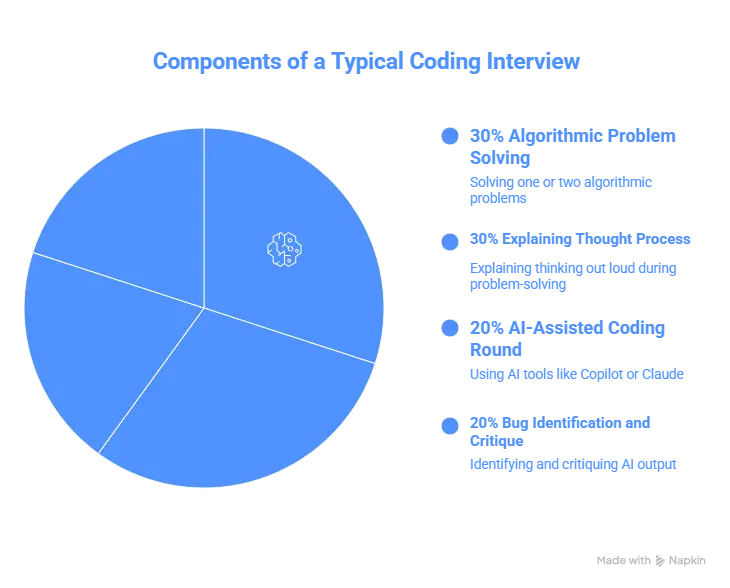
A typical coding interview runs between 45 and 60 minutes. You are given one or two algorithmic problems and asked to solve them while explaining your thinking out loud. The interviewer is watching how you approach the problem, not just whether you arrive at the correct solution.
In 2026, many companies now include an AI-assisted coding round where you are permitted to use tools like GitHub Copilot or Claude inside the interview itself. However, even in those formats, your ability to identify bugs, critique AI output, and reason through edge cases is what actually gets scored.
Types of coding interviews
Self-directed timed tests
These are automated online assessments usually sent before any live round. Platforms like HackerRank, Codility, and CodeSignal are commonly used by companies for this stage. You receive a link, a time limit (usually 60 to 90 minutes), and two to three problems. There is no interviewer watching, just your code versus automated test cases.
The biggest failure point here is time management. A 90-minute test with three problems does not mean 30 minutes each. Always move on if you are stuck past 25 minutes and return later if time allows. A partial solution on three problems typically scores better than a perfect solution on just one.
Live interviews with an interviewer
Live coding rounds happen via platforms like CoderPad or a shared Google Doc. You solve problems in real time while talking through your approach. These feel more intense, but they also give you a chance to ask clarifying questions and demonstrate your reasoning, which can actually work in your favor.
Behavioral rounds have also grown significantly. In 2026, they now account for 30 to 40 percent of total interview time at major tech companies, up from just 10 to 15 percent five years ago. Being prepared to discuss your past work and technical decisions is no longer optional.
How You’ll Be Evaluated
Key traits firms seek in coding candidates
Companies are not only looking for people who can solve hard LeetCode problems. They want engineers who can think clearly, write clean code, handle ambiguity, and communicate effectively under pressure. Here is what most hiring teams actually look for:
How interviewers assess you during a coding interview
Interviewers typically score candidates across four dimensions: correctness (does the code work?), efficiency (is it optimized?), communication (did you explain your thinking?), and code quality (is it readable and maintainable?).
Even if you do not reach the optimal solution, a candidate who communicates well and identifies the right trade-offs will often score higher than someone who silently writes a perfect solution. Thinking out loud is not just encouraged, it is evaluated.

For more on what technical employers expect, see this guide on software engineer skills required in today’s job market.
Common Pitfalls to Avoid
Tendency to rush into coding
This is the most common mistake. The moment a problem is read, many candidates immediately start typing. That almost always leads to a messy solution that misses edge cases or takes the wrong approach entirely.
Spend at least 3 to 5 minutes clarifying the problem, discussing constraints, and sketching your approach verbally before writing any code. Interviewers have seen enough rushed submissions to know this habit is a red flag.
Fear of asking clarifying questions
Asking questions is not a sign of weakness. It signals engineering maturity. In real jobs, requirements are always incomplete. Interviewers expect you to ask things like: What are the input size constraints? Can values be negative? Should the function handle null inputs?
Skipping this step often results in solving the wrong version of the problem, which wastes both your time and the interviewer’s patience.
Getting flustered under pressure
Coding interview practice is the only reliable way to manage nerves. If you have never solved a problem while someone is watching, the live format will feel paralyzing the first time. Regular coding mock interviews remove that shock factor.
When you get stuck, verbalize it. Say what you know, what you are trying, and what is blocking you. Most interviewers would rather guide a communicative candidate than sit in silence watching a panicked one.
Step-by-Step Preparation Strategy
Pick a strong programming language
Python is the most popular choice for coding interview prep in 2026, thanks to its concise syntax and powerful built-in data structures. Java and C++ are equally valid if that is what you are most comfortable with. The key rule: do not switch languages mid-prep. Pick the one you can write bug-free code in under pressure.
If you are still deciding, check out this breakdown of the best programming languages to learn for career growth.
Plan your time: Prioritize topics and questions by importance
Not all topics are equally likely to show up in interviews. Start with the high-frequency fundamentals: arrays, hash maps, trees, graphs, two pointers, sliding window, and BFS/DFS. These patterns alone cover roughly 80 percent of questions you will encounter.
According to prep research, 75 to 100 problems practiced with deep pattern understanding beats grinding through 500 problems without it. Use curated lists like the Blind 75 or the Grind 75 to maximize your coverage efficiently.
Combine studying theory with hands-on practice for each topic
Reading about binary search is not the same as implementing it under a time limit. For every concept you study, follow it immediately with two to three hands-on practice problems on LeetCode or AlgoExpert before moving forward.
Keep a tracking spreadsheet: problem name, pattern used, whether you solved it without hints, and what tripped you up. Review your failures the next day. This kind of deliberate practice is what actually builds the pattern recognition interviewers reward.
Use coding interview cheatsheets for must-know algorithms and best practices
Cheatsheets covering time complexity, common data structure operations, and sorting algorithms are invaluable during your final days of prep. Many candidates print these out and review them the morning before an interview.
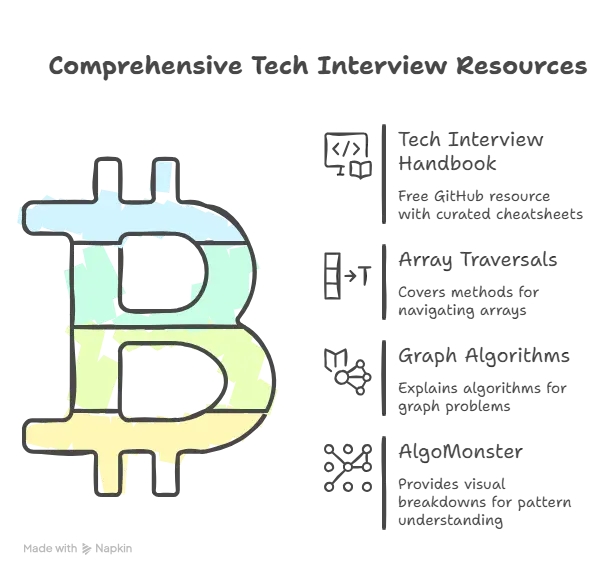
The Tech Interview Handbook on GitHub, which has helped over one million developers, is a solid free resource for this. AlgoMonster also provides visual pattern breakdowns that are excellent for quick review.
Practice self-directed coding and timed challenges
Once you know the patterns, shift to timed solo practice. Set a 45-minute timer, open a blank editor, and solve problems without looking anything up. This simulates the real assessment format used by platforms like HackerRank and Codility.
After each session, review your solution against optimal answers and understand the gap. Over time, your solve speed and pattern recognition will improve measurably.
Prepare a solid self-introduction and thoughtful questions for the interviewer
Your technical skills will not carry you if your self-introduction is a rambling mess. Prepare a 60-second structured pitch: who you are, what you have built, and what kind of role you are targeting. Keep it crisp and relevant.
Also prepare 2 to 3 thoughtful questions for the interviewer at the end. Asking about engineering culture, team challenges, or technical decisions signals genuine interest and leaves a strong impression.
If you need help framing your professional story, this software engineer cover letter guide has useful framing tips that translate to verbal introductions too.
Schedule mock coding interviews for real-world simulation
Doing mock interviews is the closest thing to the real experience without actually being in one. Practice with peers, use AI-powered platforms, or hire a coach. The goal is to get comfortable solving problems while someone is watching and asking follow-up questions.
Platforms like CoderPad support live collaborative coding, making them great for peer mock sessions. Many candidates also use Interview Cake for its detailed explanations and guided walkthroughs that help build the verbal reasoning habit.
Top Coding Interview Platforms at a Glance (2026)
| Platform | Best For | Free Plan | Mock Interviews | Difficulty Level |
| LeetCode | DSA Practice | Yes | No | Easy to Hard |
| HackerRank | Assessments | Yes | No | Easy to Hard |
| AlgoExpert | Structured Prep | No | No | Medium to Hard |
| CodeSignal | Company Tests | Yes | No | Easy to Medium |
| AlgoMonster | Pattern Learning | Partial | No | Easy to Hard |
| Grokking (Educative.io) | Pattern-Based | No | No | Beginner-Friendly |
| Interview Cake | Detailed Walkthroughs | Partial | No | Medium |
| Codility | Employer Screening | Yes | No | Easy to Hard |
| CoderPad | Live Interviews | Yes | Yes | Varies |
| Codecademy | Beginners/Python Prep | Yes | No | Beginner |
Essential Techniques and Best Practices
Core coding interview techniques
The eight patterns that cover the vast majority of interview questions are: two pointers, sliding window, binary search, BFS/DFS, dynamic programming, backtracking, stack-based problems, and hash map lookups. Learn to identify which pattern applies before you start coding.
For system design questions, which now start at mid-level roles (L4 and above at most companies), practice designing systems like a URL shortener, rate limiter, notification service, and distributed cache. Cracking the system design interview requires both breadth of knowledge and the ability to talk through trade-offs clearly.
These skills are central to long-term growth in your career. Learn more about software engineering practices that top engineers follow day to day.
Coding interview best practices
Here are the habits that consistently separate good candidates from great ones:
Top Resources and Tools
Algorithms study cheatsheets
The Tech Interview Handbook (free on GitHub) includes curated cheatsheets for every major topic, from array traversals to graph algorithms. AlgoMonster’s visual breakdowns are particularly useful for understanding how patterns relate to each other.
Practice questions for coding interviews
LeetCode remains the gold standard for coding interview practice. Its library of thousands of problems, sorted by topic, company, and difficulty, gives you maximum flexibility in how you prepare. HackerRank is better suited for simulating the timed assessment format used during company screening rounds.
For python interview preparation specifically, both LeetCode and Codility offer Python-friendly environments and company-specific question sets that mirror real assessment styles.
Key courses and books
AlgoMonster
AlgoMonster was built by engineers from Google and Facebook specifically to teach coding patterns efficiently. Rather than asking you to grind hundreds of problems, it organizes everything by pattern and uses visual explanations to make abstract concepts concrete.
It is one of the most recommended platforms for anyone looking for a structured coding interview prep course that does not waste your time. A partial free tier is available, with the full course available via one-time payment.
Grokking the Coding Interview: Patterns for Coding Questions
Available on Educative.io, this is one of the most referenced coding interview preparation courses among developers preparing for top tech companies. It teaches you to recognize problem-solving patterns rather than memorizing individual solutions, which is exactly what leads to long-term interview success.
Educative.io also offers a broader python interview preparation course for those going specifically for Python-focused roles, covering both algorithmic thinking and Python-specific syntax tricks.
Other helpful resources
Interview Cake stands out for its incredibly detailed walkthroughs where every problem is explained step by step, with space and time complexity discussed at each stage. It is particularly good for candidates who want to deeply understand why a solution works, not just memorize it.
If you are still early in your journey and wondering how to break into the field without a formal degree, this guide on how to become a software engineer without a degree is worth reading.
You can also explore software engineer interview questions that frequently appear across hiring rounds at major tech companies.
Advanced Prep (If You Have Extra Time)
Internalize key tech interview question patterns
Once you have covered the core eight patterns, go deeper. Learn monotonic stacks, union-find data structures, topological sorting, and Dijkstra’s algorithm. These show up more at senior levels and in hard-tier problems, but knowing them signals depth that impresses interviewers.
AlgoExpert has a well-curated set of these advanced problems, and many candidates use it alongside LeetCode for diversity in problem style and explanation quality.
Tackle take-home projects
According to a 2025 LinkedIn survey, 47 percent of hiring managers now prefer take-home projects over live coding rounds, particularly at startups and mid-size companies. If you are targeting those types of roles, practising real-world mini-projects under a time constraint is essential.
Focus on clean code, good naming conventions, readable structure, and including a brief README that explains your decisions. These are the signals take-home evaluators actually look for.
Building a strong software engineer portfolio that includes these kinds of projects can also significantly boost your chances during the application stage.
Daily coding challenges
Consistency beats intensity. Solving one or two problems every day for two months will do more for your performance than a two-week cramming sprint followed by burnout. Use LeetCode’s daily challenge or CodeSignal’s daily problems to maintain momentum.
If you are preparing for a python coding interview preparation specifically, set one of your daily problems to be Python-focused, paying attention to built-in libraries like collections, heapq, and itertools, which regularly come up in interview optimization discussions.
If you are exploring what it takes to get into the field more broadly, this guide on how to become a computer programmer covers the foundational skills expected at entry level.

Frequently Asked Questions (FAQs)
-
How long does coding interview preparation take?
It depends on your current level. With a computer science background and some algorithm familiarity, 4 to 6 weeks of focused preparation is usually enough. Starting from scratch, plan for 2 to 3 months. The key is daily consistency: 1 to 2 hours every day is far more effective than weekend cramming. One week is technically possible if you already have a solid foundation and are brushing up, not starting fresh.
-
What is the best way to prepare for a coding interview?
The best approach combines three things: learning problem-solving patterns (not memorizing individual solutions), practicing under timed conditions to simulate real interview pressure, and doing regular coding mock interviews to build communication habits. Platforms like LeetCode for practice and Educative.io for structured courses are among the most trusted in 2026.
-
Is Python good for coding interviews?
Python is the most popular language for technical interviews in 2026, and for good reason. Its concise syntax, built-in data structures (like dictionaries, sets, and heaps via heapq), and readable code make it ideal for writing solutions quickly under pressure. A dedicated python interview preparation course on Educative.io or a python coding interview preparation track on LeetCode can help you sharpen both language fluency and algorithmic thinking together.
-
What platforms are best for coding interview practice?
LeetCode is the most widely used for algorithm and data structure practice. HackerRank is better for simulating the timed assessment format many companies use for screening. AlgoMonster and Grokking the Coding Interview on Educative.io are better for pattern-based learning. CoderPad is excellent for live coding practice. Interview Cake stands out for deep explanations that build real understanding rather than just solution recall.
-
How many LeetCode problems should I solve before an interview?
Quality beats quantity here. Research and prep community consensus suggest that 75 to 100 problems solved with deep pattern understanding is more effective than grinding through 500 problems mechanically. Focus on the Blind 75 or Grind 75 lists for maximum topic coverage. After solving each problem, analyze the time and space complexity and understand why the optimal solution works the way it does.
-
What is system design and when should I start preparing for it?
System design interviews assess your ability to architect scalable, reliable systems. In 2026, this is expected from mid-level roles (L4 and above), not just senior positions. Common topics include designing URL shorteners, notification systems, rate limiters, and distributed caches. Start preparing for system design at least 3 to 4 weeks before your interviews using resources like Grokking the System Design Interview or ByteByteGo.
-
What are the most common mistakes in coding interviews?
The three biggest are: jumping into code before fully understanding the problem, staying silent instead of thinking out loud, and panicking when stuck instead of verbalizing what you know. On the technical side, ignoring edge cases and skipping complexity analysis are common gaps. All of these can be fixed with consistent technical interview practice, ideally through mock sessions where someone is watching and giving feedback in real time.
Conclusion
Coding interview preparation in 2026 is more structured and more demanding than it has ever been. Between algorithm rounds, system design expectations moving down to mid-level roles, and the arrival of AI-assisted coding rounds, there is genuinely more ground to cover than there was even two or three years ago.
That said, the fundamentals have not changed. Pick a language, learn the core patterns, practice under timed conditions, do mock interviews, and keep going even when progress feels slow. The candidates who consistently land offers are not the ones who grind the most problems. They are the ones who practiced like the real interview, communicated clearly, and showed up with a system.
Use tools like LeetCode, AlgoMonster, Interview Cake, and Educative.io as your technical backbone. Build your communication muscle through regular coding mock interviews. And remember: understanding why a solution works will always beat memorizing what the solution is.
For more on building a long-term career in software, explore the full software engineer career options guide to see where strong interview prep can take you.

Shahzada Muhammad Ali Qureshi (Leeo)
I’m Shahzada — a software engineer by education and an SEO professional by trade. I built WhatIsTheSalary.com to go beyond just showing salary numbers — every page is manually researched across sources like BLS, Glassdoor, LinkedIn Salary, and PayScale to give you the full picture in one place. If you found what you were looking for here, that’s exactly the point.