TL;DR
System Design Interview Prep: Imagine you’re handed a blank canvas in a FAANG interview: “Design a pastebin like Pastebin.com that handles 1M pastes/sec without crashing.” Your mind freezes—millions of concurrent users, real-time syntax highlighting, expiration logic, and global replication stare back. One wrong scalability call, and you’re out. “whatisthesalary.com“
But what if you could decode this chaos like a pro? This guide arms you with battle-tested strategies: sharding, caching cascades, and async queues that turn “impossible” into “interview gold.” Nail the interviewer’s hidden gotchas and land that dream offer.
What Are System Design Interviews?
A system design interview is an open-ended technical conversation where you’re asked to architect a large-scale distributed system from scratch. The interviewer gives you a vague prompt — “Design Instagram” or “Build a rate limiter” — and you’re expected to take it from ambiguity to a working architecture in roughly 45 to 60 minutes.
Unlike a LeetCode problem, there’s no single right answer. You’re being evaluated on your thought process, your communication, and your ability to make real engineering decisions.
Types of System Design Interviews
Not all design system interviews are the same. In 2026, you’ll typically encounter:
If you’re doing a frontend system design interview specifically, the evaluation criteria shift. You’ll need to speak to rendering strategies, client-side caching, and performance budgets rather than distributed databases.
How System Design Differs from Coding Interviews
A lot of engineers over-prepare for coding rounds and underprepare for design ones. Here’s the core difference:
Coding interviews (like those in a c coding interview or c program interview context) test whether you can write correct, efficient code. There’s a right answer. System design tests whether you can think like an engineer who builds and owns real products. There’s no single right answer — only well-reasoned and poorly-reasoned ones.
In a coding round, silence is fine while you work. In a system design interview, silence is a red flag. You’re expected to talk through your thinking the entire time.
What Interviewers Look For (and Don’t Look For)
Let’s be direct about this. Interviewers at FAANG companies are not looking for a perfect design. They’re evaluating signal across several dimensions:
What they’re NOT looking for: a memorized architecture pulled from a book. Interviewers interrupt memorized answers quickly. What they want is an engineer they’d enjoy whiteboarding with on a real problem.
How to Approach System Design Interviews
Your mindset going into this interview matters as much as your technical knowledge. Engineers who treat system design prep as a list of topics to memorize tend to struggle. Engineers who approach it as a way to demonstrate real engineering judgment tend to do well.
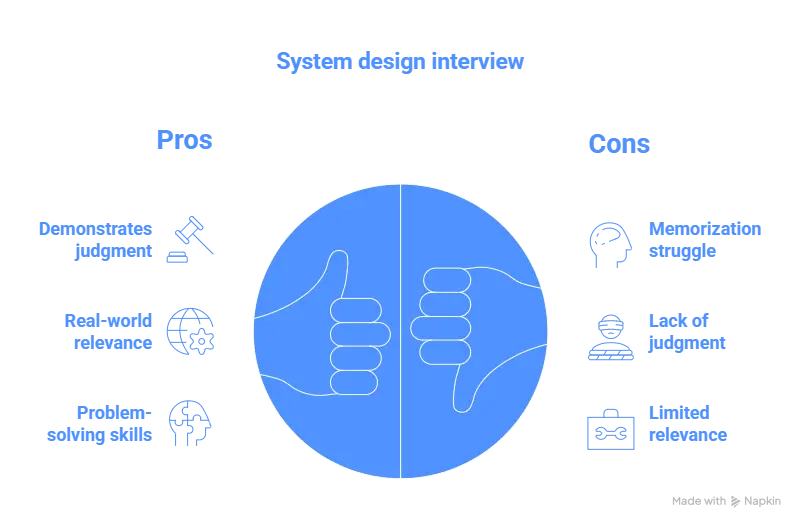
Think Like a Tech Lead, Not a Coder
The shift you need to make is this: stop thinking like someone solving a problem in isolation and start thinking like someone leading a team toward a scalable solution.
A tech lead asks: What are we actually trying to build? Who uses it? How many users? What can we sacrifice and what can’t we? These questions aren’t small talk — in a system design interview, the requirement-gathering phase is itself a primary evaluation signal. Skipping it is one of the fastest ways to fail.
If you’re also sharpening your broader engineering skills, our guide on software engineering practices covers the habits that separate good engineers from great ones.
Communication Matters More Than Perfect Solutions
This cannot be overstated. A simple design explained well will consistently outperform a complex design explained poorly. Interviewers are collecting signals every time you speak — about how organized your thinking is, how clearly you explain trade-offs, and how you handle pushback.
Practice explaining your designs out loud before your interview. Record yourself if you need to. The whiteboard paralysis is real, and the only cure is repetition.
What Happens in a Typical System Design Interview
Most system design interviews at top companies follow a similar flow:
Want to understand how this connects to broader interview readiness? Our coding interview preparation guide covers the full picture across all interview types.
5-Step Framework to Crush System Design
This is the practical structure that works across almost every system design question you’ll encounter. It’s not a rigid script — it’s a repeatable process that keeps you organized under pressure.

Step 1 – Clarify Requirements (Functional + Non-Functional)
Never start designing before you understand what you’re building. This is where most candidates fail.
Functional requirements are the core features: what the system must do. For example, in a messaging app, users must be able to send and receive messages, see online status, and access message history.
Non-functional requirements cover everything about how the system behaves: latency targets, availability guarantees (99.9% vs 99.99%), throughput, consistency model, and security constraints.
Ask questions like: Is this read-heavy or write-heavy? How many daily active users are we designing for? Are we optimizing for latency or consistency? What’s the data retention policy?
These aren’t filler questions. They define the entire architecture. A system designed for 10,000 users looks completely different from one designed for 100 million.
Step 2 – Define Core Data Models and APIs
Once requirements are clear, define the core data entities — the primary objects your system works with and their relationships. In a ride-sharing app, your entities might be: User, Driver, Trip, Location, and Payment.
Then sketch your API design. Define the key endpoints, request parameters, and response structures. This grounds your design in something concrete before you move to architecture.
For example: POST /trips with a body containing pickup_location, dropoff_location, and user_id. GET /trips/{trip_id} to retrieve trip status. Keep it simple at this stage — the goal is to anchor the conversation.
Strong software engineer skills include the ability to quickly translate product requirements into a clean data model. Practice this separately if it’s a weak spot.
Step 3 – Design High-Level Architecture
This is where you sketch the overall system. Walk through the request lifecycle from the client to the database and back. Identify which components you need: web servers, application services, load balancers, databases, caches, message queues, CDN, and so on.
At this stage, you’re not going deep. You’re showing that you understand what components exist, why each one is there, and how data flows between them. Use a top-down approach: start with the user-facing layer, work toward data storage, and explain every decision.
A useful framing: for each component you add, ask yourself “why does this exist?” If you can’t answer that clearly, it probably doesn’t belong in the design.
Step 4 – Deep Dive into Critical Components
Pick two or three components that are most interesting for the problem and go deeper. This is usually where the interviewer will guide you, but you should proactively propose where to focus.
For a social media feed, a deep dive might cover fan-out strategies (read vs write), how you’d handle celebrity accounts with millions of followers, or what happens when a user’s feed service goes down.
For a URL shortener, the deep dive might cover hash generation, collision handling, and how you’d cache popular redirects to reduce database load.
Step 5 – Address Scale, Trade-Offs, and Bottlenecks
Every design has weak points. The best candidates find them first. Walk through what happens when your system gets 10x the traffic. Where does it break? How do you fix it?
Common bottlenecks to address: a single database that becomes a write bottleneck (introduce database sharding or read replicas), a service without fault tolerance (introduce circuit breakers or multi-region replication), and slow response times under load (introduce caching layers).
Be explicit about trade-offs. If you chose eventual consistency over strong consistency, explain why that was the right call for this use case. Interviewers don’t want a perfect design — they want an engineer who can own their decisions.
15 Fundamental System Design Concepts
The table below covers the 10 core semantic entities of system design that come up in virtually every interview. Memorize these and understand the real trade-offs behind each one.
| Concept | What It Means | Why It Matters in Interviews |
| Functional Requirements | Core features the system must support (e.g., user login, data retrieval) | Defines scope before design begins |
| Non-Functional Requirements | Performance, reliability, scalability, and security expectations | Signals engineering maturity |
| High-Level Design | Architecture overview: services, databases, APIs, and data flow | The backbone of your answer |
| API Design | Endpoints, request/response structure, authentication approach | Shows practical backend thinking |
| Core Data Entities | Primary objects in the system and their relationships | Foundation of data modeling |
| Load Balancing | Distributing traffic across multiple servers to prevent overload | Critical for scalability discussions |
| Database Sharding | Splitting a database horizontally across multiple nodes | Needed when a single DB cannot handle the load |
| Caching Strategies | Using in-memory layers (e.g., Redis) to reduce DB load and latency | One of the most common deep-dive topics |
| CAP Theorem | A distributed system can guarantee only 2 of: Consistency, Availability, Partition Tolerance | Must-know trade-off for any distributed system question |
Core Concepts Every Candidate Must Know
Beyond the table above, you need to understand a few additional fundamentals before walking into any interview system design round:
If you’re newer to the field, read through our guide on how to become a software engineer to understand how system design fits into the broader career landscape.
Load Balancing, Caching, Database Sharding
These three come up in nearly every design conversation. Let’s go through each concisely:
Load balancing distributes incoming traffic across multiple servers to prevent any single server from becoming overwhelmed. Common algorithms include round-robin, least connections, and IP hash. In a design interview, mention that load balancers also provide health checking — they route traffic away from unhealthy instances automatically.
Caching strategies reduce the load on your database and cut response times by storing frequently accessed data in memory (typically Redis or Memcached). Common patterns include cache-aside (application reads from cache, falls back to DB on miss), write-through (write to cache and DB simultaneously), and write-back (write to cache first, sync to DB asynchronously). Each has different consistency and durability trade-offs.
Database sharding splits your data horizontally across multiple database nodes. For example, users with IDs 1-1M go to Shard A, 1M-2M go to Shard B. This allows you to scale reads and writes beyond what a single database can handle. The challenges are hotspot prevention (ensuring data is evenly distributed) and cross-shard queries (which become expensive).
CAP Theorem and Consistency Patterns
The CAP theorem states that a distributed system can only guarantee two of three properties simultaneously: Consistency (every read gets the most recent write), Availability (every request gets a response), and Partition Tolerance (the system continues to operate even if network partitions occur between nodes).
Since network partitions are a reality in any distributed system, you’re always choosing between consistency and availability. A banking system prioritizes consistency over availability — you’d rather the app return an error than show a wrong balance. A social media feed prioritizes availability — slightly stale data is fine.
Know the common consistency patterns: strong consistency, eventual consistency, read-your-writes consistency, and monotonic reads. Being able to explain which pattern fits which use case is a clear differentiator in senior-level interviews.
Interviewer Evaluation Criteria
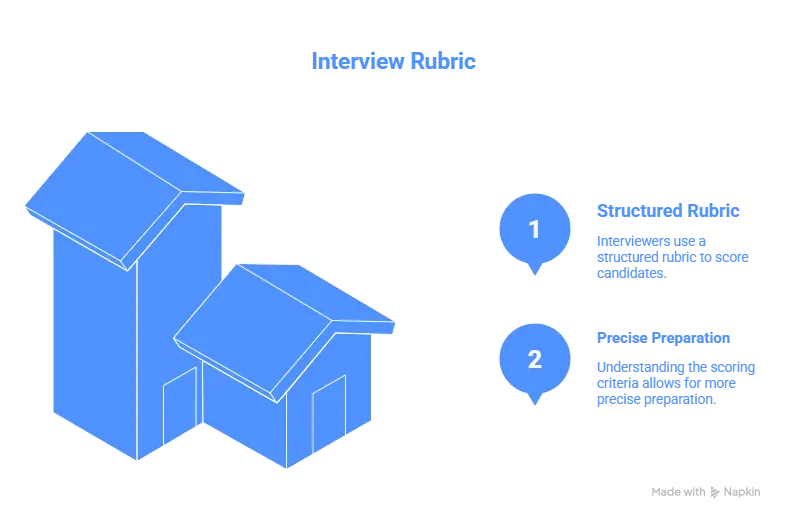
Here’s something most candidates don’t know: interviewers at top companies use a structured rubric. Understanding what they’re scoring you on lets you prepare more precisely.
Communication and Collaboration Skills
This is weighted more heavily than most engineers expect. Interviewers evaluate whether you can explain complex ideas simply, use diagrams effectively, and keep your answer organized under time pressure.
The best answers are conversational. You’re building toward a design with the interviewer, not presenting a pre-rehearsed solution at them. Ask for feedback mid-interview. Check in: “Does that approach make sense before I go deeper?” This signals collaborative instincts.
For engineers still building their fundamentals, our software engineer interview questions guide covers behavioral and technical questions across the full loop.
Structured Thinking and Problem Navigation
Interviewers track whether you have a clear mental framework or if you’re just free-associating. They watch for logical progression: do you define requirements before designing? Do you build the high-level picture before deep-diving? Do you stay organized when constraints change?
One practical tip: at the start of the interview, briefly outline your approach. “I’ll start by clarifying requirements, then sketch the high-level architecture, and then we can go deep on whatever component is most relevant.” This immediately signals structured thinking.
Technical Judgment and Practical Depth
You don’t need to know everything. But you need to know why you’re making each decision. When you say “I’d use Kafka here,” the interviewer will ask why Kafka over alternatives. What does Kafka’s partition model give you? What are the operational tradeoffs?
Practical depth means you’ve thought about how these systems actually behave in production — not just in theory. Reference real-world design patterns, known failure modes, and the types of problems that only surface at scale.
If you’re still growing your technical foundation, check out our best programming languages to learn guide to understand what skills are most in-demand at the companies you’re targeting.
Time Management Under Pressure
One of the most consistent mistakes candidates make is spending 30 minutes on the data schema and running out of time before covering bottlenecks. A better allocation for a 45-minute interview: 5 minutes on requirements, 10 minutes on high-level design, 20 minutes on deep dives, and 10 minutes on trade-offs and follow-up.
Practice with a timer. Seriously. Knowing the material is one thing. Delivering it in 45 minutes while someone is asking follow-up questions is a different skill entirely.
Top Resources for System Design Prep
The good news: there’s more quality system design prep material available in 2026 than ever before. The bad news: there’s too much of it, and a lot of it is outdated. Here’s what actually works.
Books and Courses
For engineers still deciding on their tech stack, our best programming languages guide can help you invest your learning time wisely.
Articles, Videos, and Mock Interviews
Pairing your system design prep with a strong resume is equally important. Our software engineer resume guide and software engineer cover letter guide can help make sure your application gets past ATS and into human hands.
Discord Communities and Practice Environments
If you’re newer to the field or switching careers, our guides on how long it takes to become a software engineer and how to become a software engineer without a degree are worth reading alongside this one.

Also read: Clean Code Principles: The Complete Guide for 2026
Frequently Asked Questions
-
How long should I prepare for a system design interview?
2-3 years exp: 4-6 weeks structured prep (fundamentals + practice). Juniors: 6-8 weeks heavy on databases/caching/APIs. Crunch time? 1-2 weeks intensive via “System Design in a Hurry” or DesignGurus crash course.
-
Do I need to code in system design interviews?
No—whiteboard/Excalidraw only. Evaluate architecture + data flow. Backend roles occasionally request pseudo-code to validate data structure choices or algorithm reasoning.
-
What’s HLD vs LLD in interviews?
HLD: Big picture—services, databases, APIs, data flow (FAANG standard).
LLD: Implementation details—classes, design patterns, OOP (mid/junior roles). -
How to handle unfamiliar system design questions?
Structured framework wins: 1) Clarify requirements 2) Data model 3) High-level design 4) Trade-offs. Say: “First time designing this—here’s my systematic approach.”
-
Common 2026 system design questions?
Instagram/Twitter feed, TinyURL, WhatsApp messaging, Uber ridesharing, rate limiter, web crawler, distributed cache. Emerging: RAG pipelines, LLM serving infrastructure.
-
How is evaluation different by level?
Junior: Component coverage/breadth.
Senior: Decision depth + trade-offs.
Staff+: Lead conversation, identify unprompted edge cases, production-scale judgment. -
Are mock interviews necessary?
Absolutely—3-5 minimum. Verbal delivery under interruption separates good from great. Free: Pramp peers. Paid: DesignGurus/Exponent experts. Whiteboard paralysis kills otherwise-prepared candidates.
Conclusion
System design interviews are the round where careers are made. They’re also the round most engineers feel least prepared for — because no one teaches you how to think at scale in school, and most prep material focuses on the wrong things.
To recap the core of what we covered:
One more thing: don’t delay your interviews waiting to feel “ready.” Readiness comes from doing the reps, not from reading one more chapter. Set a date, build your framework, and trust the process.
If you want to sharpen the broader picture alongside your system design prep, explore our guides on software engineer career options, the software engineer career path, and the software engineer vs software developer distinction to make sure you’re aiming at the right target. Also see our guide on how to become a computer programmer if you’re earlier in the journey.
Good luck — and go build something worth designing.

Shahzada Muhammad Ali Qureshi (Leeo)
I’m Shahzada — a software engineer by education and an SEO professional by trade. I built WhatIsTheSalary.com to go beyond just showing salary numbers — every page is manually researched across sources like BLS, Glassdoor, LinkedIn Salary, and PayScale to give you the full picture in one place. If you found what you were looking for here, that’s exactly the point.