
TL;DR
How to Land Your First Software Engineering Job in Australia — Feeling stuck after graduation or bootcamp while Aussie job boards demand experience you don’t have? Imagine turning that gap into your biggest advantage: a focused portfolio, targeted networking, and interview-ready projects that match employer needs.
This introduction gives a compact, high-impact roadmap: a problem (no experience), a paste — plug-and-play actions you can copy now, and solution steps that recruiters actually notice. “Global Salary“
Start by building 2–3 real-world projects tied to Australian employers’ stacks, showcase measurable outcomes, contribute to open source, and use LinkedIn + local meetups to get referrals.
Follow this plan and you’ll move from overlooked to interview-ready faster than you think. Want the exact 8-step checklist and two resume templates next?
Why Australia Is Worth Targeting Right Now
I want to be straight with you. Landing your first software engineering job anywhere is hard. Australia is no different. But the numbers in 2026 are genuinely in your favour if you approach this the right way.
According to data cited by immigration consultancy CanApprove, Australia currently has a shortage of close to 60,000 skilled ICT professionals. Software engineers remain on the country’s Medium and Long-Term Strategic Skills List (MLTSSL), which means the government actively wants more of them. Employers in Sydney’s fintech sector and Melbourne’s startup scene are hiring across full-stack development, cloud engineering, AI, and cybersecurity.
The average software engineer salary in Australia sits between AUD 105,000 and AUD 125,000 per year in 2026, according to data compiled from SEEK, Indeed, and Glassdoor. Entry-level roles start lower, but they start well. You are not looking at a market where your first job pays you pennies.
That said, knowing the market is good is different from knowing how to get into it. Let me walk you through the exact steps.
What to Expect in Pay: Salary by Experience Level
Before you apply anywhere, you need a realistic number in your head. Here is how salaries break down across experience levels in 2026, based on data from Glassdoor, Indeed, PayScale, and Hays Australia:
| Experience Level | National Average | Sydney / Melbourne | Notes |
| Graduate (0-1 yrs) | AUD 65,000 – 85,000 | AUD 80,000 – 95,000 | AUD 70,000 – 80,000 |
| Junior (1-3 yrs) | AUD 80,000 – 100,000 | AUD 90,000 – 110,000 | AUD 80,000 – 100,000 |
| Mid-Level (3-6 yrs) | AUD 100,000 – 130,000 | AUD 115,000 – 140,000 | AUD 100,000 – 125,000 |
| Senior (7+ yrs) | AUD 150,000 – 190,000 | AUD 160,000 – 200,000+ | AUD 140,000 – 180,000 |
| Lead / Principal | AUD 180,000 – 250,000+ | AUD 200,000 – 280,000+ | AUD 170,000 – 230,000 |
Sources: Glassdoor Australia (Feb 2026), Indeed Australia (Apr 2026), PayScale AU, Hays IT Salary Guide 2026. For a full breakdown by city and seniority, see the software engineer salary Australia guide and the junior software engineer salary in Australia breakdown.
A few important points on these numbers. PayScale reports the entry-level figure closer to AUD 67,691 for under one year of experience, while Glassdoor puts the junior average at AUD 84,000. The gap exists because PayScale includes smaller regional employers and startups; Glassdoor data skews toward larger companies. Neither is wrong. They just reflect different parts of the market.
Sydney consistently sits above the national average. If you are targeting a role there, the
See the software engineer salary in Sydney guide for a full city-level breakdown.
Step 1: Get the Right Skills in Place
You do not need to know every framework ever created. You need depth in one area and working familiarity with the tools Australian employers actually use.
The most in-demand skills for junior software engineers in Australia right now are Python, JavaScript, SQL, React, and cloud platforms like AWS and Azure. DevOps basics including Git, CI/CD pipelines, and Docker come up constantly in job postings. Agile and Scrum familiarity is expected at almost every company, including startups.
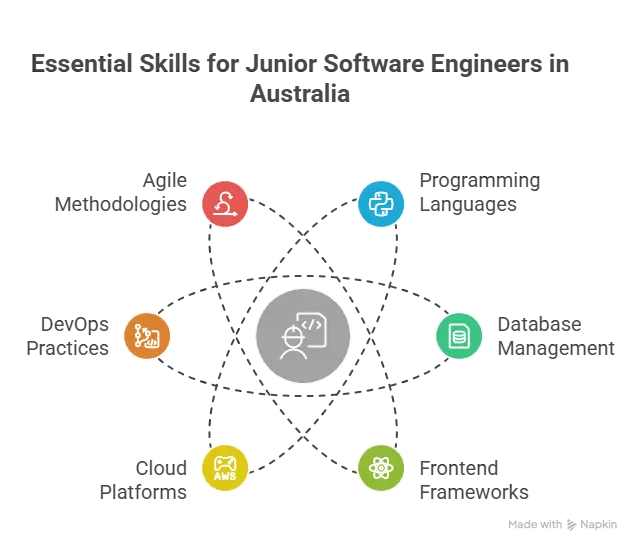
Pick your specialisation early. Web development, mobile app development, DevOps, and backend systems are all valid paths. Going deep on one area makes you more hireable than being passable at five. Employers hiring juniors are not expecting you to know everything. They are expecting you to be genuinely strong in something.
If you are still figuring out where to focus, the best programming languages to learn guide covers what the Australian job market is actually paying for right now.
Step 2: Build a Portfolio That Does the Talking
This is the step most people skip or do badly. Your GitHub is your portfolio. Your portfolio is your first interview. Get this right and a lot of other things become easier.
A strong portfolio for a junior software engineer in Australia should include three to five projects with live demos, GitHub links, and real metrics. According to a 2026 guide from WhatIsTheSalary, your portfolio should be hosted on GitHub Pages, Netlify, Vercel, or a personal .com or .dev domain. Anything hosted only locally tells employers you have not shipped anything real.
Avoid the classic beginner trap of building to-do lists and calculators. Build something that solves an actual problem, even a small one. A movie recommendation engine, a budget tracker with a real API, a browser extension. Something that shows you can think beyond tutorials.
For each project, write clearly what problem it solves, what technologies you used, what your specific contribution was, and what improved because of it. Numbers matter. ‘Reduced API response time by 35%’ is worth more than ‘built a fast API.’
Step 3: Write a Resume That Gets Past ATS and Into Human Hands
Australian recruiters scan fast. Your resume has roughly six seconds to land in the yes pile before they move on. That is not an exaggeration; it is the reality of a market where SEEK has over 90,000 active job ads at any given time.
Use a hybrid format if you have limited work history. Lead with your skills and projects, then education. If you have relevant internships or co-op experience, lead with experience first. Functional resumes rarely work for software engineering roles because they make it impossible for recruiters to assess growth.
Tailor each resume to the job posting. Mirror the exact tools and terminology listed. If the job says React, your resume should say React, not ‘front-end JavaScript frameworks.’ Australian Applicant Tracking Systems filter by keywords, and generic applications fall through.
Quantify every bullet point you can. ‘Developed a mobile app’ is weak. ‘Built a cross-platform mobile app in React Native that handled 500+ daily active users during testing’ is strong. Link to your GitHub directly.
For examples of what an effective cover letter looks like alongside your resume, the software engineer cover letter guide has templates worth studying.
Step 4: Apply in the Right Places
Most people apply everywhere and hear nothing back. The problem is not the volume. It is the targeting.
For software engineering roles in Australia, three platforms are worth the bulk of your effort. SEEK is the undisputed market leader with over 90,000 active ads and a user rating of 4.5 out of 5, according to job board analysis published in early 2026. LinkedIn is second, with over 15 million Australian users and the best direct-messaging access to hiring managers. GradConnection is specifically designed for graduate programs and early career roles, which makes it directly relevant if you are coming straight out of university.

Indeed is worth setting up an alert on, but do not rely on it as your primary channel. Jora is useful as a secondary discovery tool. For government tech roles, APS Jobs is the right platform.
The hidden job market is real. A job search strategy article from SyncSkills notes that the best Australian tech opportunities in 2026 rarely make it to job boards at all. They are filled through networks and referrals. Reach out to engineers on LinkedIn for informational interviews. Show up to tech meetups. Contribute to discussions. This is slower than clicking Apply, but it has a much higher hit rate.
Step 5: Graduate Programs Are Worth Your Time
If you are coming fresh out of a CS or software engineering degree in Australia, graduate programs are one of the cleaner paths into the industry. Companies like Atlassian, Canva, Westpac, ANZ, Telstra, and the big four consulting firms all run structured two-year graduate programs.
These programs typically pay between AUD 80,000 and AUD 95,000 in year one, come with structured mentoring, and rotate you through different teams. The application windows open six to twelve months before the start date, usually around March to June for the following year.
Graduate programs also give you a clear leveling structure from day one. Understanding where you sit on the experience ladder matters more than most new engineers realise, because it directly affects how quickly you can move to mid-level and beyond.
See the mid-level software engineer salary in Australia guide and the senior software engineer salary in Australia guide to understand where the salary jumps actually happen as you move up.
Internships: The Shortcut Nobody Talks About Enough
If you are still studying, get an internship before you graduate. If you have already graduated, a short unpaid internship or open-source contribution still beats a blank resume.
One of the more honest pieces of advice I have read on this topic came from a software engineer who documented his journey as an international student in Australia. His view was that the company does not have to be Google or Atlassian. Any internship, including at a startup or mid-size company, builds your body of work and gets your name into someone’s professional network.
Paid internships are preferable and attainable. Canva, Atlassian, and various fintech firms in Sydney run paid intern programs. But if a paid internship is not accessible to you right now, the experience still moves you forward. Think in terms of a two to three year time horizon and focus on learning high-value, transferable skills.
Step 6: Prepare for the Interview Process in Australia
Australian tech interviews in 2026 typically follow a three-stage format: a recruiter screening call, a technical coding assessment, and a final-round interview that combines technical questions with behavioural ones.
For junior roles, you do not need to be a system design expert. You do need a solid grip on data structures, algorithms, and the fundamentals of the languages you claim on your resume. LeetCode-style questions are common at larger companies. Smaller firms and startups tend to give take-home assignments instead, which reward thoughtful architecture over speed.
Practise explaining your thought process out loud. Australian employers, like most employers globally, are not just checking whether you can solve a problem. They want to see how you think when you get stuck. Walk through your logic. Ask clarifying questions. Show that you are collaborative.
The behavioural portion matters more than most engineers expect. Come prepared with specific examples of problems you solved, times you had to learn something fast, and moments where you worked through a disagreement with a teammate. Vague answers here cost offers.
If You Are an International Candidate: The ACS Skills Assessment
This section is specifically for overseas professionals applying from outside Australia. If you graduated locally, you can skip ahead.
To qualify for skilled migration visas and most sponsored roles, you need a positive skills assessment from the Australian Computer Society (ACS). This is not optional. Your visa application cannot proceed without it.
The ACS assesses over ten ICT occupations including software engineer, systems analyst, web developer, and database administrator. The standard application costs AUD 550 and takes six to eight weeks to process.
The single most common and most expensive mistake is choosing the wrong ANZSCO occupation code. Your job title is not the same as your ANZSCO code. ACS assesses your actual duties, not what it says on your business card. If you worked as a software developer doing hands-on coding every day, do not nominate ‘Software Engineer’ which implies architectural oversight. Nominate Developer Programmer (ANZSCO 261312) instead.
If you graduated from an Australian university, the Post-Australian Study pathway simplifies the process significantly. You need at least one year of full-time relevant work experience post-graduation.
How Your Salary Grows From Year 0 to Year 10
Most junior engineers underestimate how much their salary can grow in a decade if they are intentional about it. Here is a realistic picture.
Year zero to one as a graduate: AUD 65,000 to AUD 85,000. You are building fundamentals, learning to ship code in a real environment, and getting your first professional references.
Year one to three as a junior to early mid-level: AUD 80,000 to AUD 105,000. This is where your rate of growth is fastest relative to experience. One strategic job move at this stage often yields a 15 to 20 percent salary jump.

Year three to six as a mid-level engineer: AUD 100,000 to AUD 130,000. You are making real technical decisions and mentoring those behind you. The biggest salary jumps in Australian tech come from switching employers at this stage, not annual increments.
Year seven and beyond at senior level: AUD 150,000 to AUD 190,000. Staying too long at one company at this level is where most engineers lose ground. The market pays significantly more for proven senior engineers who move strategically than for those who stay loyal to one employer for a decade.
For a complete breakdown of what senior roles actually pay, the senior software engineer salary in Australia guide has city-by-city and company-by-company data.
What Career Paths Open Up After Your First Role
Your first software engineering job is not the ceiling. It is the foundation. Once you have two to three years of experience, you have genuine options.
The most common paths from a junior role in Australia are full-stack development, backend specialisation, DevOps and site reliability engineering, mobile development, data engineering, and machine learning engineering. Each of these commands a different salary ceiling and carries different day-to-day responsibilities.
Some engineers go deeper into technical leadership, eventually becoming lead engineers or principal engineers. Others move toward product management or solutions architecture. Neither path is better than the other. What matters is that you are deliberate about it early, because the skills you build in your first two to three years shape what opportunities open up later.
See the full software engineer career options guide for a breakdown of each path, including salary ranges and required skills.
Common Mistakes That Cost People Their First Role
I see the same mistakes come up repeatedly when people tell me they have been applying for months without traction.
The first is applying to hundreds of roles with the same generic resume. Volume without targeting is not a strategy; it is a time sink. The Australian job market in 2026 rewards quality applications over quantity. Tailored applications that mirror the job description convert at a much higher rate.
The second is ignoring the network entirely. A study covered by SyncSkills showed that one candidate who had spent three months perfecting her CV got four interview requests in her first week after overhauling her LinkedIn profile and being active in her industry community. The hidden job market in Australia is real and significant.
The third is applying only to big-name companies. Atlassian and Canva are great, but they are also the most competitive. Fintech firms, healthtech companies, logistics startups, and mid-size SaaS businesses hire junior engineers regularly and offer excellent learning environments.
The fourth is underestimating the superannuation component of your offer. Superannuation contributions from your employer sit at 11% of your base salary in 2026 and are paid on top of your base. A AUD 80,000 base with super is actually AUD 88,800 in total employer cost. Factor this in when comparing offers.

Also read: Junior Software Engineer Jobs Australia: Why It’s Harder
Frequently Asked Questions
-
How long does it take to land your first software engineering job in Australia?
Most candidates who are actively applying and improving their applications land their first role within three to six months. This timeline shortens significantly if you have internship experience, a strong GitHub portfolio, and a well-targeted LinkedIn profile. Without any of those, it can stretch to nine to twelve months.
-
Do I need a computer science degree to get a software engineering job in Australia?
A degree helps, but it is not mandatory. Bootcamp graduates, self-taught developers, and career changers regularly get hired, particularly at startups and mid-size tech companies. What employers want to see is demonstrated ability: real projects, clean code, and the communication skills to work in a team.
-
What is the best city in Australia for a junior software engineer in 2026?
Sydney and Melbourne offer the highest concentration of tech jobs and the highest salaries. Sydney leads in fintech and enterprise tech. Melbourne has a stronger startup ecosystem. Brisbane and Perth are smaller markets but still have active hiring, with lower competition for junior roles.
-
What programming language should I learn first for the Australian job market?
Python and JavaScript are the most in-demand languages for junior roles in Australia in 2026. Python dominates in data engineering, backend development, and automation. JavaScript is essential for full-stack and front-end roles. SQL is expected of almost every developer regardless of specialisation.
-
Is it possible to get a software engineering job in Australia from overseas without being there in person?
It is possible but significantly harder. Most Australian employers prefer to hire locally due to the cost and complexity of visa sponsorship. Your best approach is to have a positive ACS skills assessment ready, target companies listed as approved sponsors on the TSS Subclass 482 visa, and focus applications on Sydney and Melbourne where sponsor density is highest.
-
How important is a GitHub profile for getting hired as a junior software engineer in Australia?
Very important. Australian tech recruiters expect to see a GitHub link on your resume. An active profile with real projects signals that you write code outside of work hours, that you understand version control, and that your skills are visible and verifiable. A blank or inactive GitHub profile raises questions in a competitive market.
-
Should I negotiate my first software engineering offer in Australia?
Yes, always. Many first-time candidates assume the first offer is the final one. It is not. Even for graduate roles, asking for AUD 5,000 to 10,000 above the initial offer is common and rarely costs you the role. Come in with data from Glassdoor, SEEK, and Hays salary guides to support your ask.
Share Your Experience
If you have been through this process recently, whether you landed the role in three months or twelve, the details you remember matter to someone reading this right now. What worked? What surprised you about the Australian hiring process? Drop your story in the comments. Real experiences help more than any guide.
How This Article Was Created
The salary figures in this article were sourced from Glassdoor Australia (updated February to April 2026), Indeed Australia (updated April 2026), PayScale Australia (updated April 2026), and the Hays IT Salary Guide 2026. The ACS assessment details were verified against the official ACS guidelines and CanApprove’s 2026 immigration data. No salary figures were fabricated. All data reflects publicly reported figures from the sources named. This article was written to inform job seekers, not to recruit or advertise on behalf of any employer or immigration service. Data was collected and verified in May 2026.

Shahzada Muhammad Ali Qureshi (Leeo)
I’m Shahzada — a software engineer by education and an SEO professional by trade. I built WhatIsTheSalary.com to go beyond just showing salary numbers — every page is manually researched across sources like BLS, Glassdoor, LinkedIn Salary, and PayScale to give you the full picture in one place. If you found what you were looking for here, that’s exactly the point.