TL;DR
Most in-demand software engineering skills in Australia are shifting fast, and if you’re still sharpening the wrong tools, the job market will move on without you.
Here’s the reality: thousands of developers apply for the same roles every month, but hiring managers keep saying the same thing — strong candidates are still hard to find. The gap isn’t in numbers. It’s in skills.
So what separates the engineers landing $150K+ roles from those stuck refreshing their inbox? A very specific set of technical and cross-functional capabilities that Australian companies are actively paying premium salaries to secure. This guide breaks down exactly what those skills are, where the demand is coming from, and how you can position yourself to capitalise on it right now.
Why Certain Skills Pay So Much More in 2026
Australia’s total IT spending is forecast to exceed AUD $172 billion in 2026, according to Academy Xi’s market update. That number sounds abstract until you realise what it means for hiring: companies across retail, healthcare, financial services, and government are all competing for the same pool of engineers with advanced skills.
The broader “Engineering – Software” category recorded 6.7% growth in job advertisements over the past year, even as overall job ads across Australia declined by 9.3%. Jobs in STEM are projected to grow at 14.2%, nearly double the rate for non-STEM roles. And the Tech Council of Australia forecasts more than 300,000 additional tech workers will be needed by 2030.
The gap between supply and demand is sharpest at the specialist level. As Emanate Technology’s 2026 IT job market report puts it, “the highest demand is coming from cybersecurity, cloud infrastructure, data and AI, and platform engineering roles.” That quote should inform every career decision you make this year.
Most In-Demand Software Engineering Skills in Australia: 2026 At a Glance
The table below summarises the top skill categories, their typical salary ranges, and annual demand growth based on data from SEEK, Hays, Talent International, and Academy Xi’s 2026 reports.
| Skill Category | Typical Salary Range (AUD) | Demand Growth (Annual) | Top Certifications |
| AI / Machine Learning | $130,000 – $215,000+ | High – Critical shortage | Google ML, AWS AI, Deep Learning Specialisation |
| Cloud Engineering (AWS/Azure/GCP) | $110,000 – $280,000+ | Strong – 15%+ growth | AWS Solutions Architect, Azure Expert, GCP Pro |
| Cybersecurity / DevSecOps | $118,000 – $250,000+ | Critical – 3,000 shortfall by 2026 | CISSP, CEH, CompTIA Security+ |
| DevOps / Platform Engineering | $120,000 – $185,000 | 15%+ annual growth | Kubernetes, Terraform, Docker |
| Full Stack Development | $95,000 – $155,000 | Moderate – crowded market | React, Node.js, TypeScript |
| Data Engineering | $100,000 – $160,000 | Strong – growing fast | dbt, Apache Spark, SQL |
| Site Reliability Engineering (SRE) | $130,000 – $189,000 | Strong demand | Kubernetes, Prometheus, Go |
| Python Development | $95,000 – $165,000 | Very high – cross-domain | Python Institute, Django, FastAPI |
Sources: Hays 2026 Salary Guide, Academy Xi Market Update May 2026, Talent International 2026 Data, SEEK job listings May 2026.
AI and Machine Learning: The Highest-Paying Skill in Australian Tech
I want to be direct here: if you are not already building AI skills, you are leaving the biggest salary gap on the table. AI and machine learning engineers are the highest earners in Australian tech in 2026, with total comp reaching AUD $215,000 and beyond at companies like Atlassian and Canva.
According to Alcor’s 2025 salary data cited in the whatisthesalary.com senior engineer guide, senior AI and ML engineers in Australia earn between AUD $130,000 and $198,000 in base salary, with Sydney-based lead ML engineers hitting $189,000. Add equity and bonuses and the number climbs further.
The “AI-Plus” premium is the most important concept in 2026 hiring. Engineers who combine solid AI skills with domain expertise in fintech, healthcare, or cybersecurity are generating the biggest salary premiums in the market. An ML engineer who understands healthcare compliance or financial regulation is worth far more than one who only knows the model side.

LLM architects with production deployment experience are in especially short supply. Companies are not just looking for people who can call an API. They want engineers who can train, fine-tune, and deploy large language models at enterprise scale. That combination is rare, and employers are paying to find it.
What AI Skills Employers Are Actually Looking For
If you want to understand how these AI skills translate into salary by experience level, the software engineer salary in Australia guide breaks down pay from junior to principal level with 2026 data.
Cloud Engineering: Still the Most Advertised Skill Cluster on SEEK
Cloud skills are not new, but the depth of expertise employers want in 2026 has shifted significantly. The days when knowing basic EC2 and S3 commands was enough are over.
Australian companies have largely completed their initial cloud migrations. Now they need engineers who can optimise costs, build resilient multi-region architectures, and secure cloud infrastructure at scale.
According to TVIP’s 2026 IT skills report, cloud engineer salaries typically range from AUD $110,000 to $170,000, with a typical salary around $135,000 plus superannuation. At the senior architect level, Talent International’s 2026 data shows total compensation pushing AUD $280,000 and above for AWS, Azure, and GCP specialists.
DevOps engineers with deep cloud expertise and Kubernetes experience sit consistently among the highest paid engineers in Australia. The DevSecOps variant, which merges security practices directly into the deployment pipeline, now commands a noticeable premium over standard DevOps work.
In fintech and SaaS companies, total compensation with bonuses for senior DevOps specialists regularly exceeds AUD $180,000.
Cloud Skills That Move the Salary Needle
Sydney commands the highest pay for cloud roles in Australia. For a city-specific breakdown, the software engineer salary in Sydney guide details how location affects total comp for cloud specialists.
Cybersecurity: Australia’s Most Critical Skills Shortage
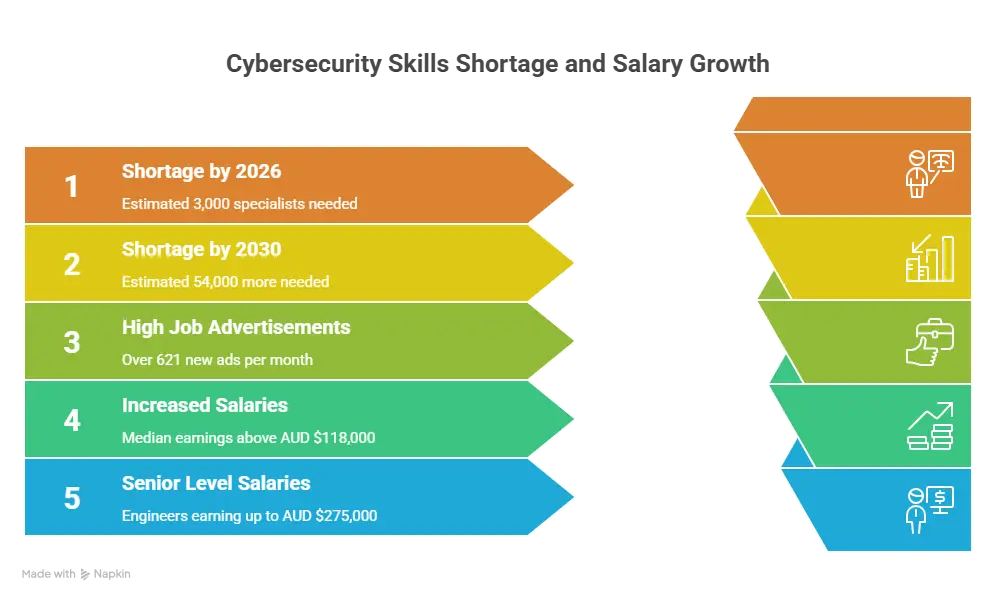
The numbers here are stark. Australia faces an estimated shortfall of 3,000 cybersecurity specialists by 2026, according to TVIP’s IT skills analysis. An estimated 54,000 more skilled people in cyber security operations and management will be needed by 2030. The vacancy rate of over 621 new cybersecurity job advertisements per month between September 2024 and September 2025 confirms that demand is not slowing.
That shortage translates directly into pay. The median full-time earnings for cybersecurity professionals in Australia sit above AUD $118,000, with employment in ICT security roles projected to grow 14.2% from 2024 to 2029. That is more than double the national average growth rate.
At the senior level, cybersecurity-focused engineers clear AUD $160,000 to $170,000 routinely, with some specialists passing $190,000. In Canberra, where government and defence demand is concentrated, engineers with security clearances can reach AUD $250,000 to $275,000.
Cybersecurity Specialisations With the Highest Demand
For engineers at the senior level weighing cybersecurity specialisation against other paths, the senior software engineer salary in Australia guide shows how specialisation premiums stack up at the $140K to $190K band.
Programming Languages: What Australian Employers Actually Want in Code
Every job post has a list of languages, and most engineers have opinions on which ones matter. I am going to skip the opinion and go straight to what SEEK and LinkedIn data shows for Australia in 2026.
Python sits at the top across multiple use cases. It leads in AI and machine learning roles, data engineering, backend API development, and automation scripting. That cross-domain demand makes Python the single most valuable language investment for most engineers right now.
JavaScript and TypeScript remain the backbone of web development. Employers consistently ask for TypeScript over plain JavaScript, reflecting the industry-wide push toward type safety in large codebases. React on the frontend and Node.js on the backend form the most requested full-stack combination in Australian job ads.
Java and C# hold strong in enterprise and government contexts. Australia’s financial services sector, government agencies, and large retailers run significant Java and .NET codebases, creating steady demand for engineers who can maintain and modernise them.
Go is growing fast in platform engineering and SRE roles. Its performance characteristics and built-in concurrency make it the preferred language for infrastructure tooling at companies that have outgrown Python for systems work.
| Language | Primary Use Case in Australia | Typical Salary Range (AUD) | Demand Trend |
| Python | AI/ML, data engineering, backend APIs | $100,000 – $165,000 | Very High |
| JavaScript / TypeScript | Full stack, frontend, Node.js backend | $90,000 – $150,000 | High |
| Java | Enterprise systems, banking, government | $100,000 – $160,000 | Stable – High |
| C# | .NET enterprise, government, game dev (Unity) | $95,000 – $155,000 | Stable |
| Go | Platform engineering, SRE, infrastructure | $115,000 – $175,000 | Growing Fast |
| SQL | Data engineering, analytics, all sectors | $85,000 – $145,000 (combined) | Always in demand |
| Kotlin / Swift | Mobile development (Android / iOS) | $95,000 – $150,000 | Moderate |
Choosing the right programming language is the first step, but building a career path around it requires a broader strategy. The guide on best programming languages to learn covers which languages offer the best long-term return in the Australian market.
The Mid-Level Reality Check: Where the Market Is Crowded
I want to address something most articles skip. Not all software engineering roles in Australia are equally in demand right now. The market in 2026 is genuinely split.
Mid-level engineering roles, general software development positions, and product roles are seeing significantly more applicants than during the post-pandemic hiring surge. Jobs and Skills Australia even removed software engineers from the official national shortage list for the first time in five years, citing market stabilisation and AI tools reducing some entry-level demand.
This does not mean the market is bad. It means generalist positioning is more competitive than it was. If you are at the 3 to 6 year mark in your career, the difference between a crowded job search and multiple competing offers often comes down to one or two specialist skills on your resume.
The mid-level software engineer salary guide for Australia shows exactly what the market is paying at this experience level, which is useful for benchmarking whether your current pay reflects your specialisation.
What Entry-Level Engineers Need to Know About Skill Positioning
Entry-level roles are more competitive than two years ago, full stop. AI tools have absorbed some of the basic development work that junior engineers used to own, which means employers expect more from junior hires before they will take the risk.
The engineers landing their first roles are the ones who have built something real. A side project using an AI API, a cloud-deployed application with a CI/CD pipeline, or a contribution to an open-source project signals more than a degree transcript.
The most effective skill combination for entry-level candidates in Australia right now is Python plus one cloud provider (AWS is the safest choice) plus basic SQL. That combination covers enough of the high-demand categories that your resume will match more filters and more job descriptions.
For a detailed breakdown of what junior roles pay and what they expect, the junior software engineer salary in Australia guide provides current 2026 data with salary ranges by city.
The Soft Skill That Is Now a Hard Requirement: Systems Thinking
This section covers something the top 10 results mostly ignore: the shift in what “soft skills” actually means in Australian tech hiring in 2026.
Hiring managers are not asking for teamwork and communication in the abstract sense anymore. They are asking for systems thinking, specifically the ability to explain how components interact within a broader architecture rather than just solving isolated tickets.
The Fuse Recruitment 2026 market report put it clearly: “Engineering teams are deeply integrated with product, design and operations. Employers value engineers who can think beyond isolated tickets. Communication is no longer optional. It is competitive advantage.”
In practical terms, this means your ability to write a clear technical proposal, explain a trade-off to a non-technical stakeholder, or lead a post-mortem without finger-pointing is now part of what determines whether you get to the senior pay band. It affects promotions at existing employers and offers from new ones.
Which Certifications Actually Pay Off in Australia Right Now
I get asked this constantly. Most certification content online is either too generic or outdated. Here is what I see reflected in actual Australian job listings and salary data in 2026.
AWS certifications remain the gold standard. The AWS Solutions Architect Professional sits at the top of the list for cloud roles, with employers explicitly asking for it in senior and lead cloud engineer job descriptions. The AWS Security Specialty is growing fast in demand, reflecting the DevSecOps trend.
For AI and machine learning, Google’s Professional Machine Learning Engineer certification and the Deep Learning Specialisation from Coursera are the most recognised by Australian employers. They signal that you can move beyond API calls and actually build production AI systems.
CISSP and CEH are the primary cybersecurity certifications that consistently appear in senior role requirements. For early-career cybersecurity professionals, CompTIA Security+ is the accepted entry point.
Kubernetes certification (CKA or CKAD) from the Cloud Native Computing Foundation is the key credential for DevOps and platform engineering roles. Employers treat it as a filter in many job descriptions.
How to Build Toward the High-Demand Tier From Any Starting Point
The path from general software developer to premium specialist does not require starting over. It requires deliberate layering of skills over time.
If you are already writing Python, the shortest path to a salary jump is adding cloud deployment skills. Build a side project that uses AWS Lambda or Azure Functions. Get the AWS Developer Associate certification. That combination alone can shift you from general backend roles into DevOps-adjacent or cloud-native roles, which pay $15,000 to $30,000 more.
If you are already in cloud or DevOps, the fastest premium comes from adding security knowledge. Understand the OWASP Top 10. Learn how to run a basic vulnerability scan. Study for the AWS Security Specialty. The DevSecOps premium is real and measurable in Australian job postings right now.
If you are a full-stack developer feeling the mid-market squeeze, the cleanest move is specialising either deeper into backend architecture and system design, or picking up data engineering skills (dbt, Spark, Airflow). Both moves take you out of the crowded generalist pool.
Understanding the full software engineer career arc helps you plan which skills to stack at each level. The guide on software engineer career options maps the major specialisation paths and what each one pays over time.
Salary Growth Timeline: What These Skills Add Over 10 Years
Skill investment pays off in different timeframes. Here is a realistic view of how the high-demand specialisations compound over a career, using verified 2026 data.
In years one to three, the difference between a generalist and a specialist is modest, roughly AUD $10,000 to $20,000. Entry-level AI and cloud roles pay more than entry-level general development, but the gap is not dramatic.
In years four to seven, the gap widens significantly. A mid-level cloud architect in Sydney is earning AUD $140,000 to $160,000 while a mid-level generalist full-stack developer is at $110,000 to $130,000.
The cybersecurity specialist at the same experience level is at $130,000 to $160,000. Each specialisation adds roughly $20,000 to $40,000 over a generalist at this band.
By years eight to ten and beyond, the compounding effect is dramatic. Senior cloud architects and AI/ML leads are at $170,000 to $280,000 in total compensation. Senior generalist engineers are at $140,000 to $170,000. The gap is now $50,000 to $100,000+, and it stays that way.
The biggest accelerant at any stage is moving employers. Most engineers who stay at one company for more than four years are being paid below market, regardless of their skill set. The 2026 data consistently shows that job-switching remains the fastest path to a meaningful raise, with typical gains of 20% to 30%.
When you are ready to negotiate with a new or current employer, a strong cover letter is your first impression. The guide on writing a software engineer cover letter covers how to position your specialist skills in a way that supports a higher salary anchor.

Four Common Misconceptions About In-Demand Skills in Australia
Misconception 1: You need to know everything about AI to benefit from the AI premium. You do not. Employers are paying premiums for engineers who can integrate AI tools into existing systems, build reliable data pipelines for AI models, and evaluate model outputs. You do not need a PhD. You need practical experience with the tools.
Misconception 2: Cloud skills are saturated because everyone has them now. Basic cloud skills are common. Advanced cloud skills are not. The difference between knowing how to spin up an EC2 instance and being able to design a multi-region active-active architecture with proper cost governance is enormous.
Employers are not short on people who passed the AWS Associate exam. They are short on people who can architect at scale.
Misconception 3: Cybersecurity is a completely separate career track. In 2026, the DevSecOps model has made security knowledge a premium add-on for software engineers who have no intention of moving fully into security.
Engineers who understand threat modelling, can review code for vulnerabilities, and can set up basic SAST/DAST tooling are worth more in most teams than pure developers who treat security as someone else’s problem.
Misconception 4: Certifications do not matter in Australia. They do, but selectively. The right certifications (AWS, Kubernetes, CISSP) function as filters in applicant tracking systems and as anchors in salary negotiations.
The wrong ones (vendor-specific, low-prestige) add weight without value. Know which certifications Australian employers actually list before investing your time.
For those considering a broader pivot into software engineering or computer programming, the guide on how to become a computer programmer covers the entry pathways and which skills to prioritise from day one.
Frequently Asked Questions
-
What is the most in-demand skill for software engineers in Australia in 2026?
AI and machine learning skills are the most in-demand and highest-paying specialisation in 2026. Cloud engineering (AWS, Azure, GCP) is the most broadly advertised skill cluster on SEEK. If you can only add one skill, cloud expertise has the widest application. If you are targeting maximum pay, AI/ML is the higher-ceiling option.
-
Which programming language pays the most for software engineers in Australia?
Python carries the widest salary opportunity because it applies across AI, data engineering, and backend development. Go is growing fastest in the high-paying platform engineering and SRE space. Java and C# remain stable in well-paying enterprise roles. For maximum salary ceiling, Python combined with cloud or AI skills is the strongest combination in the current market.
-
Is there a skills shortage for software engineers in Australia in 2026?
The shortage is skill-specific. Generalist mid-level roles have more applicants than two years ago, and Jobs and Skills Australia removed software engineers from the national shortage list for the first time in five years. However, specialists in AI, cybersecurity, cloud architecture, and platform engineering remain in critical shortage, with employers paying premiums and still struggling to fill roles.
-
Do certifications help software engineers earn more in Australia?
Yes, for specific certifications. AWS Solutions Architect Professional, Kubernetes (CKA), CISSP, and Google Professional ML Engineer consistently appear in Australian job requirements and salary negotiation contexts. They function both as ATS filters and as anchors in salary conversations. Generic or low-prestige certifications have minimal impact on Australian employer decisions.
-
What sectors in Australia have the highest demand for software engineers?
Financial services (fintech and banking), healthcare, cybersecurity and defence, and cloud-native startups in Sydney and Melbourne show the highest demand in 2026. Government and defence in Canberra are particularly strong for cybersecurity-cleared engineers, with some of the highest total compensation packages in the country reaching AUD $250,000 to $275,000.
-
How much does an AI/ML engineer earn in Australia in 2026?
Senior AI and ML engineers in Australia earn between AUD $130,000 and $198,000 in base salary according to Alcor’s data, with total compensation reaching $215,000+ at companies like Atlassian and Canva when equity is included. Lead ML engineers based in Sydney can hit $189,000 in base alone. LLM architects with production deployment experience are among the highest earners in the market.
-
What is the fastest way to increase my salary as a software engineer in Australia?
The data points to two clear levers. First, add a high-demand specialisation (AI/ML, cloud architecture, or cybersecurity) that takes you out of the generalist pool. Second, change employers. Most engineers gain 20% to 30% by moving companies, far more than the typical 3% to 5% annual raise at the same employer. Doing both in sequence is the most reliable path to a significant pay increase within two to three years.
Share Your Experience
If you have recently negotiated a salary based on specialist skills, landed a role with an AI or cloud premium, or made a skill pivot that changed your pay band, I would genuinely like to hear about it. Drop your experience in the comments. Real data from working engineers is what keeps guides like this honest.
How This Article Was Created
The salary figures and market data in this article were drawn from the following sources, all accessed in May 2026: Academy Xi 2026 Software Engineer Market Update, Hays 2026 Salary Guide, Talent International 2026 Salary Data, TVIP Top IT Skills Australia 2026, Emanate Technology IT Job Market Report April 2026, Fuse Recruitment 2026 Australian Tech Job Market Report, SEEK job listing data (live, May 2026), Alcor BPO 2025 AI/ML Salary Data, and Jobs and Skills Australia Occupation Shortage Reports.
No salary figures were fabricated. All numbers cited reference specific published sources. The article was written to help software engineers in Australia understand what the market is paying and which skills drive premium compensation. It is not recruitment advertising and no employer paid to be featured.
Data represents the Australian market as of May 2026. Salary ranges reflect base pay unless otherwise noted. Total compensation figures include equity and bonuses where specified.

Shahzada Muhammad Ali Qureshi (Leeo)
I’m Shahzada — a software engineer by education and an SEO professional by trade. I built WhatIsTheSalary.com to go beyond just showing salary numbers — every page is manually researched across sources like BLS, Glassdoor, LinkedIn Salary, and PayScale to give you the full picture in one place. If you found what you were looking for here, that’s exactly the point.