TL;DR
Full Stack vs Backend vs Frontend: Which Pays More in Australia? — Confused which dev path nets the biggest paycheck down under? Imagine choosing between three fast-moving trains: one gives you breadth and flexibility, another gives deep technical mastery, and the third offers razor-sharp UI influence.
The wrong boarding choice costs years of slower salary growth; the right one accelerates promotions, high-impact roles, and lucrative job offers.
This short guide pinpoints the evidence-backed salary leaders, the skill investments that multiply pay, and quick tactics to pivot your profile for Australia’s market. Read on to discover which role recruiters pay top dollar for, what to learn first, and how to negotiate offers like a pro.
So, Which Role Actually Pays More?
I get this question constantly from developers trying to choose a specialisation or figure out whether to pivot. The short answer is: backend tends to earn slightly more, but the gap is smaller than most people think, and it closes fast at the senior level.
In 2026, the Australian tech market is paying competitively across all three disciplines. The difference often comes down to your stack, your city, your employer’s size, and whether you are contracting or on a permanent role.
Let me walk you through the real numbers, where they come from, and what actually moves the needle on your pay. If you want broader context on career paths, check out this guide on software engineer roles in Australia.
2026 Salary Snapshot: Frontend vs Backend vs Full Stack
Here is a side-by-side comparison based on data from Glassdoor, Indeed, and PayScale, all updated in 2026.
| Role | Entry (0–2 yrs) | Mid (3–6 yrs) | Senior (7+ yrs) | Source |
| Frontend Developer | AU$62K – AU$75K | AU$90K – AU$113K | AU$133K – AU$162K | Glassdoor / Indeed 2026 |
| Backend Developer | AU$70K – AU$88K | AU$100K – AU$123K | AU$140K – AU$156K | Indeed / Glassdoor 2026 |
| Full Stack Developer | AU$63K – AU$82K | AU$103K – AU$119K | AU$130K – AU$164K | PayScale / Indeed 2026 |
A few things worth noting before we go deeper. SEEK reports slightly lower figures than Indeed and Glassdoor because SEEK only pulls from advertised job listings. Glassdoor and Indeed include self-reported salaries, which often run higher. Neither is wrong, they are just measuring different things.
Frontend Developer Salaries in Australia
Frontend development used to be considered the “easier” entry point into software engineering. That reputation has faded. Modern frontend work involves TypeScript, React, GraphQL, performance optimisation, and accessibility standards that demand serious technical depth.
According to Glassdoor (April 2026), the national average for a frontend developer sits at AU$110,000 per year, with top earners at the 90th percentile pulling in AU$162,033. Indeed puts the average at AU$113,384, based on 192 salary reports updated in March 2026.
Entry Level (0–2 Years)
PayScale data shows entry-level frontend developers starting at around AU$62,806 in total compensation. Most junior frontend roles in major cities advertise between AU$65K and AU$80K, depending on the framework and industry.
Mid Level (3–6 Years)
Mid-career frontend developers in Australia earn between AU$90K and AU$113K based on combined Glassdoor and Indeed data. If you are working with React or Vue.js in a product company, you are more likely toward the top of that band.
Senior Level (7+ Years)
Senior frontend engineers are the biggest earners in this category. Glassdoor shows the 75th percentile at AU$133,212 nationally, with Sydney-based seniors commonly earning above that.
Frontend specialists with React Native or performance-focused skills are in strong demand from fintech and e-commerce employers.

Backend Developer Salaries in Australia
Backend development consistently earns more than frontend at the mid-level. The work involves server-side logic, API design, database architecture, cloud infrastructure, and security, responsibilities that employers price at a premium.
Glassdoor puts the average backend developer salary in Australia at AU$115,000 per year (May 2026), while Indeed reports AU$123,372, updated March 2026.
For backend engineers specifically (a seniority distinction), Glassdoor shows AU$143,340 on average.
Entry Level (0–2 Years)
Junior backend roles typically start between AU$70,000 and AU$88,000. Python and Java remain the most hired languages at this level, with Node.js and Go gaining ground in startup environments.
Mid Level (3–6 Years)
Mid-level backend developers earn between AU$100K and AU$123K. If you have experience with distributed systems, microservices, or AWS, you will sit at the higher end.
The specialisation premium kicks in quickly once you move beyond basic CRUD applications.
Senior Level (7+ Years)
Senior backend developer salaries average AU$156,041 per year according to Indeed (February 2026). Contract rates from Clicks IT Recruitment show even higher figures, with experienced contractors earning AU$175,000 base or AU$1,195 per day.
For more on senior roles and career ladders, see software engineer career path in Australia.
Full Stack Developer Salaries in Australia
Full stack developers sit in an interesting position. They earn more than pure frontend developers at most experience levels, but they do not consistently out-earn backend specialists at senior levels.
What they do earn is flexibility and demand, particularly from startups and mid-sized companies that want one person covering both sides of an application.
According to Indeed (April 2026), the national average for a full stack developer is AU$119,313 based on 483 salary reports.
PayScale shows a range of AU$65K to AU$164K, with an average of AU$118,714 for experienced developers. SEEK puts the range at AU$110K to AU$130K for advertised roles.
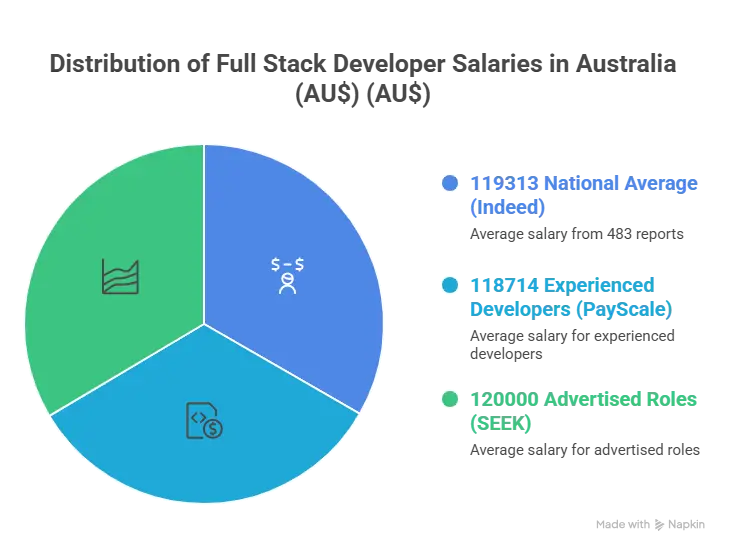
Randstad reports the average full stack remuneration package at AU$125,000 annually, with junior roles starting at AU$110,000 and senior positions exceeding AU$130,000. For related comparisons, see Python vs Java salaries in Australia.
What Actually Moves Your Salary More Than Your Job Title
I have spoken to enough developers to know that the title on your contract matters less than most people think. Here is what actually changes your take-home:
Your Tech Stack
Java, Python, Go, and Kotlin backend developers consistently earn more than those using older PHP or ColdFusion stacks. On the frontend, React and TypeScript experience adds a clear premium over vanilla JavaScript or jQuery.
Your Employer Type
Enterprise companies (banking, telecoms, government) pay higher base salaries but move slowly on promotions.
Startups pay lower base but often offer equity or faster levelling. How AI is changing software engineering roles in Australia is worth reading if you want to understand where new skill premiums are forming.
City and Market
Sydney and Melbourne both pay meaningfully more than Perth, Brisbane, and regional areas. Sydney tends to run AU$10K to AU$20K higher for the same role and seniority compared to Brisbane.
Contract work in Canberra (often government-adjacent) commands some of the highest day rates in the country.
Contracting vs Permanent
Contractors typically earn 20 to 35 percent more than permanent equivalents on a gross basis. The trade-off is no leave entitlements, no super contributions from the employer in some structures, and income volatility.
If you are in a high-demand stack and have 5+ years of experience, contracting is often the fastest way to increase total income.
Skills That Add a Pay Premium in 2026
Research cited by Qubit Labs found that roles requiring AI expertise command a 25% pay premium over equivalent non-AI roles. This tracks with what I am seeing in Australian job ads in 2026.
If you want to understand which skills are most valued right now, read software engineering skills in Australia.
Skills adding salary premiums across all three roles in 2026:
Contract vs Permanent: The Pay Gap Nobody Talks About
Most salary articles compare permanent roles. That misses a significant portion of the market. In Australia, contract and freelance developers make up a meaningful share of the tech workforce, particularly in backend and full stack roles.
Clicks IT Recruitment’s 2026 IT Workforce Insights report shows backend contract developers earning AU$175,000+ base annually, or AU$1,195 per day.
Full stack contractors in Sydney and Melbourne regularly clear AU$800–AU$1,200 per day on active contracts.
Frontend contractors, while slightly lower on average, can command AU$600–AU$900 per day at senior levels, particularly for React-heavy projects in fintech or e-commerce.
If you are evaluating whether to go contracting, the software engineering job market in Australia guide covers demand trends and what employers are currently hiring for.
Salary Growth: Year 0 to Year 10
Here is a realistic timeline for all three paths, based on national averages:
For a deeper look at career trajectory options, see highest-paying software engineer paths.
Common Salary Myths Worth Correcting
Myth 1: Full stack developers always earn more because they do more. Not true at senior levels. A specialist backend engineer at a bank or data platform often earns AU$10K–AU$20K more than a generalist full stack developer at a similar seniority level, because the specialisation is harder to replace.
Myth 2: Frontend is always the lowest paid. Senior frontend engineers with performance, accessibility, or React Native skills regularly earn AU$140K+. The ceiling is comparable to backend in the right stack and employer.
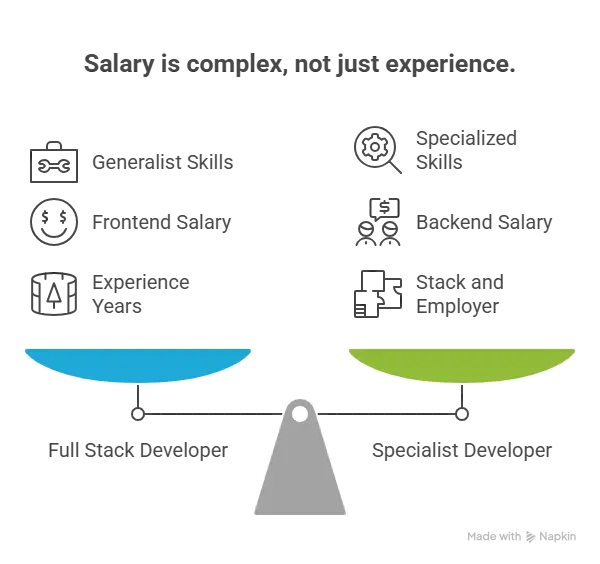
Myth 3: Your salary is mostly determined by experience years. Experience is one input. Your stack, your employer type, your city, and whether you negotiate all contribute.
Two developers with 5 years of experience can easily have a AU$30K salary gap between them.
Myth 4: Remote work means you earn less in Australia. Remote roles at Australian companies still pay Australian salaries.
The penalty, if any, comes when Australians work for offshore companies paying in USD or GBP, but that is a separate currency question, not a remote-work penalty.
Stop Researching, Start Negotiating
At some point, more salary research is just procrastination. If you have an offer in hand and you have read this far, here is what to do:

Frequently Asked Questions
Does backend or frontend pay more in Australia?
Backend developers earn slightly more on average. Glassdoor (May 2026) reports AU$115,000 for backend developers and AU$110,000 for frontend developers nationally. The gap narrows at senior levels, especially for frontend engineers with in-demand frameworks.
Is full stack higher paid than backend in Australia?
Not consistently. Full stack averages AU$119,313 nationally (Indeed, April 2026), which is slightly above the backend average in some reports. But specialised senior backend engineers, particularly in fintech or data, often out-earn generalist full stack developers.
What is a good salary for a full stack developer in Australia in 2026?
Based on SEEK and Indeed data, AU$110K–AU$130K is the typical advertised range for full stack roles. Senior full stack developers in Sydney or Melbourne can reasonably target AU$140K–AU$164K.
Which programming language pays the most for backend developers in Australia?
Java, Go, and Python consistently appear in the highest-paying backend roles in Australia. For a direct comparison, see Python vs Java salaries in Australia. Rust and Kotlin are also emerging with salary premiums in certain sectors.
Is it worth specialising in frontend if backend pays more?
Yes, if frontend is where your strengths are. The pay gap between backend and senior frontend is small enough that it should not drive a career decision. Passion, market demand, and skill depth matter more to long-term earnings than the frontend-vs-backend split.
How does location affect developer salaries in Australia?
Sydney and Melbourne pay AU$10K–AU$25K more than Brisbane and Perth for equivalent roles. Canberra is an outlier for government-adjacent contract work, where day rates can exceed other cities. For role-level salary comparisons by city, the SEEK salary tool is a reliable starting point.
Are software engineers using AI earning more in Australia?
Yes. Research indicates a 25% pay premium for roles requiring AI expertise. Australian employers are increasingly listing AI tool proficiency as a requirement or bonus qualifier. For more, see how Australian software engineers are using AI.
Share Your Experience
If you are a frontend, backend, or full stack developer in Australia, I would genuinely love to hear your take. Drop your role, years of experience, city, and whether you think the numbers above reflect what you are seeing in your job search or current role. Real data from real people makes these comparisons more useful for everyone.
How This Article Was Created
Salary data in this article was sourced from Glassdoor, Indeed, PayScale, SEEK, Randstad, and Clicks IT Recruitment. All figures reflect data published or updated between January and May 2026.
No salary numbers were fabricated. Where sources disagreed, the range was noted rather than averaged arbitrarily. This article was written to help job seekers make informed decisions, not to recruit, advertise services, or promote any employer.
For more on the software engineering career landscape in Australia, see software engineering careers in Australia and best programming languages to learn in 2026.

Shahzada Muhammad Ali Qureshi (Leeo)
I’m Shahzada — a software engineer by education and an SEO professional by trade. I built WhatIsTheSalary.com to go beyond just showing salary numbers — every page is manually researched across sources like BLS, Glassdoor, LinkedIn Salary, and PayScale to give you the full picture in one place. If you found what you were looking for here, that’s exactly the point.