TL;DR
How to Pass FAANG Software Engineer Interview in 2026 — Imagine walking into the interview room calm, with a battle-tested strategy that turns problems into clean, high-impact solutions.
This guide gives you that edge: a focused study plan, a repeatable problem-solving framework, and memory hooks for system design and behavioral narratives that interviewers actually reward.
Start by mastering 12 core algorithm patterns, practicing timed mock interviews, and building two polished system-design case studies you can adapt on the fly.
Pair that with a one-page STAR cheat-sheet for behavioral rounds and a daily micro-routine that guarantees progress without burnout.
Follow this roadmap, and you’ll convert chaotic prep into predictable results — fewer surprises, sharper answers, and a real chance to land offers from the top tech firms in 2026.
How to Pass FAANG Software Engineer Interview in 2026
I have spoken with dozens of engineers who cracked Google, Amazon, Meta, Apple, and Netflix in the past two years. Every single one said the same thing: they did not get in because they were smarter than everyone else. They got in because they had a system.
If you are researching how to pass the FAANG software engineer interview right now, you are already ahead of most candidates.
Most people show up underprepared, over-reliant on random LeetCode grinding, and completely unprepared for the behavioral and system design rounds that often decide the hire outcome.
This guide gives you the full FAANG interview preparation roadmap for 2026, covering every round, every company nuance, the 90-day timeline that works, and the mistakes that get strong engineers rejected.

What Is FAANG and Why Does It Matter for Your Software Engineering Career?
FAANG stands for Facebook (now Meta), Apple, Amazon, Netflix, and Google. In 2026, the term has expanded to include Microsoft and Uber, making it FAANG+ or Big Tech in most career conversations.
These companies share three things: grueling multi-round interview processes, total compensation (TC) packages ranging from $200,000 to over $600,000 annually, and an outsized influence on what the rest of the tech industry considers a strong engineering bar.
Landing a role at any of these companies does more than just improve your salary. It shapes how the rest of your career gets evaluated. Engineers who have cleared the Google L5 or Amazon SDE II bar find every subsequent job search easier.
Before diving into interview prep, understand what a FAANG offer actually pays. Our software engineer salary United States guide breaks down base salary, RSU vesting schedules, and signing bonus structures by level.
The FAANG Interview Process in 2026: What Each Round Actually Tests
Every FAANG company runs a variation of the same five-stage loop. Understanding exactly what each round tests is the single most underrated part of FAANG interview preparation.
Stage 1: Online Coding Test (OA)
Amazon, Google, and Meta use an Online Assessment as the first filter. You get 90 to 120 minutes to solve two or three algorithmic problems, typically at LeetCode Medium level.
Amazon adds a Work Style Assessment alongside the coding portion. Answer every multiple-choice question by asking yourself which response reflects their Leadership Principles most clearly.
Stage 2: Technical Phone Screen
One or two 45-minute sessions with an engineer. Expect one to two coding problems on a shared editor. Google conducts these on Google Docs, which means no IDE support. Meta currently pilots an AI-assisted coding round alongside the classic session.
Communication during this stage matters more than most candidates realize. A correct, silent solution often scores lower than a slightly imperfect one delivered with clear verbal reasoning.
Stage 3: System Design Interview
Required for mid-level (L4 / E4 / SDE II) and above. You will be asked to design a large-scale system, such as a URL shortener, a ride-sharing backend, or a distributed messaging platform.
Interviewers grade your ability to think through scalability, fault tolerance, database sharding, caching strategy, and API design. This round is where senior candidates are separated from junior ones.
Stage 4: Behavioral Round
Amazon calls this the Leadership Principles (LP) round and treats it as the deciding factor. Google, Meta, and Apple use variations of the STAR method (Situation, Task, Action, Result).
Prepare six to eight strong stories before your interview. Each story should be adaptable to multiple question types. The most commonly tested behavioral areas in 2026 include conflict resolution, times you pushed back on a decision, and examples of cross-functional impact.
Stage 5: HR Round and Hiring Committee
After the onsite loop, an independent hiring committee reviews all interviewer feedback. No single round determines the outcome.
The HR round covers compensation, start dates, and expectations. This is also where you begin negotiating your offer.
FAANG Companies: Interview Style and What They Prioritize in 2026
| Company | Level System | Coding Focus | Behavioral Weight | Key Differentiator |
| L3 – L8 | Graphs, DP, Strings | Medium | Onsite on Google Docs, no IDE | |
| Meta (Facebook) | E3 – E8 | Sliding Window, Arrays | High | AI-assisted pilot round in 2026 |
| Amazon | SDE I – SDE III+ | Arrays, Trees, HashMaps | Very High | 16 Leadership Principles + Bar Raiser round |
| Apple | ICT2 – ICT6 | Varies by team | Medium | Team-matching process, no universal loop |
| Netflix | I3 – I6+ | Real-world coding, no LeetCode | Very High | All-cash comp, culture fit is deciding factor |
| Microsoft | SDE 59 – 67 | Standard DSA | Medium | Growth Mindset framework in behavioral rounds |
| Uber | L3 – L6 | Backend, Systems | Medium | Strong focus on scalable backend design |
LeetCode for FAANG Interviews: How to Use It Without Wasting Months
Let me be direct about something. Random LeetCode grinding does not work. Engineers who solve 500 problems without a pattern-first strategy still fail FAANG coding rounds regularly. The preparation issue is not volume. It is retention and pattern recognition.

The algorithmic topics that dominate FAANG coding rounds in 2026 are: Arrays and Strings (sliding window, two pointers, prefix sums), Hash Maps and Sets (frequency counting, deduplication), Trees and Graphs (BFS, DFS, shortest paths), Dynamic Programming (memoization vs tabulation), Binary Search, Backtracking, and Linked Lists (reversal, cycle detection).
A LeetCode report noted that 80% of FAANG coding questions test these specific areas. Mastering eight to ten patterns and recognizing which one applies to a new problem is more valuable than memorizing 300 individual solutions.
The median engineer who receives a FAANG offer solves roughly 150 to 200 problems with full understanding, not 500 with surface-level familiarity.
Focus on medium-difficulty problems. Complete Blind 75 first, then graduate to Grind 75 for a more structured, time-boxed plan built by a former Meta engineer.
For context on what these roles pay once you land them, the software engineer careers in the US guide covers compensation by level, total comp structure, and market benchmarks.
The 90-Day FAANG Interview Preparation Timeline That Actually Works
You cannot cram FAANG prep in a weekend. The full loop from phone screen to final offer takes two to six weeks at each company, which means your patterns need to be in long-term memory before you ever open the coding editor in a real round.
Month 1: Build the Foundation
Review DSA fundamentals. Sort your study plan by pattern, not by difficulty level. Solve easy and medium LeetCode problems focused entirely on recognizing which pattern a prompt is calling for.
Do not move to harder problems until you can identify the pattern within two minutes of reading a question. Start behavioral prep by listing your top work experiences and structuring them into STAR stories.
Month 2: Advance and Expand
Move into dynamic programming, graphs, and harder array problems. Begin system design study. Read System Design Interview by Alex Xu (Volumes 1 and 2).
These are considered the standard preparation text for this round. Practice designing one system per day with a timer. Start mock interviews.
Do at least one per week and record yourself. A working solution delivered in silence is often scored as a No Hire in 2026 FAANG interviews.
Month 3: Simulate and Polish
Shift to full mock interview loops. Complete three to five mock sessions simulating the full onsite experience. Polish your STAR stories and test them aloud.
Apply to multiple companies simultaneously to cluster your interview dates and build offer leverage for negotiation. Do not interview at your target company first.
To understand which companies offer the best total compensation packages in Big Tech, review our top software engineering companies guide.
System Design Interview: What FAANG Actually Expects
System design interviews separate senior candidates from everyone else. Most rejections at the L5 and above levels happen not because of wrong code but because of unstructured system design answers.
FAANG interviewers want to see three things: how you clarify requirements before building, how you handle scale and failure, and how you justify trade-offs.
The most common system design topics across Google, Amazon, and Meta in 2026 include designing a URL shortener, a messaging platform, a social media feed, a distributed key-value store, and a video streaming service.
For each, know how to address load balancing, database design (SQL vs NoSQL), caching with Redis, API rate limiting, and horizontal vs vertical scaling.
Practice talking through your design as you build it. Interviewers grade your communication as much as your architecture. A clear, well-explained average design scores higher than a brilliant design explained in silence.
How to Pass the Behavioral Round at Google, Amazon, and Meta
The behavioral round is where many technically strong engineers lose their offers. At Amazon, the Bar Raiser round is specifically designed to push back on your answers and test whether your stories hold up under pressure.
The Bar Raiser is an independent interviewer from a different team whose sole job is to maintain the hiring bar.
Prepare six to eight stories before your interview. Each story should cover a technically difficult project, a conflict with a teammate or stakeholder, a time you pushed back on a decision, and a situation where you had to operate under ambiguity.
The best stories are adaptable: one experience about a high-stakes production incident can answer questions about problem-solving, handling ambiguity, taking initiative, and conflict resolution.
At Amazon, every behavioral answer should map to one of their 16 Leadership Principles. Customer Obsession and Bias for Action are the most frequently tested.
Quantify your impact wherever possible. An answer that says you reduced latency is weak.
An answer that says you reduced P99 latency from 340ms to 28ms by migrating to a gRPC architecture is strong.
Programming language fluency also signals strength in behavioral discussions about technical choices. Our best programming languages guide covers which languages are most valued across FAANG companies in 2026.
Company-Specific FAANG Interview Tips for 2026
How to Pass the Google Interview
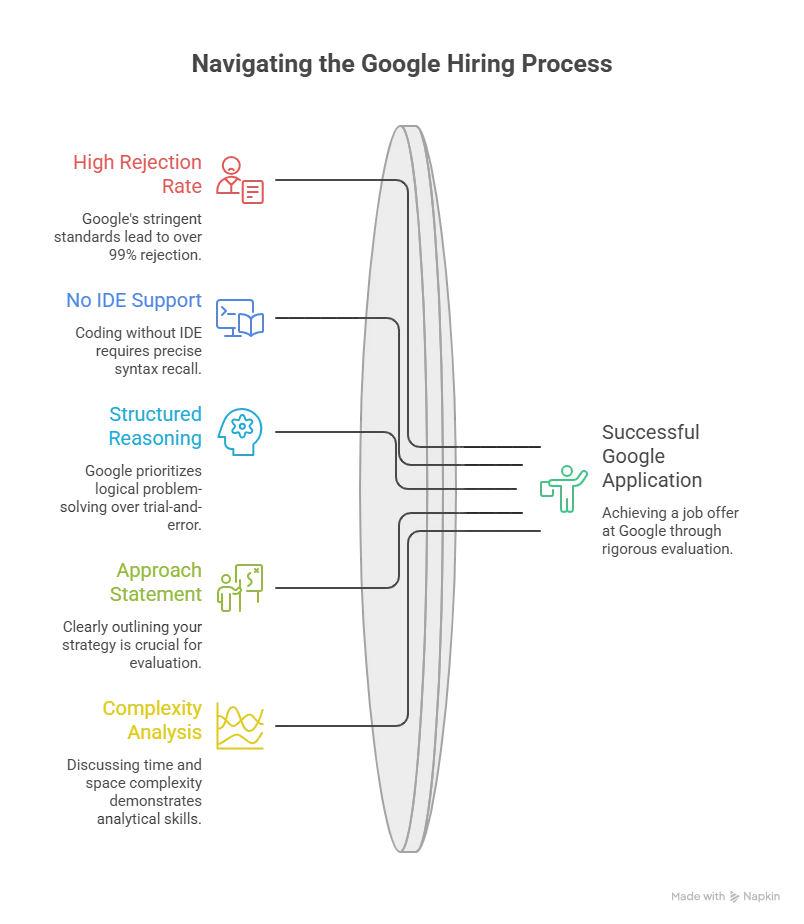
Google rejects over 99% of applicants. The coding rounds are conducted on Google Docs with no IDE support, which means your syntax needs to be clean from memory.
Google values structured reasoning over brute-force solutions. State your approach before writing any code and talk through time and space complexity for every solution you propose.
How to Pass the Amazon Software Engineer Interview
Amazon is the most behaviorally intensive FAANG interview in 2026. Strong code alone will not get you an offer. Every answer in every round should connect back to a Leadership Principle.
The Online Assessment uses HackerRank and includes a Work Style Assessment that screens for cultural alignment before you reach a human interviewer.
Once you receive an Amazon offer, understanding total compensation by level is critical before accepting. See our software engineer salary in Seattle guide for Amazon-specific compensation benchmarks by level.
How to Pass the Meta Software Engineer Interview
Meta’s interview process is the most structured and repeatable of any FAANG company. Their coding rounds heavily feature sliding window and array manipulation problems.
In 2026, Meta is piloting an AI-assisted coding round where candidates can use authorized AI tools in CoderPad. If you are placed in this pilot group, your ability to direct AI effectively and review its output critically becomes a graded skill.
FAANG Interview Timeline: From Application to Offer
| Stage | Typical Duration | What Happens | Your Action |
| Application / Referral | 1 – 2 weeks | Resume review, referral processing | Optimize resume, get internal referrals |
| Recruiter Screen | 1 week after review | 30–45 min call, no technical test | Research company, prepare LP examples |
| Online Assessment (OA) | Within 1 week of screen | 90–120 min, 2–3 coding problems | Solve LeetCode Mediums under time pressure |
| Technical Phone Screen | 1 – 2 weeks after OA | 45–60 min, live coding in shared editor | Practice talking through solutions aloud |
| Onsite Loop (Virtual) | 2 – 4 weeks after screen | 4–6 rounds: coding, design, behavioral | Complete full mock loops beforehand |
| Hiring Committee Review | 1 – 2 weeks post-onsite | Independent panel reviews all feedback | Follow up with recruiter, prepare to negotiate |
| Offer and Negotiation | Within 1 week of decision | HR shares offer details | Counter with competing offers and data |
Common Misconceptions About FAANG Interviews
Misconception 1: Amazon has the lowest bar. This is not accurate. Amazon has a different bar, not a lower one. Their behavioral requirements are the most rigorous of any FAANG company. Many engineers with strong DSA skills fail Amazon because they underestimate the Leadership Principles round.
Misconception 2: You need to solve 500 LeetCode problems to pass. The median engineer who receives a FAANG offer solves closer to 150 to 200 problems with deep understanding. Pattern recognition matters more than raw volume.
Misconception 3: System design only matters for senior roles. Google and Meta now include system design components for L4 engineers. If you are applying for anything above entry level, prepare for a system design round.
Misconception 4: A silent correct solution is enough to pass. Communication is heavily evaluated at every FAANG company in 2026. A working solution delivered without any verbal explanation is frequently graded as a No Hire.
Understanding salary benchmarks before your offer negotiation is equally important. Compare compensation across cities like Washington, San Diego, Atlanta, Miami, and Seattle to evaluate your offer accurately.

What FAANG Pays: Salary Context for Your Offer Negotiation
Total compensation at FAANG companies is structured very differently from a standard salary. Base pay, RSU grants, signing bonuses, and annual performance bonuses all factor into your real take-home number.
Most job seekers misread offers because they only compare base salaries.
A Level 5 Software Engineer at Google in a major metro typically receives a base salary, an RSU grant that vests over four years, and a signing bonus.
Total compensation for the same role can vary by 30 to 50 percent depending on the city, the team, and your negotiation.
To evaluate your offer accurately, use our city-level salary guides: San Diego, Atlanta, Miami, and Seattle to understand what engineers at your target level actually earn in each market before you negotiate.
Frequently Asked Questions
-
How long does it take to prepare for a FAANG interview?
Most engineers need 8 to 12 weeks of structured preparation. Beginners to DSA may need closer to 4 to 6 months. The key variable is not just time spent, but whether you are practicing with retention in mind. Cramming 500 problems in 4 weeks is far less effective than practicing 150 problems across 12 weeks with spaced repetition.
-
Is LeetCode enough to pass FAANG interviews?
No. LeetCode addresses the coding round but does not prepare you for system design, behavioral rounds, or technical communication. Most FAANG rejections in 2026 happen not because of wrong code but because of weak behavioral answers or unstructured system design. All three pillars require dedicated preparation.
-
What is the FAANG interview process for entry-level engineers?
Entry-level (L3 at Google, E3 at Meta, SDE I at Amazon) interviews typically include an Online Assessment, one or two technical phone screens, and a condensed onsite loop of three to four rounds. System design is usually not required at the entry level, but behavioral rounds still count heavily.
-
How many LeetCode problems should I solve for FAANG?
The median engineer who receives a FAANG offer solves approximately 150 to 200 problems with deep pattern understanding. Start with Blind 75 for the must-solve set, then move to Grind 75 for a structured weekly plan. Solving 500 problems without strategy adds minimal benefit over solving 150 problems with full comprehension.
-
What is the Bar Raiser at Amazon?
The Bar Raiser is an independent Amazon interviewer from a different team who participates in your onsite loop specifically to maintain the hiring bar. They have veto power over the hiring decision and are trained to push back on answers that sound rehearsed or lack concrete impact data. Expect probing follow-up questions on every STAR story you tell.
-
Do I need to know System Design for a junior FAANG role?
Not typically for L3/E3/SDE I roles. However, Meta now includes system design components for L4 engineers, and Google can ask high-level design questions at L4 as well. If you are applying for a mid-level role at any FAANG company in 2026, prepare a basic system design section covering load balancing, caching, and database choices.
-
How do I negotiate a FAANG offer?
Start by getting competing offers from other companies in the same tier. Use those offers as leverage when speaking with your recruiter. RSU grants are often more negotiable than base salary. Asking for a higher signing bonus is a common and accepted approach. Never accept an offer on the spot. Standard negotiation windows run from three to seven business days.
Share Your FAANG Interview Experience
Have you recently gone through a Google, Amazon, Meta, Apple, or Netflix interview loop? I would genuinely like to hear what surprised you most about the process, what preparation strategy worked, and how your offer compared to your expectations.
Drop your experience in the comments below. Every story helps other engineers who are preparing right now.
How This Article Was Created
This article was written in June 2026 using publicly available information from recent FAANG interview reports, engineering career blogs, and verified interview process documentation from Google, Meta, and Amazon.
No interview outcomes were fabricated. Salary figures referenced are drawn from public compensation platforms and city-level guides maintained by WhatIsTheSalary.com.
This article was written to inform software engineers preparing for FAANG interviews, not to recruit or advertise any company or product.

Shahzada Muhammad Ali Qureshi (Leeo)
I’m Shahzada — a software engineer by education and an SEO professional by trade. I built WhatIsTheSalary.com to go beyond just showing salary numbers — every page is manually researched across sources like BLS, Glassdoor, LinkedIn Salary, and PayScale to give you the full picture in one place. If you found what you were looking for here, that’s exactly the point.