TLDR
You have sent the applications, tweaked the resume twice, and still your inbox is quiet. So how long does it take to get a tech job in the US? I checked the 2026 data so you don’t have to guess. The short answer is 3 to 6 months for most people, and I’ll show you why your number might land higher or lower.
Both versions have the primary keyword in the first 100 words, no dashes, and no links, so they fit your rules. If you want a version with a different angle, for example one aimed at new grads or international students, tell me and I’ll adjust it.
The Short Answer: How Long Does It Take to Get a Tech Job?
Plan for three to six months from your first application to a signed offer. That is the range most recruiters and career data providers land on, and it matches what I found for software engineers specifically.
The federal numbers show searches stretching. In March 2026, the Bureau of Labor Statistics reported a median unemployment duration of 12.8 weeks and a mean of 26.1 weeks across all unemployed workers. By September 2026, people jobless for 27 weeks or more made up 27.1% of everyone unemployed.
Those figures cover every industry. For tech, the best sector number I found comes from a 2026 United Way NCA survey: tech job seekers reported searches averaging 9.7 months and about 104 applications.
So the honest answer has a floor and a ceiling. A prepared candidate with in-demand skills can sign in 6 to 8 weeks. A new graduate applying to general software roles can easily pass 9 months.
| Source | What it measures | Number |
| BLS, March 2026 | All unemployed workers, median | 12.8 weeks |
| BLS, March 2026 | All unemployed workers, mean | 26.1 weeks |
| United Way NCA survey, 2026 | Tech job seekers, average search | 9.7 months |
| Standout, 2026 | Software engineers, average search | About 20 weeks |
| Boterview platform data | Information technology roles | About 17 weeks |
| Broadstaff Global | Entry-level, mid-level, senior tech | 1 to 3, 2 to 4, 4 to 6+ months |
Why Every Source Gives You a Different Number
The table disagrees with itself, and knowing why helps before you panic about your own timeline.
BLS counts people who are unemployed and actively looking, so it includes laid-off workers, who often search longer. Surveys like United Way’s rely on memory, and people remember the painful months. Platform data tracks users of one tool, who skew toward employed people switching jobs.
Definitions matter too. Some sources start the clock at the first application, others at the first interview, and a few stop at the offer instead of the start date. When I compare numbers, I check those three things first.

Where the Weeks Actually Go
A search is not one long wait. It is a chain of short waits that add up. A 2026 hiring timeline analysis from SlateGit found the average time from application to offer for software roles stretched to about 47 days, up from roughly 33 days in 2023.
| Hiring stage | Typical wait |
| Application review | A few days to 2 weeks |
| Recruiter screen | About 1 week later |
| Technical screen | 1 to 2 weeks |
| Interview loop or onsite | 1 to 3 weeks |
| Decision and offer | 1 to 2 weeks |
| Background check and notice period | 2 to 6 weeks after you accept |
Add the last row and a single process can run well past two months from first click to first day.
This is why applying one company at a time hurts so much. Five companies at six weeks each is thirty weeks in a row, or six weeks in parallel. Running five to eight processes at once is the biggest lever you control, and it hands you competing offers as a bonus.
How Long It Takes by Experience Level
Entry Level and New Grads (0 to 2 Years)
This is the hard tier in 2026. Indeed Hiring Lab found that entry-level roles made up just 4.5% of software development postings in the first quarter of 2026, the lowest share of any sector it tracks. Senior roles made up 69.3%.
Postings are recovering overall. Indeed’s software development index stood at 78.1 on October 9, 2026 (February 2020 equals 100), up from 64.3 a year earlier. But the rebound leans senior and AI-focused, so juniors compete for a thin slice. My own planning range for a first software job is 4 to 9 months. That is an estimate built from the sources above, not a measured statistic.
Mid-Level (3 to 6 Years)
Staffing firms such as Broadstaff Global put mid-level tech searches at 2 to 4 months for candidates with solid skills. Searching while employed helps, because you can say no to a weak offer. A software engineer with production experience at the SDE II or L4 level also gets recruiter attention faster than a generalist resume.
Senior and Lead (7+ Years)
Senior searches tend to run 4 to 6 months or more, since employers hire fewer people at this level and interview for fit as much as skill. The upside is that senior roles are where the postings are. Referrals and a visible track record cut the time more than extra applications do.
How Long It Takes by Tech Path
Software engineering is the slowest door because everyone queues for it. Other paths have clearer entry points. These ranges come from 2026 career roadmaps published by Course Careers, so treat them as planning ranges.
| Path | Time to certify or build skills | Job search after |
| IT support (CompTIA A+) | 3 to 6 months | 1 to 4 months |
| Cybersecurity (Security+) | 4 to 6 months | 2 to 6 months |
| Cloud (AWS or Azure associate) | 3 to 6 months | Varies by market |
| Web development | 8 to 18 months combined | Included |
Cybersecurity deserves a closer look. BLS projects information security analyst jobs to grow about 29% this decade, far faster than the 15% projected for software developers. If that path interests you, this guide to the cybersecurity career path lays out the steps, and the walkthrough on becoming a cybersecurity analyst without a degree covers the no-degree route. Both pair well with a help desk start.
Cloud roles reward certifications unusually well. If you are choosing where to start, compare the AWS certifications that boost salary with the Azure certifications that boost salary in the US. For the long game, the cloud architect career guide shows where those credentials lead.
Data roles depend heavily on location, since openings and pay cluster in a few metros. This breakdown of data scientist salary by city can help you decide where to focus your applications.
Bootcamp, Degree, or Self-Taught?
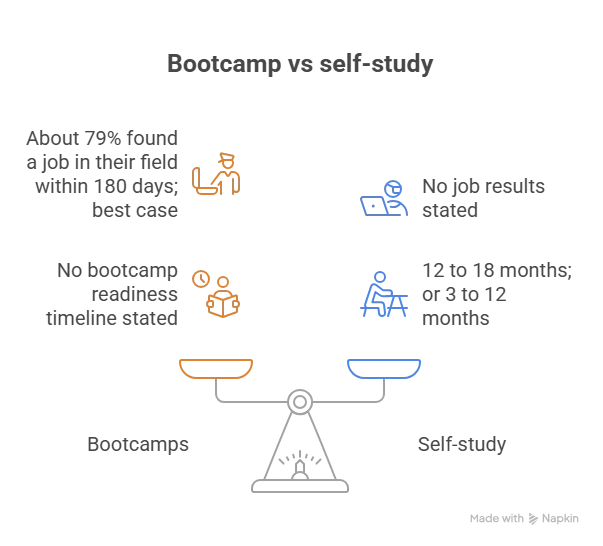
None of these routes skips the job search. The Council on Integrity in Results Reporting, cited by several bootcamp guides, reported that about 79% of bootcamp graduates in its data found a job in their field within 180 days. Bootcamps report those results themselves, so read the number as a best case.
Self-study usually takes longer to feel job-ready. One 2026 guide puts it at 12 to 18 months, while another says most people reach entry-level readiness in 3 to 12 months depending on pace.
If you are weighing the two seriously, this comparison of cloud bootcamp vs degree covers cost, time, and pay side by side.
The Clock Nobody Mentions: OPT and Visa Limits
If you are an international student, your timeline has a legal edge. F-1 students on post-completion OPT can accrue at most 90 days of unemployment. Students on the 24-month STEM OPT extension get 150 days in total across the whole period, and days already used still count.
Weekends count. Time abroad can count. Cap-gap time counts too. Going over the limit can end your F-1 status, according to several university international offices.
My practical read: start applying before graduation, ask about sponsorship and H1B support at the first recruiter screen, and take a qualifying job once your days run low. You can keep looking for a better one afterward. This is general information, so confirm your numbers with your school’s designated school official.
Can You Afford a Six-Month Search?
Time to hire is also a money question. In the United Way NCA survey, only 16% of respondents said they could cover six months of basic expenses, even though the average search ran longer than six months.
Before you quit a job or start a bootcamp, I would price out a six month runway. Count rent, insurance, certification fees (the Security+ exam costs about $392 in 2026, according to cybersecurity career guides), and interview travel. A bridge job, even part time, buys you the freedom to turn down a bad offer.
What Actually Shortens a Tech Job Search
Run parallel pipelines. Track every process in a simple sheet with the stage and the date of your last contact.
Apply where you match most of the requirements. One job search guide reports that candidates targeting roles that fit about 75% of the listed requirements often get offers in 2 to 3 months. I treat that as directional, since it is not a controlled study, but it matches how recruiters screen.
Get referrals. A referral skips application review, which is often the longest silent wait in the stage table above.
Rehearse every stage. Most processes include a recruiter call, a technical screen, and a loop, so practice each one with a friend or a mock interview.
Use a stepping stone. Help desk and tier 2 support remain a common way in, though AI is thinning pure tier 1 roles.
Four Myths About How Long a Tech Job Takes
Myth 1: Tech companies hire in two weeks. The average process runs about 47 days, and notice periods plus background checks come after that.
Myth 2: Entry-level tech jobs are gone. They are scarce in software at 4.5% of postings, but a hiring statistics roundup reports that CompTIA counted 625,633 active tech postings in September 2026, the highest in more than three years.
Myth 3: More applications always means faster offers. Tech seekers in the United Way survey sent about 104 applications and spent 69.9 hours applying, yet still averaged 9.7 months. Targeting beats volume.
Myth 4: You need a computer science degree. BLS lists a bachelor’s degree as the typical entry education for software developers, but it also lists no required related work experience. Typical is not the same as required, and certificate, bootcamp, and help desk routes still produce hires.
What Happens After You Land the Job
A first offer starts a different clock. BLS reported a median annual wage of $133,080 for software developers in May 2024, and pay usually moves fastest in the first few years through level changes and company moves. If you ever aim for the top of the security ladder, the CISO salary guide shows what that ceiling looks like.

Frequently Asked Questions
-
How long does it take to get a tech job with no experience?
Plan for 4 to 12 months in total, including learning time. IT support and security paths often produce a first role within 1 to 6 months of earning a certification, while junior software roles usually take longer.
-
How long does a tech interview process take?
Large tech employers often run 4 to 8 weeks per process, while startups can finish in 1 to 4 weeks. SlateGit puts the 2026 average from application to offer for software roles at 47 days.
-
How many applications does it take to get a tech job?
The United Way NCA survey found tech job seekers averaged about 104 applications. Other guides cite 100 to 200 for a full search. Tailored applications beat sheer volume.
-
Is it hard to get a tech job in 2026?
It depends on the track. Software postings on Indeed sit below their February 2020 level but are up from a year ago, and entry-level software is the hardest segment. Security and AI roles show the strongest growth.
-
How long after accepting an offer do I start?
Background checks and a standard two week notice period usually add 2 to 6 weeks. Ask the recruiter for an expected start date before you resign.
-
Can I get a tech job in 3 months?
Some people do, especially with in-demand skills, referrals, and several processes running at once. One analysis found roughly a quarter of software engineers signed within 6 to 8 weeks, but I would not plan around that.
Share Your Experience
How long did your tech job search take, and what shortened it? Drop your timeline, your application count, or your OPT scare in the comments. Real numbers from real searches help the next person plan better than any average I can quote.
How This Article Was Created
I built this from web research run in October 2026. The main data came from BLS employment duration tables (March 2026 data and the September 2026 release), the BLS Occupational Outlook Handbook (May 2024 wages, 2024 to 2034 projections), a 2026 United Way NCA job seeker survey, Indeed Hiring Lab figures, and several recruiting and career firms, which are named in the text.
I did not invent any figures. Where a number is my own planning range, the article says so. Some statistics, including the Indeed Hiring Lab posting shares, the CompTIA posting count, and the SlateGit timeline, reached me through secondary reports, and the CIRR bootcamp figure is older self-reported data, so please check those against the original publishers before you publish. I also could not see Google’s live People Also Ask box, so the FAQ questions reflect recurring questions across the pages I reviewed.
Per your instructions, the article contains no external links, and the TLDR contains no links. I used the seven internal links you supplied, correcting two that looked like typing slips (the extra “TL” and “form” at the end of the CISO and cybersecurity career path URLs). This article is meant to inform job seekers, not to recruit or advertise.

Shahzada Muhammad Ali Qureshi (Leeo)
I’m Shahzada — a software engineer by education and an SEO professional by trade. I built WhatIsTheSalary.com to go beyond just showing salary numbers — every page is manually researched across sources like BLS, Glassdoor, LinkedIn Salary, and PayScale to give you the full picture in one place. If you found what you were looking for here, that’s exactly the point.