TL;DR
Thinking of Switch Careers to Software Engineering in the US, but overwhelmed by bootcamps, degrees, visas, and hiring trends? You’re not alone — and you don’t need a straight-line path.
This guide condenses what works in 2026: realistic timelines, high-impact learning shortcuts, portfolio-first job strategies, and visa-aware job search tactics so you land a role faster and smarter.
Start with one project that solves a real problem, publish it, and network around that work; employers hire demonstrable impact, not credentials.
I’ll show step-by-step milestones for your first 3, 6, and 12 months, plus quick templates for resumes, LinkedIn, and outreach that get replies. Ready to pivot with purpose?
Why I Looked Into Switching to Software Engineering
A few years ago, I was sitting in a meeting that had nothing to do with me, doing work that felt like it was going nowhere. I kept hearing about people switching careers to software engineering and landing jobs at companies I actually respected.
So I started digging. What I found surprised me. The path is real, the salaries are real, and the timeline is shorter than most people assume.
If you are reading this, you are probably at a similar crossroads. Maybe you are 30 and wondering if it is too late. Maybe you do not have a degree and think that rules you out.
It does not. This guide is built for people who want honest information about what the career change to software engineering actually looks like in the US in 2026.

Step 1: Get Clear on Your Motivation
Before you write a single line of code, figure out why you want to make this switch. Job satisfaction, better growth opportunities, higher pay, or simply chasing a career you actually care about.
These are all valid reasons, and clarity on your motivation is what keeps you going during the hard stretches.
Career changers who have a specific reason tend to push through the learning curve faster than those who are just vaguely curious. Write it down. Revisit it when you want to quit.
Step 2: Explore Career Paths in Software Engineering
Software engineering is not one job. It is a family of roles, and picking the right path early saves months of wasted effort. Here are the main tracks worth knowing about:
According to Bureau of Labor Statistics, software developer roles are projected to grow 25% through 2032, much faster than average. That means the demand for people in all of these paths is only going up.
Step 3: Map Your Transferable Skills and Identify the Gaps
Most career changers underestimate how much they already bring to software engineering. Problem-solving, project management, and communication are skills that technical teams genuinely value.
The gaps tend to be technical: Python, Java, cloud platforms, and testing frameworks.
Start by listing what you already do well. Then map the technical skills you need to add. That gap list becomes your learning plan.
How to Learn Software Engineering Without a CS Degree
The no-degree path is real and well-traveled in 2026. Here are the most common options:
If you want to know which programming languages give you the best return on your learning time, this breakdown of the best programming languages to learn is worth reading before you commit to a stack.
Software Engineer Salaries by Experience Level in the US (2026)
Here is how salaries stack up across experience levels for career changers and working software engineers in the US, based on data from Glassdoor, Levels.fyi, and ZipRecruiter:
| Experience Level | Avg. Base Salary | Common Stack / Role | Time to Land First Job |
| Career Changer (0-1 yr) | $78,000 – $95,000 | Python, JavaScript, React | 3 – 9 months |
| Junior SWE (1-2 yrs) | $95,000 – $115,000 | Full-Stack, QA, DevOps | 2 – 6 months |
| Mid-Level SWE (3-5 yrs) | $115,000 – $145,000 | Cloud, Backend, Data Eng. | 1 – 3 months |
| Senior SWE (6+ yrs) | $145,000 – $185,000+ | Architecture, Team Lead | 1 – 2 months |
| Career Changer (30+, no degree) | $70,000 – $100,000 | Bootcamp, Self-taught stack | 4 – 12 months |
For a detailed national breakdown, the full software engineer salary guide for the United States covers total compensation, RSUs, and bonus structures by level.
City-by-City Salary Comparison for Career Changers
Where you work matters as much as what you know. US tech salaries vary significantly by city, and so does the cost of living that offsets them.
Seattle, WA
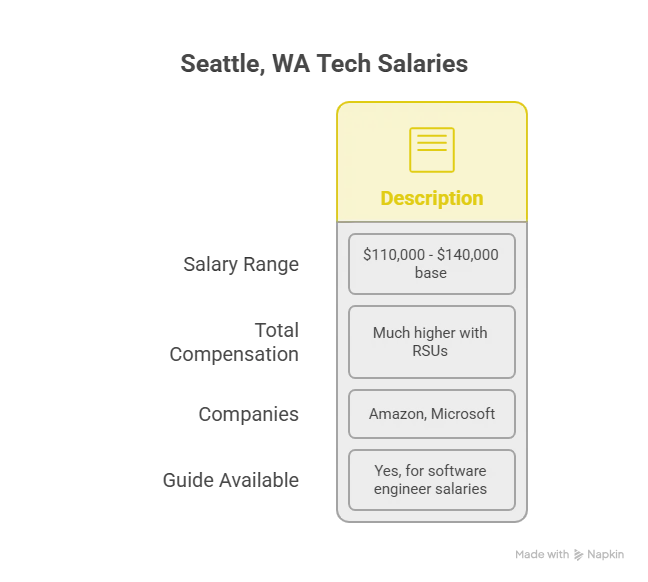
Seattle remains one of the highest-paying tech cities in the US. Entry-level software engineers at companies like Amazon and Microsoft typically earn $110,000 to $140,000 base, with total compensation going much higher once RSUs are included.
If you are targeting Seattle, the complete guide to software engineer salaries in Seattle, WA breaks down what each level actually pays.
San Diego, CA
San Diego has a growing biotech and defense tech sector that creates strong demand for software engineers outside the traditional FAANG pipeline.
Mid-level engineers average $120,000 to $145,000. See the detailed breakdown at software engineer salary in San Diego.
Atlanta, GA
Atlanta is one of the most underrated cities for career changers. The cost of living is lower than coastal cities, companies like NCR, Delta, and Cox Enterprises are actively hiring, and salaries have caught up faster than most people expect. The software engineer salary guide for Atlanta has current figures.
Miami, FL
Miami has no state income tax, a fast-growing fintech and crypto sector, and rising software engineer salaries. Career changers who target Miami often find less competition than coastal hubs. Review what the market looks like at software engineer salary in Miami.
Washington, DC
DC offers strong salaries driven by government contracting and cybersecurity. Security clearances are a differentiator that career changers can pursue over time. The software engineer salary guide for Washington has level-by-level data.
Top Software Engineering Companies for Career Changers
Not every employer values a CS degree equally. Some companies, including several large tech firms and mid-size startups, have explicitly moved toward skills-based hiring.
A full breakdown of the top software engineering companies can help you prioritize where to apply.
Companies known for hiring career changers and non-traditional backgrounds in 2026 include Salesforce, Shopify, IBM, Accenture, and a growing number of Series A and B startups that need generalists who can ship fast.
Can You Become a Software Engineer After 30?
Yes. And not in a motivational-poster way. In a practical, data-backed way.
Career changers who enter software engineering after 30 often bring a work ethic, communication skills, and domain knowledge that recent CS graduates do not have.
A former nurse who becomes a healthcare software engineer has context a 22-year-old cannot replicate. A former teacher who switches into EdTech understands the user better than most.
The honest timeline for someone starting at 30 with no coding background: 6 to 18 months of serious study, then 3 to 9 months of job searching. Total: 9 to 27 months.
That sounds like a long time, but it is a one-time investment for a career that typically runs 20 to 30 years.
For a full career guide on what the role actually involves day to day, this overview of what it means to be a software engineer in the US is worth reading before you commit.
Career Change to Software Engineering: What Success Actually Looks Like
Software engineer career change success stories tend to follow a pattern. The person had a strong prior career, got frustrated with limited growth, found a learning path that matched their schedule, built a portfolio of real projects (not just tutorials), and then networked their way into a first interview.
What separates successful career changers from those who stall is usually not intelligence or technical skill. It is consistency. Coding 90 minutes a day for 12 months beats cramming for two weeks and then stopping.
A few realistic examples from reported outcomes in 2026:
How to Negotiate Your First Software Engineering Salary as a Career Changer
Most first-time job seekers in software engineering leave money on the table because they accept the initial offer without negotiating. Here is what actually works:

Common Mistakes Career Changers Make When Switching to Software Engineering
Frequently Asked Questions
-
How long does it take to switch careers to software engineering?
Most career changers take 9 to 18 months from starting to learn to accepting a first offer. Bootcamp graduates tend to be on the shorter end. Self-taught learners vary more widely depending on consistency and prior background.
-
Do I need a computer science degree to become a software engineer in the US?
No. Many US employers, including large tech companies, have removed degree requirements and now evaluate candidates on portfolio projects, technical assessments, and demonstrated problem-solving ability.
-
What is the best programming language to learn for a career change?
Python is the most versatile starting point in 2026. It covers web development, data engineering, automation, and machine learning. JavaScript is a close second, especially if you want to move into front-end or full-stack development quickly.
-
Can I become a software engineer at 35 or 40 with no experience?
Yes. Age is not a legal or practical barrier. The honest challenge is time. A career changer at 35 or 40 may have more financial obligations that limit full-time study, but part-time programs and evening bootcamps are built specifically for this situation.
-
What salary can I expect as a career changer entering software engineering?
First roles for career changers in the US typically fall between $75,000 and $100,000 depending on city and stack. Coastal cities like Seattle and San Diego skew higher. Atlanta and Miami offer strong salaries with lower cost of living.
-
Is software engineering oversaturated in 2026?
Entry-level roles have become more competitive since 2022, but demand for experienced engineers remains high. The key is specialization. Career changers who bring domain expertise from a previous field and pair it with engineering skills are genuinely differentiated candidates.
Final Thoughts
Switching careers to software engineering in the US is one of the most financially and professionally rewarding moves you can make in 2026.
It takes real effort, a realistic timeline, and a willingness to be a beginner again. But the path is well-documented, the demand is real, and the salary outcomes for people who follow through are hard to argue with.
If you have made a career change to software engineering, or you are in the middle of one right now, share your experience in the comments. Real stories from real people are more useful than any guide.
How This Article Was Created
This article was written using publicly available compensation data from Glassdoor, Levels.fyi, ZipRecruiter, Bureau of Labor Statistics, and LinkedIn Salary.
No salary figures were fabricated. Data reflects reported ranges as of early 2026. The article was written to inform job seekers and career changers, not to recruit or advertise on behalf of any employer or educational program.

Shahzada Muhammad Ali Qureshi (Leeo)
I’m Shahzada — a software engineer by education and an SEO professional by trade. I built WhatIsTheSalary.com to go beyond just showing salary numbers — every page is manually researched across sources like BLS, Glassdoor, LinkedIn Salary, and PayScale to give you the full picture in one place. If you found what you were looking for here, that’s exactly the point.