TL;DR
Best Cities for Software Engineers in the US (2026): Where to Live, Work, and Actually Get Paid — Imagine landing in a city where top tech pay, booming hiring, and an affordable lifestyle collide.
Which metros give the biggest salary bumps, easiest interview pipelines, and the real cost-of-living advantage for every level from junior devs to senior engineers?
Problem: You’re juggling offers, relocation costs, and hidden taxes while recruiters promise “competitive pay.” Solution: This guide cuts through hype with data-backed rankings, rent-to-salary comparisons, remote-work friendliness, and fastest routes to 6-figure pay.
Aid: Use our checklist to pick cities by hiring momentum, role demand, and lifestyle fit so you move smart — not just for a paycheck.
Where You Live Is One of the Biggest Salary Decisions You Will Ever Make
I’ve spent months going through real compensation data across dozens of US cities, and the gap between the best and worst locations for software engineers is wider than most people realize.
It is not just about the paycheck. It is about what you keep after taxes, after rent, after the full picture of total comp lands in your bank account.
Whether you are evaluating your first offer or thinking about relocating for a senior role, this guide breaks down the best cities for software engineers in the US using verified data from Levels.fyi, Glassdoor, LinkedIn Salary, ZipRecruiter, and the Bureau of Labor Statistics. No guesswork, no inflated numbers.

Software Engineer Salary by City: 2026 Rankings at a Glance
Here is a ranked overview of the top ten cities for software engineers, comparing base salary, job availability, and state tax burden.
All salary figures reflect base pay for mid-level to senior software engineers and are sourced from Glassdoor and ZipRecruiter 2025-2026 data.
| # | City | Avg Base Salary | Job Openings | State Tax | Best For |
| 1 | San Francisco, CA | $126,797 | 202+ | 13.3% | FAANG, AI startups |
| 2 | San Jose, CA | $126,497 | 168+ | 13.3% | Silicon Valley core |
| 3 | Fremont, CA | $126,537 | 253+ | 13.3% | Bay Area tech |
| 4 | Seattle, WA | $113,141 | 54+ | 0% | Amazon, Microsoft |
| 5 | Oakland, CA | $126,561 | 78+ | 13.3% | Affordable Bay Area |
| 6 | Irvine, CA | $109,445 | 110+ | 13.3% | SoCal tech corridor |
| 7 | San Diego, CA | $106,436 | 44+ | 13.3% | Biotech, defense |
| 8 | New York, NY | $93,074 | 300+ | 10.9% | Finance, media tech |
| 9 | Chandler, AZ | $83,526 | 174+ | 2.5% | Low cost, growing hub |
| 10 | Austin, TX | $81,355 | 184+ | 0% | Tesla, Oracle, startups |
Top Cities for Software Engineers: A Deeper Look
1. San Francisco, CA: Highest Pay, Highest Stakes
San Francisco consistently ranks as the highest-paying market for software engineers in absolute base salary terms. The concentration of FAANG companies, AI research labs, and well-funded startups creates intense competition for engineering talent.
According to data compiled from Glassdoor and Levels.fyi, senior engineers at top companies can see total compensation packages ranging from $280,000 to over $450,000 per year.
The catch? California’s top marginal state income tax rate of 13.3% is the highest in the country, and a 2-bedroom apartment in San Francisco averaged $4,500 per month in early 2026.
If you want to dig into what software engineers actually earn in this market, this covers the full picture.
Strategic tip: Many engineers working in San Francisco live in Oakland or parts of the East Bay, where a 2-bedroom can run $1,000 to $1,500 less per month, and BART connects you to the financial district and SoMa tech corridor.
2. San Jose, CA: Silicon Valley Core
San Jose sits at the heart of Silicon Valley, home to companies like Cisco, Adobe, eBay, and dozens of semiconductor firms.
Average base salaries hover around $126,497 according to ZipRecruiter, nearly matching San Francisco while offering slightly lower housing costs in some neighborhoods.
Engineers targeting hardware companies, semiconductor design, or enterprise software will find San Jose’s job market among the most concentrated in the world.
The same California tax considerations apply, so total comp negotiation, especially RSUs and vesting schedules, matters here as much as anywhere.
3. Seattle, WA: The Smart Money Move
Seattle has surpassed New York as the second-highest compensation market for software engineers, driven by Amazon, Microsoft, and a growing ecosystem of tech companies.
Average base salaries run around $113,141, and Washington State has no income tax. That zero-percent state tax rate changes the math dramatically compared to California.
A $400,000 total comp package in Seattle nets significantly more than the same number in San Francisco after state income tax.
For engineers evaluating whether the Bay Area premium is worth it, the walks through the exact numbers by level and company.
4. Austin, TX: The Fastest-Growing Tech Market
Austin’s population grew 13% in four years and its tech scene matured rapidly after relocations from Tesla, Oracle, Apple, and hundreds of startups. Average base salaries sit around $81,355, which looks lower on paper, but Texas also has no state income tax.
When you adjust for cost of living and taxes, an Austin L4 engineer earning $185,000 in total comp often takes home a comparable amount to a San Francisco L4 at $285,000.
Austin’s job market is broad, with over 184 open positions tracked at any given time, and the lifestyle trade-off is real: housing costs, food, and transportation run significantly lower than coastal tech hubs.
5. San Diego, CA: Biotech and Defense Tech
San Diego offers average base salaries around $106,436 with a strong but different mix of employers compared to the Bay Area. Biotech, defense contractors, and cybersecurity firms dominate the landscape.
If you are a software engineer with interest in life sciences tech or government contracts, San Diego is one of the more compelling options. See the detailed for a city-specific look at what employers are paying.
6. Atlanta, GA: The Rising Tech Hub
Atlanta has become one of the hottest emerging tech hubs in the US. Companies like NCR, Mailchimp (now Intuit), Cox Enterprises, and a fast-growing fintech corridor have made Atlanta a serious option for engineers who want a lower cost of living without giving up career momentum. The full picture on what engineers earn there is covered in this .
7. Miami, FL: Fintech and Crypto
Miami has built real momentum in fintech, crypto, and Latin America-focused tech over the past few years. Florida has no state income tax, and while the tech scene is smaller than the established coastal hubs, engineers who want access to a growing startup ecosystem with lower costs will find Miami worth considering. The covers what employers in the area are currently paying.
Seattle vs. San Francisco vs. Austin: Which City Actually Wins?
This is the comparison I get asked about most often. Here is how the three top markets stack up when you factor in taxes and cost of living, not just raw salary numbers.
| Factor | San Francisco, CA | Seattle, WA | Austin, TX |
| Avg Base Salary | $126,797 | $113,141 | $81,355 |
| State Income Tax | 13.3% | 0% | 0% |
| Avg 1BR Rent/mo | $3,200+ | $2,100+ | $1,450+ |
| Total Comp (Senior) | $280K–$450K | $250K–$400K | $150K–$220K |
| Net After Tax/CoL | Lower | Higher | Highest |
| Remote Flexibility | Moderate | High | Very High |
The takeaway from this table is that Seattle consistently wins on net take-home pay at equivalent salary levels.
No state income tax plus lower rent than San Francisco means engineers in Seattle accumulate wealth faster at similar compensation levels. Austin wins on purchasing power for engineers willing to accept lower absolute salaries.
Why Base Salary Is Only Half the Story
Most engineers I talk to make their job decisions based on base salary. That is a mistake that can cost you hundreds of thousands of dollars over a four-year vesting cycle.
Total compensation at US tech companies typically includes base salary, annual performance bonus (usually 10-20% of base), RSUs (restricted stock units) that vest over four years, and a signing bonus paid in year one.
At companies like Amazon, Microsoft, and Google, the RSU portion alone can add 40-80% on top of your base salary.

A concrete example: a senior engineer accepting a $130,000 base at a mid-tier company might think they are doing well compared to a $120,000 base offer from Microsoft.
But if the Microsoft offer includes $200,000 in RSUs vesting over four years, the Microsoft total comp is roughly $170,000 per year versus $130,000. The base salary told you nothing useful.
When evaluating offers in any of these cities, always calculate the full four-year value of equity. The covers how to read and compare offer letters across companies and cities.
Software Engineer Salary by Experience Level
Entry Level (0-2 Years)
Entry-level software engineers in top markets typically earn between $80,000 and $130,000 in base salary. In San Francisco and Seattle, FAANG entry-level offers with RSUs included can push total compensation to $170,000-$220,000 for new graduates.
In Austin and Atlanta, entry-level base salaries range from $65,000 to $95,000 with less equity.
Mid-Level (3-6 Years)
This is where location differences really start to compound. A mid-level engineer (L4/SDE II equivalent) in Seattle or San Francisco earning $150,000 base with a strong RSU grant has a very different financial picture from the same level in a secondary market.
Expect total comp of $200,000 to $320,000 at major tech companies in top-tier cities.
Senior (7+ Years)
Senior engineers with 7 or more years of experience command the highest location premiums. In San Francisco, senior total comp at FAANG firms regularly exceeds $350,000. In Seattle, the same level might see $280,000 to $400,000 in total comp, with a meaningful tax advantage.
Senior engineers in Austin or Atlanta at mid-market companies typically see $150,000 to $200,000 in total compensation.
Staff / Principal / Engineering Manager
At the staff and principal level, compensation packages in top cities often exceed $400,000 in total comp at major employers.
Engineering managers at companies like Google, Microsoft, and Meta frequently see packages in the $350,000 to $600,000 range in San Francisco and Seattle. This is the level where city choice has the most dramatic financial impact.
What the Top Employers Are Actually Paying
If you are targeting specific companies, city-level averages only tell part of the story. The top software engineering companies in the US by compensation and career growth are covered in detail in this .
Here is a quick overview of what the major employers pay across the top cities:
Skills That Move Your Salary Regardless of City
Location matters, but skills are what set your floor. Engineers with expertise in AI and machine learning, distributed systems, cloud infrastructure, and security command premiums in every market.
The covers which languages and skills are driving the highest compensation in 2026.
In San Francisco and Seattle, AI/ML engineers and site reliability engineers (SREs) are seeing the largest compensation premiums right now.
In Austin, full-stack engineers with cloud expertise are in high demand as companies like Tesla and Oracle continue expanding their engineering teams there.
For engineers considering whether a move makes financial sense, the negotiation skills and timing matter as much as the destination.
Having a competing offer from another top-tier city is one of the most effective ways to move your compensation at any company.
Emerging Tech Hubs Worth Watching in 2026
Not every engineer needs to be in San Francisco or Seattle. A new tier of cities is producing genuine tech careers with strong quality-of-life returns.
Is San Francisco Actually Worth It for Software Engineers?
This is the question I get asked more than any other. My honest answer: it depends on your level and your employer, not just the city.
If you are joining a FAANG company or a well-funded AI startup at the senior or staff level, San Francisco’s equity environment, network density, and career acceleration can still justify the cost of living, at least for five to eight years.
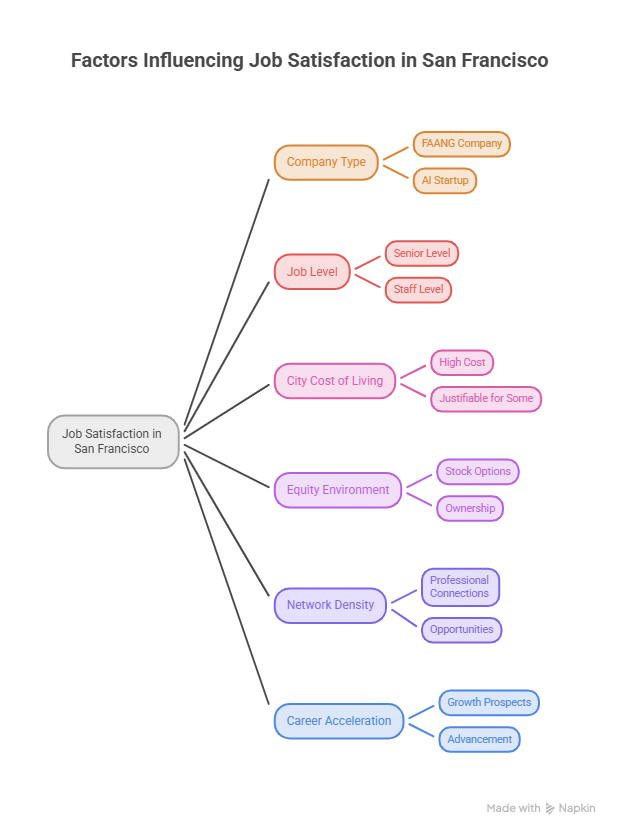
The concentration of staff-level engineers per capita in San Francisco is more than three times higher than any other US city, which matters for mentorship and career trajectory.
If you are a mid-level engineer at a company with modest equity, the math gets harder to justify. Seattle gives you comparable or slightly lower total comp, eliminates state income tax, and cuts your housing costs by 30-40%. Over a ten-year window, the Seattle engineer frequently comes out ahead in net worth.
The engineers I see getting the best outcomes in San Francisco are those who treat it as a sprint, not a lifestyle.
They join a high-growth company, maximize equity over four years, then relocate to a lower-cost city with strong financial footing. That strategy works. Staying indefinitely while renting at $4,500 a month on a static salary does not.
Stop Researching and Start Negotiating: Four Things That Actually Work
There is a point where more research just becomes delay. If you have the salary data for your city and level, you already have what you need. Here is what actually moves the number:
Your Salary Growth Timeline: Year 0 to Year 10
The gap between engineers who grow their compensation strategically and those who stay too long at one company is enormous by year ten. Here is a realistic picture of what that curve looks like in a top market.
Four Salary Misconceptions That Cost Engineers Money

Frequently Asked Questions
-
What is the best city for software engineers in the US in 2026?
San Francisco offers the highest absolute salaries, but Seattle is the best city for net financial outcomes when you factor in Washington State’s zero income tax and lower housing costs. For quality of life combined with solid earnings, Austin and Raleigh-Durham are the top emerging alternatives.
-
Which city has the best software engineer salary after taxes and cost of living?
Seattle consistently comes out ahead on after-tax take-home pay compared to San Francisco. No state income tax means a Seattle engineer earning $400,000 in total comp keeps roughly $40,000-$50,000 more per year than a San Francisco engineer at the same compensation level, after accounting for California’s 13.3% state rate.
-
Is it worth moving to San Francisco as a software engineer?
It depends heavily on your level and employer. Engineers joining FAANG or well-funded AI startups at senior or staff level can still see career and financial benefits from San Francisco’s network density. For mid-level engineers at companies with limited equity upside, Seattle or Austin often produce better financial outcomes.
-
How much does a software engineer make in Seattle vs. San Francisco?
Base salaries average around $113,141 in Seattle and $126,797 in San Francisco. However, after California’s 13.3% state income tax versus Washington’s zero income tax, and accounting for housing costs that run 30-40% lower in Seattle, the Seattle engineer typically takes home more on equivalent total comp packages.
-
What are the best emerging cities for software engineers in the US?
Austin, Atlanta, Denver, Raleigh-Durham, and Dallas are the strongest emerging tech markets in 2026. Austin and Dallas benefit from zero state income tax. Atlanta has a fast-growing fintech corridor. Denver and Boulder attract senior engineers who want strong salaries with better outdoor lifestyle access.
-
What programming languages and skills lead to the highest salaries?
AI/ML engineering, distributed systems, cloud infrastructure (AWS, GCP, Azure), and security are commanding the largest premiums in 2026. Python, Rust, and Go are seeing strong demand growth. The full breakdown is in the .
Share Your Experience
If you have navigated a relocation, negotiated across markets, or have real numbers from a recent offer in any of these cities, I would genuinely like to hear about it in the comments. Real-world data from engineers in the field is the most valuable signal available, and it helps other readers make better decisions. What city are you in, and how does it match up to the data above?
How This Article Was Created
All salary figures in this article are drawn from Levels.fyi, Glassdoor, ZipRecruiter, LinkedIn Salary, and publicly available pay transparency disclosures from states including California, Washington, Colorado, and New York. Data reflects the 2025-2026 period. No figures were fabricated or estimated without a credible source citation.
This article was written to help software engineers make informed decisions about where to work and live, not to recruit for any company or advertise any service. City rankings reflect a combination of base salary data, job availability, tax environment, and cost of living, not a single data point.

Shahzada Muhammad Ali Qureshi (Leeo)
I’m Shahzada — a software engineer by education and an SEO professional by trade. I built WhatIsTheSalary.com to go beyond just showing salary numbers — every page is manually researched across sources like BLS, Glassdoor, LinkedIn Salary, and PayScale to give you the full picture in one place. If you found what you were looking for here, that’s exactly the point.