TLDR
Software Engineer Resume that lands dream jobs? Yours is probably buried in the ATS black hole—generic, bloated, and screaming “next candidate.” Recruiters spend 7 seconds scanning; yours vanishes.
Enter the fix: a battle-tested framework that laser-targets keywords, quantifies impact (e.g., “Boosted app speed 40%”), and hooks humans instantly. No fluff, just proven wins from FAANG hires.
Ready to transform your resume into a job magnet?
Software Engineer Resume Guide 2026
Why Your Software Engineer Resume Needs to Stand Out in 2026
The software engineering job market in 2026 is highly competitive. Companies are receiving 500+ applications per open role, and hiring managers spend an average of 6–7 seconds on initial screening. That means your resume has one job before anything else: survive the bots.
Most software engineer resumes score below 50% on ATS systems, and roughly 75% never reach a recruiter at all. If your resume reads like a list of technologies with no context, you disappear into the noise.
What hiring managers are actually scanning for in those first 10 seconds:
The seniority question is answered by scope, not years. A mid-level engineer describes the code they wrote. A senior engineer describes the system they designed and the trade-offs they navigated. A staff engineer describes the problems they identified and the organizational changes they drove.
If you are also working on your cover letter alongside your resume, check out this software engineer cover letter guide for help writing one that matches your application.
ATS-Friendly Formatting Essentials
Before your content even matters, your format has to be readable. ATS software parses your resume into structured fields — work experience, education, skills — and ranks you against other candidates based on keyword match.
Here is what an ATS-friendly software engineering resume looks like in 2026:
One page is ideal for engineers with under 5 years of experience. Senior engineers with 8–10+ years of relevant work can go to two pages, but every line needs to add value.
Resume Templates by Experience Level
Not every software engineering resume should look the same. The structure, emphasis, and content shift significantly depending on where you are in your career.

Entry-Level Software Engineer Resume
For a fresher or recent graduate, the challenge is showing capability without a long work history. A resume for a software engineer fresher should lead with strength — meaning your projects, your technical skills, and any internship experience come first.
Your professional summary should be tight and honest: mention your degree, your strongest languages, and a standout project or result.
Highlight Projects and University Work
Projects are the most powerful section on a software resume for freshers. Choose 3–5 that show real skills, not toy examples. For each one, describe what you built, what technologies you used, and what the outcome was.
Good example:
Developed a full-stack e-commerce web app using React and Node.js, handling 500+ simulated concurrent users with 99.8% uptime in load testing.
If you contributed to open-source projects on GitHub, include those too. A well-maintained GitHub portfolio link on your resume tells a hiring manager more than a page of buzzwords.
Programming Languages and Frameworks
For entry-level roles, list the languages and frameworks you actually know — not every tool you touched once. A focused, honest skills section beats an inflated one. Common skills for entry-level software resumes include:
Need to decide which languages to focus on first? This guide on best programming languages to learn can help you prioritize.
Junior/Mid-Level Software Engineer Resume
At this stage, you have real work experience to anchor your resume. The focus shifts from potential to proven results. Each bullet in your experience section should follow this structure: action verb + what you did + measurable result.
Avoid listing job duties. Instead, describe what changed because of your work. Did you reduce API response times? Increase code coverage? Ship a feature that affected X users?
Mid-level engineers should also start demonstrating collaboration — cross-functional work, Agile participation, code review contributions, and mentoring junior developers.
Senior Software Engineer Resume
A senior software engineer resume needs to tell a story of growth. Recruiters and hiring managers want to see that you have moved from executing tasks to owning systems.
Show Career Progression and Promotions
If you were promoted within the same company, show that clearly on your resume. List both titles under the same employer with separate date ranges. This signals internal recognition and career momentum.
Example format:
Senior Software Engineer | Company Name | Jan 2023 – Present Software Engineer | Company Name | Jun 2020 – Dec 2022
Beyond titles, your bullet points should reflect increased responsibility — larger teams, higher-stakes systems, architectural decisions, and cross-team leadership.
For a deeper look at the career stages between junior and senior, this software engineer career path guide is worth reading.
Software Test/QA Engineer Resume
A software test engineer resume should emphasize testing methodologies, automation tools, and defect reduction metrics. Highlight experience with tools like Selenium, Jest, Cypress, or JUnit, and always quantify outcomes — for example, “automated regression testing suite covering 85% of codebase, reducing QA cycle time by 40%.”
Include any CI/CD integration experience since modern QA work is tightly coupled with DevOps pipelines.
Lead/Principal Software Engineer Resume
At lead or principal level, technical depth must be paired with demonstrated leadership. Your resume should show that you can mentor teams, drive technical roadmaps, and make decisions that affect the entire engineering organization.
Quantify your leadership: how many engineers did you mentor? How large were the teams you led? What business impact did your architectural decisions have?
Software Architect Resume
A software architect resume sits at the intersection of engineering and strategy. The focus is on system design, scalability decisions, technology selection, and stakeholder alignment.
Use your experience section to describe the systems you designed, not just the code you wrote. Include specifics: “Designed microservices architecture supporting 10M+ daily transactions, reducing infrastructure costs by 30%.”
For engineers exploring the broader scope of this role, software engineer career options covers where the architect path leads.
Software Engineer Intern Resume
An intern resume is about showing you are ready to contribute from day one. Lead with education, then list relevant projects and any prior internship experience. Include your expected graduation date, GPA if above 3.5, and relevant coursework such as Data Structures, Algorithms, or Cloud Computing.
Keep it to one page. Clean, honest, and specific.
Section-by-Section Writing Guide
Header (Name, Contact, GitHub/Portfolio Links)
Your header should include your full name, phone number, professional email, LinkedIn URL, and a GitHub portfolio link. If you have a personal portfolio site, include that too.
Do not put these in the document header or footer — some ATS systems cannot read content in those areas. Place everything in the body of the document.
Your GitHub profile is especially important for software engineers at all levels. Make sure your pinned repositories are relevant to the roles you are targeting and have clear README files before sharing the link. Recruiters will click it.
Want to build a strong portfolio before applying? This software engineer portfolio guide walks through exactly what to include.
Professional Summary (Technical Expertise + Impact)
Write your professional summary last, after finishing all other sections. It should be 2–4 lines that cover your years of experience, your core tech stack, and one or two key achievements.
Instead of writing “Professional Summary” as the section title, condense your experience into a headline under 10 words. Think of it like a LinkedIn headline.
Example:
Full-Stack Engineer with 5 years of experience building scalable microservices at high-growth startups. Led migration from monolithic to microservices architecture, cutting deployment time by 75% and improving uptime to 99.95%. Proficient in TypeScript, Python, AWS, and Kubernetes.
Experience Section
This is the most important section on any software engineering resume. Format each role with your title, company name, location, and dates. Under each, use bullet points — each starting with a strong action verb — to describe your impact.

Quantify Achievements with Metrics
Numbers make your experience real and credible. Vague bullets get skipped. Specific ones get noticed.
Weak: Helped improve application performance. Strong: Optimized PostgreSQL queries and implemented Redis caching, reducing average response time from 800ms to 120ms for 2M+ daily users.
At every experience level, there are metrics worth including:
| Experience Level | Key Metrics to Quantify |
|---|---|
| Entry-Level / Fresher | Projects completed, bugs resolved, test coverage %, users in demos |
| Junior / Mid-Level | Response time improvements, deployment frequency, code coverage %, feature adoption |
| Senior Engineer | System scale (users/requests), uptime %, team size mentored, cost savings |
| Lead / Principal | Team size managed, roadmap delivery rate, org-wide adoption, business impact ($) |
| Software Architect | Systems designed, transaction volumes, infrastructure cost reduction, stakeholder teams aligned |
Use Strong Action Verbs
Every bullet should start with a powerful, specific verb. Avoid passive phrasing. Here are solid options grouped by impact type:
Education and Certifications
List your degree, university, graduation year, and relevant coursework. If you have certifications — AWS Certified Solutions Architect, Google Cloud Professional Developer, Certified Kubernetes Administrator — list them here or in a separate section.
Certifications are increasingly important for cloud and DevOps-heavy roles. If you are still building credentials, check out this guide on how long it takes to become a software engineer to plan your path.
Technical Skills Section
Create a dedicated technical skills section organized by category. This makes it easy for both ATS and human reviewers to quickly identify your stack.
Example format:
Always tailor this section to the job description. Reorder skills to put the most relevant ones first for each application.
Essential 2026 Skills to Include
Programming Languages (Python, Java, JavaScript)
Python, JavaScript/TypeScript, and Java remain the three most in-demand languages across software engineering job postings in 2026. Go is gaining ground for backend infrastructure, and C# remains strong in enterprise environments.
For frontend-focused roles, TypeScript has essentially replaced plain JavaScript as the expected standard. Knowing at least two languages well is better than knowing six superficially.
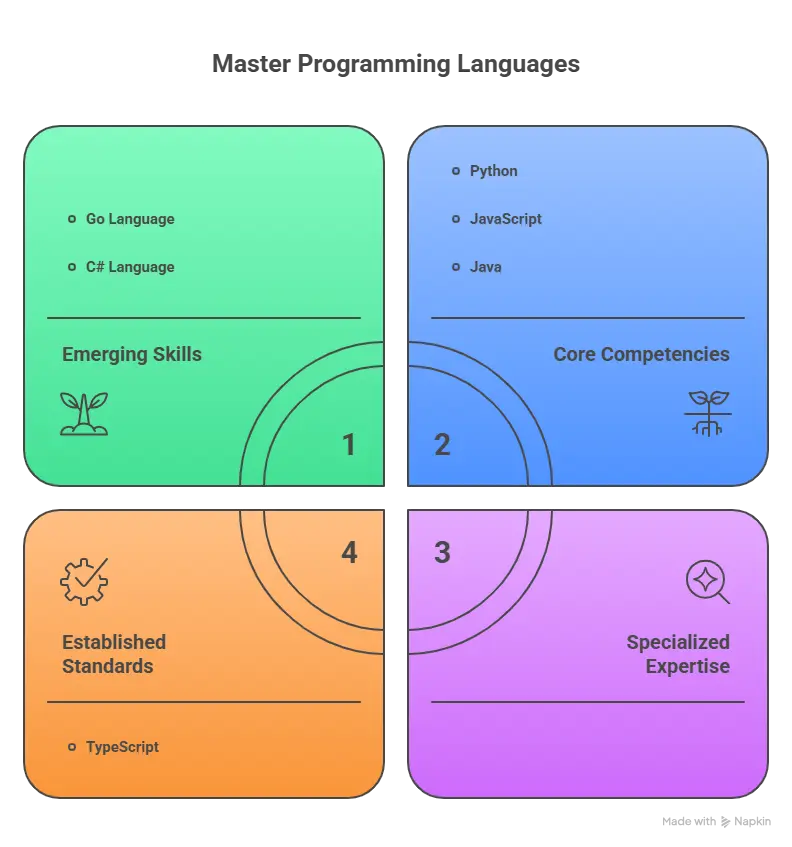
This breakdown of the best programming languages can help you decide where to invest your learning time.
Frameworks, Cloud Platforms, DevOps Tools
Cloud-native development is the default in 2026, not a specialty. Employers expect familiarity with at least one major cloud platform (AWS, GCP, or Azure) and core DevOps tooling. Key tools to include if you have experience:
Engineers who can show production Kubernetes experience and CI/CD pipeline ownership are consistently among the highest-compensated in the market right now.
Soft Skills (Leadership, Problem-Solving)
Soft skills matter, but they should be shown through your achievements rather than listed as buzzwords. Instead of writing “strong communicator,” describe a time you aligned three teams to ship a feature on schedule.
Skills worth demonstrating through context include: mentoring junior developers, cross-functional collaboration, Agile/Scrum participation, technical documentation, and problem decomposition under pressure.
For a full breakdown of what skills employers look for by role, see this guide on software engineer skills required.
Writing Tips That Get Interviews
Tailor to Job Description Keywords
This is the single highest-impact software engineer resume tip available. Read the job description carefully. Pull out the technologies, tools, and phrases used. Then use those same terms naturally throughout your resume — in your summary, experience bullets, and skills section.
Modern ATS systems in 2026 use AI-enhanced matching. Keyword stuffing will be detected and penalized. The goal is contextual integration, not repetition.
Showcase Projects with Links
For entry-level and junior engineers especially, projects with live links or GitHub repos can make a resume stand out significantly. Include the project name, the tech stack used, and one concrete outcome or metric.
For senior engineers building on GitHub, a well-documented portfolio showing consistent contributions, clean code, and real-world problem-solving is a powerful credibility signal beyond the resume itself.
Demonstrate Leadership Progression
Even if you have never held a management title, you can demonstrate leadership through your bullet points. Mentored engineers, led code reviews, drove adoption of new tools, coordinated cross-team releases — these all signal readiness for more senior roles.
If you are actively preparing to step into a lead or staff role, this software engineering practices guide covers the patterns and habits that matter at that level.
Include Metrics and Business Impact
The best software engineering resumes connect technical work to business outcomes. Every engineer affects something: performance, reliability, developer productivity, user retention, or cost. Find that connection and make it explicit.
If you helped reduce infrastructure costs by migrating to AWS, say so. If you shipped a feature that increased daily active users, include that number. Business impact separates candidates who understand their work from those who just execute it.
Common Mistakes to Avoid
Generic Resumes Without Customization
Sending the same resume to every job is one of the most common and costly mistakes. Generic resumes without customization score poorly on ATS systems and feel impersonal to recruiters.
At minimum, adjust your professional summary and reorder your skills section to match the priorities of each job description you apply to. For high-interest roles, rewrite specific bullet points to echo the language in the posting.
Missing GitHub/Portfolio Links
Especially at the junior and mid-level, not including a GitHub portfolio link is a missed opportunity. Hiring managers and technical leads do click these links — and a well-maintained profile with documented, relevant projects can push a borderline application into an interview.
Make sure your profile is active, your pinned repositories are clean, and your README files explain what each project does and why you built it.
Weak Metrics and Vague Achievements
Bullets like “responsible for backend development” or “worked on improving performance” tell a recruiter nothing. They could describe anyone. Vague descriptions of what you did signal either that you do not know your own impact or that there was none.
Go back through every bullet. Ask: what changed, by how much, and for how many people? If you cannot answer that, the bullet needs to be rewritten or removed.
If you need help preparing for what comes after the resume, this guide on software engineer interview questions will help you walk in ready.

Also read: Software Engineer Salary in Sydney, Australia (2026)
Frequently Asked Questions
-
How long should a software engineer resume be?
For engineers with under 5 years of experience, one page is the standard. Senior engineers with 8–10+ years of relevant experience can use two pages, but every line should justify its space. Recruiters spend around 6–7 seconds on initial screening, so conciseness always wins.
-
Should I include a GitHub link on my software engineering resume?
Yes, absolutely. A GitHub portfolio link is especially valuable for early-career engineers. It gives hiring managers direct proof of your code quality, documentation habits, and problem-solving approach. Just make sure your pinned repositories are relevant and have clear README files before you apply.
-
What is the best format for a software engineering CV?
Reverse-chronological is the standard format for most software engineers. It shows your most recent and relevant experience first, which is what ATS systems and recruiters expect. Stick to a clean, single-column layout with standard section headings to ensure ATS compatibility.
-
How do I write a resume for a software engineer fresher with no experience?
Lead with a strong education section, then list relevant projects with links and measurable outcomes. Include your technical skills, any internship experience, open-source contributions, and certifications. A strong software resume for freshers proves capability through real work, even if that work was academic or personal projects.
-
What skills should I include in the technical skills section?
At minimum, include your programming languages, frameworks, cloud platforms, DevOps tools, databases, and version control. Organize them by category and tailor the list to match the job description. Avoid listing tools you cannot speak to in an interview.
-
How do I make my resume ATS-friendly?
Use a single-column layout, standard section headings, and web-safe fonts. Avoid tables, graphics, multi-column formats, and text boxes. Submit as a .docx or text-based PDF. Include keywords from the job description naturally throughout your resume — in your summary, experience, and skills sections.
-
Can I apply for a software engineer role without a degree?
Yes. Many companies now hire based on demonstrated skills, portfolio work, and practical experience. If you are building your path without a traditional degree, this guide on how to become a software engineer without a degree outlines realistic steps to get there.
Conclusion
A strong software engineer resume in 2026 is not just a list of what you know — it is evidence of what you have done and the impact it created. Whether you are writing a resume for a software engineer fresher just entering the field, building out a senior software engineer resume to target your next big role, or crafting a software architect resume that reflects years of system design experience, the same principles apply: be specific, be honest, and be relevant to the job.
Format for ATS first. Tailor for the reader second. Quantify everything you can. And always include your GitHub portfolio link — it is one of the highest-return additions you can make to any software engineering CV.
If you are ready to take the next step beyond the resume, explore what the software engineer role actually looks like day to day, and start preparing for what comes after the application.

Shahzada Muhammad Ali Qureshi (Leeo)
I’m Shahzada — a software engineer by education and an SEO professional by trade. I built WhatIsTheSalary.com to go beyond just showing salary numbers — every page is manually researched across sources like BLS, Glassdoor, LinkedIn Salary, and PayScale to give you the full picture in one place. If you found what you were looking for here, that’s exactly the point.