TL;DR
Pay Transparency Laws for Software Engineers: What Every 2026 Job Posting Now Requires — Imagine your next job hunt where every salary, band, and bonus rule is visible before you click apply.
No more blind interviews, lowball offers, or negotiating in the dark. New laws are shifting power to candidates, forcing companies to publish clear pay ranges, benefits, and criteria that determine raises and promotions.
This change rewires how you read job posts, craft applications, and negotiate offers.
Learn the exact phrases to spot compliant postings, how to use posted ranges to benchmark your worth, and what to do when listings still dodge transparency.
What Pay Transparency Laws Actually Require in 2026
There is still no single federal pay transparency law. What exists instead is a patchwork of state and local rules that, taken together, now cover a majority of the U.S. workforce. Compensation laws in this space generally fall into three buckets.
The first is job posting compliance, where the employer must list a salary range directly on the ad. The second is disclosure upon request, where the range only has to be shared if an applicant or employee asks for it.
The third is the salary history ban, which stops an employer from asking what you earned at your last job and using that number to lowball your next one.
Federal law still plays a supporting role here. The Equal Pay Act of 1963 bars wage discrimination based on sex for similar work, Title VII of the Civil Rights Act extends that to race, color, religion, and national origin, and the National Labor Relations Act protects your right to discuss pay with coworkers without fear of retaliation.
None of these require salary range disclosure directly, but they set the floor that state pay transparency laws build on.

States That Require Salary Range Disclosure in 2026
Coverage depends heavily on where the job is performed, not just where the company is based. Here is a snapshot of the states with the most active enforcement for software engineering and other tech roles.
| State | Effective Date | Employer Threshold | What The Law Requires | Penalty Range |
| California | Jan 1, 2023 | 15+ employees | Pay scale in every job posting; 3-year recordkeeping | $100 to $10,000 |
| Colorado | Jan 1, 2021 | 1+ employee | Range, benefits, and other comp in every posting | $500 to $10,000 |
| Illinois | Jan 1, 2025 | 15+ employees | Pay scale and benefits in postings; internal notice of promotions | Set by state investigation |
| New York State | Sep 17, 2023 | 4+ employees | Good-faith range for new roles, promotions, and transfers | Up to $3,000 (NYC up to $250,000) |
| Washington | Jan 1, 2023 | 15+ employees | Wage or salary range, benefits, in every posting | $100 to $5,000 |
| New Jersey | Jun 1, 2025 | 10+ employees | Range where min to max spread stays within 60% | $300 first offense, $600 after |
| Massachusetts | Oct 29, 2025 | 25+ employees | Good-faith range on postings, promotions, transfers | Warning, then escalating fines |
| Maine | Jan 1, 2026 | 10+ employees | Pay range in all job postings, direct or third-party | Civil penalties, state-set |
| Vermont | Jul 1, 2025 | 5+ employees | Compensation range in every job ad | Civil penalties, state-set |
| Delaware | Sep 26, 2027 | Employer-wide | Pay range and benefits disclosure (warning on first violation) | $500 to $10,000 |
A few patterns stand out. Colorado has the lowest threshold, applying to employers with even a single Colorado-based employee.
New York City carries the steepest financial exposure, and Delaware is the newest state to sign a law, though it will not take effect until late 2027.
If your target employer operates in more than one of these states, most compliance teams build their job postings around whichever state has the strictest requirement and apply that template everywhere.
How This Changes Software Engineer Job Postings
Pull up any software engineer job posting, and salary range disclosure now tells you more than most interviews do.
According to the Bureau of Labor Statistics, the median software developer wage sits at $130,160 based on the most recent national survey.
Glassdoor’s broader dataset, pulled from over 700,000 self-reported salaries, puts the average closer to $150,000.
Levels.fyi, which leans toward engineers at equity-granting tech companies, reports an average total compensation of $192,400 across the United States.
Those three numbers are not contradictory. They measure different populations. BLS captures every developer in the country, including the ones at insurance companies and government agencies working on a fixed pay scale.
Levels.fyi skews toward big tech, where stock options and RSU grants push total comp well past base salary.
For a full breakdown by experience level and city, this complete salary guide and the national salary overview both track these figures against live 2026 data.
This is exactly why pay transparency matters for engineers specifically. A posted range that only shows base salary without mentioning equity or bonus structure is technically compliant in most states, but it can still be misleading if you do not ask what sits behind the number.
Salary History Bans and Fair Pay Practices
Salary history bans are the quieter half of this legislation, but they change the negotiation dynamic more than most candidates realize.
Under these laws, a recruiter can ask what you are looking for, but not what you currently make or made in your last role.
This protects employee rights in a very direct way. If your last employer underpaid you, that number can no longer follow you into your next offer and anchor it low.
Fair pay practices under these laws mean your next salary should reflect market rate and your skills, not a number carried over from a previous job.
As of 2026, salary history bans exist in roughly 17 states and a growing list of cities, including Alabama, California, Colorado, Hawaii, Illinois, and New York, with Virginia adding its own ban effective July 1, 2026.
Employers that keep asking for pay stubs or W-2s during screening in a banned jurisdiction are exposing themselves to real compliance risk, not just a bad look.
Remote Software Engineer Roles and Multi State Compliance
Remote job coverage is where most companies trip up, and where most candidates get the biggest advantage. The general rule across nearly every state pay transparency law is simple:
if the role could be performed by someone living in a covered state, the posting has to comply with that state’s disclosure rules, no matter where the company’s office sits.
That means a fully remote software engineer posting from a Texas-based startup still needs a compliant salary range the moment a Colorado or California resident could reasonably apply. It also means candidates comparing offers across borders should look past the headline number.
If you are weighing a U.S. remote offer against a role based outside the country, the Vancouver software engineer salary breakdown is a useful comparison point for currency, cost of living, and how far a given total comp actually stretches.
Visa status does not exempt a posting from these rules either. H1B sponsorship roles are still subject to the same salary range disclosure requirements as any other posting in a covered state, on top of the prevailing wage rules the H1B program already enforces separately.
Employer Obligations Beyond the Job Ad
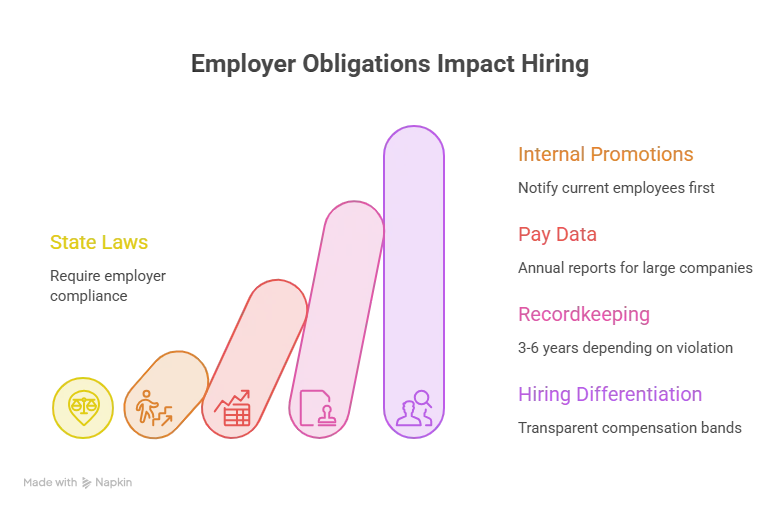
Job posting compliance is only one piece of what these laws demand. Several states, including Illinois and Colorado, require employers to notify current employees of promotion opportunities before or alongside external postings, so internal candidates get a fair shot.
California adds another layer for larger companies: employers with 100 or more employees must file annual pay data reports with the state’s Civil Rights Department, and recordkeeping obligations now stretch three to six years depending on the type of violation involved.
Hiring compliance at this level is becoming a genuine differentiator. Companies that build transparent, well-documented compensation bands tend to show up favorably in comparisons of the top software engineering employers, partly because clear pay bands reduce the back-and-forth that used to drag out offer negotiations.
How to Use Salary Range Disclosure When You Negotiate
A posted range is a starting point, not a ceiling. Employers are required to post a good-faith range they genuinely expect to pay, which means the top of the range is not a myth, it is a real number someone at that company has been offered before.
Use the posted range alongside independent data. If a posting shows $120,000 to $160,000 but BLS and Glassdoor both put the market rate for that experience level closer to $150,000, that is your opening argument, not a guess.
Strengthening your case also means strengthening your profile before you negotiate. Engineers who ship visible work outside their day job tend to have more leverage in these conversations.
A few side projects worth putting on a resume can do more for your negotiating position than another certification.
It also helps to understand how AI tools are reshaping the software engineer role, since employers are increasingly pricing AI fluency into senior and staff-level offers.
Common Misconceptions About Pay Transparency Laws
Myth 1: The posted range can be as wide as the employer wants
Several states now police this directly. New Jersey caps the spread between minimum and maximum at 60 percent of the minimum, and regulators in multiple states have flagged artificially broad ranges as non-compliant during audits.
Myth 2: You are protected everywhere once one state passes a law
Coverage is jurisdiction specific. A candidate in a state with no pay transparency law is not covered just because the employer operates in California, unless the role itself could be performed from a covered state.
Myth 3: The employer must offer you the top of the range
Nothing in these laws requires that. The range reflects what the employer expects to pay across the pool of qualified candidates, and your actual offer still depends on experience, level, and negotiation.
Myth 4: Current employees do not benefit from these laws
Most job posting compliance laws also apply to internal promotions and transfers, so existing employees get the same visibility into pay ranges as outside applicants.
Coding Bootcamps, Internships, and Entry-Level Compliance
Pay transparency rules apply just as much to entry-level and internship postings as they do to senior roles.
If you are weighing a coding bootcamp path into software engineering, the posted ranges on junior roles are now one of the more reliable ways to gauge realistic starting pay before you enroll.
The same goes for internships. Entry-level total compensation at large tech employers has climbed enough that comparing offers matters early.
Reviewing a current software engineer internship guide for the US alongside actual posted ranges gives you a much more grounded starting number than general career advice ever could.
What’s Next for Pay Transparency Legislation
The trend line points toward more states, not fewer. The federal Salary Transparency Act and Paycheck Fairness Act have both been introduced in Congress without passing, but the pressure to standardize these rules nationally keeps building each session.
Internationally, the EU Pay Transparency Directive is pushing similar requirements across European employers, which puts additional pressure on U.S. multinational tech companies to standardize compensation transparency globally rather than maintain separate practices by region.
For software engineers specifically, expect posted ranges to get more detailed over the next few years, not less, especially as more states start requiring benefits and bonus structure disclosure alongside base pay.

Share Your Experience
If you have applied to a role with a posted salary range that turned out to be misleading, or negotiated successfully using one,
it is worth sharing. Real offer data from engineers navigating these laws in practice is often more useful than another compliance checklist, so drop your experience in the comments if you have one worth passing along.
Frequently Asked Questions
-
Do pay transparency laws apply to remote software engineer jobs?
Yes, in most cases. If the remote role could be performed by someone living in a state with a pay transparency law, that state’s disclosure requirements generally apply, regardless of where the employer’s office is based.
-
Which states have the strictest pay transparency laws for tech jobs in 2026?
Colorado, Illinois, New York, California, and Washington currently have the most comprehensive requirements, covering job postings, internal promotions, and in some cases annual pay data reporting.
-
Can an employer still ask about my salary history?
Not in the roughly 17 states with salary history bans. Employers in those jurisdictions can ask what you expect to earn, but not what you currently make or made at a previous job.
-
What happens if a company does not include a salary range in a job posting?
It depends on the state. Penalties range from a few hundred dollars per violation in states like New Jersey to as much as $250,000 in New York City for repeat or willful violations.
-
Does the posted salary range include stock and bonuses?
Not always. Many postings only reflect base salary. It is worth asking directly about RSU grants, vesting schedule, and signing bonus, since total compensation at equity-granting companies can run well above the posted base range.
-
Do pay transparency laws apply to H1B software engineer roles?
Yes. H1B sponsored roles still fall under the same state disclosure requirements as any other posting in a covered jurisdiction, in addition to the separate prevailing wage rules tied to the visa program.
-
Will there be a federal pay transparency law?
Not yet. The Salary Transparency Act and Paycheck Fairness Act have both been introduced in Congress but have not passed, so coverage remains state by state for now.
How This Article Was Created
The figures in this article come from publicly available data published by the Bureau of Labor Statistics, Glassdoor, and Levels.fyi, along with employment law summaries from compliance and HR resources covering 2026 state legislation. No salary or penalty figure was invented or estimated without a public source behind it.
Data reflects publicly available figures current as of mid-2026. Pay transparency legislation changes frequently, so specific thresholds and penalty amounts should be confirmed against your state’s current statute before relying on them for a legal or compliance decision. This article was written to inform job seekers and is not legal advice.

Shahzada Muhammad Ali Qureshi (Leeo)
I’m Shahzada — a software engineer by education and an SEO professional by trade. I built WhatIsTheSalary.com to go beyond just showing salary numbers — every page is manually researched across sources like BLS, Glassdoor, LinkedIn Salary, and PayScale to give you the full picture in one place. If you found what you were looking for here, that’s exactly the point.