TL;DR
Software Engineer Burnout and Pay: How the Two Are Actually Connected in 2026 — You’re grinding through tickets, acing interviews, and still waking up exhausted.
What if the missing link isn’t just hours or perks, but how pay structures shape workload, career choices, and mental load?
In 100 words: Compensation signals expectations. Equity-heavy packages push engineers to chase growth and risk, salary-only roles force clock-in productivity, and opaque pay bands create chronic stress.
In 2026, hybrid work, AI-assisted tooling, and rapid role inflation mean pay design now dictates who stretches, who burns out, and who leaves.
Small changes to pay mix, transparency, and career ladders can flip burnout into sustainable momentum.
Why Pay and Burnout Keep Showing Up in the Same Conversation
I have read enough compensation surveys and burnout studies side by side to notice something. They keep describing the same engineer from two different angles.
One report calls it workload stress. The other calls it salary dissatisfaction. Underneath, it is the same person, tired, underpaid relative to their output, and running out of reasons to stay.
JetBrains research on developer priorities ranks hours and pay above almost everything else, with a sense of achievement coming in third. That order matters.
Engineers do not burn out only because the work is hard. They burn out when hard work stops feeling worth it, and compensation is the clearest signal of whether it is.
Performance pressure adds another layer. When a company underpays relative to the market, it often compensates by demanding more output to justify the smaller headcount it can afford.
That combination, more work for less relative pay, is close to a textbook definition of burnout causes.
There is also a mental health cost that rarely shows up on a compensation spreadsheet. Chronic exhaustion from overwork does not stay contained to working hours.
It follows engineers home, affects sleep, and slowly narrows their tolerance for the same job they used to enjoy.
Employers who treat compensation and employee well-being as separate line items are usually the ones surprised when a strong performer resigns with no warning.

The Numbers Nobody Wants to Say Out Loud
Here is the current data on burnout and pay side by side, pulled from the sources tracking both.
| Metric | Figure | Source |
| Developers who experience burnout at some point in their career | 73% to 83% | JetBrains / Haystack Analytics |
| Average burnout rate across all full time US workers | 51% | JetBrains developer survey analysis |
| US workers who say they are satisfied with their pay | 30% | Pew Research Center |
| Developers at critical burnout levels in 2026 | 22% | LeadDev Engineering Leadership Survey |
| Developers at moderate burnout levels in 2026 | 25% | LeadDev Engineering Leadership Survey |
| Employees more likely to stay when satisfied with pay | 87% | SHRM, cited by Apollo Technical |
| Lost productivity linked to falling engagement in 2026 | $438 billion | Gallup State of the Global Workplace |
Two rows stand out together. Pay satisfaction sits at 30%, and burnout among developers sits north of 70%. Correlation is not proof of causation, but the overlap is too consistent across sources to write off as coincidence.
What Underpayment Actually Does to a Team
Underpaying a team rarely causes a mass exodus overnight. It causes something slower and more expensive: quiet erosion of employee well-being.
The pattern usually goes like this. A few engineers leave for better offers. The company backfills slowly or not at all.
The remaining team absorbs the workload stress of the empty seats on top of their own. Deadlines stay the same. Headcount does not.
Six months later, the engineers who stayed are more burned out than the ones who left, and they are earning less than what the market now pays for their exact skill set.
That gap between market rate and actual pay is one of the most reliable predictors of retention risk on any engineering team, and it usually shows up first as thinner on-call rotations and a quieter erosion of work-life balance.
What Software Engineers Are Actually Earning in 2026
Base pay varies a lot by experience and location, so a single average salary figure hides more than it reveals. The Bureau of Labor Statistics puts the national median software developer salary at $133,080, with California’s median reaching $170,910 and lower cost states like Mississippi sitting closer to $86,460.
PayScale data shows entry level engineers with under a year of experience earning around $84,370 in total compensation, while engineers with one to four years of experience average closer to $94,901.
Senior engineers with five or more years typically land between $160,000 and $200,000 in base salary, with total compensation reaching $250,000 to $400,000 once stock and bonus are added at larger tech employers.
For a full breakdown by experience band, I would point you to our software engineer salary guide for the United States, and if you want every number in one place, the complete software engineer salary guide lays out the full range by title and seniority.
How Location and Company Change the Equation
Company tier moves the number more than almost anything else. At Google, a new grad software engineer role, level L3, carries a median total compensation near $212,000, while an L4 engineer with two to five years of experience sits closer to $305,712 once base, stock refresh, and bonus are combined.
At the senior end across major tech firms, base salaries of $300,000 or more at the 80th percentile are becoming the norm in the US.
That range only tells part of the story though, because it depends heavily on which employer you are looking at. Our guide to top software engineering companies breaks down how base, equity, and bonus differ by employer, which matters more than the job title alone.
Location matters just as much. Engineers weighing a move north should check how the numbers compare in our software engineer salary guide for Vancouver, since cost of living and currency conversion change the real value of a Canadian offer more than most people expect.
For a broader look at what the role actually involves day to day across markets, our software engineer career overview is a good starting point.
The AI Factor Is Making This Worse and Better at the Same Time
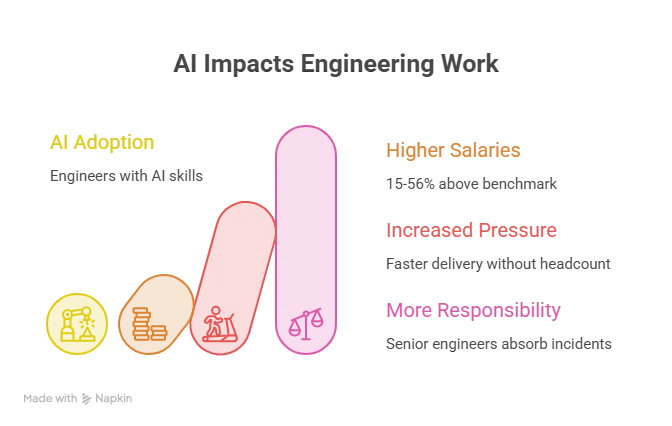
AI is reshaping this equation in two directions at once. Engineers with demonstrated LLM, MLOps, or applied AI experience are earning 15% to 25% above the standard benchmark for their level, and a 2025 PwC study found AI-required roles carrying a wage premium as high as 56% over comparable non-AI positions.
At the same time, AI tools are raising the performance pressure bar. Teams that adopt AI assistants often expect faster delivery without adding headcount, which pushes workload stress onto the engineers who are already stretched thin.
The senior engineers left holding legacy systems and production incidents are absorbing more responsibility, not less, even as junior hiring slows.
If you want to see exactly how these tools are reshaping day to day engineering work, our piece on how AI tools are changing the software engineer role covers it in detail, and our guide to building an AI software engineer career in the US walks through how to position yourself for the premium instead of just the extra workload.
Retention Risk: What Happens When Burned Out Engineers Stay Anyway
Not every burned out engineer quits. Some stay because the job market feels uncertain, because relocating is expensive, or because they are simply too exhausted to job hunt. This is where the real cost shows up.
Gallup’s State of the Global Workplace links the 2026 drop in global engagement to $438 billion in lost productivity.
A separate S&P Global study of 1,782 companies found that a one point rise in average employee happiness correlates with a 1.0 to 1.2 percentage point increase in return on assets, worth $1.39 billion to $2.29 billion in additional annual profit across the sample.
Inside an engineering org, this shows up as slower code reviews, higher defect rates, and a strange sorting effect. The engineers with the most external options leave first, since they can.
The ones who stay tend to be either genuinely loyal or simply stuck, and neither group performs at their best while carrying unresolved mental health strain and unrewarded performance pressure.
What Actually Helps
None of this means every burned out engineer needs to quit, and it does not mean every underpaying company is acting in bad faith. Budgets are real. But there are concrete moves that shift the balance back toward the engineer.
Building visible proof of impact outside your day job is one of the strongest levers you have in a pay negotiation.
Our guide to side projects for software engineers covers how to pick projects that actually move the needle on your next offer, rather than ones that just eat your weekend.
If you are earlier in your career and weighing how to break in, our breakdown of coding bootcamps for software engineers in the US and our guide to landing a software engineer internship in the US both walk through realistic paths into the field without assuming you already have five years of experience nobody will give you a chance to get.
And if the burnout is less about pay and more about the nature of the work itself, it is worth reading our comparison of software engineer vs data scientist career paths before assuming a raise is the only fix.
Sometimes the better answer is a lateral move into a role that fits your energy differently, not just a bigger number on the same job.

Frequently Asked Questions
-
Is software engineer burnout actually caused by low pay?
Low pay is rarely the only cause, but it is consistently one of the top two or three factors, alongside workload and unclear expectations. When pay feels fair relative to output, engineers tolerate a heavier workload far better than when pay and workload are both working against them.
-
What percentage of software engineers experience burnout?
Between 73% and 83% of developers report experiencing burnout at some point in their career, according to JetBrains and Haystack Analytics data, compared to a 51% average across all full time US workers.
-
Does a raise actually fix burnout?
A raise alone rarely fixes burnout if the workload and expectations stay the same. It removes salary dissatisfaction as a factor, but if performance pressure and unrealistic scope remain, the underlying exhaustion tends to return within a year.
-
How do I know if I am underpaid relative to the market?
Compare your total compensation, not just base salary, against current data for your level, location, and company tier. If your base has not moved in over two years while market medians have risen, that gap is a reliable early warning sign.
-
Should I quit if I am burned out and underpaid?
Not necessarily as a first step. Try negotiating with current market data in hand first, since many companies will counter rather than lose a known performer. If leadership will not move on pay or workload after a direct conversation, that response itself is useful information for your next decision.
Final Thought
If you have negotiated a raise after feeling burned out, taken a lower offer just to escape a bad workload, or found that a pay bump did not actually fix how you felt about the job, that experience is worth more than another salary chart.
Feel free to share what actually worked, or did not, in the comments. Real numbers from real engineers are still the best data this topic has.

Shahzada Muhammad Ali Qureshi (Leeo)
I’m Shahzada — a software engineer by education and an SEO professional by trade. I built WhatIsTheSalary.com to go beyond just showing salary numbers — every page is manually researched across sources like BLS, Glassdoor, LinkedIn Salary, and PayScale to give you the full picture in one place. If you found what you were looking for here, that’s exactly the point.