TL;DR: Become a Software Engineer Without a Degree in 2025–2026
How to become a software engineer without a degree—imagine pulling in $100,000+ entry-level in late 2025, no college debt weighing you down. It might sound like a scam,”what is the salarly”but in today’s skills-first market, self-taught coders are making it real. While tech hiring got pickier, giants like Google and startups are snapping up talent—they care more about your GitHub projects than a diploma.
Stuck in a dead-end job? Dreaming of coding apps that change lives, working remote, and earning solid cash? That four-year degree isn’t the only way anymore.
The grind isn’t easy—you’ll hustle harder than some grads. But with entry-level pay often hitting $100k-$126k and remote freedom, it’s worth it. You don’t need a cap and gown. You need a smart plan. Let’s map your path to that breakthrough.
Introduction
What does a software engineer do?
Software engineers create the tech we use every day. They code apps, fix glitches in websites, and build systems for businesses. Picture debugging your bank’s app so it doesn’t crash mid-transfer. Or designing software that helps doctors track patients. It’s problem-solving with keyboards. Fun, right? But it can get tricky when deadlines loom.
Do you need a degree to become a software engineer?
Short answer: no. Plenty of pros got started without one. Companies like Google and Microsoft hire based on skills, not papers. If you can code and prove it, you’re in the game. Sure, a degree opens some doors faster. But self-taught folks sneak in through the side entrance all the time.
Benefits of becoming a software engineer without a degree
You skip the debt mountain. No four years of tuition bills. Learn at your pace, maybe while keeping your day job. Remote work is common, so code from your couch. Job growth is steady, too. And let’s be honest, telling people “I taught myself” feels pretty badass. Who needs a cap and gown when you’ve got GitHub commits?
How much does a software engineer make without a degree?
It depends on where you live and what you know. Entry-level gigs in the US start around $70,000 to $100,000 a year. Average pay hits about $130,000, plus bonuses.
Without a degree, you might start lower, but skills can push you to $150,000 quick. In places like Austin, seniors pull $180,000. Not shabby for ditching lectures. Just don’t spend it all on fancy keyboards.
Understanding the Current Landscape
The Hidden Reality About Learning Paths
Tech changes fast. Self-teaching isn’t a walk in the park. You need grit. But hidden perks? You learn what matters, not dusty theory.
What’s actually happening in tech hiring
Hiring’s picky in 2025. New grads struggle, with entry jobs down. Big tech cut back, but startups are picking up. Remote gigs are fading; offices call folks back. Over 126,000 tech jobs vanished this year. Yikes. But specialized skills? They’re gold.
The mentorship gap nobody talks about
Finding a guide is tough. Most newbies code alone, missing real feedback. Online forums help, but a mentor spots your blind spots. Like that time I debugged for hours—turns out, a pro could’ve fixed it in minutes. Hunt for one early. It bridges the gap between hobby and hire.
The AI hiring reality nobody discusses
AI shakes things up. It automates simple code, hurting juniors. Young devs aged 22-25 saw jobs drop 20%. But flip side? AI creates roles. Think AI trainers or security pros. Use tools like GitHub Copilot to speed your learning. Robots aren’t stealing all jobs—they’re making smarter ones. Funny how tech bites its own tail.
Current industry reality and market demand
Demand grows 15% through 2034. AI and ML lead the charge, up 184% in postings. But entry-level’s rough—unemployment for CS grads hit 6%. Self-taught? Focus on niches like DevOps. Market’s split: oversaturated basics, starving for experts. Stay sharp.
Degree vs. Bootcamp vs. Self-Taught
Hey, let’s talk paths. Picking how to learn coding feels like choosing pizza toppings. Everyone’s got an opinion. But in 2025, with jobs picky, you need the facts. I’ll break it down simple. No fluff.
Comparing different educational pathways
Three main ways: college degree, bootcamp, or go solo self-taught. Each has ups and downs. Think about your time, cash, and how you learn best. Degrees give deep knowledge. Bootcamps rush you to job-ready. Self-taught? It’s like DIY home repair—cheap, but you might hammer your thumb.
College Degree Pros and Cons:
Pros: Builds strong basics in theory, like algorithms and systems. Easier to snag interviews—many firms still love that paper. Rounded skills help long-term, like moving to management. Average cost? Around $100,000 for four years, but scholarships help.
Cons: Takes forever—four years minimum. Expensive if no aid. Lots of unrelated classes, like history, when you just want code. In 2025’s tight market, even grads struggle, with unemployment at 6-15% for newbies. Funny how you pay big bucks to learn stuff you Google later.
Bootcamp Pros and Cons:
Pros: Quick—3-6 months. Job-focused, hands-on projects. Build a portfolio fast. Instructors guide you, plus networking. Job placement? Some hit 85% within six months. Costs $10,000-$20,000, cheaper than college. Great for career switchers.
Cons: Intense, like cramming for finals daily. Not deep on theory—might miss basics. In 2025, some bosses see them as scams now, with market flooded. No degree means harder interviews. Pick reputable ones, like General Assembly, or waste money.
Self-Taught Pros and Cons:
Pros: Free or low-cost—use YouTube, freeCodeCamp. Flexible, learn at your pace. Proves hustle, which impresses startups. Build real projects you love. In 2025, it’s still possible to land jobs if you shine. Feels good being your own boss.
Cons: No structure—easy to quit or skip hard parts. Takes discipline; many fizzle out. Harder to get noticed without credentials. Market’s tough—degreed folks flood apps, so self-taught rarely get calls. Like teaching yourself guitar—fun, but gigs? Rare without practice.
Unique twist: In 2025, hybrid works best. Mix self-taught with certs to boost a bootcamp. Or degree plus side projects. Data shows bootcamp grads earn similar to degrees entry-level, around $90,000, if placed. Self-taught? Might start lower, but skills catch up quick.
What percentage of software engineers don’t have a degree?
It varies by source and region. Recent stats say 27% to over 30% code without any college degree. Older surveys? Stack Overflow’s 2016 Developer Survey found 56% without a CS degree. But in big tech, it’s lower—maybe 7% without related fields. Startups love non-degrees more. In 2025, with AI shaking jobs, skills matter over paper. But degrees still open doors faster.
Success stories of well-regarded software engineers without degrees
Real people make it happen. Bill Gates dropped out of Harvard, built Microsoft—now worth billions. Mark Zuckerberg left too, for Facebook. John Carmack quit after two semesters, created Doom, changed gaming forever. Linus Torvalds self-taught Linux, powers most servers.
Newer ones for 2025 inspo: Sean Parker, self-taught hacker, co-founded Napster and helped Facebook. Kourosh, a dev making $6,000/month from apps while full-time employed—all self-learned. Amit Shekhar switched from civil engineering to Android dev, no CS degree. Reddit tales? One self-taught landed a job in six months, earning $110,000 entry-level. These stories show grit wins. If a high school dropout can, why not you? Just don’t quit your day job yet—ha, learn first.
Step-by-Step Guide to Becoming a Software Engineer Without a Degree
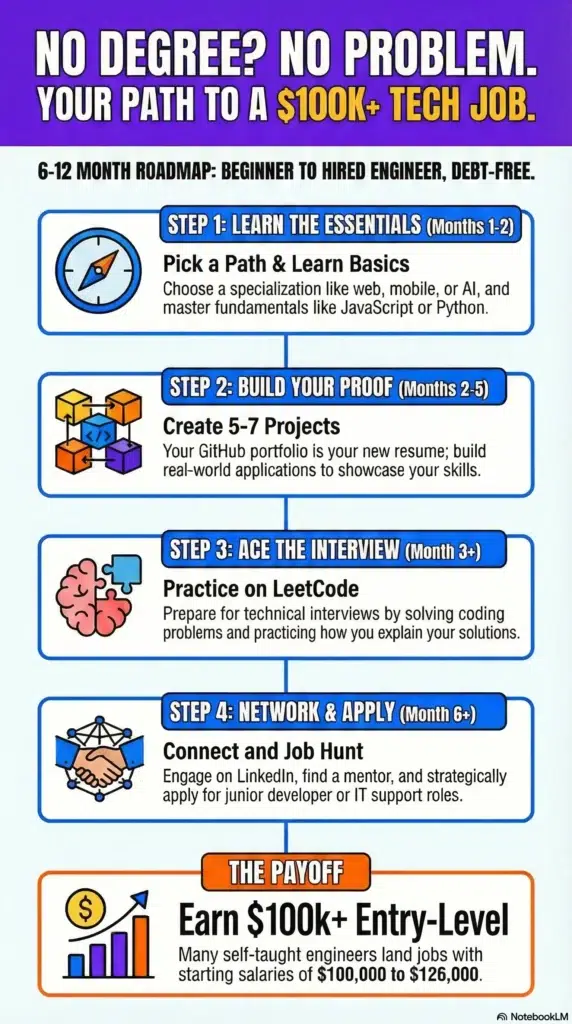
Hey, reader. Ready to jump into coding without that college bill? I’ve seen folks like you make it happen. This guide breaks it down month by month. No magic—just real steps. Mess up along the way? That’s normal. Let’s get you started.
Step 1: Choose Your Programming Specialization Path (Month 1)
First things first. Look at what you already know. Played with HTML on a blog? That’s a win. Or maybe nothing—fine too. Spend this month picking a focus.
Web dev if you like building sites. Mobile for apps on phones. Or go bold with AI—it’s exploding right now.
In 2025, AI jobs like machine learning engineers grew the most. Demand for AI skills shot up, with postings up 25% from last year. Why? Companies need folks to handle smart tech. But don’t chase trends blind. Read job posts on LinkedIn. Search “entry-level software engineer” and see what’s hot in your area.
Strategy: Start broad, then niche down. Learn basics like how code works. Match to your likes—games? Try Unity. Finance? Python for data. Don’t jump around; that’s like starting five books and finishing none.
Funny story: I once tried everything and ended up confused. Pick one path. By end of month, have a plan. Tools? Free quizzes on sites like CareerFoundry help.
Unique tip: Check X (Twitter) for real talks. Search “self-taught developer advice 2025″—folks share what’s working now. One post said focus on cloud stuff like AWS—it’s big. Spend 1-2 hours daily. You’ll feel clearer.
Step 2: Gain Essential Skills and Learn Programming Languages (Months 1-2)
Now build those basics. Core stuff: For web, grab HTML, CSS, JavaScript—it’s the most used, with 66% of devs on it. Python? Easy for newbies, tops the charts for AI and data—adoption jumped 7% this year. Java or C# for big company apps.
Don’t skip data structures—arrays, trees, queues. Algorithms? Sorting, searching. These pop in interviews. Self-taught route: FreeCodeCamp or Codecademy. They’re free, interactive. Hard? Yeah, it stings at first. But rewarding when code runs.
How long? Real talk: 3-6 months full-time for basics, but up to a year part-time. Practice daily—30 minutes minimum. Mess up? Laugh, debug, learn. I once looped code forever—coffee break fixed it.
Unique info: In 2025, learn with AI tools like GitHub Copilot for hints. But understand why it suggests stuff. For in-demand skills, add TypeScript—up in rankings. Read books like “Clean Code” for pro habits.
Join forums like Stack Overflow early. Ask questions. By month 2, code simple programs. Track progress in a journal. Feels good seeing growth.
Step 3: Build Foundational and Industry-Specific Projects (Months 2-5)
Projects are your proof.
Start small: A to-do app in JavaScript. Then a full site with login. Use React for front-end—hot skill.
Portfolio on GitHub: Clean code, good READMEs with how-to-run instructions. Add screenshots.
Tips: Twist projects real-world. Add AI chat to an app using OpenAI API. Or build sustainable tech—like a carbon tracker. Gets eyes in interviews.
Version control? Master Git—commit often, branch for features. Pro practices: Write tests, collaborate on open-source.
Unique angle: Tie to 2025 trends. Green tech apps stand out as companies go eco. Or AI tools—ML jobs grew huge. One self-taught dev shared on X: Cloned Twitter with extras, landed a gig. Aim for 5-7 projects.
Debug on different devices. Share on Reddit for feedback. Employers scan fast—make yours shine. Humor: Your first project might crash like my old car. Fix it, drive on.
In-depth: Spend time on docs. Explain problems solved. This shows thinking. For industry-specific: If web, build e-commerce. Mobile? Weather app. By month 5, your GitHub’s a story of you.
Step 4: Prepare for Technical Interviews (Month 3+)
Interviews? Scary but doable. Read pro code on Stack Overflow—see patterns. Practice on LeetCode, HackerRank—medium problems first. Focus algorithms like binary search.
Modern prep: Mock on Pramp—free, real feel. No degree?
Push projects: “I built this app that handles users.” Skills: Problem-solving, talk your thoughts. Communication key—explain like to a friend.
AI helps: Use for hints, not copy. In 2025, some tests check AI ethics.
Approach: Breathe, think aloud. Bomb first? Normal—I froze once, now laugh. Solve 100 problems. Track in notes.
Unique: Join Discord groups for mocks. X posts say practice behavioral too—”Why self-taught?” Answer with passion. Market’s tight, but skills win. Keep going; persistence pays.
Step 5: Strategic Networking and Mentorship
Network like a pro. Join Reddit’s r/cscareerquestions—post, help.
LinkedIn: Comment smart, connect devs.
Reach mentors on X: “Advice for self-taught?” Polite wins.
Connect students on Discord—like freeCodeCamp server. Swap code. Feedback from pros: Post on Dev.to. They catch bugs.
Unique tip: Virtual meetups on Meetup.com. In 2025’s market—with jobs up but picky—ties help. Don’t lurk; chat. I got a tip once that changed everything. Build 50 contacts. Follow up. Give back—review code. It’s mutual.
In-depth: Aim events weekly. X searches show self-taught success. Mentors bridge gaps. Be patient; good ones busy.
Step 6: Execute Strategic Job Search (Month 6+)
Hunt time. Start IT support—foot in door, learn ropes.
Jobs sans
degree: Junior dev, QA tester.
Companies: Startups, Shopify-like midsize.
Big ones? Apple, Amazon hire skills-first. Google too.
First: Tailor resumes—projects top, keywords like “Python.” Apply 10 daily on Indeed, LinkedIn. Track rejections—learn why.
2025 market: Jobs grew 15% projected to 2034, but entry tough. AI shakes juniors, down 20%. Niche in ML—up big.
Salaries: Entry $90k+, average $139k.
Unique: Freelance Upwork for experience. X stories: Self-taught to Slack in months. Keep applying. Network aids. You got this—one rejection closer to yes.
Practical Resources and Support
Educational Resources
Bootcamps: General Assembly or App Academy. Quick, job-focused.
Certifications: Google’s IT Support or AWS Developer.
For 2026, grab AI certs—demand’s high.
Languages? Udemy has cheap courses on Python, Java.
Free options: freeCodeCamp or Codecademy.
To land jobs without degree, try Coursera’s Google Data Analytics—broadens skills.

Daily Practice and Investment
Code every day. Even 30 minutes. Buy a decent laptop—$500 gets you far.
Use free tools like VS Code. Keep learning: Newsletters like Pragmatic Engineer. For 2026, refine AI skills. Market wants them.
Career Development and Growth
Building Your Career
No degree? No problem. Freelance on Upwork first. Build gigs into full-time. Keep growing: Courses yearly. Timeline: 6-12 months to entry job, 2-3 years to mid-level at $150,000+.
Understanding the Market
Takes 6-18 months self-taught. Demand solid, but competitive. Prep: Niche down, network hard. AI creates jobs, not kills them all.
Frequently Asked Questions
Can you become a software engineer without a degree?
Yes, absolutely. In 2025, about 27-30% of devs skip college altogether. Companies like Google, Amazon, and startups hire based on skills, projects, and hustle—not diplomas. Build a strong GitHub, nail interviews, network smart, and you’re in. It’s tougher without the paper, but thousands do it every year. Your code speaks louder than credentials.
How long does it take to become a software developer?
Real talk: 6-12 months if you grind full-time, 12-24 months part-time. Basics in 3 months, solid projects in next 3-6, job hunt after. Depends on your start point and daily hours. Some land junior roles in 6 months; others take longer. Consistency beats speed—code daily, and you’ll get there faster than you think.
Is software engineering hard to learn?
It’s challenging, yeah—no sugarcoating. Debugging frustrates everyone at first. But it’s learnable with practice. Start simple, build momentum. Millions taught themselves. If you like puzzles and don’t mind failing a lot (then fixing it), you’ll love it. Harder than easy jobs, but way more rewarding—and funny when your code finally works.
What are the benefits of becoming a software engineer without a degree?
You save $100k+ in debt, learn only what matters, move at your pace. Prove real grit—bosses love that. Faster to job market, often remote work, high pay from day one ($80k-$120k entry). Plus, bragging rights: “I built this career myself.” Feels better than any diploma ceremony, trust me.
Bottom Line
You don’t need a degree to make it as a software engineer. Just consistent hustle, solid projects, and smart networking.
In 2025, skills beat paper every time. Start small today—code one line, build one app. Six months from now, you could be in a new job, debt-free and smiling.
Your move. Open that laptop and begin. You’ve got this.

Shahzada Muhammad Ali Qureshi (Leeo)
I’m Shahzada — a software engineer by education and an SEO professional by trade. I built WhatIsTheSalary.com to go beyond just showing salary numbers — every page is manually researched across sources like BLS, Glassdoor, LinkedIn Salary, and PayScale to give you the full picture in one place. If you found what you were looking for here, that’s exactly the point.