TLDR
You hit submit, and nothing happens. No call, no email, just silence. After the fifth ghosted application, it is easy to blame a robot that tossed your resume. But ATS Filters in US Job Applications rarely work that way, and guessing wrong costs you weeks.
Here is the real problem. Employers now get 244 applications per job, according to Greenhouse’s March 2026 data, so recruiters skim fast. One wrong answer on a single screening question can end your application before anyone opens your resume.
The fix is simpler than the myths suggest. In this guide, I show what really rejects you, how to answer knockout questions, and how to format a resume that works for both the system and the recruiter. Pair it with the IT salary and career guides on WhatIsTheSalary, so you know your worth before you apply.
What an ATS Actually Does With Your Application
An applicant tracking system, or ATS, is the database your application lands in. It stores your resume, records your answers, and puts you in a queue for a recruiter. Jobscan’s 2026 report detected an ATS at 97.4% of Fortune 500 companies, so you will meet one at almost every large employer.
Volume is why this matters. Greenhouse’s Hire Standard report, published in March 2026, found 244 applications per job in 2025. That is up 111% from roughly 116 in 2022. Greenhouse also reported that recruiter teams shrank by 55% over the same period.

Does the ATS Really Reject 75% of Resumes?
You have probably seen that number. It appears on resume service sites everywhere. The Interview Guys traced it to a 2012 sales pitch from a resume optimization company called Preptel, and Hiration found no traceable source behind it either.
Huntr took a harder look. Its April 2026 report analyzed 1.7 million applications, reviewed 225,000 resumes, and included interviews with recruiters at Amazon, Microsoft, and two Fortune 500 employers. Its conclusion: no major ATS rejects a resume without a human involved.
Treat survey claims with care, too. Enhancv asked 25 US recruiters, and 92% said their system does not auto-reject for formatting or content. That sample is small, and other career sites dispute it.
Here is the honest middle ground:
Which ATS Will You Meet in US Job Applications?
Huntr counted the platforms behind 1,665,447 job postings its users saved in 2025. Greenhouse and Workday together covered about half. Huntr says these shares likely undercount, because companies that host an ATS on their own domain get credited to the company.
| Platform | Share of saved postings (2025) | Common at | What to know |
| Greenhouse | 30.6% | Tech, startups, mid-size firms | Recruiters read your uploaded file. AI matching surfaces people but removes no one. |
| Workday | 19.6% | Large enterprises | Recruiters call its parser the weakest of the major systems. Keep contact details out of headers. |
| Ashby | 10.7% | Startups, growth-stage tech | States that its AI never ranks or scores applicants. |
| iCIMS | 7.4% | Enterprise, healthcare | Long forms. The screening questions matter more than layout. |
| Workable | 6.5% | Small and mid-size firms | Matches meaning, not just keywords, so stuffing helps little. |
| Lever | 6.2% | Tech, mid-size firms | Keeps your profile for future roles. |
| SmartRecruiters | 5.2% | High-volume hiring | May rank your screening answers with AI. |
Fortune 500 employers look different. Jobscan reports that Workday and SAP SuccessFactors together run 52.4% of them.
You can usually spot the system in the application URL. Look for myworkdayjobs.com, greenhouse.io, lever.co, ashbyhq.com, icims.com, smartrecruiters.com, or apply.workable.com.
Knockout Questions: The One Real Auto-Reject
This is where applications die quietly. A knockout question carries a rule tied to one answer. Greenhouse’s auto-reject feature, for example, reads your answers to application questions, not your resume. A Big Four recruiter told Huntr the older enterprise systems worked the same way: the questions did the filtering.
The common ones:
Read each question to the end. Authorization and sponsorship sit side by side and ask different things.
Degree and experience questions
If a form asks whether you hold a bachelor’s degree and you do not, you may never reach a person. That does not close the field. Our guide on becoming a cybersecurity analyst without a degree shows the other routes in. If you are weighing school against a shorter path, our cloud bootcamp vs degree comparison puts the costs side by side.
For years of experience, enter your real number. If you are one year short of the posting, a referral or a short note to the recruiter lets a human judge you, which a form never will.
Certification questions
Certification boxes work the same way. Use the exact credential name from the posting, and only tick it if you hold it, for example AWS Certified Solutions Architect Associate or Microsoft Certified: Azure Administrator Associate. Not sure which credentials pay off? See our lists of AWS certifications that boost salary and Azure certifications that boost salary in the US.
Work authorization and sponsorship
This is the biggest filter for international applicants. A yes to “Will you now or in the future require sponsorship?” can end an application at employers that do not sponsor. Answer truthfully. A false answer tends to surface in later background checks and can cost you the offer.
Salary expectation fields
Some forms ask for a desired salary, and employers can set limits on it. Check the market first. Our CISO salary guide and data scientist salary by city page show what these roles typically pay, so you do not type a number that sits too low or prices you out.
How to Write a Resume That Works for the ATS and the Recruiter
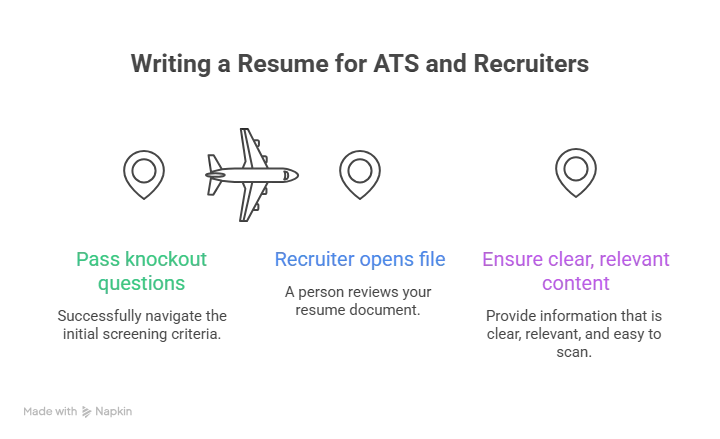
After the knockout questions, a person opens your file. Both audiences want the same thing: clear, relevant, easy to scan.
Mirror the job post in your own words
Huntr’s data puts interviews at about 6% of applications for tailored resumes, or 1 in 17, against about 3% for generic ones. It is the biggest lever I found.
Read the responsibilities section, not just the requirements. An Amazon recruiter told Huntr that many applicants skip it. Match the job title wording where it is true. If you are moving toward architect roles, our cloud architect career guide maps the titles and skills you can mirror honestly.
Do not paste the job post into your resume. That same recruiter flagged AI-written resumes that echo the posting too closely.
Keep the layout plain
Lead with numbers
Recruiters give the first scan about 6 to 10 seconds, so put your strongest results in the top third of page one. Use numerals, because they stand out. Compare these two example bullets:
The second bullet is an illustration. Write yours with your real figures.
Tricks That Backfire
Greenhouse’s 2025 AI in Hiring Report found that 41% of US job seekers admit to using prompt injections, meaning hidden text meant to fool AI filters. I would skip it.
Here is why. When an ATS parses your resume, it strips the formatting and shows the recruiter raw text, so white-on-white keywords appear in plain view, according to a July 2026 Remotivated analysis. Greenhouse also reported that 74% of hiring managers fear fraud more than they did a year earlier.
Mass applying has its own cost. Recruiters see every role you applied to at their company. One Fortune 500 recruiter told Huntr that seeing 15 applications from one person raised doubts.
Beat the Pile: Apply Early and Reach a Human
With 244 applications per job on average, timing and people matter. A Microsoft recruiter told Huntr he aims to get 5 candidates into interviews per role, and once those are in motion, the pipeline often closes. Apply in the first days when you can.
Keyword advice mostly applies to sourcing, where recruiters search databases and LinkedIn for people. Huntr makes this point, and it means your LinkedIn headline and About section deserve the same job titles and skills as your resume.
After you apply, send a short note to the recruiter or hiring manager. If you are switching into security and unsure which titles to target, our cybersecurity career path guide is a good place to map that out.
What the Workday and Eightfold Lawsuits Mean for Applicants
Two cases keep AI screening in the news. In Mobley v. Workday, an applicant over 40 alleges Workday’s tools screened him out of jobs. A federal judge let a nationwide age-discrimination collective action proceed in May 2025, and legal trackers report further 2026 rulings that kept the case moving. In January 2026, applicants sued Eightfold AI, alleging it scored candidates and filtered them out before any human looked.
Both are allegations. Among the sources I reviewed, none reports a court finding that either company discriminated.
For you, the takeaway is practical. Huntr’s recruiters said legal risk is one reason many employers keep humans in the screening decision. Expect a person to read your file, and write for that person.

A 10 Minute Check Before You Submit
- Paste your resume into a plain text editor. If the order scrambles or contact details vanish, simplify the layout.
- Compare your top 5 bullets with the job’s responsibilities, and swap in the post’s wording where it is true.
- Reread every knockout answer exactly as the form words it.
- Check that your job titles and skills match what a recruiter would type into a search box.
- Save as a text-based PDF or a .docx, not an image.
ATS checkers such as Jobscan and Resume Worded give their own scores. Huntr notes that no employer sees those numbers, so I use them as a gut check only.
Frequently Asked Questions
-
Do ATS systems automatically reject resumes?
Not on resume content, according to Huntr’s 2026 research on the major platforms. Knockout questions can reject you automatically based on your answers. A recruiter makes the other decisions.
-
Is a PDF or Word file better for ATS?
Both work with every major system. Workday tends to handle .docx slightly better. Use a text-based file, not a scanned image or a design tool export.
-
Do I need a one-page resume?
No. Huntr’s analysis of 225,000 resumes found two-page resumes perform as well as or better than one-page ones at every experience level.
-
How do I know which ATS a company uses?
Check the application page URL. Domains such as greenhouse.io, myworkdayjobs.com, lever.co, and ashbyhq.com point to the system. If the company hosts its careers page on its own domain, it is harder to tell.
-
Can I use AI to write my resume?
Many people do. Greenhouse reports that 65% of candidates use AI at some point in the application process. Use it to organize your real experience, then edit it yourself. Recruiters told Huntr that AI-written resumes that mirror the posting look like a red flag.
Share Your Experience
Have you hit a knockout question that surprised you, or landed an interview after changing your resume? Tell me in the comments.
How This Article Was Created
I drew on Huntr’s April 2026 ATS report (2025 application data), Jobscan’s 2026 Fortune 500 ATS report, Greenhouse’s Hire Standard report (March 2026) and AI in Hiring Report (November 2025), Enhancv’s recruiter survey, Remotivated’s July 2026 analysis, and legal coverage of Mobley v. Workday and the Eightfold AI case. I reviewed everything in October 2026. I did not invent any figures. Where samples are small or sources disagree, I say so. This article is meant to inform job seekers, not to recruit or advertise.

Shahzada Muhammad Ali Qureshi (Leeo)
I’m Shahzada — a software engineer by education and an SEO professional by trade. I built WhatIsTheSalary.com to go beyond just showing salary numbers — every page is manually researched across sources like BLS, Glassdoor, LinkedIn Salary, and PayScale to give you the full picture in one place. If you found what you were looking for here, that’s exactly the point.