TLDR
You aced the final round, then heard nothing for two weeks. No rejection, no offer, just a calendar that refuses to move.
I wrote this US Tech Interview Process Explained: Stages and Timeline guide because most candidates guess where they stand. Companies hide the waiting inside recruiter calls, hiring committees, and team matching. One missed step can cost you weeks, or the competing offer that gives you bargaining power.
Below, I break down all five stages, show reported wait times at Amazon, Google, Apple, and startups, and flag the 2026 changes around AI rounds. Once an offer lands, check it against real tech salary data before you reply.
US Tech Interview Process Explained: The Short Version
The tech interview process in the US works like a funnel. Each stage tests one thing, and each handoff adds scheduling days that never show up on the job post.
How long does the whole thing take? Glassdoor’s Amazon interview page shows software development engineer candidates reporting an average of 36 days to get hired, based on 22 submissions. Candidate guides for big companies mostly land between 3 and 6 weeks. One 2026 benchmark roundup, citing Ashby data, puts the median at 40 days for technical roles.
Demand gives you a reason to stay patient. The Bureau of Labor Statistics projects 10 percent growth for software developers, QA analysts, and testers from 2025 to 2035, with about 106,100 openings a year. The median wage for software developers was $135,980 in May 2025. Strong demand still does not speed up any one company’s calendar.

The Five Stages of a Tech Interview, One by One
Stage 1: Resume screen and recruiter call
A recruiter checks your resume, target level, salary range, and whether you need visa sponsorship. The call runs about 30 minutes and stays non-technical. Scheduling alone often takes one to two weeks. Before you hang up, ask: what is the timeline from here to offer, and who owns each decision?
Stage 2: Online assessment or technical phone screen
Some companies send a timed online assessment first. Others book a live call with an engineer. Expect one or two coding problems in 45 to 60 minutes. The wait before the next step usually runs one to two weeks.
Stage 3: The interview loop
The loop, often called the onsite even when it happens on video, bundles several interviews. A typical mix covers coding, system design for mid and senior levels, and a behavioral round. In Amazon’s own interview guide, the company says you meet two to seven people, including a Bar Raiser, an objective third party usually from another team. For a deeper look, see my Amazon interview process breakdown, plus the official Amazon interviewing page.
Stage 4: Debrief, hiring committee, and team matching
Interviewers write up feedback independently. At Google, a hiring committee that never met you makes the call. Candidate guides describe Google team matching as a separate step after approval, and it can add several weeks.
Stage 5: The offer
The recruiter calls first, then sends a written offer. Ask for base, sign-on bonus, RSU grant, vesting schedule, bonus target, and level in writing. The stock value recruiters quote uses today’s share price, so a 20 percent drop before vesting cuts that piece of your pay by 20 percent. Check your numbers against Levels.fyi for your level, then learn how to negotiate a tech offer.
Reported Timelines by Company
| Company | Typical stages | Reported total time | What usually slows it |
| Amazon | Recruiter call or online assessment, loop with a Bar Raiser | 36 days average for SDE on Glassdoor; guides say 3 to 6 weeks | Waiting for a loop slot |
| Recruiter, one or two technical screens, loop of 4 to 5, hiring committee, team match | 6 to 12 weeks in one 2026 guide; others say 4 to 8 | Team matching after approval | |
| Apple | Recruiter, hiring manager screen, technical screens, onsite of 4 to 8 hours | 4 to 8 weeks; some candidates report 10 to 12 | Headcount limits and scheduling |
| Meta | Recruiter, screen, loop with a traditional coding round and an AI-enabled one | I found no reliable figure, so confirm with your recruiter | Format varies by role and level |
| Startups | Compact loop, sometimes a take-home task | 4 to 6 weeks for 52% of companies, per Underdog | Silence between stages |
What Changed in the 2026 Tech Interview Process
Formats shifted this year, mostly because of AI. Three changes matter.
Google wants you in a room. CEO Sundar Pichai told the Lex Fridman Podcast that Google would add at least one in-person round, to make sure the fundamentals are there.
Meta lets some candidates use AI. Hello Interview reports that Meta started rolling out an AI-enabled coding round in October 2025, and it sits next to a traditional coding round with no AI. Read my guide to the Meta AI-enabled coding interview if your loop includes one.
Amazon still bans AI. interviewing.io lists AI use in Amazon interviews as prohibited.
My rule: ask your recruiter in writing whether AI is allowed in each round, and keep the reply. If the answer is vague, assume it is off.
Why Team Matching and Downleveling Add Weeks
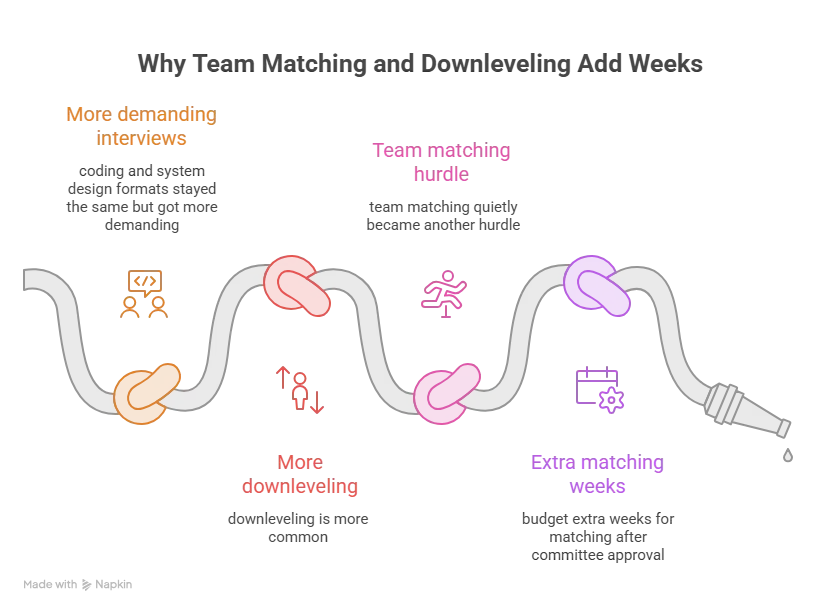
Passing the loop does not end the wait. The Pragmatic Engineer reports that coding and system design formats stayed the same but got more demanding, that downleveling is more common, and that team matching quietly became another hurdle. Interview Query tells Google software engineer candidates to budget extra weeks for matching after committee approval. IGotAnOffer says that approval stays valid for roughly 12 months.
Level matters more than the logo here. It sets your pay band and your RSU grant. Ask which level the team is hiring for before you get attached to a title.
H1B, OPT, and Your Interview Timeline
If you need sponsorship, say so on the recruiter call. Employers want to know early so nothing surprises them at the offer stage. Cap-subject H-1B filings follow an annual season that opens in April, so your calendar matters if you are on F-1 OPT.
Ask whether the team has sponsored petitions before. Large employers that file often have immigration departments built for it. Some companies that will not file an H-1B still hire OPT candidates for a fixed window, so ask before you assume the door is closed. My H1B interview process guide covers the questions to ask in each round.
How to Run Several Interview Processes at Once
At some point, more research is just delay. Once you know the stages, the next move is timing. Here is what I would do.
- Start processes in the same window. Offers need to be open at the same time for you to have bargaining power. Interview Cake suggests scheduling your favorite company last, so you arrive warmed up.
- Share your timeline early. Tell each recruiter you are talking to other companies and when you expect to decide. It gives them a reason to move faster.
- Ask for more time on an exploding offer. A Taro Logo mentor notes that the custom is two weeks, though it can run shorter. Ask within a day, keep the request dated and honest, and never invent a competing offer. More on this in my guide to exploding offers.
- Negotiate after the written offer, and look at RSUs first. In Levels.fyi data for Meta E5 engineers in the Bay Area, analyzed by IGotAnOffer, RSU grants varied far more than base pay or sign-on bonus. That spread usually signals room to negotiate.
Four Myths About the Tech Interview Timeline
Myth 1: Silence means rejection. Not always. Leon Staff’s 2026 Apple timeline guide describes post-onsite silence as the most common Apple experience, with some candidates waiting 10 to 12 weeks. If you hit this, here is what to do when the recruiter goes quiet.
Myth 2: Passing the loop means you have the job. Hiring committees, team matching, and level decisions come after it.
Myth 3: Every company runs the same loop. Amazon says it uses two to seven interviewers depending on the role. Google adds in-person rounds. Meta pilots AI-enabled ones.
Myth 4: You must answer an offer within days. Many companies extend deadlines when you ask politely and give a date.

Frequently Asked Questions
-
How long does the tech interview process take in the US?
Most US tech companies take about 3 to 6 weeks from the first recruiter call to an offer. Glassdoor submissions put Amazon software development engineer hiring at an average of 36 days. Google candidates report anywhere from 4 to 12 weeks across 2026 guides, mostly because of team matching.
-
What are the stages of a tech interview?
Most US processes follow five stages: recruiter call, online assessment or technical screen, interview loop, internal review, and offer. Google adds team matching after committee approval. Startups usually run a shorter and less standardized version.
-
How many interview rounds does a software engineer have?
It depends on level and employer. Amazon says its loop includes two to seven interviewers depending on the role. Add a recruiter call and one or two technical screens before that.
-
Why is the tech interview process so long?
Every handoff needs calendars to line up, and feedback goes through written reviews or committees. One 2026 benchmark roundup citing Ashby puts the gap between first screen and final interview at about 18 days for technical candidates.
-
Can you use AI in a tech interview?
Only when the company says so. Meta runs an AI-enabled coding round next to a traditional one, while Amazon prohibits AI use. Ask your recruiter in writing for each round.
-
What should I ask the recruiter about the timeline?
Ask what the timeline is from here to offer, who owns each decision, and whether a hiring committee or team matching comes after the loop. Then share your own deadlines, such as other interviews or visa dates.
Share Your Experience
Have you been through a US tech interview in 2026? I would like to hear how long your process took, which stage dragged, and whether you negotiated. Drop your timeline in the comments. Real numbers help the next person decide when to push and when to wait.
How This Article Was Created
I wrote this article to inform job seekers, not to recruit for or advertise any employer. Every figure comes from a public source named in the text, and I did not invent or estimate any numbers. Where sources disagree, I show the range.

Shahzada Muhammad Ali Qureshi (Leeo)
I’m Shahzada — a software engineer by education and an SEO professional by trade. I built WhatIsTheSalary.com to go beyond just showing salary numbers — every page is manually researched across sources like BLS, Glassdoor, LinkedIn Salary, and PayScale to give you the full picture in one place. If you found what you were looking for here, that’s exactly the point.