TLDR
You studied the job description, polished your resume, and landed the interview. Then the hiring manager says, “Tell me about a time you failed,” and your mind goes completely blank.
That freeze costs candidates offers every day, and it has nothing to do with talent. Most people never practice telling their stories out loud. Behavioral Interview Questions and Answers for US Jobs come down to a system, not a memorized script.
In this guide, I will show you the STAR method, real sample answers, and a story bank you can build in one weekend. Prepare it once, and you will know exactly what to say. Then check what the role really pays in our IT salary and career guides, so you can negotiate with confidence.
What Behavioral Interview Questions Test in US Hiring
A behavioral question starts with a prompt like “Tell me about a time when…” or “Give me an example of…” The interviewer is not hunting for a perfect story. They want proof that you have already done the thing the job requires.
The reason US employers lean on this format is practical. A large meta-analysis by Sackett and colleagues, published in the Journal of Applied Psychology in 2022, put the predictive validity of structured interviews at .42, compared with .19 for unstructured ones. Older work by Schmidt and Hunter reported a higher figure of .51. Either way, the message is the same: the same questions, scored the same way, beat a friendly chat.
Skills matter too. NACE’s Job Outlook 2026 report found that 70% of employers use skills-based hiring, and 87% of those apply it during interviews. So the interview is where your skills have to show up as stories.
The STAR Method, and the Step Most People Skip
STAR stands for Situation, Task, Action, Result. Situation and Task set the scene in two sentences. Action is the meat. Result closes with a number or a clear outcome.
Where candidates slip is the balance. They spend a minute on the background and ten seconds on what they actually did. Flip that. Aim for roughly 20% setup, 60% action, and 20% result.
Two habits help most with US interviewers:

Behavioral Interview Questions and Answers for US Jobs: 10 Worth Preparing
Most questions fall into a handful of buckets. Here are the ten I would prepare first, along with the story each one is really asking for.
| Question | What they are testing | Story to prepare |
| Tell me about a time you disagreed with a coworker. | Conflict handling | A disagreement that ended in a better decision |
| Describe a time you failed. | Accountability, learning | A real miss, plus how you changed afterward |
| Tell me about a tight deadline. | Prioritization, pressure | A project where you cut scope on purpose |
| Give an example of leading without authority. | Influence, initiative | A time you rallied peers without a title |
| Tell me about an unhappy customer. | Empathy, problem solving | A complaint you turned into a repeat client |
| Describe a mistake you caught early. | Attention to detail | A near miss and the check you added |
| Tell me about learning something fast. | Adaptability | A new tool mastered in a few weeks |
| Describe tough feedback you received. | Coachability | Feedback you acted on, with proof |
| Tell me about going beyond your job description. | Ownership | An unasked improvement with a measurable result |
| Describe a decision made with incomplete information. | Judgment | A call you made and how you limited risk |
Sample answer: a disagreement with a coworker
Situation: On a website redesign, a teammate wanted to launch before testing finished, and I thought that was risky. Task: I owned quality for the release. Action: I did not argue in the meeting. I pulled the last three bug reports, showed that two of them hit the checkout page, and proposed a two-day test window with a rollback plan. Result: We launched two days later, caught a payment bug, and avoided a weekend outage. Now we plan test time together at the start of every project.
Sample answer: a time you failed
Situation: In my second year as a coordinator, I missed a vendor renewal date, and our shipping software lapsed for a day. Task: I had to fix it and make sure it never happened again. Action: I called the vendor, restored access by noon, told my manager before she heard it elsewhere, and set 60-day alerts for every contract. Result: We had no lapses over the next two years. My lesson was to build a system instead of trusting memory.
These samples are illustrations of structure. Swap in your own details, because interviewers can tell when a story belongs to someone else.
Build a Story Bank Instead of Memorizing Answers
Memorized scripts fall apart the moment an interviewer asks a follow-up. A story bank holds up better.
Pick eight experiences from jobs, internships, class projects, or volunteer work. Cover these themes: a conflict, a failure, a win with a number, a time you led, a time you learned fast, a customer or stakeholder problem, a high-pressure moment, and a decision you made with data.
Write each one as four short notes: situation, your actions, the result, the lesson. Then say them out loud. A conflict story about a teammate can answer questions on communication, collaboration, and pressure with a small change in emphasis.
How Amazon and Other Big Employers Run Behavioral Rounds
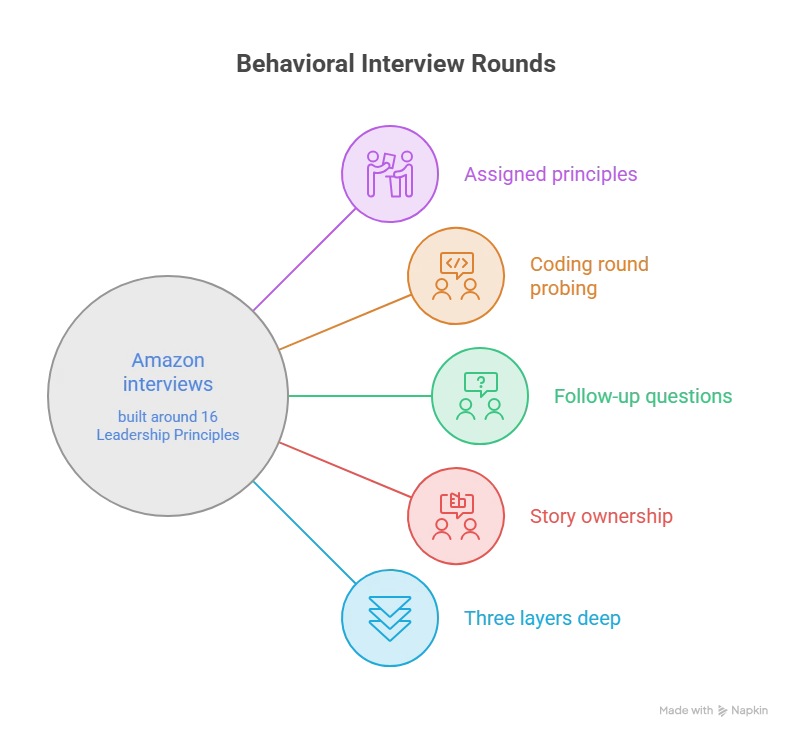
Amazon is the clearest example. Its interviews are built around 16 Leadership Principles, and each interviewer in the loop is assigned specific principles to test. Behavioral probing can also appear inside a coding round, so do not assume a technical round is story-free.
The follow-ups matter more than your opening answer. Expect “What exactly did you do?” and “What would you change?” Interviewers are checking whether the story is truly yours and whether you can go three layers deep on it.
Behavioral Questions for Tech, Cloud, and Data Roles
Technical candidates often assume the coding or architecture round decides everything. It rarely does. Tech interviewers still ask how you handled a failed deployment, a vague requirement, or a stakeholder who changed scope.
If you are aiming at cloud work, pair your stories with proof of skill. Certifications give you something concrete to talk about, and the guides on AWS certifications that boost salary and Azure certifications that boost salary in the US show which ones employers reward. For senior paths, the cloud architect career guide explains why interviews at that level lean on influence and trade-offs.
Data candidates face a similar mix. Expect a question about explaining a model to a non-technical manager. Knowing what the market pays also helps you set expectations before the offer talk, and the numbers in data scientist salary by city make a useful reference.
Leadership stories grow more important as titles grow. Anyone aiming at executive security roles should read the CISO salary guide alongside their prep, because those interviews test judgment, risk communication, and board-level influence more than tools.
No Degree, Career Switcher, or Bootcamp Graduate? Your Stories Do More Work
If your resume has a gap where a degree would normally sit, behavioral answers are your best equalizer. The skills-based hiring numbers above suggest that more employers care about proof of ability than where you studied.
Take security as an example. The route into cybersecurity analyst jobs without a degree depends on evidence, so your answers should lean on lab work, incident write-ups, and self-driven learning. If you are still choosing a route, the comparison of a cloud bootcamp vs a degree helps you explain your choice when an interviewer asks about it. For a longer view of where a first role leads, the cybersecurity career path guide maps it out.
Use stories from side projects, volunteer work, and bootcamp capstones. Interviewers care that the behavior is real, not that it happened on a payroll.
One-Way AI Video Interviews
Some employers now screen with recorded, one-way video interviews. You see the question on screen, get a short prep window, and record your answer with no human present. HireVue is a common example. Prep time is often 30 to 60 seconds and answers run one to three minutes, though settings vary by employer.
The questions are usually familiar behavioral ones, so your story bank still applies. What changes is delivery. Practice with a timer, look at the camera lens instead of your own face, and pick a quiet spot with clear audio. Structure matters even more here because no interviewer is nodding you along.
Know your rights too. Illinois, for example, requires employers to tell candidates when AI will analyze a video interview, explain how it works, and get consent first. If a company does not say how your recording will be evaluated, it is fine to ask the recruiter.
Questions a US Interviewer Should Not Ask
Federal law, including Title VII, the Americans with Disabilities Act, and the Age Discrimination in Employment Act, bars hiring decisions based on protected traits such as race, religion, sex, national origin, disability, and age (40 and over). Many states add more protections. Off-topic questions still slip in, often out of friendliness.
You do not have to answer, and you do not have to be rude. Redirect to the job.
| Off-limits or risky question | A calm redirect |
| Where are you originally from? | I can answer any work authorization questions the role requires. What I would like you to know is how my experience fits this job. |
| Are you planning to have children? | My focus is doing this job well. Can I share how I would handle the workload and schedule? |
| How old are you? | I would rather talk about my track record. Let me tell you about the results I have delivered. |
| Do you have any health conditions? | I can perform the essential duties of this role with or without accommodation. |
| What did you earn at your last job? | I would like to focus on what this role is worth. What is the range for the position? |
Several states also restrict salary history questions, so the last row is not just good manners, it may be the law where you apply.
Mistakes That Sink Good Stories

Frequently Asked Questions
-
What are behavioral interview questions?
They ask you to describe specific past situations, usually starting with “Tell me about a time.” Employers use them because past behavior is a strong clue to future performance.
-
How do I answer behavioral interview questions?
Use the STAR method: Situation, Task, Action, Result. Spend most of your time on what you personally did, then end with the outcome and a short lesson.
-
How long should my answers be?
Aim for 90 seconds to 2 minutes. Short enough to hold attention, long enough to show your actions and the result.
-
What if I have no work experience?
Use school projects, volunteer work, internships, or personal builds. Interviewers want to see the behavior, and it can come from any setting.
Share Your Experience
Have you faced a behavioral question that stumped you, or a story that worked better than you expected? Share it in the comments. Real examples help other job seekers more than any template.
How This Article Was Created
I built this guide from published research and 2026 career resources. The research figures come from the Journal of Applied Psychology work by Sackett and colleagues (2022) and the earlier Schmidt and Hunter review, as reported in 2026 interview statistics summaries, plus NACE’s Job Outlook 2026 report. Amazon and AI video interview details come from 2026 coaching and career guidance. I did not invent any statistics. The sample answers are illustrations of structure, not real candidate accounts. This article was written to inform job seekers, not to recruit or advertise. Data was checked in November 2026.

Shahzada Muhammad Ali Qureshi (Leeo)
I’m Shahzada — a software engineer by education and an SEO professional by trade. I built WhatIsTheSalary.com to go beyond just showing salary numbers — every page is manually researched across sources like BLS, Glassdoor, LinkedIn Salary, and PayScale to give you the full picture in one place. If you found what you were looking for here, that’s exactly the point.