TL;DR
What to Wear and Say in a US Job Interview can decide your offer in the first 7 seconds, long before you answer a single question. Research shows hiring managers often form a lasting impression almost instantly.
The problem? Most candidates over-prepare answers but ignore their outfit, tone, and opening lines. Dress too casual or sound too rehearsed, and even a perfect resume gets wasted.
The solution is simple: dress one level above the company’s culture, open with a confident handshake and a clear 30-second introduction, and back every answer with a real example. Then, when salary comes up, don’t guess. Research real pay ranges on What Is The Salary so you can negotiate with confidence. Here’s exactly how to look and sound hired.
Why What to Wear and Say in a US Job Interview Both Matter
Most guides pick a lane. Style sites talk about blazers, and career coaches talk about answers. Your interviewer sees and hears both at the same moment, so I plan them together.
The numbers back that up. In a 2019 Accountemps survey of more than 2,800 senior managers at US companies, 94% said a candidate’s style of dress matters, and 52% called it very important. That survey is older, and I could not find a US survey of that size since. Dress codes have relaxed, but Robert Half’s current guidance still tells candidates to aim one level above the company’s everyday dress code.
Clothes will not win you the job. They can quietly take you out of the running, though, and your words decide the rest.
What to Wear: Use the One Step Above Rule
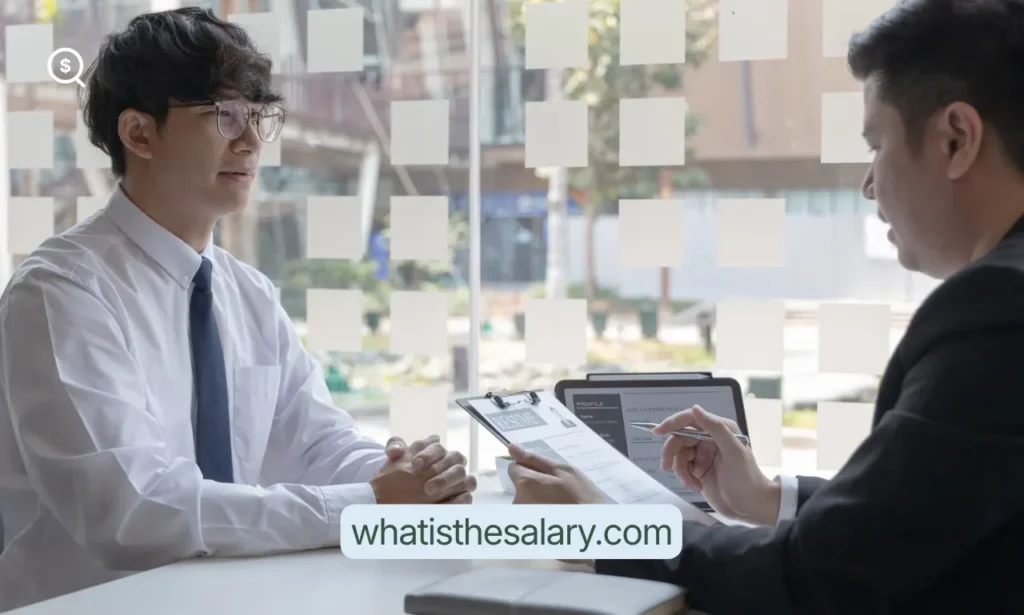
This is the rule I trust most. Find out what employees wear on an ordinary Tuesday, then dress one step more formal. If the office runs on jeans and tees, wear chinos and a button-down or a neat knit. If people wear business casual, add a blazer. If people wear suits, wear a suit.
Decode the Dress Code Before You Choose
Do not guess. Check the careers page, recent LinkedIn posts, and team photos, and look at what senior people wear, not interns at a party. If a recruiter or HR contact is in the loop, ask directly. Robert Half’s own advice is to ask them, and the question shows you prepare.
What US Managers Say About Suits
Opinions split, which is why you research first. Here is how senior managers answered the suit question in the Accountemps survey.
| Manager view on interview suits | Share of managers |
| Candidates should always wear a formal suit | 37% |
| It depends on the position or department | 36% |
| Candidates should just look professional | 23% |
| A suit is too much for today’s relaxed dress codes | 4% |
Where you interview shifts the answer too. In that survey, 54% of managers in Miami, New York, and Washington, D.C. said a suit should always be worn. Phoenix (45%), Minneapolis (43%), and Charlotte (42%) had the highest shares of managers saying it depends on the role or department.
Outfit Cheat Sheet by Setting
Use this table as a starting point, then adjust to what your research turns up.
| Setting | What I would wear | Why |
| Finance, law, consulting | Navy or charcoal suit, pressed shirt or blouse, polished closed shoes | Conservative fields reward the safe choice |
| Corporate office, business casual | Blazer, trousers or skirt, button-down or blouse, leather shoes | One step above daily dress |
| Tech and startups | Dark jeans or chinos, button-down or fine knit, clean leather sneakers or boots | Smart casual fits the culture without looking careless |
| Retail, food service, warehouse | Clean trousers, neat shirt or polo, closed shoes | Dress up from the work uniform |
| Video interview | Solid colors, blazer or collared top, full outfit including trousers | You may need to stand up mid-call |
| Executive or client facing | Tailored suit or equivalent business formal | You represent the company to buyers and boards |
Small Details That Quietly Matter
Fit beats price. Clothes that run too tight or too baggy distract you and the interviewer, and comfort keeps you calm. Wear the full outfit once before the day to catch itchy fabric, tight shoes, and missing buttons.
Handle the basics too. Iron everything, clean your shoes, trim your nails, tidy your hair or beard, and keep fragrance light. Silence your phone before you walk in. Robert Half’s collection of manager stories includes a candidate who wore his old employer’s uniform, so skip anything that looks like work gear.
Video Interviews: Dress and Sound Right on Camera
Dress fully, trousers included. Solid colors read cleanly on camera, while busy patterns can look messy. Dressing completely also puts you in the right headspace.
Set the camera at eye level, face a window or lamp, and choose a plain background. Test your link and audio ten minutes early. Look at the lens when you speak, not at your own face. You still send a thank-you after a video call, according to Robert Half.
What to Say in the First Few Minutes
Nearly every US interview opens with “Tell me about yourself.” Treat it as your pitch, not an invitation to recite your life. I recommend the Present, Past, Future formula. The Muse CEO Kathryn Minshew shared it, and university career centers such as Brandeis and UT Austin teach it.
Here is how it sounds: “I’m currently a support lead at a software company, where I cut resolution times last year. Before that I trained new hires, which taught me to explain complex things simply. Now I want to move into customer success, and your onboarding team is exactly that work.” Swap in your real results.
Keep it near one minute. Rehearse out loud until it sounds like you talking, not reading.
How to Answer Behavioral Questions With STAR
When you hear “Tell me about a time…”, interviewers want proof, not claims. The STAR method gives you a frame: Situation, Task, Action, Result. Set the scene in one sentence, state your responsibility, spend most of your time on what you did, and finish with the outcome, ideally with a number.
Prepare four or five stories before the interview. A conflict, a mistake, a win, and a time you led or learned something new will cover most questions. Say “I,” not “we,” when you describe your own actions.
What to Say When They Ask About Salary
This question trips up more candidates than any other, so get the legal picture first. No federal law bans pay history questions, but nearly twenty states and many cities restrict them. Virginia’s ban took effect on July 1, 2026, alongside a pay transparency law, according to Foley & Lardner. Local news coverage adds that Virginia is now one of 13 states requiring salary ranges in job postings.
Even where the question is legal, you do not have to volunteer your current pay. Give your expectation instead. A script that works: “Based on market data for this role in this city, I’m looking for $X to $Y, and I’m open to discussing the full package.”
Location changes the number, so check a breakdown such as data scientist salary by city to see how pay shifts between markets before you name a range. I am not a lawyer, and rules differ by state and city, so check yours.
Questions You Do Not Have to Answer
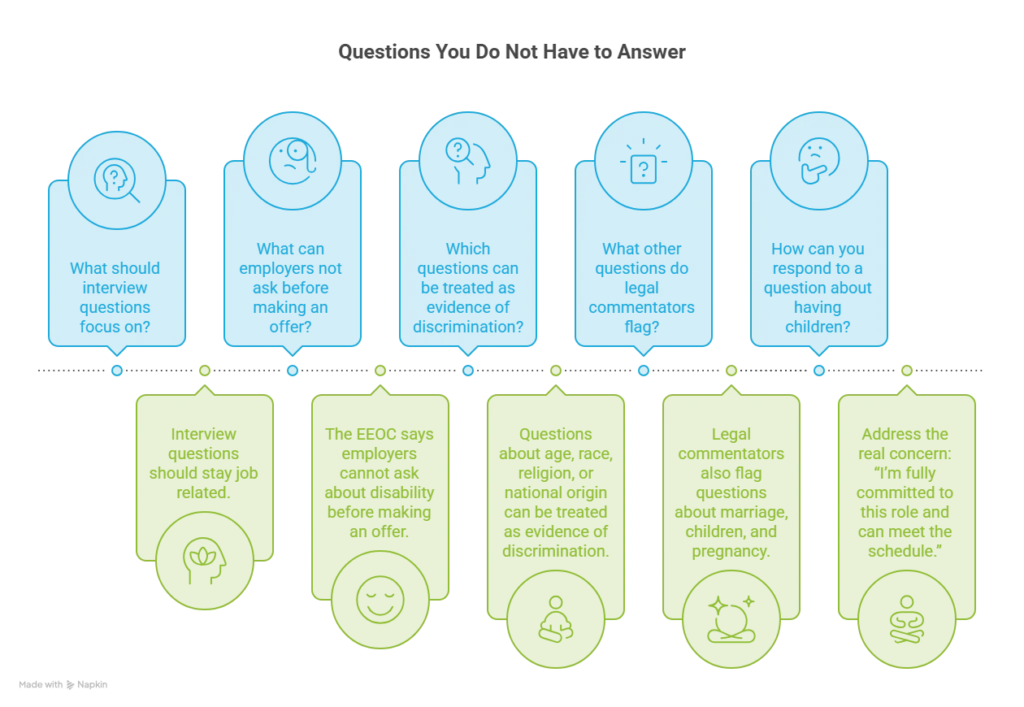
Interview questions should stay job related. The EEOC says employers cannot ask about disability before making an offer, and questions about age, race, religion, or national origin can be treated as evidence of discrimination. Legal commentators also flag questions about marriage, children, and pregnancy.
You can still answer smoothly. If someone asks whether you plan to have children, address the real concern: “I’m fully committed to this role and can meet the schedule.” A question like “Are you legally authorized to work in the US?” is fair, so answer it plainly.
If You Are Interviewing for a Tech, Cybersecurity, or Cloud Role
Tech interviews usually run smart casual, so use the decoding step above, then add one polished layer such as a blazer or a neat overshirt. Your words carry more weight here, and a few topics come up again and again.
If you have no degree, lead with what you can prove: labs, certifications, projects, and results. This guide to becoming a cybersecurity analyst without a degree covers realistic routes, and the same thinking helps when you explain a non-traditional path in the room. If you are weighing or defending a bootcamp, read this cloud bootcamp vs degree comparison, then answer with specifics: what you built and how fast you learned it.
Certifications give you concrete talking points. Match them to the employer’s stack. For Microsoft shops, see these Azure certifications that boost salary in the US. For Amazon shops, check the AWS certifications that boost salary. Mention the one you hold and a project where you used it.
Then comes “Where do you see yourself in five years?” Have a real answer. A look at the cybersecurity career path helps you describe a believable next two steps, and the cloud architect career guide does the same for cloud candidates.
Targeting executive security roles? Interviewers expect business language: risk, budget, and board communication. Before you discuss compensation, read this CISO salary guide so your number matches the seniority.
Questions to Ask the Interviewer
Always bring questions. Ask what success looks like in the first 90 days, how the team measures performance, what the biggest challenge is, and what happens next in the process. Hold questions about vacation and benefits until the recruiter or an offer opens that door.
After the Interview: Send the Thank-You Email
Most candidates skip this, and that works in your favor. A 2017 Accountemps survey found 80% of HR managers called thank-you messages helpful (22% very, 58% somewhat), yet respondents said only 24% of applicants sent one.
Email is the safe channel. In the same survey, 94% of HR managers called it appropriate, while only 5% accepted a text message. A more recent Robert Half survey found 27% of US hiring managers say a thank-you can tip the scales between candidates with equal skills. Send yours within 24 hours.
Keep it to three or four lines. Thank them, mention one specific moment from the conversation, restate why you fit, and say you look forward to next steps.

Frequently Asked Questions
What should I wear to a job interview in the US?
Dress one step above what employees normally wear at that company. Suits remain the safe choice in finance and law, while tech and startups usually accept smart casual with a polished layer.
Can I wear jeans to an interview?
Only if the culture is casual, such as many startups. Then choose dark, clean, well-fitting jeans with a blazer or good shirt. When unsure, wear trousers.
What should I say first in an interview?
Greet the interviewer warmly, then answer “Tell me about yourself” with the Present, Past, Future formula in about a minute.
Do I have to tell an interviewer my current salary?
No. Nearly twenty states restrict pay history questions, and elsewhere you can politely decline and share your target range instead.
Is a thank-you email necessary?
It is not required, but surveys show hiring managers value it and many candidates skip it. Send it within 24 hours.
What if the interviewer asks an illegal question?
Redirect to the job by answering the underlying concern, or say you would rather focus on your qualifications. If it keeps happening, you can report it to the EEOC or your state agency.
Share Your Experience
Has an outfit backfired on you, or has a salary answer worked better than you expected? I would like to hear it. Share your offer stories, negotiation outcomes, and surprises in the comments so other job seekers can learn from them.
How This Article Was Created
I built this guide from public sources: Accountemps and Robert Half surveys (2017 and 2019), Robert Half’s 2026 interview guidance, EEOC guidance on pre-employment inquiries, Foley & Lardner and local news coverage of Virginia’s 2026 law, and university career center advice on interview answers. I did not invent any figures, and every older statistic carries its year. I checked these sources in November 2026. I wrote this to inform job seekers, not to recruit or advertise, and rules vary by state, so confirm your local requirements.

Shahzada Muhammad Ali Qureshi (Leeo)
I’m Shahzada — a software engineer by education and an SEO professional by trade. I built WhatIsTheSalary.com to go beyond just showing salary numbers — every page is manually researched across sources like BLS, Glassdoor, LinkedIn Salary, and PayScale to give you the full picture in one place. If you found what you were looking for here, that’s exactly the point.