TLDR
Best programming languages for software engineers aren’t all created equal, and picking the wrong one early in your career can cost you years of wasted effort. Most engineers learn this the hard way, spending months mastering a language only to realize the job market moved on, or their stack doesn’t scale.
Here’s the real problem: there are over 700 programming languages in existence. “whatisthesalary.com“Nobody tells you which ones actually matter.
The good news? A handful of languages dominate real-world software engineering, and knowing which ones to focus on changes everything. This guide cuts through the noise, breaks down the languages that are genuinely worth your time in 2025, and tells you exactly what each one is best for, so you can make a smarter, faster decision.
What Programming Languages Do Software Engineers Actually Use?
According to the Stack Overflow Developer Survey 2025, 66% of professional developers use JavaScript, making it the most-used language among working engineers. Python comes in close and leads the TIOBE Index with a 21.81% share as of early 2026, largely driven by its dominance in AI and machine learning projects.
SQL, often overlooked in language rankings, showed 59% adoption among developers in the same survey. Almost every software application touches a database, and SQL is the language that queries it.
Most software engineers do not use just one language. They typically have one primary language and two to three others they pull in for specific tasks. The range of languages you know also plays a role when preparing for software engineer interview questions, where language-specific questions are common across all levels.
How Are Programming Languages Used in Software Engineering?
Before jumping into the list, it helps to understand why different languages exist. Frontend development uses JavaScript, HTML, and CSS to build what users see in their browser. Backend development relies on Python, Java, and Go to handle servers and business logic. Mobile development calls for Swift on iOS and Kotlin on Android. And systems programming is dominated by C++, C, and the increasingly popular Rust.
Understanding these domains helps narrow down which language is worth your time. This also matters when you look at the broader difference between roles — if you are unsure about the distinction, this guide on software engineer vs software developer breaks down how the two roles differ and which languages tend to align with each.
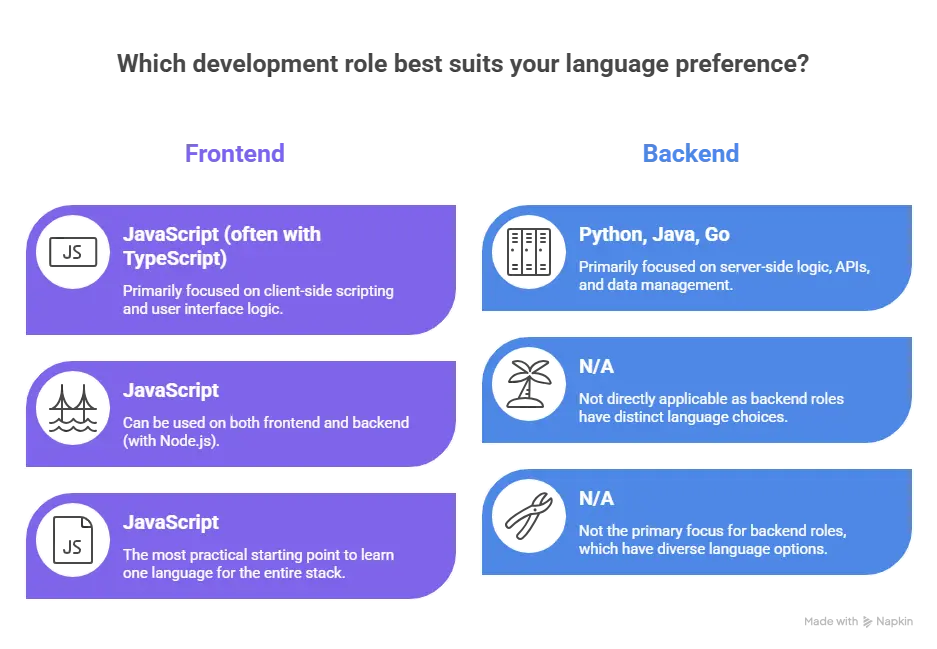
Frontend vs Backend vs Full-Stack: Does the Language Change?
Yes, it does. Frontend engineers almost always work with JavaScript, often paired with TypeScript for larger codebases. Backend engineers have more choices, but Python, Java, and Go dominate modern backend roles. Full-stack engineers typically use JavaScript on both ends, with Node.js handling the server side.
If you are aiming to be a full-stack engineer, JavaScript is the most practical starting point. You learn one language and apply it across the entire stack.
Top Programming Languages for Software Engineers in 2026 — Compared
Here is a quick-reference comparison of the most popular software engineer languages by use case, difficulty, and job demand in 2026.
| Language | Best For | Difficulty | 2026 Usage | Job Demand | Top Framework |
| Python | AI, data, backend | Beginner-friendly | 21.81% TIOBE | Very High | Django / FastAPI |
| JavaScript | Web frontend & backend | Moderate | 66% (SO Survey) | Very High | React / Node.js |
| TypeScript | Large-scale JS projects | Moderate | Rapidly growing | High | Angular / Next.js |
| Java | Enterprise & Android | Moderate | 8.84% TIOBE | High | Spring Boot |
| C++ | Systems, games, embedded | Advanced | 10.3% TIOBE | Medium-High | Unreal Engine |
| SQL | Database management | Beginner-friendly | 59% (SO Survey) | Very High | PostgreSQL |
| Go | Cloud-native, APIs | Moderate | Rapidly growing | High | Gin / Fiber |
| Rust | Systems, memory safety | Advanced | 72% admiration | Growing fast | Actix / Tokio |
| Swift | iOS / macOS apps | Moderate | Apple ecosystem | High | SwiftUI |
| Kotlin | Android development | Moderate | Android-first | High | Ktor |
Python — Best for Data, AI, and General-Purpose Development
Python is the most in-demand coding language for software engineers heading into 2026. It holds the top spot on the TIOBE Index with a 21.81% share and saw a 7 percentage point increase in the Stack Overflow Developer Survey from 2024 to 2025 — the largest single-year jump of any language in recent memory.
Python powers over 80% of today’s machine learning and AI projects. Frameworks like TensorFlow, PyTorch, Django, and FastAPI have made it the go-to language for backend APIs and data pipelines. If you are only going to learn one language in 2026, Python is the safest bet.
JavaScript — The Language of the Web
JavaScript has been the most-used language in the Stack Overflow Developer Survey for over a decade. In 2025, 66% of professional developers reported using it. It is the only language that runs natively inside a browser, making it the best coding language for web engineers by default. On the server side, Node.js extends JavaScript into backend development.
TypeScript — JavaScript but Safer
TypeScript adds static typing on top of JavaScript, catching bugs at compile time before they hit production. Its adoption is rapidly growing, and many companies now list it as a hard requirement in engineering job postings. If you already know JavaScript, TypeScript is the highest-ROI skill you can add with minimal extra learning time.
Java — Enterprise Standard and Android Development
Java holds 8.84% on the TIOBE Index and remains a fixture in enterprise software. Large companies running banking, insurance, and logistics software almost always have Java in their stack. Spring Boot has modernized Java development, and it remains the primary language for Android app development through the Android SDK.
C++ — Systems, Games, and Performance-Critical Applications
C++ sits at 10.3% on the TIOBE Index and dominates anywhere raw performance matters. Game engines like Unreal Engine, operating system kernels, and embedded systems firmware all rely on C++. The language gives engineers direct control over memory management, which makes it both powerful and demanding.
SQL — The Language Every Software Engineer Needs
SQL is often left out of language rankings because it is technically a query language. That is a mistake. 59% of developers in the Stack Overflow 2025 survey reported using SQL. PostgreSQL has been the most popular database among developers for three consecutive years. Whether you are building web apps, data pipelines, or backend APIs, SQL is non-negotiable.
Go (Golang) — Built for Modern Backend Systems
Go was built by Google for the demands of modern software infrastructure. It compiles fast, handles concurrency cleanly, and produces lean binaries ideal for cloud-native applications. Kubernetes, the most widely used container orchestration platform, is written in Go. Go adoption is growing fast in DevOps, platform engineering, and scalable API development.
Rust — The Most Admired Language in 2026
Rust has been voted the most admired programming language in the Stack Overflow Developer Survey for ten consecutive years. In 2025, it held a 72% admiration rate and Rust-related job postings grew 35% year over year. Amazon, Microsoft, and Cloudflare have already integrated Rust into critical infrastructure.
Swift and Kotlin — For Mobile App Developers
Swift is Apple’s primary language for iOS and macOS development. Kotlin is the modern standard for Android development, officially preferred by Google over Java for new projects. Both are approachable, have modern tooling, and open up strong mobile engineering career paths.
Which Programming Language Should You Learn First as a Software Engineer?
If you are starting from scratch, the clearest answer is Python or JavaScript, depending on your goal. This decision also connects closely to how long it takes to become a software engineer — the language you pick affects your learning timeline significantly.
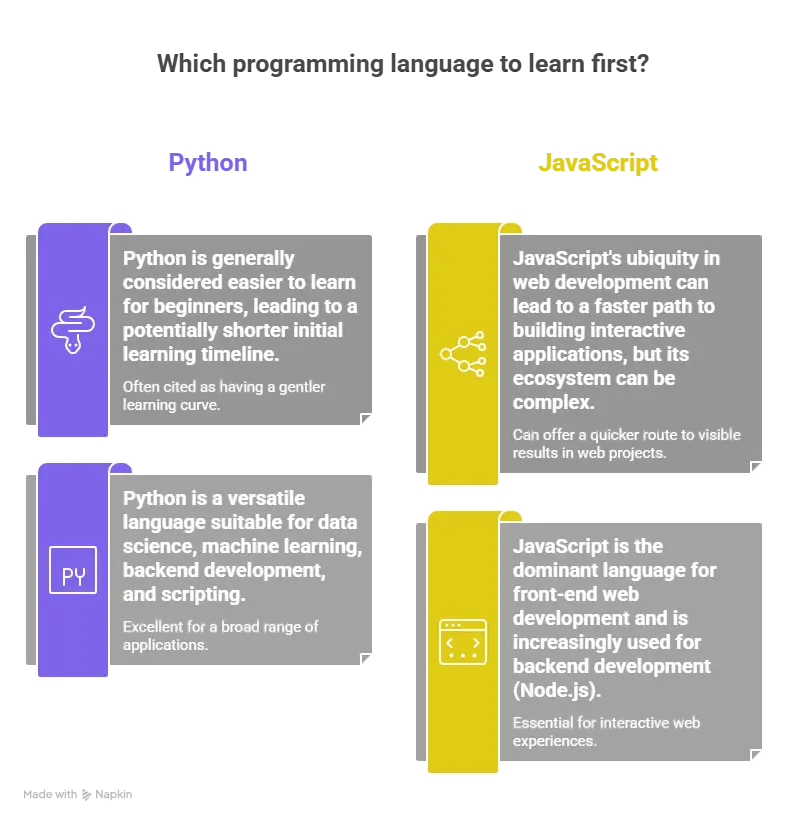
Pick Python if you want to work in AI, machine learning, data science, or backend development. It is the most beginner-friendly language with the widest range of career paths in 2026.
Pick JavaScript if you want to build websites and web applications. The ability to use one language for both frontend and backend development makes it the most practical choice for full-stack engineers.
Choosing a Language Based on Your Career Goal
Here is a quick breakdown of the best language to learn for software engineering by target role:
How Many Programming Languages Should a Software Engineer Know?
The practical answer is one language deeply, with two to three others at a working level. Depth matters more than breadth in the job market. A developer who knows Python inside out will outperform someone who has scratched the surface of six different languages. Once you have your primary language solid, adding SQL is the highest-leverage next step for almost any engineering role.
What the Data Says: Most Used Languages Among Developers in 2026
The numbers below come from the Stack Overflow Developer Survey 2025, the TIOBE Index (February 2026), and GitHub trend data.
Python: 21.81% TIOBE share, 7 percentage point growth in Stack Overflow survey, top language in AI repositories on GitHub
JavaScript: 66% usage among professional developers, most-used language in the Stack Overflow 2025 survey
SQL: 59% adoption in Stack Overflow Developer Survey 2025
Java: 8.84% TIOBE share, strong presence in enterprise and Android
Rust: 72% admiration rate, most admired language for ten consecutive years, 35% YoY growth in job postings
TypeScript: Rapidly growing, increasingly listed as a hard requirement in web engineering roles
The U.S. Bureau of Labor Statistics projects software developer job growth at 18% through 2033, adding over 300,000 positions. For context on what those roles pay, the software engineer salary in Washington averages above $140,000, while the software engineer salary in Munich and software engineer salary in Melbourne reflect strong international demand for engineers with the right language skills.
Where to Learn Programming Languages for Software Engineering
The quality of learning resources has never been better. And the good news is that you do not need a computer science degree to get started. Many working engineers today became software engineers without a degree by using these exact platforms:
The most important factor is consistency. Pick one resource, stick with it through the basics, and start building projects as early as possible. Real projects teach you more than any tutorial.

Also read: Software Engineer Salary in the United States (2026 Guide)
FAQ: Best Programming Languages for Software Engineers
-
What are the most important programming languages for software engineers?
Python, JavaScript, and SQL are the most important programming languages for software engineers in 2026. Python leads in AI and backend roles. JavaScript is essential for web development. SQL is required for almost every role that touches a database. TypeScript, Java, and Go round out the list for engineers targeting specific fields.
-
Is coding the same as programming in software engineering?
Coding and programming are often used interchangeably, but programming typically refers to the broader process of designing, writing, testing, and maintaining software. Coding is the act of writing the actual lines of code. In practice, software engineers do both, along with system design, code review, and debugging.
-
Which language should a complete beginner learn first?
Python is the best coding language to learn first for most beginners. Its syntax is clean and readable, the ecosystem is massive, and the career paths it opens up are among the most in-demand in the industry. Once you are comfortable, you can move on to frameworks like Django or FastAPI and start applying for entry-level roles. Check out our guide on the software engineer career path to see how language skills fit into the broader journey.
-
Can you become a software engineer by learning just one language?
Yes. Python, JavaScript, and Java each have full ecosystems that can support an entire career. Starting with one language and going deep is a much better strategy than learning five languages at a surface level. Most engineers expand their knowledge over time, but the first job usually requires depth in one area.
-
What programming languages are in highest demand for jobs in 2026?
Python, JavaScript, TypeScript, Java, and Go are the most in-demand programming languages in the 2026 job market. SQL is non-negotiable for most backend and data engineering roles. Rust is the fastest-growing language in job postings, with 35% year-over-year growth. Having the right language skills also makes a difference in your application — a well-written software engineer cover letter that highlights your specific language expertise can set you apart from candidates with similar experience.
Conclusion
The best programming languages for software engineers in 2026 are not a mystery. Python, JavaScript, TypeScript, Java, Go, and SQL consistently show up in job postings, developer surveys, and GitHub repositories. The real question is which one you should focus on first — and that depends entirely on where you want to take your career.
If you want to work in AI or data science, Python is your answer. If web development is the goal, JavaScript and TypeScript are the clearest path. For enterprise backend roles, Java and Go remain strong choices. And for engineers drawn to systems-level work, Rust is the top language to learn for software engineering in 2026.
Do not let the number of options overwhelm you. Pick one language that aligns with your target role, go deep with it, and build real projects. Language skills compound quickly once you have the fundamentals. A developer who has built five real projects in Python will get interviews that someone with theoretical knowledge of ten languages will not.
Once you have your language foundation in place, the next steps — building your resume, preparing for interviews, and understanding your salary range — all become much clearer. If you are mapping out those next steps, our guides on the software engineer career path, software engineer interview questions, and how to become a software engineer without a degree are worth reading next.

Shahzada Muhammad Ali Qureshi (Leeo)
I’m Shahzada — a software engineer by education and an SEO professional by trade. I built WhatIsTheSalary.com to go beyond just showing salary numbers — every page is manually researched across sources like BLS, Glassdoor, LinkedIn Salary, and PayScale to give you the full picture in one place. If you found what you were looking for here, that’s exactly the point.