TLDR
Software Engineer Career Options explode in 2026, but 87% of engineers hit the “junior trap” – stuck coding CRUD apps while ML engineers bank $250K+ and CTOs run companies. Wasted years picking the wrong specialization?
The fix: This guide maps 19 proven career paths – Full Stack ($140K), DevOps ($180K), AI/ML ($220K+), Tech Lead to CTO. Real progression roadmaps, skills gaps, and salary jumps by level. “whatisthesalary.com“
Your breakout plan: Skip dead-end roles, target high-demand tracks like Cloud Engineering or Data Engineering. From bootcamp grad to C-suite, unlock the software engineer career options that actually pay off.
Software Engineer Career Path Overview
Before diving into specializations, it helps to understand how software engineering careers are typically structured. Most companies use a leveling system that goes from junior to mid-level to senior, and then branches into either technical leadership or people management.
According to the US Bureau of Labor Statistics, software development roles are projected to grow 17 percent through 2033, adding over 327,900 new jobs in the US alone. The global software market was valued at $743 billion in 2026, with projections pointing toward $2.2 trillion by 2034. That kind of growth creates real opportunities across every level of the career ladder.

Entry-Level Software Engineer Jobs and Progression
Starting out as an entry-level software engineer typically means writing code, fixing bugs, and working under the guidance of more experienced teammates. Most entry roles require foundational knowledge of at least one programming language, usually Python, Java, or JavaScript, along with basic data structures and algorithms.
According to ZipRecruiter’s February 2026 data, entry-level engineers in the US generally start in the $75,000 to $100,000 range. That number varies depending on location, company size, and your technical depth going in.
One shift worth noting: AI tools have changed what companies expect from junior engineers. Many firms now expect new hires to use AI coding assistants as part of their daily workflow, which means the bar for entry has shifted from “can you write basic code” to “can you problem-solve and architect efficiently.”
If you are still mapping out your path from the beginning, this detailed software engineer career path guide walks through every stage from your first job to senior-level roles.
Junior to Senior Software Engineer Roadmap
The jump from junior to senior software engineer is not just about years on the job. It is about the depth and complexity of what you can handle independently.
Here is how the typical software engineer career progression looks in 2026:
Mid-level software developers in 2026 earn between $110,000 and $148,000 for remote roles, while senior-level backend roles average around $159,000 according to Motion Recruitment’s 2026 salary data. The jump in pay between levels is significant, which is why investing in skill-building early pays off.
For a full picture of what hiring managers look for at each stage, read the complete software engineer overview covering responsibilities, daily tools, and what actually gets people hired.
Top Software Engineer Career Options by Specialization
Once you have a few years of experience, the most important career decision you will make is picking a specialization. Generalists still get hired, but specialists tend to earn more, advance faster, and build deeper expertise that compounds over time. Here are the most valuable directions in 2026.

Full Stack Developer Career Path
Full stack development remains one of the most in-demand career options for software engineers in 2026. A full stack developer works across both the front-end (what users see) and back-end (server, database, API logic), making them extremely flexible assets for product teams.
The typical full stack developer stack in 2026 includes React or Next.js on the front end, Node.js or Python on the back end, PostgreSQL or MongoDB for databases, and AWS or Vercel for deployment. According to Motion Recruitment, React developer salaries grew by 6.85 percent year over year, with senior-level React roles rising over 8 percent, one of the largest jumps in all of tech.
Full stack developers in the US typically earn between $115,000 and $150,000. If you are trying to decide which languages to prioritize on this path, this guide on the best programming languages breaks down which ones are paying off the most in 2026.
Front-End vs Back-End Developer Options
If full stack feels like too much ground to cover, specializing in one layer is a perfectly valid career choice with strong salary upside.
Front-end developers focus on the user interface and experience. They work with HTML, CSS, JavaScript frameworks like React or Vue, and tools like TypeScript and Figma for design handoff. US salaries for front-end developers in 2026 range from $95,000 to $130,000 depending on experience and tech stack depth.
Back-end developers handle server logic, databases, APIs, and system reliability. Languages like Go, Python, Java, and Rust dominate here. Senior back-end roles typically pay between $110,000 and $145,000, with specialists in distributed systems or microservices commanding more.
If you are deciding which path fits your skills better, this comparison of software engineer vs software developer is worth reading before you commit to a direction.
High-Demand Technical Software Careers
Beyond application development, there is a whole category of infrastructure and data-focused roles that are seeing some of the strongest growth in 2026. These roles tend to sit closer to the systems layer and often pay a premium as a result.
DevOps Engineer Job Progression
DevOps engineering has gone from a niche specialization to a core function in almost every software team. In 2026, DevOps engineers are responsible for CI/CD pipelines, container orchestration with Kubernetes and Docker, infrastructure as code with Terraform, and system reliability.
DevOps roles command salaries between $125,000 and $160,000 in the US, and top roles in DevSecOps (which combines security with DevOps practices) are pushing even higher. According to Boundev’s 2026 job market report, DevOps engineers command a 20 to 40 percent salary premium over general software engineering roles.
Career progression in DevOps typically goes from DevOps Engineer to Senior DevOps, then into Site Reliability Engineer (SRE), Platform Engineer, or engineering management. The SRE track at companies like Google, Meta, and Amazon is particularly lucrative.
Cloud Engineer Career Opportunities
Cloud engineering is one of the fastest-growing technical career paths in software right now. As more businesses move infrastructure to AWS, Google Cloud, and Microsoft Azure, demand for engineers who understand cloud architecture has surged.
Cloud engineers in the US earn between $130,000 and $170,000 on average in 2026. Certifications matter here more than in most other software roles. AWS Solutions Architect, Google Professional Cloud Architect, and Azure Administrator certifications significantly boost your earning potential and interview performance.
Cloud engineering often overlaps with DevOps and systems engineering. Many engineers come into cloud from a backend or infrastructure background, then specialize further into areas like cloud security, cost optimization, or multi-cloud architecture.
If cloud or infrastructure roles interest you, it helps to know which employers are actively building these teams. Check the list of top software engineering companies to see where the best cloud engineering jobs are in 2026.
Data Engineer Salary and Skills
Data engineering sits at the intersection of software development and data science. Data engineers build the pipelines that move, transform, and store data so that analysts and ML engineers can actually use it. In 2026, this role has become indispensable at any data-driven company.
Core skills for data engineers include Apache Spark, SQL, Python, Airflow for orchestration, and dbt for transformation. Cloud data warehouses like Snowflake, BigQuery, and Redshift are also standard in this stack. Salaries range from $120,000 to $155,000 in the US, with senior data engineers and data platform leads earning more.
The demand for data engineers has been driven by companies needing real-time analytics, AI model training pipelines, and regulatory data compliance, especially in FinTech and healthcare.
AI and Advanced Software Engineer Roles
If there is one area reshaping software engineering career options more than anything else in 2026, it is artificial intelligence. AI is not replacing engineers. It is creating entirely new roles and pushing compensation upward for those who can work with it effectively.
Machine Learning Engineer Career Track
Machine learning engineers are among the highest-paid professionals in all of tech. They build and deploy predictive models, recommendation systems, and AI-powered features using tools like PyTorch, TensorFlow, and MLOps frameworks. According to DataCamp’s 2026 salary data, ML engineers earn an average of $186,067 in the US, the highest of any software engineering title tracked.
The career track for ML engineers typically starts with a strong foundation in Python and statistics, moves into model building and training, then advances into MLOps (operationalizing models at scale) or research engineering. AI engineers, a closely related role focused more on integrating LLMs and AI APIs into products, earn between $135,000 and $240,000 depending on location, with a 12 percent pay premium over general software roles according to Ravio’s 2026 Compensation Trends report.
According to research.com, AI-driven demand has caused a 40 percent increase in roles requiring combined AI and programming skills. If you are building toward this path, Python, ML fundamentals, and cloud deployment experience are your core building blocks.
Mobile App Developer Specializations
Mobile development remains a solid and well-compensated career option in software engineering. There are two main tracks: native development using Swift for iOS and Kotlin for Android, and cross-platform development using Flutter or React Native.
US salaries for mobile app developers range from $110,000 to $145,000 in 2026. Cross-platform experience is increasingly preferred by startups and mid-size companies looking to ship faster with smaller teams. Native development is still the gold standard for performance-critical apps in finance, gaming, and healthcare.
Beyond mobile apps, this career path can evolve toward mobile architecture, platform engineering for mobile SDKs, or even hybrid roles that combine mobile with backend systems design.
Software Engineer Career Options: 2026 Salary and Growth Table
Use this table to compare career options for software engineers across roles, salaries, growth rates, and required skills:
| Career Role | Avg US Salary (2026) | Growth Rate | Key Skills Required |
| Entry-Level Software Engineer | $75,000 – $100,000 | 17% (2033) | Python, Java, Git, DSA |
| Junior Software Engineer | $90,000 – $115,000 | 17% (2033) | OOP, REST APIs, Testing |
| Senior Software Engineer | $140,000 – $175,000 | High | System Design, Leadership |
| Full Stack Developer | $115,000 – $150,000 | High | React, Node.js, SQL, AWS |
| Front-End Developer | $95,000 – $130,000 | Moderate-High | HTML, CSS, React, TypeScript |
| Back-End Developer | $110,000 – $145,000 | High | Go, Python, Microservices |
| DevOps Engineer | $125,000 – $160,000 | 22%+ | Docker, Kubernetes, CI/CD |
| Cloud Engineer (AWS/Azure) | $130,000 – $170,000 | Very High | AWS/GCP/Azure, Terraform |
| Data Engineer | $120,000 – $155,000 | High | Spark, SQL, Airflow, dbt |
| Machine Learning Engineer | $160,000 – $220,000 | Very High | PyTorch, TensorFlow, MLOps |
| AI Engineer | $135,000 – $240,000 | Fastest Growing | LLMs, Prompt Eng., Python |
| Mobile App Developer | $110,000 – $145,000 | Moderate-High | Swift, Kotlin, Flutter |
| React Developer | $110,000 – $150,000 | High (6.85% YoY) | React, Redux, REST, TS |
| Cybersecurity Engineer | $120,000 – $160,000 | Very High | Pen Testing, SIEM, Cloud Sec |
| Solutions Architect | $150,000 – $200,000 | High | Cloud, Microservices, Design |
| Engineering Manager | $160,000 – $210,000 | Stable-High | Leadership, Roadmaps, Agile |
| CTO / Tech Lead | $200,000 – $350,000+ | Stable | Strategy, Vision, People Mgmt |
| QA Engineer / SDET | $85,000 – $130,000 | High | Selenium, Jest, Test Automation |
| Sales Engineer | $110,000 – $150,000 | Moderate | Communication, Tech Demo, CRM |
| FinTech Software Engineer | $130,000 – $180,000 | Very High | Payment APIs, Compliance, Java |
| Game Developer | $80,000 – $130,000 | Moderate | Unity, Unreal, C++, C# |
Sources: DataCamp 2026, Motion Recruitment 2026, BLS Occupational Outlook, Ravio Compensation Trends 2026, ZipRecruiter Feb 2026.
Leadership and Management Career Paths
Not every software engineer wants to stay hands-on with code forever. For many, the most exciting career options in software engineering are on the leadership and management side. These paths come with higher total compensation packages and broader organizational impact.
Engineering Manager Development
The engineering manager role is the first major step off the individual contributor track. Engineering managers are responsible for team performance, hiring, roadmap planning, and creating the conditions for engineers to do their best work. This is less about writing code and more about systems thinking, people skills, and business alignment.
Engineering managers in the US earn between $160,000 and $210,000 in 2026, often with significant equity on top. The transition is not automatic. Most companies expect a future manager to have proven senior engineering ability and demonstrated leadership informally before moving into the role.
Tools of the trade include Jira, Confluence, OKR frameworks, and whatever engineering planning system the company uses. Soft skills like giving feedback, navigating conflict, and running effective 1:1s matter as much as technical credibility here.
Tech Lead to CTO Progression
The highest point of the software engineer career progression is the CTO role, and there are two common paths to get there. One is through the technical track, going from senior engineer to staff engineer to principal engineer to VP of Engineering and finally CTO. The other is through the management track, going from engineering manager to director to VP to CTO.
Tech leads typically earn $150,000 to $180,000, while CTOs at mid-size companies can command $200,000 to $350,000 or more, often with substantial equity. At startups, the CTO title comes earlier but with less base compensation. At large enterprises, the path is longer but more structured.
If leadership is your long-term goal, it helps to study how the best engineering organizations are structured. See how Google software engineer jobs are leveled and what their technical leadership ladder actually looks like in practice.
Industry-Specific Software Careers
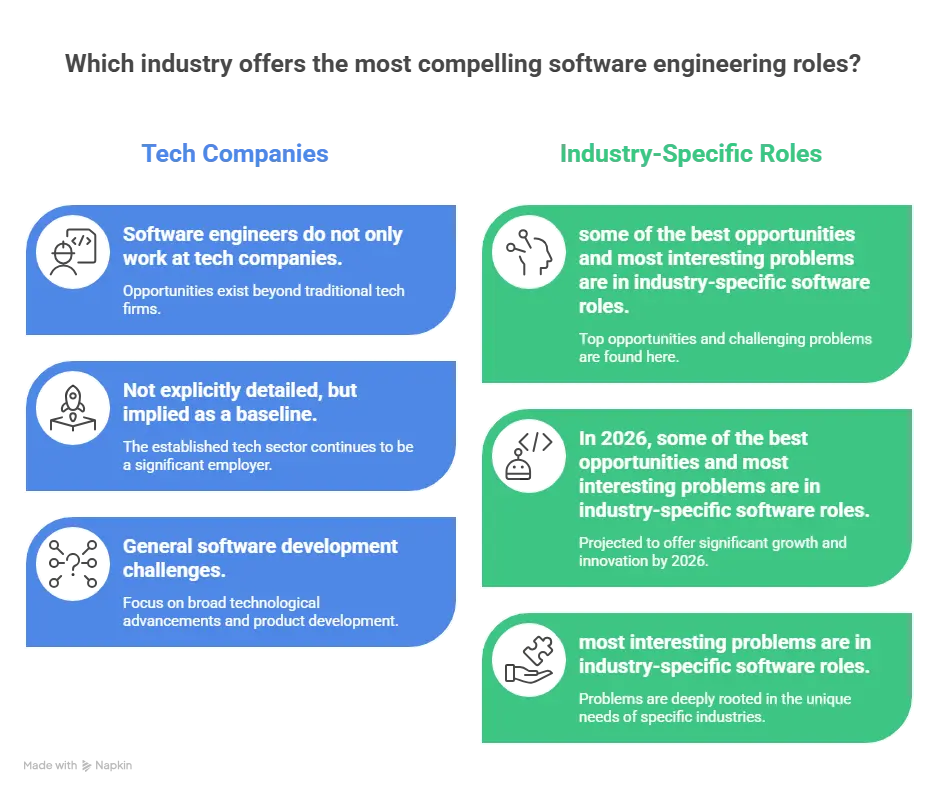
Software engineers do not only work at tech companies. In 2026, some of the best opportunities and most interesting problems are in industry-specific software roles. Two sectors stand out.
FinTech Software Engineer Jobs
FinTech is one of the most active sectors hiring software engineers in 2026. Banks, payment processors, investment platforms, and crypto companies all need engineers who understand both software systems and financial infrastructure.
FinTech software engineers typically work on payment APIs, fraud detection systems, compliance tooling, trading platforms, and real-time data pipelines. Salaries range from $130,000 to $180,000 in the US, and companies like Stripe, Plaid, Robinhood, and Coinbase pay at the higher end.
Regulatory knowledge (PCI-DSS, SOC 2, GDPR) combined with software engineering gives you a rare skill combination that commands a premium in this sector. Java, Python, and Go dominate the FinTech backend stack.
For a broader view of the highest-paying opportunities across software roles, explore this ranked list of top software pay jobs with compensation data for 2026.
Gaming Developer Career Options
Game development is a competitive but genuinely exciting career path in software engineering. Game developers work with engines like Unity and Unreal Engine, programming languages like C++ and C#, and specialized systems for rendering, physics simulation, and multiplayer networking.
Salaries for game developers in the US range from $80,000 to $130,000, which is lower than some other engineering paths, but top game engineers at studios like Epic Games, Riot, or Valve earn significantly more. Mobile gaming, in particular, is a growth area, with the mobile games market continuing to expand globally.
For engineers coming from traditional software backgrounds, transitioning into game development typically means learning a game engine, understanding real-time rendering concepts, and building a portfolio of small games. Many game developers also have transferable skills in graphics programming, simulation, or systems engineering.
Alternative Software Engineer Careers
One of the most underrated aspects of a software engineering background is how many doors it opens outside of pure coding roles. These alternative career options for software engineers are growing fast and often provide better work-life balance, different challenges, or higher-impact environments.
QA Engineer to Technical Recruiter
QA engineering is a natural on-ramp for people who want software engineering skills without diving deep into product development. QA engineers test software, write automated test suites, and ensure releases meet quality standards. In 2026, the QA to SDET (Software Development Engineer in Test) transition is a popular path for QA engineers who want more programming involvement.
US salaries for QA engineers and SDETs average around $130,000 according to DataCamp’s 2026 data. Automation skills using Selenium, Cypress, or Jest significantly increase earning potential. Tools like Playwright are gaining ground as well.
Technical recruiting is another alternative career path for software engineers that is often overlooked. Engineers who move into recruiting bring technical credibility to candidate evaluations and can explain job requirements accurately. Technical recruiters at FAANG-adjacent companies earn $80,000 to $130,000, often with commission or bonuses on top.
If you are exploring a career move, your materials need to reflect that clearly. A strong software engineer cover letter helps you stand out whether you are applying to a traditional engineering role or pivoting into something adjacent.
Sales Engineer and Project Manager Roles
Sales engineering is one of the best alternative careers for software engineers who enjoy communicating with people and want to earn strong compensation without managing codebases. Sales engineers work with prospects and clients to demo software products, explain technical capabilities, and support the sales process. US salaries range from $110,000 to $150,000, often with a healthy commission structure on top.
Project management is another alternative career path that software engineers frequently explore. With a technical background, engineers-turned-PMs can translate between business needs and engineering realities more effectively than most. PMP certification or Scrum Master credentials can accelerate this transition. PM salaries in tech range from $100,000 to $145,000 in 2026.
Both roles leverage engineering knowledge without requiring constant coding, which makes them attractive for mid-career engineers looking for a change of pace or a shift in day-to-day work.
Best Companies for Software Careers
Top Software Engineer Employers in 2026
Where you work matters as much as what you do. The best software engineering careers tend to be at companies with strong engineering cultures, competitive compensation, and clear paths for growth.
In 2026, the top employers for software engineers include the obvious FAANG tier (Meta, Apple, Amazon, Netflix, Google), but also fast-growing companies in cloud infrastructure, FinTech, and AI. Companies like Stripe, Databricks, OpenAI, Figma, and Cloudflare are offering highly competitive total compensation packages to attract senior talent.
Beyond the big names, enterprise software companies like Salesforce, ServiceNow, and SAP consistently offer stable, well-paying software engineering roles with good career trajectory. Defense tech companies like Palantir and Anduril are also paying premium salaries for engineers who want to work on complex systems problems.
For a curated list of the best places to build your career, check the full guide on ranked by reputation, pay, and growth opportunity.

Also read: top software engineering companies
Software Engineer Career FAQs
-
Do you need a degree to become a software engineer?
Not necessarily. Many engineers today enter the field through bootcamps, self-study, or online courses. That said, a computer science degree still opens more doors at larger companies. For a full breakdown, read .
-
What is the average software engineer salary in 2026?
The US median salary for a software engineer in 2026 is approximately $130,000. Entry-level roles start around $75,000 to $100,000, while senior engineers and architects can earn $160,000 to $200,000 or more.
-
Which software engineering specialization pays the most?
Machine learning engineers and AI engineers currently command the highest salaries, averaging $186,000 and up to $240,000 in top markets. Cloud engineers and solutions architects also pay very well in 2026.
-
How long does it take to become a software engineer?
It depends on your path. A traditional CS degree takes four years. Bootcamps range from three to six months. Self-taught routes vary widely. For a realistic timeline, see .
-
What are the best alternative careers for software engineers?
Sales engineering, technical program management, technical recruiting, product management, solutions architecture, and DevOps are all strong alternative career paths for software engineers looking to shift focus.
-
Is software engineering a good career in 2026?
Yes. The BLS projects 17 percent employment growth through 2033. Salaries remain well above the national median, and new roles in AI, cloud, and FinTech are expanding the total opportunity set. Competition is stronger than it was in 2021, but skilled engineers are still very much in demand.
-
What is the typical software engineer interview process?
Most companies use a mix of algorithmic coding rounds, system design interviews, and behavioral interviews. Preparation strategies and common question types are covered in detail in this guide.
Conclusion
Software engineering in 2026 is not a single career. It is a starting point with dozens of directions you can take it.
If you want to stay technical, you can specialize in machine learning, cloud infrastructure, DevOps, mobile, or cybersecurity, all of which are paying well above average and growing fast. If you want to move into leadership, the engineering manager and CTO track is well-defined and financially rewarding. And if you want something different entirely, alternative career options like sales engineering, technical recruiting, or product management let you use your technical background in entirely new contexts.
The most important thing in 2026 is not picking the perfect path on day one. It is building strong fundamentals, staying curious, and developing expertise in areas where the market is actually paying.
Here is a quick recap of the key directions covered in this guide:
Whether you are just starting out or looking to make a move, the career opportunities for software engineers remain genuinely wide open. Start with your strengths, pick a direction, and build from there. For more resources across every stage of the journey, explore the full library at .

Shahzada Muhammad Ali Qureshi (Leeo)
I’m Shahzada — a software engineer by education and an SEO professional by trade. I built WhatIsTheSalary.com to go beyond just showing salary numbers — every page is manually researched across sources like BLS, Glassdoor, LinkedIn Salary, and PayScale to give you the full picture in one place. If you found what you were looking for here, that’s exactly the point.