TL;DR
Contract vs Full-Time Jobs in the US can look like a simple choice until you realize most people pick wrong, not because they’re careless, but because nobody shows them the full picture before they sign. You see a contract rate that’s $30 an hour higher and assume you’re winning. You don’t see the 15.3% self-employment tax you now owe yourself, the $12,000 health insurance bill coming in January, or the six weeks of bench time between projects that nobody warned you about.
That’s the problem. Most career advice compares a contract hourly rate to a salary number and stops there. That comparison is broken from the start.
This guide breaks down every real difference between contract and full-time work in the US, including taxes, benefits, job security, and what your take-home actually looks like after the math is done. If you’re trying to figure out which path actually pays you more and fits your life, WhatIsTheSalary.com has the salary data and career tools to help you make that call with real numbers, not guesses.
Contract vs Full-Time Jobs in the US: Pros and Cons
I’ve had this exact conversation with a lot of people who were staring at two job offers, one labeled “contract” and the other “full-time,” trying to figure out which one would actually serve them better. The numbers on paper look obvious until you realize the contract rate doesn’t account for taxes you now owe yourself, or the health insurance you suddenly have to find on your own.
This article walks through every real difference between contract work and full-time employment in the US as of 2026, including pay, taxes, benefits, job security, and career growth. By the end, you’ll know which path fits your situation and how to compare offers without leaving money on the table.
What the 2026 US Job Market Actually Looks Like
The line between contract and full-time work has been blurring fast. Contract roles are on the rise across tech, finance, marketing, and healthcare. By 2026, experts predict contract positions could account for up to 40% of all new professional job postings in the US, up from roughly 30% in 2020.
That shift is happening because companies want flexibility. When budgets tighten or projects have clear endpoints, bringing on a contractor is faster and more financially predictable than committing to a full-time hire with benefits, payroll taxes, and severance obligations.
For workers, that means more options than ever. But more options also means more decisions you need to get right.
The Core Differences Between Contract and Full-Time Work
Before we get into the pros and cons, it helps to understand the structural differences between the two arrangements.
A contract worker is typically hired for a defined period or project. You’re either classified as a 1099 independent contractor or a W-2 contractor placed through a staffing agency. You file your own taxes, handle your own benefits, and when the project ends, so does your engagement.
A full-time employee is hired on an ongoing basis. The company withholds taxes from your paycheck, pays part of your Social Security and Medicare taxes, and typically provides health insurance, paid time off, and a retirement plan like a 401(k) with an employer match.

Contract vs Full-Time: Side-by-Side Comparison (2026)
| Factor | Contract Worker (1099) | Full-Time Employee (W-2) |
| Tax Form | 1099-NEC | W-2 |
| Tax Withholding | None — you pay quarterly estimated taxes | Automatic payroll withholding by employer |
| Self-Employment Tax | Full 15.3% (you cover both halves) | 7.65% only (employer covers the other half) |
| Health Insurance | Self-funded ($4,000–$18,000/year avg.) | Employer-sponsored (avg. $24,000/year employer contribution — KFF 2026) |
| 401(k) / Retirement | Self-funded (SEP-IRA or Solo 401k) | Employer match (avg. 5% of salary) |
| Paid Time Off | None — unpaid bench time comes out of your earnings | Typically 10–15 days paid leave per year |
| Job Security | Project-based, ends at contract close | Ongoing unless terminated or laid off |
| Hourly Rate | Generally higher (to offset expenses) | Lower hourly but total comp is fuller |
| Schedule Flexibility | Often high, especially for remote contracts | More structured, company-defined hours |
| Career Advancement | Self-directed, based on your hustle | Structured path with promotions and reviews |
| Visa Sponsorship (H-1B) | Requires careful legal structuring | Standard employer sponsorship route |
The Pay Reality: What Contract Workers Actually Take Home
This is where most people get tripped up. A contract rate sounds great on paper until you do the math. Here’s how it really works.
Say you land a contract at $85 per hour. Working 40 hours a week for 50 weeks puts your gross income at around $170,000. But that number is not what you take home.
First, there’s self-employment tax. As a 1099 contractor, you pay the full 15.3% on 92.35% of your net earnings. That’s roughly $24,100 gone before federal or state income taxes touch your money.
Then there’s health insurance. If you’re buying your own coverage on the marketplace, budget between $4,000 and $18,000 per year depending on your age, state, and plan tier.
Add unpaid downtime. Most contractors lose 2 to 6 weeks per year between engagements or during slow seasons. That $170,000 gross drops to roughly $136,000 to $153,000 in billed hours if you account for realistic bench time.
After all of that, a contractor earning $85 per hour may realistically net somewhere around $110,000 to $125,000 in take-home pay. Still solid, but not the number the hourly rate implied.
Meanwhile, a full-time employee earning $140,000 W-2 salary, with employer-paid health insurance worth $24,000 per year and a 5% 401(k) match ($7,000 per year), has an effective total compensation package closer to $171,000, before even factoring in paid leave.
Related read: Data Scientist Salary by City to see how total comp varies by location across the US.
Pros of Contract Work
Higher Hourly Pay Ceiling
Skilled contractors, especially in tech, cybersecurity, and finance, can command rates that push total gross income well above what a salaried role at the same company would pay. Senior IT contractors in the US reported median rates of $100 to $160 per hour in 2026, according to data from Robert Half’s 2026 Technology Salary Guide.
If you’re exploring cybersecurity specifically, check out how to become a cybersecurity analyst without a degree for context on what that career path looks like from the contract side.
Flexibility and Variety
Contract work lets you choose the projects you take on, switch industries without explanation, and structure your day in ways that most salaried roles don’t allow. If you get bored doing the same thing for years, contract work keeps things moving.
Faster Skill Building
Working across multiple companies and codebases, industries, or client types in a short window builds a resume that a single long-term employer simply can’t match. Contract professionals often move up the expertise ladder faster because they’re constantly solving new problems.
This is especially true in cybersecurity. Here’s a look at a structured cybersecurity career path if that’s the direction you’re heading.
Tax Deductions for Business Expenses
As a 1099 contractor, you can deduct legitimate business expenses including home office, equipment, software, professional development, and health insurance premiums. If you structure your contracts through an LLC or S-Corp, additional tax planning tools become available. A good accountant can recover thousands here.
Cons of Contract Work
No Benefits, No Cushion
No employer-paid health insurance. No paid time off. No 401(k) match. No life insurance. No short-term disability. Every one of those things you now pay for out of pocket, or you go without. That gap is real money, often $20,000 to $40,000 per year in employer contributions that a full-time employee receives and a contractor does not.
Income Instability
Contract work ends. Sometimes a client renews, sometimes they don’t. Sometimes you line up back-to-back engagements seamlessly. Sometimes you don’t, and two months of bench time can wipe out a quarter of your projected annual income. If financial stability is important to you, this is a serious drawback.
Self-Employment Tax Burden
The full 15.3% self-employment tax on top of federal and state income tax is a shock to people making the switch from W-2 employment for the first time. You’ll need to pay quarterly estimated taxes and potentially face penalties if you underestimate. This requires discipline and planning.
Visa and Immigration Complexity
For H-1B visa holders or anyone pursuing permanent residency, contract arrangements require precise legal structuring. Many sponsoring companies will not support green card sponsorship for contract workers. If US residency is a goal, this matters a lot.
Pros of Full-Time Employment
Stability and Predictable Income
A full-time salary hits your bank account on the same schedule every two weeks. You can budget, plan, and make long-term financial commitments, like a mortgage or car payment, without worrying about whether your contract renews next month.
Full Benefits Package
Employer-sponsored health insurance, dental, vision, life insurance, short-term disability, a 401(k) with company match, paid time off, parental leave, and sometimes tuition reimbursement. These benefits have real dollar value that most people underestimate when comparing offers.
Career Development and Promotions
Full-time roles come with performance reviews, promotion pathways, mentorship, and often formal training budgets. If you want to grow into leadership, a manager track, or specialize within a large organization, full-time employment gives you that runway in a way most contract gigs do not.
Understanding the US tech interview process can help you land that full-time role with the right package.
Visa and Immigration Support
For workers on H-1B visas or seeking green card sponsorship, a full-time position at a sponsoring employer is typically the only viable path. Companies sponsor full-time employees, rarely contractors.
Cons of Full-Time Employment
Less Flexibility
Full-time employment usually means fixed hours, mandatory meetings, and less control over what you work on day to day. If the company decides to pivot, restructure, or put you on a project you don’t love, you don’t have the same exit options a contractor does.
Lower Hourly Equivalent
When you calculate the actual hourly rate implied by a full-time salary, it’s often lower than what a contractor earns per hour in the same role. A $140,000 annual salary across 2,000 hours is $70 per hour, while a contractor in the same role might bill $100 to $120 per hour.
Limited Upside
Salary increases at most companies are incremental, typically 3% to 5% per year. Contractors can renegotiate their rate every engagement and sometimes land 20% to 30% bumps when they switch clients. Full-time employees who want bigger jumps often have to change employers.
How Taxes Work Differently for Each Employment Type
This is the section most articles skip, and it’s the one that costs people the most money.
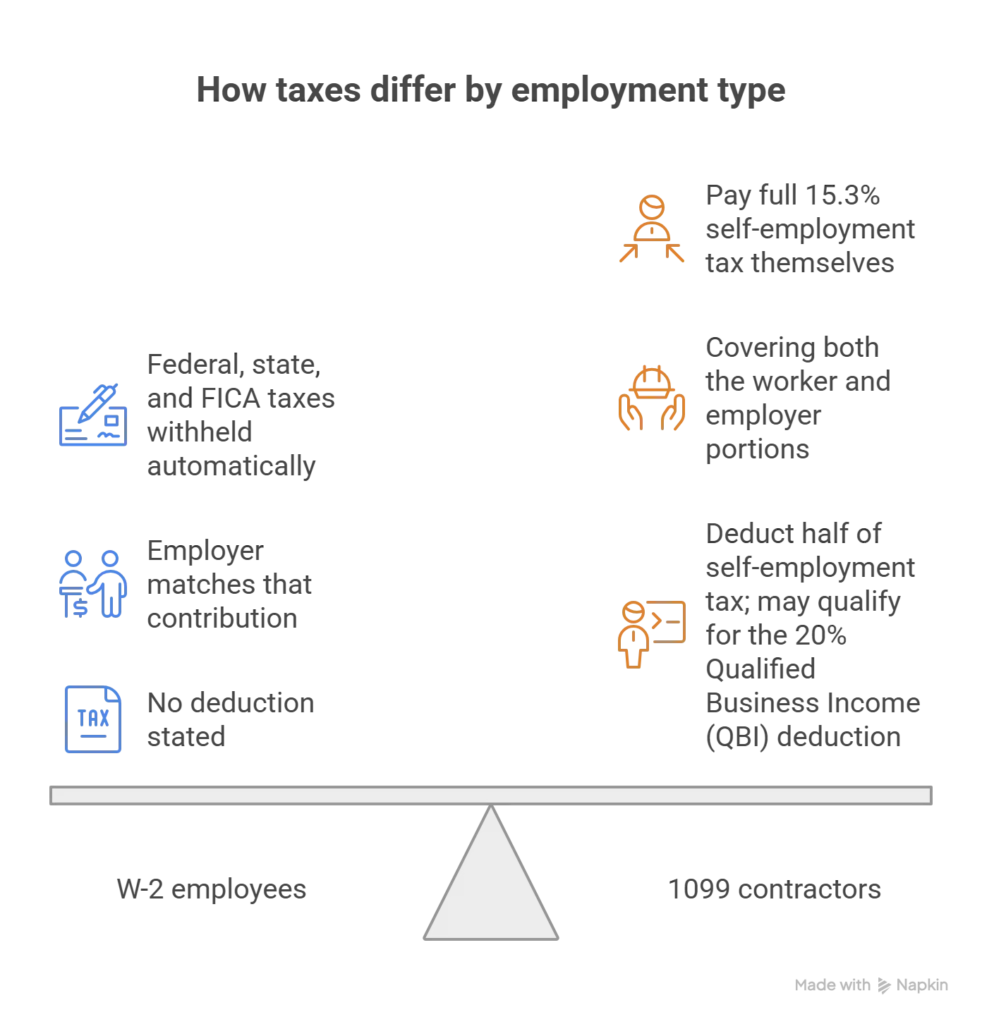
W-2 employees have federal, state, and FICA taxes withheld automatically. They pay 6.2% of their wages toward Social Security (up to the 2026 cap of $184,500) and 1.45% toward Medicare. Their employer matches that contribution.
1099 contractors pay the full 15.3% self-employment tax themselves, covering both the worker and employer portions. On $150,000 of contract income, that is roughly $22,950 in self-employment tax before any federal or state income tax.
The IRS does allow contractors to deduct half of their self-employment tax on their income tax return, and those with pass-through income may qualify for the 20% Qualified Business Income (QBI) deduction under current law. These help, but they don’t eliminate the gap.
Understanding how ATS filters work in US job applications is also worth your time if you’re job hunting and want to make sure your resume reaches a human reviewer.
What to Know Before You Negotiate Either Offer
Most job seekers compare a contract hourly rate against a salary number and pick based on that. That’s the wrong move. The right comparison is net take-home after taxes, benefits costs, and lost paid time off.
A rough rule of thumb: a 1099 contractor needs to earn 40% to 70% more than a comparable W-2 employee to break even on actual take-home pay, once you account for benefits, self-employment tax, and unpaid downtime.
Before any interview, make sure you’re prepared to handle compensation conversations the right way. This guide on what to wear and say at a US job interview covers exactly that.
And when the interview turns to past experience and salary expectations, knowing your behavioral interview questions and answers keeps you from leaving compensation on the table.
Here are four things worth negotiating regardless of contract type:
- Contract workers: negotiate your rate to include estimated tax burden, benefits replacement, and downtime buffer before agreeing to any number.
- Full-time employees: push for RSU grants, signing bonus, or extra PTO if the base salary is non-negotiable.
- Both: ask for a written description of what performance metrics lead to a raise or rate increase.
- Both: clarify remote vs. on-site expectations before signing, since that affects your effective hourly rate significantly.
How Your Employment Type Affects Your Resume
Contract experience reads differently on a resume than full-time experience. Some hiring managers see a contract-heavy background as a sign of adaptability and broad exposure. Others read it as a red flag for commitment or depth.
The key is how you frame it. Contract roles should be listed with clear client names or industries, project outcomes, and the specific skills demonstrated. Vague entries like “various clients” won’t get you far.
Understanding the difference between a US resume vs CV and what employers actually want is a good place to start before you update your profile.
Contract vs Full-Time in Tech: A Special Note on Career Entry
Tech is one of the industries where the contract vs full-time decision hits differently. Entry-level contract roles in cloud, DevOps, and software development have become increasingly common as a pathway into full-time positions.
Many companies now use a contract-to-hire model, where you work as a contractor for 3 to 6 months before being offered a permanent role. This arrangement protects the employer while giving you a chance to prove your value.
If you’re still building your skills for a tech career, the question of training paths matters a lot. This comparison of cloud bootcamp vs traditional degrees lays out which route actually delivers value for your money.

Four Common Misconceptions About Contract vs Full-Time Pay
Myth 1: “Contract always pays more.”
Not after taxes and benefits. For many mid-level professionals, the net financial difference is smaller than the headline rate suggests. A $100/hour contract rate and a $140,000 salary can end up close to the same take-home when you account for the full picture.
Myth 2: “Full-time is always safer.”
Layoffs happen. Full-time employment provides stability until it doesn’t. The difference is that contractors already expect their engagement to end, so they’re usually better prepared with savings and pipeline than W-2 employees who get blindsided.
Myth 3: “You can’t build a career on contract work.”
Some of the most highly paid professionals in the US work exclusively on contract. Senior IT consultants, fractional executives, and specialized engineers often earn more over a 10-year career on contract than they would have in a salaried track.
Myth 4: “Benefits don’t matter much if you’re young and healthy.”
Until you need them. Health insurance, disability coverage, and employer 401(k) matching are worth tens of thousands of dollars per year. The person who skips these in their 20s and 30s often regrets it when medical bills hit or retirement planning starts late.
Frequently Asked Questions
-
Is contract work better than full-time in 2026?
It depends on your situation. Contract work offers higher hourly rates and flexibility, but you trade away employer-paid benefits, job security, and visa support. Full-time employment provides stability, structured growth, and comprehensive benefits. Neither is universally better.
-
How much more do contractors make than full-time employees?
Contractors typically earn 20% to 50% more in gross hourly pay, but after self-employment tax, benefits costs, and unpaid downtime, the net difference is often 10% to 30%. In some cases, well-compensated full-time employees with RSUs and benefits packages come out ahead.
-
Do contract workers pay more in taxes?
Yes. Contract workers pay the full 15.3% self-employment tax, covering both the employee and employer portions of Social Security and Medicare. W-2 employees only pay 7.65%, with the employer covering the other half. This is one of the most significant financial differences between the two arrangements.
-
Can a contract job turn into a full-time job?
Yes, and this happens regularly. Many companies use a contract-to-hire model specifically to evaluate candidates before making a permanent offer. If you want a full-time role at a company, taking a contract position there first is often a viable strategy.
-
Do contract workers get benefits?
Generally, no. Independent contractors are responsible for their own health insurance, retirement savings, and paid time off. Some W-2 contract placements through staffing agencies do include partial benefits, but they’re usually less comprehensive than what a direct full-time employee receives.
-
Which is better for visa sponsorship?
Full-time employment is almost always the better path for H-1B holders and those pursuing green card sponsorship. Employers sponsor permanent employees, not independent contractors. Contract arrangements for visa holders require specific legal structures and are significantly more complicated.
-
How do I compare a contract rate to a salary offer?
Start by calculating your true contract earnings after self-employment tax, health insurance, and unpaid downtime. Then add the value of employer-paid benefits to the salary offer. A rough benchmark: you need a 1099 contract rate that is 40% to 70% above the equivalent salary to break even on net take-home.
Share Your Experience
I’d love to hear how this played out for you. Did you switch from full-time to contract and come out ahead? Did the tax reality surprise you? Drop your story in the comments. Real experiences help others make smarter decisions than any article can on its own.
How This Article Was Created
The salary and compensation data referenced in this article comes from publicly reported figures by sources including the Bureau of Labor Statistics (BLS), KFF’s 2026 Employer Health Benefits Survey, Robert Half’s 2026 Technology Salary Guide, Stack Overflow’s 2026 Developer Survey, and the IRS self-employment tax guidelines. No salary figures were fabricated. All data reflects conditions as of 2026. This article was written to inform job seekers, not to recruit, advertise, or promote any employer or platform

Shahzada Muhammad Ali Qureshi (Leeo)
I’m Shahzada — a software engineer by education and an SEO professional by trade. I built WhatIsTheSalary.com to go beyond just showing salary numbers — every page is manually researched across sources like BLS, Glassdoor, LinkedIn Salary, and PayScale to give you the full picture in one place. If you found what you were looking for here, that’s exactly the point.