TL;DR
Stressed about software engineer interview question? This guide’s got your back.
Software Engineer Interview Questions got you sweating like it’s finals week all over again? Picture this: You’re in the hot seat, heart pounding, and the interviewer drops a curveball like “Explain MVC architecture.” Blank mind, awkward silence—yep, we’ve all been there. It’s the nightmare that tanks dream jobs.
But hey, no more fumbling. This guide flips the script with a problem-solution vibe: Spot the common pitfalls, then arm yourself with answers that wow. From behavioral quirks to tech deep dives, we’ve got 200+ questions unpacked simply.
Ready to turn nerves into nods of approval? Dive in—your next offer’s waiting, minus the comedy of errors.
Introduction
What is a Great Software Engineer?
It’s not about knowing every framework or cranking out code the fastest. A great one solves problems that matter. Writes code another human can actually read six months later. Listens to the team. Admits when they’re stuck. And keeps learning—because let’s face it, tech moves quick. If you can debug at 2 a.m. without crying, you’re already ahead.
The Cost of Hiring the Wrong Person
Companies know this hurts. A bad hire can waste months of team time. Lost productivity. Rework. Sometimes tens of thousands in salary before they leave. That’s why interviewers throw tough technical interview questions software engineer style at you. They want to spot red flags early. Better safe than sorry.
How to Build Confidence Interviewing
Simple: practice. A lot. Say your answers out loud. Do mock interviews with a friend—or even your dog (they’re great listeners). Watch yourself on video if you’re brave. It feels weird at first, but it works. Remember, the interviewer has been on your side of the table too. They’ve flubbed answers. Take deep breaths. You’ve got real skills.
Overview of What This Guide Covers
We’ll walk through tons of common interview questions software engineer pros get asked. Heavy on behavioral interview questions software engineer—those “tell me about a time” ones. Plus software engineer technical interview questions and answers. Sections for seniors, freshers, full-stack folks, even google software engineer interview vibes.
Also Read : How to become a software engineer without degree
Behavioral & Culture Fit Interview Questions (30+ Questions)
Okay, let’s talk about the part that catches a lot of folks off guard. Behavioral interview questions software engineer rounds aren’t about code. They’re about you. How you work with people. How you handle mess-ups. If you’ll fit the team.
These software engineer behavioral interview questions show up in every software engineer interview. Even big ones like Google software engineer interview. Companies want engineers who communicate and grow, not just lone wolves.
Nail them with stories from your life. Use STAR: Situation, Task, Action, Result. Keep it real—no one’s perfect.

Career Motivation & Goals
Interviewers check if you’re excited or just chasing pay.
- Why do you want to become a software engineer? Talk about loving puzzles or building stuff that helps people. I once fixed a buggy app and users thanked me—it hooked me.
- What aspect of our company, product, or team interests you most? Research them. Mention a feature you use or their impact.
- Do you know what we do? (Company research) Yes! Prep this. Flubbing it hurts.
- Where do you see yourself in 5 years? Growing—maybe senior or leading projects. Show ambition without saying “your job.”
- What kind of job would you be passionate about? One with tough problems and great teammates.
Current Work Experience
They probe why you’re moving.
- Are you currently working? Be honest.
- What do you like about your current job? Focus positives: learning, impact.
- What do you dislike about your current job? Frame as growth: “Want more scale challenges.”
- Why do you want to leave your current job? Better opportunities. Never trash your boss.
Self-Reflection & Growth
Shows you’re humble and improving.
- What are you most proud of in your career? Pick something with real results.
- What have you done that you wish you could do over? Admit a mistake and what you learned. We all have them.
- What would you like to improve about yourself? Something real, like public speaking.
- Rate your skills on key technologies (1-10 scale) Honest but confident. Explain your numbers.
Project Experience & Problem-Solving
These mix into technical interview questions software engineer too.
- Describe the last project you worked on, including obstacles and contributions. Highlight your role and fixes.
- Can you describe a project you’re most proud of and why? Impact matters most.
- Can you describe a time you made a difficult decision on a project? Trade-offs happen.
- How would you handle a project behind schedule? Reprioritize, talk early, maybe cut scope.
- How do you determine a project’s success? User happiness, on-time delivery, clean code.
Learning & Adaptability
Tech changes fast—show you keep up.
- Tell me about learning a new tech quickly. Share steps: docs, tutorials, build something small.
- Describe a time you learned new tech for a project. Similar—focus on results.
- How do you stay updated? Blogs, newsletters, side projects. No one reads everything.
Collaboration & Feedback
Teams matter more than solo coding.
- How do you explain technical challenges to non-tech stakeholders? Analogies work wonders. Like comparing APIs to restaurant menus.
- How do you handle feedback and criticism of your code? “Thanks, good point.” Then fix it. Ego checked at door.
Personal Projects & Interests
Proves passion.
- Do you have personal software projects? Share if yes—shows drive.
- Do you have any GitHub repositories? Clean ones shine.
- Have you launched on ProductHunt? Cool if yes, but not required.
- Do you do anything fun outside work? Yes! Balance keeps you sane. Gaming, sports—whatever.
Company-Specific Behavioral Questions
Top tech has favorites.
- Airbnb: Focus on user experience, belonging, handling ambiguity.
- Amazon: Tie to Leadership Principles—like ownership or customer obsession.
- ByteDance (TikTok): Creativity, fast pace, global impact.
- Dropbox: Collaboration, simplicity in design.
- Lyft: Safety, community, innovation in mobility.
- Palantir: Mission-driven, complex problems, ethics in data.
- Slack: Communication tools—ironic if you ramble.
- Stripe: Payments scale, rigor in engineering.
- Twitter (X): Real-time systems, free speech vibes (depending on era).
Programming Languages & Paradigms Questions
Time to get technical. These software engineer technical interview questions and answers hit the basics. Interviewers want to see if you know your tools. Especially for full stack software engineer interview question or senior software engineer interview question.
Be ready to explain why you choose certain languages. Tie it to projects.
Language Knowledge
- What programming languages are you familiar with? In 2026, top ones include JavaScript/TypeScript (web king), Python (AI and quick scripts), Java (enterprise stuff), and Go or Rust for performance. Mention what you’ve used and why.
- What programming languages do you prefer to use? Depends on the job. Python for fast prototyping—it’s forgiving. TypeScript for big apps, catches errors early.
Programming Paradigms
- What are your thoughts on declarative vs. imperative paradigms, like functional and object-oriented programming? Imperative tells how step-by-step. Declarative says what you want. Functional (like Haskell style in JS) avoids side effects—easier to test. OOP groups data and behavior. Both good; mix them often now.
- Have you used object-oriented design in a recent project? Yes, most do. Classes for models, inheritance for reuse. But watch overdoing it—composition over inheritance is trendy.
Design Patterns
- What are your most used design patterns and in what contexts? Singleton for one database connection. Observer for events, like UI updates. Factory for creating objects without specifying classes. They solve common problems without reinventing wheels.
Architecture & Frameworks
- What is the difference between a library and a framework? Library: You call it (like lodash for utils). Framework: It calls you (inversion of control, like React managing components).
- What front-end/back-end technologies and development frameworks have you used? Front: React (most popular in 2026), Vue, or Angular. Back: Node.js, Django, Spring. Full-stack? MERN stack common.
- What are some key differences between Angular and React? Angular is full framework—batteries included, two-way binding. React is library—flexible, one-way data, virtual DOM for speed. React wins popularity (way more jobs), Angular for big enterprise apps.
Software Development Methodologies & SDLC Questions
Process questions check if you ship good software on time. Common in software engineering manager interview questions too.
Agile & Development Practices
- What is “Agile” software development and what are your thoughts on it? Flexible, iterative. Short sprints, feedback loops. Love it—catches issues early. But needs discipline or it turns chaotic.
- Can you explain continuous integration and its benefits? Merge code often, auto-test. Benefits:
- Fault isolation (bugs found quick).
- More tractable changes (small diffs).
- Accelerated releases (deploy anytime).
- Happier customers (faster features).
SDLC Models
- Explain SDLC and its phases. Software Development Life Cycle: Plan, requirements, design, code, test, deploy, maintain.
- What different SDLC models are available? Waterfall, Agile, Spiral, RAD, V-model.
- What is the Waterfall method and its use cases? Linear, one phase done before next. Good for fixed requirements, like regulated industries.
- What is the Spiral model and its disadvantages? Iterative with risk analysis each loop. Disadvantages: Complex, costly for small projects.
- What is the RAD model and its limitations? Rapid Application Development—quick prototypes. Limitations: Needs skilled team, not for large systems.
- Which SDLC model is the best? No one best. Agile for most modern stuff.
- Which process model removes defects before software gets into trouble? Maybe V-model—testing planned early.
Project Management
- What project management tools are you familiar with? Jira (dev favorite), Trello (simple boards), Asana, Monday.com. Jira rules for agile teams in 2026.
- What are CASE tools? Computer-Aided Software Engineering—tools for design, modeling.
- What is the name of various CASE tools? Older ones like Rational Rose. Now integrated in IDEs, or UML tools like Lucidchart, Enterprise Architect.
- Mention some software analysis and design tools. Draw.io for diagrams, Visual Paradigm, StarUML.
- What is a feasibility study? Early check: Technical possible? Cost worth it? Schedule realistic?
- Define the term WBS (Work Breakdown Structure). Breaks project into small tasks. Like a todo list hierarchy—makes estimating easier.
Software Architecture & Design Questions
We’re getting into the bigger picture now. These software engineer interview question test if you can design systems that don’t fall apart later. Common in senior software engineer interview question and system design rounds.
MVC Architecture
- Can you describe the MVC (Model-View-Controller) architecture? Simple split: three parts working together.
- Model: Handles data and business logic. Like your database and rules.
- View: What users see. The UI—pretty screens.
- Controller: The middleman. Takes user input, updates model, refreshes view.
- What is MVC architecture? Keeps things clean. Change UI without touching logic. Popular in web apps—think Rails or Spring.
System Design Concepts
- What is cohesion and coupling? Cohesion: How related stuff inside a module is. High cohesion = good (one job well). Coupling: How much modules depend on each other. Low coupling = better (easy changes).
- Why is modularization important in software engineering? Breaks big mess into small pieces. Easier to test, fix, reuse. Teams work without stepping on toes.
- What is concurrency, and how to achieve it? Running multiple things at once. Threads, async/await, promises in JS. Careful—race conditions bite.
Requirements & Documentation
- What is SRS (Software Requirements Specification)? The blueprint. Lists what software must do, features, limits.
- What is a use case diagram? Shows actors (users) and what they do with system. Stick figures and ovals.
- What is a baseline? Frozen version of requirements or code. “This is agreed—don’t change without talk.”
- What is physical and logical DFD (Data Flow Diagram)? Logical: What data moves, ignores how. Physical: How it’s implemented—servers, files.
- What is Level-0 DFD? Top view. One bubble for whole system, inputs/outputs.
- What is the black hole concept in DFD? Data goes in, nothing comes out. Bad sign—missing process.
- What elements to consider in system model construction? Functions, data, behavior, performance, security.
Software Testing & Quality Assurance Questions
Testing saves lives—or at least weekends. These technical interview questions software engineer folks love because bugs cost money.
Testing Philosophies
- What are your thoughts on software testing? Essential. Catch issues early. Better than fixing in production at midnight.
Testing Types
- What is black box testing? Test without seeing code. Just inputs/outputs—like a user.
- What is white box testing? Peek inside. Test paths, branches.
- Distinguish between alpha and beta testing. Alpha: In-house, early build. Beta: Real users outside, closer to release.
- What is regression testing? Re-run old tests after changes. Make sure new stuff didn’t break old.
- Which testing is used for fault simulation? Fault injection—force errors to see if system handles them.
Quality Assurance
- Difference between quality assurance and quality control? QA: Prevent defects (processes). QC: Find defects (testing).
- Difference between verification and validation? Verification: Built right? (reviews). Validation: Right thing built? (does it work for users).
Debugging
- What is debugging? Hunting why code misbehaves. Logs, breakpoints, rubber duck talking.
- Describe a difficult bug in a large app. How did you debug? Share a story. Maybe race condition—used logs, repro steps, fixed with locks.
Reliability & Quality Models
- Which model checks software reliability? Things like Weibull or Musa models. Predict failures.
- What is CMM (Capability Maturity Model)? Levels 1-5. How mature your processes are. Level 5 = optimized.
- What are software quality attributes? Reliability, usability, performance, security, maintainability.
Algorithms & Data Structures Questions
LeetCode territory. These software engineer interview question and answers separate coders from thinkers. Practice medium problems.
Data Structures
- Explain a binary search tree. Each node has left (smaller) and right (bigger). Fast search if balanced.
- How would you implement a hash table? Array of buckets. Hash key, handle collisions (chains or open addressing).
- How to detect a cycle in a linked list? Floyd’s tortoise and hare. Two pointers—one fast, one slow. Meet = cycle.
Algorithms
- Time complexity of merge sort? O(n log n). Always. Stable, good for big data.
- Difference between DFS and BFS? DFS: Deep first, stack or recursion. BFS: Level by level, queue. DFS for paths, BFS for shortest.
Complexity Analysis
- How to measure software complexity? Lines of code, cyclomatic, Halstead metrics.
- Formula for cyclomatic complexity? E – N + 2 (edges – nodes + 2). Or decision points + 1.
- Cyclomatic complexity for 17 edges and 13 nodes? 17 – 13 + 2 = 6. Means 6 independent paths to test.
Web Development Questions
Web stuff is huge for full stack software engineer interview questions. Interviewers want to know if you build sites that load fast and work everywhere. Especially in 2026, with everyone on phones.
Modern Web Concepts
- Explain progressive web apps (PWAs) and why they’re important. PWAs feel like native apps but run in browsers. Offline work, push notifications, fast loads. Important because users hate slow sites. Better engagement, no app store hassle.
- Explain serverless architecture. No managing servers. Code runs on demand—think AWS Lambda. Pay only for use. Scales auto. Great for unpredictable traffic, but watch cold starts.
Web Optimization
- How would you optimize a website for mobile devices? Easy wins:
- Use responsive design—media queries, flexible grids.
- Simplify interface—big buttons, less clutter.
- Enhance page speed—compress images, minify code.
- Optimize key elements position—thumb-friendly navigation.
- How would you handle cross-browser compatibility issues? Test on Chrome, Firefox, Safari, Edge. Use polyfills or feature detection. Prefixes for CSS if needed. Tools like BrowserStack help. Or just use modern standards—old IE is mostly gone.

Also read: How To Become A Software Engineer Without A Degree In 2026
Database Management
- Talk about your familiarity with database management systems (DBMS). Relational like PostgreSQL (flexible, powerful) or MySQL (fast for web). NoSQL for big unstructured data—Mongodb or Redis for caching. In 2026, Postgres leads dev popularity, MySQL close behind. Pick based on needs—joins for relational, speed for NoSQL.
Security
- How do you ensure the security of your code?
- How do you make sure your code is secure? Validate inputs always. Use HTTPS. Sanitize outputs against XSS. Prepared statements for SQL injection. Dependency updates—npm audit. OWASP top 10 checklist. One breach and it’s game over.
Software Engineering Fundamentals Questions
Back to basics. These software engineer interview questions show if you get the roots.
Software Characteristics
- What are the characteristics of software? Reliable, efficient, maintainable, usable.
- Various categories of software? System (OS), application (apps), embedded (devices).
- Software doesn’t wear out but deteriorates—why? Changes pile up. Bugs from fixes, requirements shift. Entropy wins without refactoring.
Software Maintenance
- What is software re-engineering? Restructure old code without changing behavior. Make it modern.
- What is reverse engineering? Dig into code to understand it—no source? Tools help recreate.
- Define adaptive maintenance. Update for new environments—like OS upgrades.
Software Estimation & Metrics
- Software project estimation techniques? Expert judgment, analogy, function points, COCOMO.
- What is a function point? Measure size by features, not lines.
- What is COCOMO model? Constructive Cost Model—effort based on size.
- Estimation for organic software in basic COCOMO. Effort = 2.4 * (KLOC)^1.05 months.
- How to find size of a software product? Lines of code, function points.
Risk & Project Management
- Difference between risk and uncertainty? Risk: Known possibles. Uncertainty: Unknown unknowns.
- Activities under umbrella activities? Tracking, quality assurance, config management.
Additional Technical Concepts
- Difference between EXE and DLL. EXE: Standalone executable. DLL: Library, shared code, loaded by others.
Additional Interview Question Categories
We group more here. Tailor to level.
General Interview Questions
Common ones: Strengths/weaknesses, why us, salary expectations. Keep positive.
Experience & Background Questions
Deep on resume. Projects, roles, challenges overcome.
In-Depth Technical Questions
Hard ones for sr software engineer interview questions. System design, optimizations.
Entry-Level Questions
Basics heavy. 36 common for freshers: OOP concepts, simple algorithms, interview questions for fresher software engineer.
IT Tech Interview Questions
Support side: Networking, OS, troubleshooting. Mix with coding.
Interview Preparation & Strategy
Almost there. You’ve got the questions down. Now let’s talk software engineer interview prep. Smart strategy beats cramming every night.
Good prep turns “uh oh” into “I’ve got this.” Let’s make your next software engineer interview less stressful.
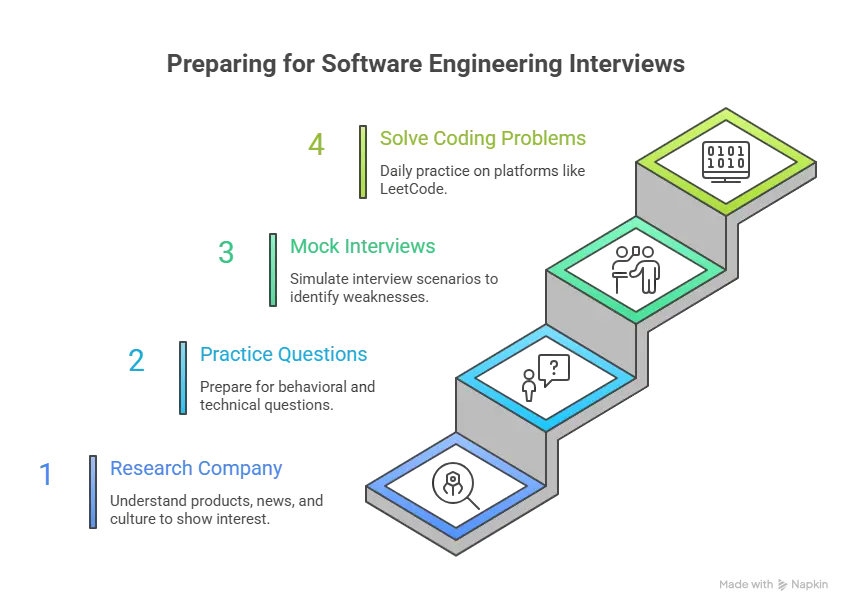
How to Prepare for Software Developer Interviews
Start early. Consistency wins.
- Do your research. Know the company inside out. Products, recent news, culture. Shows you care.
- Practice common questions. Behavioral and technical. Review common interview questions software engineer get asked.
- Do mock job interviews. With friends or online tools. Feels real, spots weak spots.
- Practice coding problems. Daily on LeetCode or similar. Aim for 100-200 problems.
Interview Best Practices
Show up ready to chat, not just code.
- What is the STAR technique in interviews? Situation, Task, Action, Result. Structures your stories. Clear and impactful.
- Tips for answering software engineer interview questions. Think aloud. Explain trade-offs. Ask clarifying questions. It’s a conversation.
- How can I impress a software engineer interviewer? Be enthusiastic. Solve cleanly. Communicate well. Ask good questions back—like about team challenges.
The Interview Process
From the other side.
- Invite the smart people. Hire folks smarter than you sometimes.
- I’m not always right. Admit gaps. Humility goes far.
- One and done. One strong round can seal it.
- How I grade a candidate. Problem-solving, communication, culture fit. Not perfection.
Software Engineer Interview Practice
Hands-on wins.
- Resources: LeetCode, HackerRank, Grokking courses. Mock on interviewing.io or Pramp.
Practice like it’s real. You’ll feel the difference.
Top Software Companies & Career Resources
Dream jobs exist. Let’s look at hot spots.
Top 5 Highly Rated Software Companies to Work For
As of early 2026, engineers love these for pay, balance, growth:
- NVIDIA (AI boom, top comp).
- Google (innovation, perks).
- Microsoft (great balance, stability).
- Meta (impactful projects).
- Apple (premium products, culture).
Career Development Resources
Keep growing.
- Master interviews: Tech Interview Handbook, Exponent.
- Bootcamps: Consider solid ones if switching.
- DevOps guides: Free online paths abound.
FAQ About Software Engineering Interviews
What questions will be asked in a software engineer interview?
Mix: Coding, system design, behavioral. Depends on level—more design for senior software engineer interview questions.
What do I need to know for a software engineering interview?
Solid fundamentals, problem-solving, communication. Plus company-specific prep.
How can I impress a software engineer interviewer?
Clear thinking, enthusiasm, good questions. Show you’re a teammate.
Related Topics & Resources
We’re wrapping up strong. These extras help beyond just software engineer interview questions. Career tips, learning stuff, and more. Think of it as bonus level for your software engineer interview prep.
Career Guidance
Smart questions flip the script.
- Questions to ask a software engineer. Stuff like “What’s a tough bug you fixed?” or “How do you stay sharp?” Great for mentoring chats.
- Questions to ask a software engineer interviewer. About 18 good ones: Team size, challenges, growth ops. Shows you’re serious.
- Software developer vs. software engineer: What’s the difference? Honestly, often the same job these days. Developers focus more on coding features. Engineers handle bigger design, systems, principles. Titles vary by company—don’t sweat it too much.
- What is software engineering? Applying engineering rules to build reliable software. Plan, design, test, maintain. Like building bridges, but for code.
- How to get into the gaming industry. Build games in Unity or Unreal. Portfolio of fun projects. Learn C++ or C#. Network on forums. Start small—indie vibes.
Technical Learning Resources
Keep learning. Tech waits for no one.
- 9 of the most in-demand coding languages (with tips). As of 2026:
- Python – Easy, AI king. Tip: Start with basics.
- JavaScript – Web everywhere.
- TypeScript – Safer JS.
- Java – Enterprise solid.
- SQL – Data must.
- Go – Fast backends.
- Rust – Safe speed.
- Kotlin – Android love.
- C# – Games, Windows.
- 14 top scripting languages you can learn. Python, JavaScript, Bash, PowerShell, Ruby, Perl, PHP, Lua, Groovy, and more niche ones. Great for automation—save time daily.
- 10 computer software examples. OS like Windows, browsers, Office, Photoshop, games, antivirus. Plus definitions.
- What is coding? Telling computers what to do. Fun puzzles, basically.
- Coding terminology: 68 terms to know. Variables, loops, APIs, bugs—get the lingo.
Portfolio & Skills Development
Stand out.
- How to create a software engineer portfolio in 6 steps. Pick projects. Host on GitHub. Write readmes. Add live demos. Explain challenges. Polish it.
- 5 interview questions about binary search skills (with answers). Classic algo. Know time complexity, implement it. Practice variations.
Topic-Wise Interview Questions
Dig deeper.
- Categorized by tech: Java, Python, cloud, frontend. Domain like embedded or mobile embedded software engineer interview questions.
Relevant Resources
More goodies.
- FreeCodeCamp, Coursera, books like Clean Code. YouTube channels. Communities.
Conclusion
Phew, we covered a lot. From behavioral questions for software engineers to algorithms and prep tips.
Final Preparation Tips
Practice daily. Sleep well. Eat something. Breathe.
Next Steps for Interview Success
Apply wide. Follow up. Learn from each one—even nos.
Encouragement for Candidates
You’ve put in the work reading this. That’s huge. Interviews are just chats with fellow coders. One will click. Go get that role—you deserve it. Rooting for you big time!

Shahzada Muhammad Ali Qureshi (Leeo)
I’m Shahzada — a software engineer by education and an SEO professional by trade. I built WhatIsTheSalary.com to go beyond just showing salary numbers — every page is manually researched across sources like BLS, Glassdoor, LinkedIn Salary, and PayScale to give you the full picture in one place. If you found what you were looking for here, that’s exactly the point.