
TLDR
Entry-level software engineers in the US earn between $75,000 and $126,000 per year in 2026, depending on location and specialization.
Software Engineer Skills Required solve the #1 tech career killer: 87% of coding bootcamp grads jobless 6 months post-graduation.
Problem: Companies reject “tutorial completers” lacking real-world debugging, system design, and cross-team collaboration—hired engineers ship 3X faster code. “whatisthesalary.com“
Mind-Blowing Solution: Master 7 skills Big Tech tests: Python proficiency + SDLC mastery = $120K entry-level offers. Front-end React portfolios land jobs 2X faster than backend.
What is a Software Engineer?
A software engineer is someone who applies engineering principles to design, build, test, and maintain software systems. The role goes far beyond writing code — it involves understanding user needs, collaborating across teams, and making architectural decisions that affect entire products. Wondering how this role differs from a developer? Read our software engineer vs software developer breakdown.
According to the U.S. Bureau of Labor Statistics, employment for software developers is projected to grow 25% from 2022 to 2032 — far faster than the average for all occupations — driven by continued adoption of software, cloud platforms, and AI-enabled systems. That kind of growth makes understanding the skills required to be a software engineer more important than ever.
Key Responsibilities
A typical software engineer’s job description includes:
Typical Day in Life
No two days are exactly the same, but most software engineers spend their time in a mix of coding sessions, code reviews, standups, and architecture discussions. You might start your morning fixing a production bug, spend the afternoon designing a new API, and wrap up reviewing a teammate’s pull request before EOD.
As the role of developers expands beyond coding, new expectations are emerging — expectations that shape team structures, hiring decisions, and the skills companies value most.
Career Paths Available
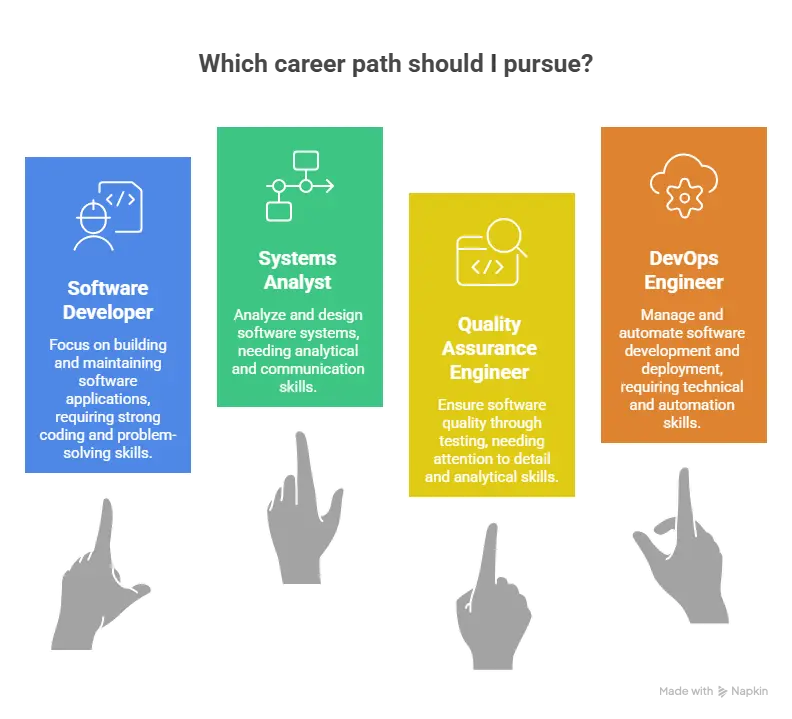
Software engineering opens doors to several specializations. You can go deep as a backend or frontend developer, move into full-stack, pivot toward DevOps or cloud infrastructure, or transition into AI/ML engineering. To understand where this journey can take you, check out our full software engineer career path guide. Senior engineers often move into staff or principal engineering roles, or shift into engineering management and technical leadership.
Essential Technical Skills for Software Engineers
Core Programming Languages (Java, Python, C++, JavaScript)
Programming is still the foundation of everything. The languages US companies want most right now are Python, Java, JavaScript, C++, C#, Go, and Rust. Python has really taken off because you can use it for nearly everything: web development, machine learning, automation — you name it.
Pick one or two to start, go deep, and then branch out. Not sure where to begin? Check out our guide to the best programming languages for software engineers. Knowing a language well is worth more than knowing five languages at surface level. AI productivity tools and code assistants are also becoming must-have skills. Tools like Cursor AI and Microsoft Copilot are changing how developers work, and companies want engineers who can use these tools well without letting code quality slip.
Software Development Life Cycle (SDLC)
Understanding the SDLC — from requirements gathering to deployment and maintenance — is a non-negotiable for any software engineer. You need to know where your work fits in the bigger picture and how to collaborate effectively at each stage, whether your team runs Agile sprints, Kanban boards, or a hybrid workflow.

Frameworks, Libraries & Databases
Knowing a language isn’t enough — you need to know the ecosystems around it. React, Node.js, Django, Spring Boot, and .NET are among the most in-demand frameworks. On the database side, solid SQL fundamentals paired with NoSQL knowledge (MongoDB, Redis) covers most use cases.
Having a grasp of APIs and database management systems, along with the ability to model data in a way that supports the product, is among the required computer software skills for engineers.
Debugging, Testing & Version Control
Even in the age of automation, understanding the ins and outs of software testing and debugging is one of the core technical skills required if you want to become a software engineer. Though new AI programs can perform some of these tasks, testing is still a costly and time-consuming part of any software development project.
Version control is essential in collaborative projects where multiple engineers work on the same files. With strong Git skills, you can contribute clean code and avoid overwriting others’ work — and that translates to smooth, scalable workflows.
System Design & Algorithms
Modern AI systems rely on core computer science concepts: algorithms that determine efficiency and feasibility, data structures that shape performance and scalability, and computer systems that govern memory, computation, and throughput. System design is how you demonstrate senior-level thinking. It’s not just about making something that works — it’s about making something that scales, stays reliable under load, and remains maintainable over time.
Role-Specific Technical Skills
Here’s a breakdown of the technical skills required for each major software engineering specialization in 2026:
| Role | Core Languages | Key Tools/Frameworks | Key Concepts |
| Front-End Developer | HTML, CSS, JavaScript | React, Vue.js, Svelte | Responsive design, accessibility, Web APIs |
| Back-End Developer | Python, Java, Node.js, Go | Django, Spring Boot, Express | REST APIs, databases, server-side logic |
| Full-Stack Developer | JavaScript/TypeScript, Python | React + Node.js, Angular + .NET | Client-server arch, CI/CD basics |
| DevOps Engineer | Bash, Python, Go | Docker, Kubernetes, Terraform | Cloud platforms, CI/CD, monitoring |
| AI/ML Engineer | Python, R | TensorFlow, PyTorch, scikit-learn | Data pipelines, model training, MLOps |
| Embedded SW Engineer | C, C++ | RTOS, FreeRTOS | Hardware interfaces, memory mgmt |
Front-End Developer Skills
A basic front-end technical skill set includes HTML5 (semantic markup), CSS3 (Flexbox, Grid), and JavaScript (ES6+ features), as well as familiarity with modern front-end frameworks and libraries like React.js (including hooks and server components), Vue.js, or Svelte. Performance optimization, cross-browser compatibility, and accessibility (WCAG) are also important if you want to stand out.
Back-End Developer Skills
Back-end engineers own the server-side of applications. You need strong database skills, API design knowledge, and understanding of security best practices. Authentication protocols, caching strategies, and understanding how to build services that don’t fall over under traffic are all part of the job.
Back-end development powers the server side of web apps using frameworks like Node.js, programming languages, API security and protocols, and version control software.
Full-Stack Developer Skills
Full-stack engineers combine the responsibilities of back-end and front-end engineers in one holistic role. In addition to front-end and back-end skills, you should be fluent in integrating APIs, managing databases, ensuring smooth client-server communication, and solid DevOps basics for CI/CD, automation, and monitoring.
DevOps & Cloud Skills
Pick one cloud provider — AWS, Azure, or GCP — and learn its basics. Create a free-tier account and try deploying a small project. Explore serverless functions and learn basic cloud security practices to protect your applications.
Kubernetes, Docker, and infrastructure-as-code tools like Terraform are consistently in high demand for DevOps roles in 2026. If you are based in South Asia, also check out the top paying software companies in Pakistan for local opportunities.
AI/ML Engineer Skills
AI engineers build cutting-edge artificial intelligence systems at the intersection of data science and software engineering, using big data to train AI models that can deliver value both to businesses and users. Key skills include Python, machine learning frameworks (TensorFlow, PyTorch), data pipeline design, and increasingly, MLOps — the practice of deploying and maintaining ML models in production.
Critical Soft Skills for Software Engineers
Problem Solving & Critical Thinking
Software engineers must be curious and creative problem-solvers, able to sift through code to pinpoint a programming error while also anticipating other issues before they arise and adapting quickly to solve them. This is one of the most important soft skills required for software engineers because tools change fast — your thinking ability doesn’t become obsolete. Explore the range of software engineer career options to find the path that best suits your strengths.
Communication & Team Collaboration
It’s extremely rare that software engineers work in isolation. They should be able to clearly communicate — in writing and orally — with virtually any type of team or company stakeholder, regardless of that person’s technical background. Being able to explain a technical tradeoff to a non-technical product manager is just as valuable as knowing how to write the code itself.
Leadership & Time Management
Even if you’re not managing people, taking ownership of your tasks, meeting deadlines, and driving projects forward are traits that get you noticed and promoted. Clear communication helps teams align quickly and avoid rework, and it’s consistently ranked by hiring managers as a key differentiator between good engineers and great ones.
Continuous Learning & Adaptability
Modern software engineering isn’t just about writing code — it’s about designing entire systems and adapting to rapid tech evolution. Trending technologies like cloud computing, microservices architecture, and AI integration have redefined how software is built. If you’re not learning, you’re falling behind. The best engineers treat continuous learning as part of the job, not extra credit.
Security Awareness
Cybersecurity skills not only protect products — they build trust, enabling teams to innovate faster without compromising safety. Understanding secure coding practices, authentication flows, and common vulnerabilities like OWASP Top 10 should be part of every engineer’s toolkit in 2026, regardless of specialization.
How to Build Software Engineering Skills
Learning Paths (Degree vs Bootcamp vs Self-Taught)
There’s no single correct path into software engineering anymore. A traditional bachelor’s degree in computer science or software engineering provides a strong theoretical foundation, and some hiring managers still prefer it.
However, intensive coding bootcamps (12–16 weeks) or comprehensive online courses can teach you practical development skills much faster than a 4-year degree — and many are project-focused, which means you graduate with a portfolio to show employers. If you’re unsure about the timeline, our guide on how long does it take to become a software engineer covers it in detail.
What matters most is what you can demonstrate, not the name of the institution on your certificate. If you are starting from scratch, our guide on how to become a computer programmer is a solid starting point.
Certifications & Online Courses
Certifications signal to employers that you’ve validated your skills through structured learning. High-value software engineer certifications in 2026 include:
Platforms like Coursera, Pluralsight, and Linux Foundation are all solid starting points.
Practice Projects & Portfolios
Build things. Real things. A portfolio with 3-5 well-documented projects beats a blank resume with a CS degree every time. Work on open-source contributions, personal tools you actually use, or small SaaS products. Push everything to GitHub and write a clear README for each project.
Conferences & Communities
Join developer communities like Dev.to, Hashnode, or local meetups. Attend or watch conferences like Google I/O, AWS re:Invent, or PyCon. These aren’t just networking events — they’re where you learn what the industry is actually building and talking about right now. If you’re exploring opportunities abroad, we also have a dedicated guide on software engineer jobs in Australia.
Proving Your Skills to Employers
Resume Skills Section
Your software engineer resume skills section should list technologies, languages, and tools relevant to the job description. Use metrics and outcomes to demonstrate impact. For example, instead of writing ‘Led a team project,’ write ‘Led a cross-functional team to deliver a scalable architecture, reducing system downtime by 30%.’ Always align your resume with ATS systems by incorporating relevant keywords from the job listing.
Interview Testing Common Skills
Software engineering interviews typically test data structures, algorithms, system design, and behavioral questions. Platforms like LeetCode, HackerRank, and Interviewing.io are widely used to prepare. For a curated list of what to expect, browse our software engineer interview questions guide. For senior roles, system design questions carry significant weight — you’ll be expected to walk through how you’d architect a scalable system from scratch.
Showcasing Without Experience
No experience? No problem — but you have to compensate with proof of skill. Contribute to open source, build a portfolio, write technical blog posts, or complete a capstone project through a bootcamp or online course. You can even become a software engineer without a degree — many engineers have done exactly that. Entry-level software engineer requirements often lean heavily on potential, culture fit, and demonstrated initiative rather than years of experience.

Also read: Highest Paying Software Engineer Jobs in Australia (2026 Guide)
Frequently Asked Questions
-
What are the most important software engineer skills for 2026?
Technical skills like Python/Java proficiency, SDLC knowledge, and cloud computing top the list. Soft skills including problem-solving and communication are equally critical for senior roles.
-
Do software engineers need a degree in 2026?
No degree required—bootcamps and self-taught paths work if you build strong GitHub portfolios. However, 70% of FAANG roles still prefer Computer Science bachelor’s.
-
What programming languages should software engineers learn in 2026?
Python, JavaScript, Java, and TypeScript dominate. Add Go for DevOps, Rust for systems—focus on 2-3 based on your specialization (web, AI, backend).
-
How can I prove software engineer skills without experience?
Build 5+ GitHub projects, contribute to open source, complete LeetCode (300+ problems), and earn certifications like AWS Certified Developer.
-
What soft skills do employers test in software engineer interviews?
Behavioral questions test communication, teamwork, and problem-solving. System design rounds evaluate critical thinking and collaboration under pressure.
-
Which software engineer role has easiest entry in 2026?
Front-end development—JavaScript/React skills + portfolio gets junior roles fastest. Lower algorithm complexity vs backend/AI positions.
-
What salary can entry-level software engineers expect in 2026?
US: $85K-$120K base. Europe: €50K-€75K. India: ₹12-20L. Switzerland leads globally at CHF 95K+ starting.
Conclusion
The software engineer skills required in 2026 go well beyond knowing how to write code. You need a solid grasp of programming languages, system design, testing, and version control — on top of the soft skills that make you someone people actually want to work with.
The good news is that the path into software engineering has never been more open. Whether you choose a university degree, a bootcamp, or the self-taught route, what ultimately gets you hired is proof — proof that you can build things, solve real problems, and keep learning when the technology around you changes.
Start with one programming language, understand the SDLC, pick a specialization that interests you, and build projects you are proud of. Add a certification or two to validate your skills, and show up in communities where other engineers share what they are learning. That combination — consistent learning, real experience, and strong communication — is what separates engineers who grow from those who plateau.
The job market in 2026 is competitive, but it rewards engineers who invest in the right skills. Use this guide as your checklist, track your gaps, and close them one at a time. The best engineers are not the ones who know everything — they are the ones who never stop building.

Shahzada Muhammad Ali Qureshi (Leeo)
I’m Shahzada — a software engineer by education and an SEO professional by trade. I built WhatIsTheSalary.com to go beyond just showing salary numbers — every page is manually researched across sources like BLS, Glassdoor, LinkedIn Salary, and PayScale to give you the full picture in one place. If you found what you were looking for here, that’s exactly the point.