TLDR
DevOps Salary in Australia in 2025–2026 will surprise you. While general software engineers earn around AUD 110,000, DevOps engineers are commanding AUD 130,000 – 143,000 on average — with senior and cloud specialists easily hitting AUD 175,000 to AUD 220,000+.
The gap is massive, and it’s widening fast.
Companies are desperate for engineers who can build scalable pipelines, master Kubernetes, and manage multi-cloud infrastructure — but talented DevOps professionals remain in short supply. “whatisthesalary.com” This guide reveals exactly what DevOps engineers are earning right now by experience level and city, plus the proven strategies to boost your salary into the top tier.
Why These Roles Pay a Premium
Before the numbers, it is worth understanding why specialist roles like AI, ML, and DevOps consistently sit above the general software engineering average.
The 2025–26 Australian Tech Salary Guide, produced by consulting firm Think and Grow and based on real salary data across Australian states and territories, confirmed that AI-focused roles now command higher salaries than many traditional software roles. The report described the current period as the industry being “caught between the familiar and the frontier” — and the salary premium for those operating at that frontier is very real.
According to Think and Grow co-founder Anthony Sochan, the number of true AI experts in Australia is small relative to demand, which is why companies are willing to pay significant premiums. Organisations like Commonwealth Bank are partnering directly with OpenAI to access AI expertise they simply cannot hire fast enough.
DevOps earns its premium for a different reason — it sits at the intersection of development, infrastructure, and operations, and the skills required to do it well (cloud architecture, CI/CD pipelines, Kubernetes, infrastructure-as-code) are genuinely hard to develop and in constant demand.
AI Engineer Salary in Australia (2025–2026)
The “AI engineer” title covers a range of roles — from engineers building and deploying AI models in production, to engineers integrating AI APIs into products, to specialists working on foundational model infrastructure. The salary varies accordingly.
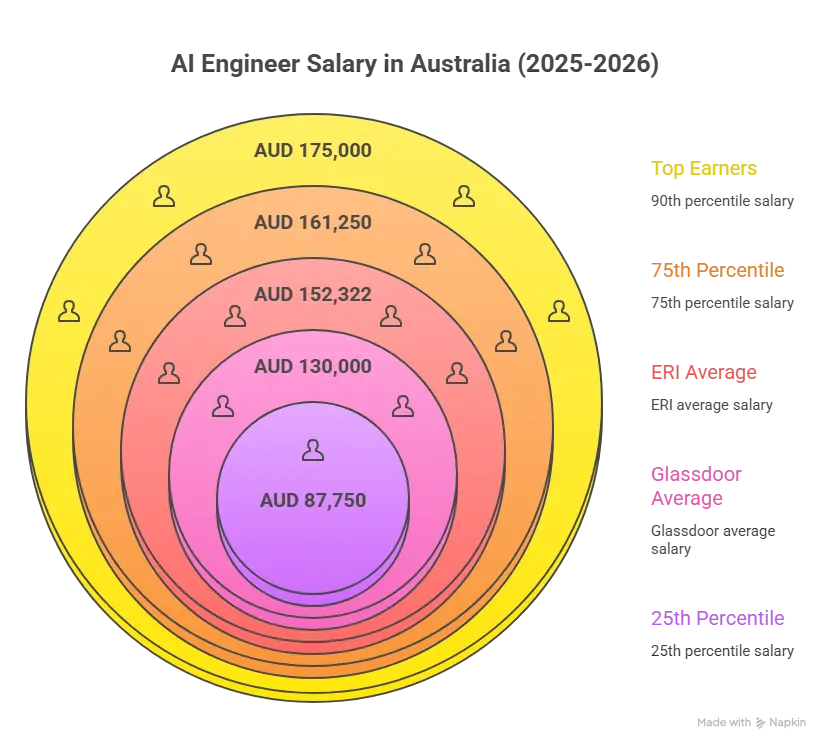
Glassdoor data updated March 2026, based on 32 verified salary submissions, puts the average AI engineer salary in Australia at AUD 130,000 per year — or AUD 63 per hour. The typical pay range sits between AUD 87,750 at the 25th percentile and AUD 161,250 at the 75th percentile. Top earners report up to AUD 175,000 at the 90th percentile.
The ERI Economic Research Institute puts the average for an artificial intelligence engineer in Australia at AUD 152,322 per year, with the range running from AUD 104,950 to AUD 185,986 based on direct employer and employee survey data.
The Think and Grow 2025–26 Australian Tech Salary Guide reports that those working in data and AI in Australia earn an average of AUD 157,000 annually — significantly above the general software engineering average of AUD 109,601 reported by Indeed for the same period.
AI Engineer by experience level (2025–2026):
The Director of AI title is worth noting separately. According to the Think and Grow report, directors of AI in Australia are earning an average of AUD 236,000 annually, with the range reaching AUD 250,000. These are necessarily senior roles given how new widespread AI adoption is, and the supply of people who can genuinely hold them is extremely limited.
Where AI engineering pays the most:
Financial services and fintech are the highest-paying industries for AI engineers in Australia. Banks like CommBank, NAB, and ANZ are investing heavily in AI for fraud detection, credit risk, customer experience, and automated compliance. Healthcare AI and government digital transformation are also strong growth areas. Sydney leads on salary, followed by Melbourne, with Brisbane growing fast.
Machine Learning Engineer Salary in Australia (2025–2026)
Machine learning engineers are a more defined technical role — building, training, evaluating, and deploying ML models at scale. The combination of strong maths, statistical fundamentals, and software engineering skills makes experienced ML engineers among the hardest roles to hire in Australia.
Indeed Australia, drawing from 63 verified salary reports updated March 6, 2026, puts the average machine learning engineer salary at AUD 149,225 per year.
Glassdoor, based on 178 salary submissions updated March 2026, puts the average at AUD 137,000 per year, with the typical range between AUD 105,000 at the 25th percentile and AUD 176,000 at the 75th percentile. Top earners report up to AUD 226,300 at the 90th percentile.
Levels.fyi, which captures total compensation at tech companies in Australia, puts the median ML engineer salary at AUD 169,097 — reflecting the fact that ML engineers at tech product companies earn significantly more than the broader market average.
The Think and Grow 2025–26 Salary Guide confirms that machine learning engineers are being paid “far more than traditional software development roles” — a notable comment in a report covering the full spectrum of Australian tech salaries.
ML Engineer by experience level:
Sydney-based lead ML engineers can hit AUD 189,000 in base salary according to Alcor’s 2025 data cited in the senior salary guide for Australia. The “AI-Plus” premium — engineers who combine strong ML skills with domain expertise in healthcare, fintech, or cybersecurity — is generating the largest salary premiums in the current market.
What industries pay the most for ML engineers:
Fintech and financial services, healthcare AI, defence and government analytics, e-commerce and recommendations, and SaaS companies building AI-native products. Companies like Atlassian, Canva, SafetyCulture, and REA Group all have active ML engineering teams and pay at or above market benchmarks.
Key skills that push ML salaries higher:
Deep learning frameworks (PyTorch, TensorFlow), experience deploying models to cloud platforms (AWS SageMaker, Google Vertex AI, Azure ML), strong Python and software engineering fundamentals, experience with LLMs and generative AI specifically, and the ability to bridge the gap between research and production — ensuring models are not just accurate but scalable and maintainable. Engineers with hands-on LLM fine-tuning or retrieval-augmented generation (RAG) experience are commanding the highest entry offers in this category right now.
DevOps Engineer Salary in Australia (2025–2026)
DevOps engineering has matured from a buzzword-heavy trend into a core engineering function at virtually every serious tech employer in Australia. The role spans CI/CD pipeline management, infrastructure-as-code, cloud architecture, containerisation (Docker, Kubernetes), and site reliability engineering. The salary reflects that breadth.
Glassdoor data from March 2026 puts the average DevOps engineer salary in Australia at AUD 130,000 per year for Sydney, noting this is 9% below the national DevOps average — meaning the national average sits closer to AUD 143,000. Top earners report up to AUD 181,632 at the 90th percentile.
Robert Half’s 2025–2026 Salary Guide, one of the most widely referenced guides in Australian recruiting, places AI/ML engineers at AUD 148,000 at the 25th percentile and AUD 172,000 at the 50th percentile — with senior DevOps and cloud specialists typically sitting in the same band.
DevOps Engineer by experience level:
Senior DevOps engineers at the contract level are commanding daily rates of AUD 800–1,200+, with some AI and cloud specialists hitting AUD 1,050+ per day. That translates to AUD 200,000–250,000+ per year for contractors working at a high utilisation rate — a significant premium over the permanent equivalent.
Cloud specialisation drives the biggest premiums:
AWS, Azure, and GCP specialists consistently earn above the DevOps average. Specific data from 2025 shows AWS developers earning between AUD 143,725 and AUD 214,058 in total compensation, and solutions architects receiving packages between AUD 236,990 and AUD 386,830 at senior levels. Multi-cloud specialists — engineers comfortable across two or more major cloud platforms — earn AUD 145,254–183,478 across experience levels, with senior positions reaching AUD 275,218.
The reason cloud pays a premium is structural: 76% of organisations now use multiple cloud platforms, the expertise is genuinely complex to develop, and the shortage of experienced cloud architects in Australia is not going away quickly.
Junior vs Senior: How the Gap Looks in Specialist Roles
The salary progression in AI, ML, and DevOps roles is steeper than in general software engineering. Here is a direct comparison:
| Role | Junior (0–2 yrs) | Senior (6–9 yrs) | Premium vs General SWE |
|---|---|---|---|
| General SWE | AUD 70,000–88,000 | AUD 140,000–170,000 | Baseline |
| AI Engineer | AUD 85,000–110,000 | AUD 155,000–195,000 | 15–25% above |
| ML Engineer | AUD 90,000–115,000 | AUD 155,000–198,000 | 20–30% above |
| DevOps Engineer | AUD 80,000–105,000 | AUD 140,000–175,000 | 10–20% above |
| Cloud Architect | AUD 95,000–120,000 | AUD 165,000–210,000 | 25–35% above |
The 20–30% premium for AI and ML engineers is consistent across data sources and is widely expected to hold or grow through 2026 as enterprise AI adoption accelerates. The limiting factor is talent supply — universities are producing more AI-capable graduates, but practical production ML experience remains scarce.
The Melbourne vs Sydney Split for Specialist Roles
The Think and Grow 2025–26 Salary Guide notes that tech workers in New South Wales are paid 5% more than the national average, while most roles in Victoria are paid below the national average. This applies to specialist roles too.
For AI and ML engineers, Sydney leads by approximately 5–8% in base salary terms. Senior ML engineers in Sydney report base salaries reaching AUD 189,000 for lead roles, while Melbourne equivalents typically top out around AUD 170,000–180,000. Brisbane is growing rapidly as an AI employment market, particularly for government AI projects and fintech companies expanding outside Sydney.
For DevOps roles, the city premium is less pronounced — the skills are in demand everywhere there is a mature tech employer, and remote work has partially equalised rates across cities. Senior contract DevOps engineers in Brisbane can now approach AUD 900–1,100 per day for the right specialisation, not far below Sydney rates.
Certifications That Move the Number
In specialist tech roles, the right certification can meaningfully change your compensation. The certifications most consistently associated with salary premiums in Australian job market data for 2025–2026 are AWS Solutions Architect Professional and AWS DevOps Engineer Professional (typically adds AUD 10,000–20,000 for cloud roles), Google Professional Machine Learning Engineer, Certified Kubernetes Administrator (CKA) for DevOps, and any Google or DeepLearning.ai specialisation certificates for AI/ML roles.
These are not checkbox credentials — employers care because they signal genuine technical depth. Combined with hands-on project experience, they regularly push mid-level candidates into the upper portion of their salary band.
Where the Market Is Heading
The trajectory for AI and ML engineering salaries in Australia is upward. Australia’s IT sector is projected to grow 5.9% over the next five years. The government is projecting a 22.6% increase in software engineering positions between 2023 and 2028 — roughly 58,000 new roles — and a disproportionate share of those are in AI, cloud, and DevOps.
The demand-supply gap is structural. Australia needs 312,000 additional tech workers by 2030 and produces approximately 7,000 IT graduates annually. The Hays FY25/26 Salary Guide found that tech salaries grew 9.6% in the last year — faster than inflation — and nearly 10% of organisations plan pay increases of up to 20% for top tech talent in the near future.
For engineers already in AI, ML, or DevOps, this is a genuinely strong market. For those considering a pivot into these specialisations from general software engineering, the investment in retraining has a clear and near-term financial return.
For a full picture of how these specialist salaries compare to general software engineering at every level, check our main guide on software engineer salary in Australia.

Also read: What is The Software Engineer Salary in Australia: Complete Guide for 2026
Frequently Asked Questions
-
What is the average AI engineer salary in Australia in 2026?
AI engineers in Australia earn an average of AUD 130,000 – 157,000 per year. Senior AI engineers can expect AUD 155,000 – 195,000, while principal and director-level roles reach AUD 195,000 – 260,000+.
-
How much does a Machine Learning Engineer earn in Australia?
Machine Learning engineers earn between AUD 137,000 – 149,225 on average. Senior ML engineers typically make AUD 155,000 – 198,000+, with top principal roles going up to AUD 280,000+.
-
Are AI and ML engineers paid more than regular software engineers in Australia?
Yes. AI and ML engineers command a 20–30% salary premium over general software engineering roles. The gap is even wider at senior levels due to high demand and limited talent supply.
-
What is the average DevOps engineer salary in Australia in 2025–2026?
DevOps engineers in Australia earn an average of AUD 130,000 – 143,000 per year. Senior DevOps and cloud specialists typically earn AUD 140,000 – 175,000, with principal roles reaching AUD 175,000 – 220,000+.
-
Which city pays the highest for AI and ML engineers in Australia?
Sydney pays the highest salaries for AI and ML engineers, typically 5–8% above the national average. Melbourne follows closely, while Brisbane is growing quickly as a strong alternative.
Conclusion
The specialist tech roles of AI Engineer, Machine Learning Engineer, and DevOps Engineer are currently among the best-paid positions in Australia’s tech industry. With salaries 20–30% above general software engineering roles — and still rising — these specialisations offer one of the fastest paths to higher earnings in 2025–2026.
Whether you’re already working in these areas or planning to pivot, the combination of strong demand, skills shortage, and rapid enterprise adoption means the premium is likely to continue. Focus on building production-ready experience with LLMs, cloud platforms, and modern DevOps tools to maximise your value in this competitive market.
The message is clear: in Australia’s tech scene right now, depth beats breadth — and the pay reflects it.

Shahzada Muhammad Ali Qureshi (Leeo)
I’m Shahzada — a software engineer by education and an SEO professional by trade. I built WhatIsTheSalary.com to go beyond just showing salary numbers — every page is manually researched across sources like BLS, Glassdoor, LinkedIn Salary, and PayScale to give you the full picture in one place. If you found what you were looking for here, that’s exactly the point.