
TLDR
Remote Entry-Level Software Engineer Jobs unlock 1000s of dream roles in 2026, but 90% of new grads get ghosted by “remote” listings that demand 3+ years experience. Spent months on LinkedIn with zero callbacks?
The fix: This guide reveals 300+ truly remote entry-level positions at Canva, Infosys, Nymbus — no experience required. Live job links, salary ranges ($80K+), and skills that land interviews. “whatisthesalary.com“
Your launchpad: Skip bootcamp scams, beat ATS filters, negotiate junior pay like a senior. From zero to full-time remote engineering — your first six-figure remote job starts here.
What is an Entry-Level Remote Software Engineer Job?
An entry-level remote software engineer job is a work-from-home position designed for developers with 0 to 2 years of professional experience. These roles go by a few different titles depending on the company: Junior Software Engineer, Associate Software Engineer, Software Engineer I, or even Software Developer Intern.
The job itself involves writing and testing code, debugging software, participating in code reviews, and collaborating with senior engineers through tools like Slack, Zoom, Microsoft Teams, Jira, and GitHub. You are not expected to know everything. You are expected to learn fast, communicate clearly, and deliver working code.
Most remote entry level software engineer jobs fall into one of three tracks: frontend (HTML5, CSS3, React.js), backend (Node.js, Python, Java, SQL), or full stack, which combines both. There are also related entry-level roles worth considering, including QA Engineer, DevOps Engineer, and Mobile App Developer.
Top Remote Entry-Level Software Engineer Jobs in 2026
Current Job Titles and Openings
Based on current listings across LinkedIn Jobs, Indeed, Glassdoor, and Built In, here are the most common job titles for remote entry level software engineer roles actively hiring right now:
According to Indeed, there are over 480 active remote entry level software engineer listings at any given time in early 2026. Built In tracks hundreds more across US tech hubs and fully remote positions.
Featured Companies Hiring: Canva, Infosys, Affirm, and More
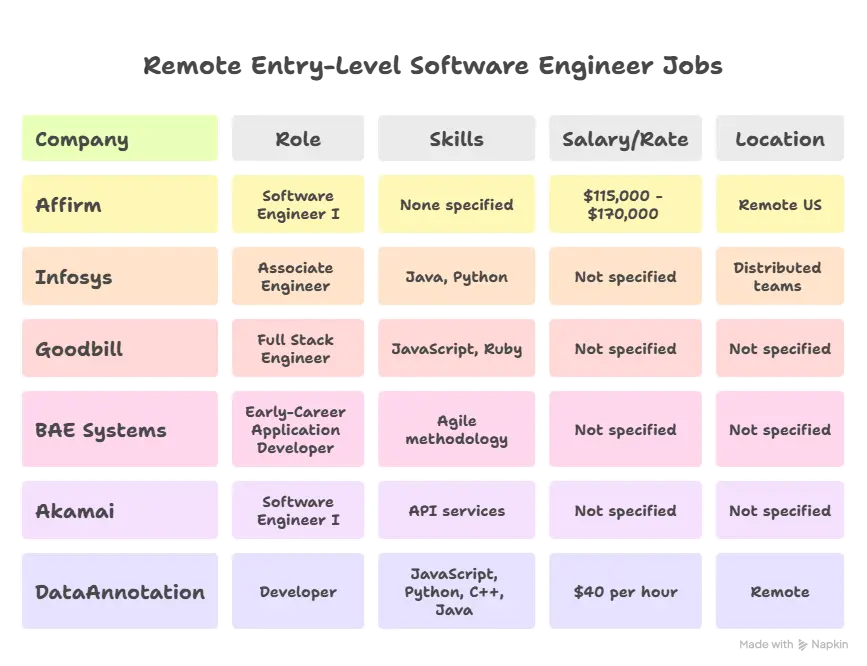
Some of the most active companies currently posting remote software engineer jobs entry level positions include Affirm, which is hiring Software Engineer I roles with salaries between $115,000 and $170,000 for remote US positions. Infosys is hiring associate-level engineers for distributed teams with a focus on Java and Python skills. Goodbill, a healthtech startup, is bringing on full stack engineers with backgrounds in JavaScript and Ruby.
Other notable companies with open remote entry level roles include BAE Systems for early-career application developers using Agile methodology, Akamai for Software Engineer I roles building API services, and DataAnnotation, which offers flexible remote work for developers proficient in JavaScript, Python, C++, or Java at $40 per hour.
Popular Entry-Level Software Roles
Software Engineer I and Associate Software Engineer
These two titles are the most common starting points for new grad software engineer remote positions. Software Engineer I roles typically require a Computer Science degree or equivalent coding bootcamp experience. Associate Software Engineer roles are similar but sometimes skew toward companies that value portfolio projects and GitHub contributions over formal degrees.
Daily responsibilities include writing clean, maintainable code, participating in Agile sprint ceremonies, documenting your work, and fixing bugs. You will spend a lot of time in pull request reviews and pair programming sessions, which is great for learning fast.
Full Stack, Backend, and Frontend Internships
If you are still in school or have just graduated, remote internship to full-time conversion paths are a smart strategy. Companies like Google, Microsoft, Amazon, and Shopify run structured internship programs that often lead to full-time junior developer offers. Shopify and GitLab, both remote-first companies, are particularly active in converting strong interns to full-time hires.
For frontend roles, knowing React.js, HTML5, CSS3, and JavaScript is the baseline. Backend roles lean on Python, Java, Node.js, SQL, and REST APIs. Full stack positions want both, plus familiarity with Git and GitHub for version control.
Related Roles: Data Engineer, QA Engineer, Security Analyst
Do not overlook adjacent roles when searching for remote software jobs entry level. QA Engineers test software for bugs and performance issues. Entry-level QA roles are less competitive and are a great foot in the door to the broader engineering world. DevOps Engineer positions, even at entry level, are in high demand, with 44.8% of DevOps roles offering full remote work as of 2026. Security Analyst roles are also growing rapidly and often accept developers transitioning from software engineering.
Top Companies Hiring Remote Entry-Level Engineers
Tech Giants and Remote-First Companies
Several well-known companies consistently hire entry level remote software engineer candidates. For a complete breakdown of the best employers in the industry, see our guide to the top software engineering companies to work for. Here is what you need to know about the biggest names hiring right now:
Startups and Mid-Size Companies Worth Watching
Beyond the giants, companies like Affirm, Goodbill, Replicated, and ElevenLabs are among the fastest-growing remote-first employers hiring entry-level talent in 2026. Startups often pay 15 to 30 percent above average to compete for emerging talent. They also tend to move faster in the hiring process and give junior developers more ownership earlier in their careers.

Business web solutions firms, SaaS companies, and fintech startups are particularly active on platforms like Wellfound (formerly AngelList) and LinkedIn Jobs. Freelance platforms like Upwork, Fiverr, and Toptal are also worth exploring for contract-based remote programming jobs for beginners.
Remote Entry-Level Software Engineer Salary Expectations
Pay Ranges by Role and Experience
One of the most common questions about remote entry level software engineer jobs is: what does it actually pay? Here is the honest breakdown based on verified 2026 data from ZipRecruiter, Glassdoor, Built In, and PayScope. For a deeper look at top-paying specializations, check out our full guide to the highest paying software jobs in the US.
The average salary for a remote entry-level software developer in the US is approximately $100,265 per year as of early 2026, according to ZipRecruiter data covering over 200 job openings. However, the realistic range for most beginners falls between $63,500 and $106,000, depending on role, company size, and location.
Glassdoor reports the average entry-level remote software engineer salary at $78,000 per year, while PayScope pegs the national entry-level median at $86,000. The variation comes down to company size, tech stack, and whether you are targeting startups versus enterprise employers.
Below is a detailed salary breakdown by role type for remote entry level positions in 2026:
| Role | Salary Range (Remote) | Average / Source | Experience |
| Junior / Associate Engineer | $63,500 – $80,000 | $78,000 avg (Glassdoor) | 0 – 1 year |
| Software Engineer I | $80,000 – $110,000 | $86,000 median (PayScope) | 0 – 2 years |
| Full Stack Developer (Entry) | $70,000 – $105,000 | $100,265 avg (ZipRecruiter) | 0 – 2 years |
| Frontend Developer (Junior) | $65,000 – $95,000 | $88,000 avg | 0 – 1 year |
| Backend Developer (Junior) | $68,000 – $100,000 | $90,000 avg | 0 – 2 years |
| QA Engineer (Entry-Level) | $55,000 – $80,000 | $67,000 avg | 0 – 1 year |
| DevOps Engineer (Entry) | $75,000 – $110,000 | $95,000 avg | 0 – 2 years |
| Software Developer Intern | $29,500 – $55,000 | $40/hr (DataAnnotation) | Student / Grad |
For freelance vs full-time comparison: full-time remote roles come with benefits including health insurance, PTO, and equity. Freelance contract jobs through platforms like Upwork or Toptal can pay higher hourly rates but without the stability or benefits package. For beginners, a full-time role is generally the better starting point for skill development and mentorship.
Most In-Demand Skills for Entry-Level Remote Roles
Technical Skills and Tools
Based on an analysis of 10,745 job postings for remote software engineer positions, the top technical skills employers are asking for in 2026 are:
Beyond languages, familiarity with REST APIs, Data Structures and Algorithms, and basic Debugging skills are expected in almost every junior developer job description. React.js and Node.js are the most requested frontend and backend frameworks respectively.
Remote work tools matter too. Employers expect you to be comfortable with Slack for async communication, Zoom or Microsoft Teams for video calls, Jira or Trello for project tracking, and GitHub for code collaboration.
Soft Skills Employers Want
Technical interview preparation will get you in the door. But soft skills are what keep you there, especially in a remote environment where you cannot tap someone on the shoulder.
The skills that consistently come up in remote hiring are async communication (written updates, clear documentation), independent problem-solving, and the ability to work across time zones. Employers hiring for distributed teams specifically look for candidates who can operate with minimal hand-holding.
A strong GitHub portfolio showing 3 to 5 real projects, active contributions, and clean commit history signals all of these things without you having to say them out loud.
How to Get Your First Remote Software Engineer Job
This is the part most guides gloss over. Here is what actually works in 2026:
Start with your GitHub portfolio. Recruiters check it before your resume in many cases. Build 3 to 5 projects that solve real problems, use the tech stack the role requires, and include a solid README. If you do not have a CS degree, this portfolio becomes even more critical. Read our detailed guide on how to become a software engineer without a degree to understand what employers actually look for.
Practice LeetCode consistently. Most technical interviews for entry-level roles include 2 to 3 coding challenges focused on Data Structures and Algorithms. Easy to Medium level problems are the standard for junior roles. Aim for 50 to 100 solved problems before you start applying seriously.
Use multiple job platforms simultaneously. LinkedIn Jobs and Indeed are the highest volume. Glassdoor is great for salary transparency. Wellfound (AngelList) is best for startup roles. For worldwide remote jobs, check Remote Rocketship and DailyRemote.
Tailor your resume for each application. Use keywords from the job description naturally. Do not stuff your resume with every technology you have ever touched. Pick the ones relevant to that specific role.
Apply to 10 to 15 positions per week minimum. According to Remote Rocketship data, it takes about 47 days on average for employers to close a job opening. Start early, follow up, and do not stop applying while you are waiting to hear back.
Interview Tips and Salary Negotiation
Common Interview Stages for Remote Roles
Most remote entry level software engineer hiring processes follow a predictable structure. To prepare properly, go through our full list of software engineer interview questions that hiring managers are actually asking in 2026:
Negotiation Strategies for Entry-Level Remote Roles
Most new developers accept the first offer they get. That is almost always a mistake. Research salary ranges on Glassdoor and ZipRecruiter before your interview so you walk in knowing the market. For remote roles, push for location-neutral compensation, especially if you are in a lower cost-of-living area.
If base salary is fixed, negotiate for signing bonuses, extra PTO, remote work stipends, or professional development budgets. Many remote-first companies have more flexibility on equity and perks than base pay, particularly at the junior level.
Hiring Timeline for Remote Positions
How Long Companies Take to Hire
Understanding the timeline sets realistic expectations. If you are also thinking about how long it takes to get fully job-ready as a developer, read our breakdown of how long it takes to become a software engineer before you plan your application schedule.
Based on an analysis of 7,816 remote job listings, it takes an average of 47 days from posting to close. Large companies like Google, Microsoft, and Amazon run structured hiring cycles that can take 4 to 8 weeks from application to offer. Startups and mid-size companies often move faster, sometimes completing the entire process in 2 to 3 weeks.
Apply early for any open role, as many remote job openings attract hundreds of applicants within the first few days of posting. Set up job alerts on LinkedIn Jobs, Indeed, and Glassdoor so you are always among the first to apply.

Also read: Software Engineer Salary & Hourly Rates (US Focus 2026)
FAQ: Remote Entry-Level Software Engineering Jobs
-
Can I get a remote software engineer job with no experience?
Yes, but you need to replace experience with proof of skill. A strong GitHub portfolio, completed coding bootcamp, online certifications, and a record of LeetCode practice can compensate for a lack of work history in many entry-level remote roles.
-
What degree do I need for remote software engineer jobs entry level?
A Computer Science or Software Engineering degree is preferred at most large companies. However, many startups and mid-size tech firms accept coding bootcamp graduates and self-taught developers with demonstrable skills. Read our full guide on how to become a software engineer without a degree for a step-by-step path.
-
Which platforms are best for finding remote entry level software jobs?
LinkedIn Jobs, Indeed, Glassdoor, and Wellfound are the top four platforms. For worldwide remote jobs, Remote Rocketship and DailyRemote specialize in fully distributed roles. Upwork and Toptal work well for freelance and contract entry-level work.
-
How much do entry-level remote software engineers earn in 2026?
The average is around $78,000 to $100,265 per year in the US. The realistic range for most beginners is $63,500 to $106,000. Top earners at the 90th percentile can make up to $149,000 at high-growth startups or well-funded tech companies.
-
Are remote software engineer entry level jobs available worldwide?
Many are, especially at companies like GitLab and Automattic that operate with fully distributed global teams. Opportunities also exist outside the US — for example, explore software engineer jobs in Australia if you are open to international remote hiring. Always check location requirements carefully before applying.
Final Thoughts
Landing your first remote software engineer job in 2026 is absolutely achievable. The market is active, distributed teams are now the norm, and companies across every industry are hiring junior developers who can write clean code, communicate asynchronously, and keep learning.
Your path forward is clear: build a strong GitHub portfolio, get comfortable with JavaScript, Python, Git, and SQL, practice LeetCode consistently, and apply across multiple platforms simultaneously. Do not wait until you feel 100% ready. Most successful junior engineers landed their first role at around 70% readiness and learned the rest on the job.
If you want to go deeper, here are the resources that will move the needle most for you right now. Start with understanding how long it takes to become a software engineer so you set realistic timelines. Then use our software engineer interview questions guide to prepare for the technical rounds that will actually decide your offer.
Once you are in the door, think about where you are headed. Map out your full software engineer career path from junior all the way to principal or staff engineer. And if you are weighing job titles, our breakdown of software engineer vs software developer will help you target the right roles from day one. The remote opportunity in software engineering has never been bigger. The only thing standing between you and your first offer is consistent, focused effort. Start today.

Shahzada Muhammad Ali Qureshi (Leeo)
I’m Shahzada — a software engineer by education and an SEO professional by trade. I built WhatIsTheSalary.com to go beyond just showing salary numbers — every page is manually researched across sources like BLS, Glassdoor, LinkedIn Salary, and PayScale to give you the full picture in one place. If you found what you were looking for here, that’s exactly the point.