
TLDR
Software Engineer Salary in Tokyo can shatter every expectation you have about tech careers. Imagine earning top-tier yen packages in a city where bullet trains whisk you to work, AI labs buzz 24/7, and cherry blossoms frame your morning commute—all without Silicon Valley burnout.
Yet most engineers stay stuck overseas, convinced language barriers and visa walls make Tokyo impossible. They settle for half the pay while the real opportunities vanish. “whatisthesalary.com“
The breakthrough solution? This guide reveals the exact negotiation scripts, visa shortcuts, and hidden salary data that top 1% engineers use to land life-changing offers in weeks. Your Tokyo chapter starts now.
How Much Does a Software Engineer Make in Japan?
Average Software Engineer Salary in Japan (National Overview)
The average software engineer salary in Japan sits at around ¥5.69 million per year, based on 2024 data from Japan’s Ministry of Health, Labour and Welfare. That is slightly above the national average salary of ¥4.9 million for full-time employees. So software engineering does pay above average, but it varies enormously depending on where you work and who you work for.
According to TokyoDev’s 2025 survey of English-speaking international developers in Japan, the median compensation was ¥9.5 million. That gap between ¥5.69M and ¥9.5M tells you something important: your company type and language skills matter a lot.
Developers working at international-headquartered companies reported a median of 35% more than those at Japanese domestic firms.
Average Software Engineer Salary in Tokyo
Tokyo is where the money is. The average software engineer salary in Tokyo comes in at approximately ¥7.2 million per year according to Glassdoor (March 2026 data, 3,055 salary submissions). The typical range sits between ¥5.5 million at the 25th percentile and ¥10.29 million at the 75th percentile. Top earners in the 90th percentile report up to ¥13.15 million annually.
According to Levels.fyi data updated as of March 2026, the average total compensation for a software engineer in the Greater Tokyo Area is ¥8.5 million, with the salary range spanning ¥6.47 million to ¥12.3 million. The median salary from CareerCheck.io puts this figure at ¥9.5 million, with a full range of ¥4.5 million to ¥29.9 million.
SalaryExpert puts the average even higher, at ¥14.1 million gross, noting Tokyo pays 38% more than the national average. This higher figure includes bonuses and reflects a broader methodology. In short, expect the average software engineer Tokyo salary to sit between ¥7.2M and ¥9.5M for most practical purposes, with senior and specialized roles going much higher.
Here is a full breakdown of software engineer salary in Tokyo by experience level:
| Experience Level | Annual Salary (JPY) | Approx. USD | Notes |
| Entry-Level (0-2 yrs) | ¥4,000,000 – ¥7,000,000 | $27,000 – $47,000 | New graduates, local firms |
| Mid-Level (3-6 yrs) | ¥7,000,000 – ¥12,000,000 | $47,000 – $81,000 | Tokyo avg range |
| Senior (7+ yrs) | ¥10,000,000 – ¥17,000,000 | $67,000 – $114,000 | Top firms up to ¥20M+ |
| Staff / Principal | ¥15,000,000 – ¥25,000,000 | $101,000 – $168,000 | Multinational firms |
| Google Tokyo (L3-L6) | ¥15,660,000 – ¥40,700,000 | $105,000 – $274,000 | Median: ¥24.4M |
How Tokyo Compares to Other Cities
Tokyo pays the most for software engineers in Japan, and by a significant margin. Osaka and Yokohama are the next best options, with average engineer salaries ranging from ¥6 million to ¥9 million. Kyoto sits slightly lower at ¥6 to ¥8 million, while Nagoya is an emerging tech city with growing demand and average pay between ¥5.5 and ¥7.5 million.
The general rule: stick to Tokyo if maximizing your tokyo software engineer salary is the goal. The city accounts for a disproportionate share of Japan’s tech jobs, multinational offices, and high-paying startup activity.
Software Engineer Salary by Experience Level
Entry-Level Software Engineer Salary in Japan
New graduates and engineers with under two years of experience can expect annual salaries in the range of ¥3.98 million to ¥5 million at typical Japanese companies, based on PayScale data from 2026. At international firms or well-funded startups, entry-level roles can start at ¥6 to ¥7 million.
Some Japanese tech giants are moving aggressively on starting salaries. Sony, NEC, and DeNA have raised new graduate starting packages for AI roles to as high as ¥10 million. This is a major shift from the traditional seniority-based pay culture that used to cap new graduate salaries tightly.
Mid-Level Software Engineer Salary in Japan
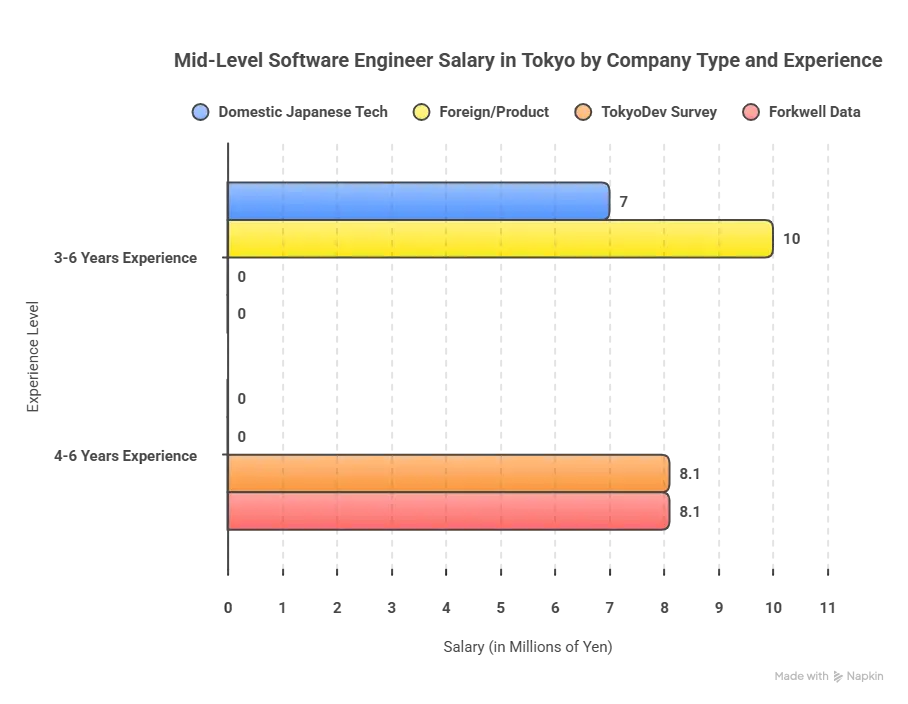
Mid-level engineers with 3 to 6 years of experience typically earn ¥7 million to ¥12 million per year in Tokyo. The type of company makes a big difference here. Developers at domestic Japanese tech companies might sit at the lower end of that range, while those at foreign firms or growing product companies like Mercari can push above ¥10 million comfortably.
TokyoDev data shows that developers with 4 to 6 years of experience earned a median of ¥8.1 million in their survey pool, while the broader Japanese developer data from Forkwell placed similar experience levels significantly lower. That gap highlights the premium that comes with working at international or product-focused firms.
Senior Software Engineer Salary in Japan
The average senior software engineer salary in Tokyo is ¥10.7 million per year according to Glassdoor (2026 data), with the typical range sitting between ¥8.33 million at the 25th percentile and ¥14.5 million at the 75th percentile. Top senior earners in the 90th percentile report up to ¥19 million annually.
At elite firms, those numbers climb further. Senior engineers at companies like Preferred Networks, Bloomberg, or Amazon Japan regularly clear ¥15 to ¥25 million in total compensation. The senior software engineer salary in Tokyo can reach ¥30 to ¥40 million at FAANG-level companies when stock compensation is included.
Total Pay Trajectory Over a Career
A typical software engineering career in Tokyo might look like this: you start at ¥4 to ¥5 million as a new graduate at a domestic firm, move to ¥7 to ¥10 million mid-career at a product company or international firm, and reach ¥12 to ¥20 million+ as a senior or staff engineer.
Those who make it to principal or distinguished engineer levels at top companies can exceed ¥25 million in total annual compensation.
Software Engineer Salary by Age
How Age Affects Pay in the Japanese Tech Market
Japan’s traditional seniority-based pay system, known as nenko joretsu, historically tied salary growth to age rather than pure merit. While many modern tech companies have moved away from this model, age still correlates with pay in the broader market, partly because it tends to track with experience.
TokyoDev’s survey data shows a consistent trend: international developers earn significantly more than their Japanese counterparts at every age group, and the gap widens with age. For engineers aged 35 to 39, the median salary of international developers was 65% higher than that of typical Japanese developers in the same bracket. Younger groups showed a smaller gap, with international developers earning around 36% more than local peers in their late 20s.
The practical takeaway here: if you are targeting the best average software engineer salary in Tokyo, prioritize company type and skill set over age. The most meritocratic employers, including international firms and forward-thinking Japanese product companies, base your pay on what you can do.
Software Engineer Salary by Gender
Gender Pay Gap Among Software Engineers in Japan
The gender pay gap in Japan’s tech sector is real and well-documented. TokyoDev’s survey found that only 12% of respondents were women, and female respondents consistently reported lower median compensation than male counterparts. Even after accounting for experience differences, men continued to earn more.
The gap is most severe at outsourcing companies. According to TokyoDev’s data, only 11% of women at outsourcing firms earned more than ¥5 million per year, compared to 39% of men in the same company type. At product-focused companies and international firms, the disparity was smaller but still present.
Japan’s Wage Structure Basic Statistical Survey confirms women software engineers earned less than men at every experience level surveyed in 2023. Closing this gap is an ongoing challenge, but some international employers are actively working toward pay equity, which is another reason many female engineers in Japan gravitate toward multinational tech firms.
Software Engineer Salary by Company Type and Size
Startups vs. Enterprise Companies
Startups in Japan can be a mixed bag. Early-stage companies may offer lower base salaries, compensating with equity or stock options. Growth-stage startups like Mercari, SmartHR, or Freee tend to offer more competitive base packages, often in the ¥8 to ¥15 million range for experienced engineers, along with meaningful stock options.
Large enterprise companies, particularly legacy Japanese corporations, tend to follow the traditional seniority model. Pay is more predictable but growth can be slower unless you push into specialized roles. That said, major Japanese enterprises investing heavily in AI and digital transformation, like Fujitsu and NEC, are aggressively raising compensation for engineering talent in 2026.
Japanese Companies vs. Foreign/Multinational Firms
This is arguably the single biggest driver of salary variation in Japan. TokyoDev’s data shows that engineers at internationally headquartered companies earned a median 35% more than those at Japanese domestic firms. For developers working at companies with no Japanese legal entity at all, the median was ¥13.5 million.

Foreign multinationals like Google, Amazon, Bloomberg, and JPMorgan operate with global compensation benchmarks and tend to include stock options or RSUs as a core part of the package. Google Tokyo software engineer salary, for example, ranges from ¥15.6 million for L3 engineers to over ¥40 million for L6 principals, with a median total comp of ¥24.4 million as of March 2026 data from Levels.fyi.
How Employer Size Affects Your Paycheck
Company size matters less than company type in Japan. A mid-sized international firm will typically outpay a large domestic corporation. However, within Japanese companies, larger firms with dedicated engineering departments tend to pay more than smaller ones, and many are now adopting market-rate compensation systems to compete for talent.
Top Paying Companies for Software Engineers in Japan
Highest Paying Tech Companies in Tokyo
Here is a breakdown of what top employers are paying software engineers in Tokyo in 2026:
| Company | Type | Engineer Salary Range (JPY) | Notable Perks |
| Google Japan | Multinational | ¥15.6M – ¥40.7M+ | RSUs, annual bonus, housing |
| Amazon Japan | Multinational | ¥10M – ¥25M | RSUs, relocation support |
| Mercari | Japanese Tech | ¥7M – ¥15M | Flexible work, stock options |
| Rakuten | Japanese Tech | ¥6.8M – ¥12M | English workplace, global ops |
| Preferred Networks | AI Startup | ¥12M – ¥17M | AI research focus, equity |
| LINE Yahoo | Japanese Tech | ¥6M – ¥11M | Large user base, stable |
| Fujitsu (AI roles) | Enterprise | ¥10M – ¥30M | AI engineer premium pay |
| Bloomberg | Multinational | ¥15M – ¥30M+ | Finance tech, high base |
The google software engineer salary in Tokyo stands out clearly at the top. Levels.fyi data from March 2026 confirms that Google Tokyo pays a median of approximately ¥24.4 million total compensation, with the top-end reaching over ¥40 million for L6 senior engineers.
What Sets High-Paying Employers Apart
The highest-paying companies in Tokyo share a few traits: they operate with global compensation benchmarks rather than Japan’s local market rates, they include equity components (RSUs or stock options) as standard, and they compete for world-class engineering talent. They also tend to have English-friendly or fully English-language work environments, which opens them up to a global talent pool.
Top Paying Locations in Japan
Tokyo vs. Osaka vs. Other Cities
Tokyo consistently offers the highest average software engineer salary in Japan. Osaka comes in second, with senior engineers earning ¥8 to ¥12 million at competitive companies. Yokohama benefits from proximity to Tokyo and overlaps significantly in salary ranges.
Nagoya is growing as a tech hub, particularly in manufacturing tech and automotive software, but pay still trails Tokyo by 20 to 30%. Fukuoka has an emerging startup scene with government incentives, but salaries remain modest at ¥4 to ¥7 million for most roles.
Is Tokyo Always the Best-Paying City?
For most software engineering roles, yes. Tokyo has the highest concentration of multinational tech offices, product-focused startups, and financial technology firms. The higher cost of living is real, but the purchasing power at senior levels remains strong.
CareerCheck.io notes that Tokyo’s cost of living index of 58/100 represents moderate living costs relative to other global tech hubs, and at a median salary of ¥9.5 million, software engineers here enjoy solid purchasing power compared to cities like New York or San Francisco.
Top Paying Job Titles and Related Roles
Software Engineer vs. Senior Engineer vs. Staff Engineer
The title hierarchy in Tokyo tech companies generally follows this compensation ladder: Software Engineer (¥5.5M to ¥10M), Senior Software Engineer (¥8.3M to ¥14.5M), Staff Engineer (¥15M to ¥22M), and Principal or Distinguished Engineer (¥20M to ¥30M+). At FAANG-level employers, all of these figures are considerably higher.
Staff engineer roles are still relatively uncommon at traditional Japanese companies but are standard at multinational tech firms and growing product companies. If you can get into that individual contributor track, the pay jump from senior to staff is often the biggest single salary increase in a software engineering career in Tokyo.
Highest Paying Specializations (Backend, AI/ML, Cloud, etc.)
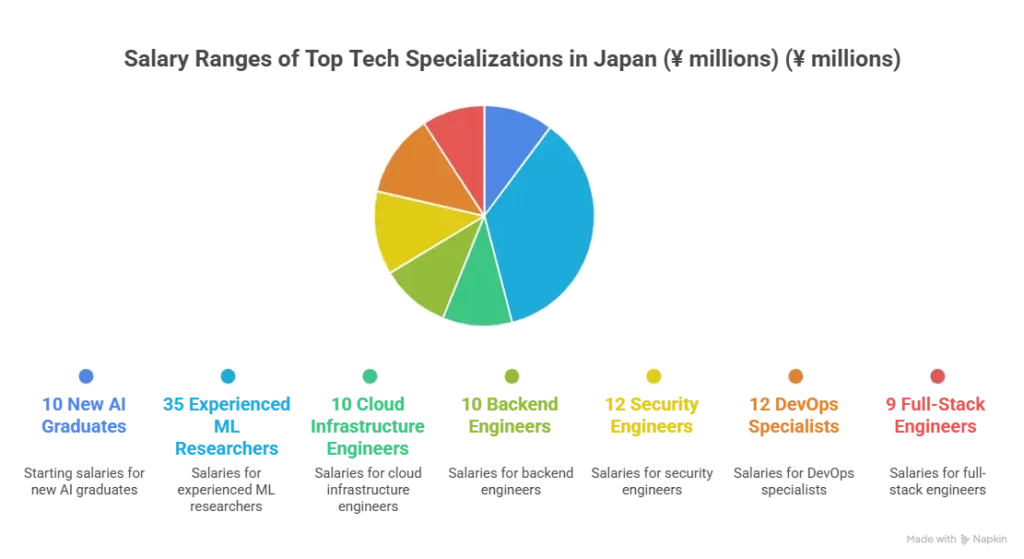
AI and machine learning engineers are commanding the highest premiums in Japan right now. Companies like Sony, Fujitsu, and several AI-focused startups are offering ¥10 million starting salaries for new AI graduates and up to ¥30 to ¥40 million for experienced ML researchers.
Cloud infrastructure engineers, particularly those with AWS, GCP, or Azure expertise, are also in extremely high demand.
Backend engineers remain the most commonly hired profile in Tokyo, with salary ranges from ¥6 to ¥15 million depending on seniority and company. Security engineers and DevOps specialists are also seeing above-average pay as Japan’s corporate sector accelerates its digital transformation.
Full-stack engineers are versatile and in demand, though their pay sits slightly below pure backend or AI specialists at the top end.
Compensation Trends for Software Engineers in Japan
Year-Over-Year Salary Growth
TokyoDev’s data shows strong upward momentum in software engineer salaries in Japan over the past few years. The median compensation for their survey pool increased from ¥7 million in 2019 to ¥9.5 million by 2022, a 36% jump in three years. It dipped slightly to ¥8.5 million in 2023 before rising again to ¥9.5 million in the 2025 survey.
The broader Japanese market is also moving. Japan’s government and major corporations are increasingly recognizing that IT talent needs to be paid at global rates to attract and retain skilled engineers. Many large companies have publicly committed to raising software engineer pay in 2025 and 2026 as part of their digital transformation strategies.
Market Demand and Hiring Outlook
Japan’s IT services market reached approximately USD 93.72 billion in 2025 and is projected to keep growing, driven by AI adoption, cloud migration, and the country-wide push for digital transformation across government and enterprise. The software segment alone was valued at USD 24.6 billion in 2025.
The talent deficit is the critical factor here. Japan is estimated to be short around 300,000 IT professionals currently, with that figure projected to reach 787,000 by 2030. This supply-demand imbalance is one of the strongest structural drivers of salary growth, and it shows no signs of reversing. Foreign engineers are increasingly being recruited to fill the gap.
How Japan Compares Globally
Compared to the United States, Japan’s software engineer salaries are lower in absolute terms. A mid-level engineer in San Francisco might earn USD 150,000 to $200,000 total comp, while the equivalent in Tokyo earns roughly USD 50,000 to $80,000.
However, Japan’s lower cost of living, excellent public infrastructure, universal healthcare, and strong work-life balance norms mean the quality-of-life comparison is much closer than the raw numbers suggest.
Compared to most of Europe and Southeast Asia, Tokyo software engineer salaries are competitive and often superior. And for engineers targeting roles at Japan-based FAANG offices, the total compensation can approach or match global rates.
What Does a Software Engineer Do in Japan?
Core Responsibilities
Software engineers in Japan design, develop, test, and maintain software systems, applying principles of computer science, engineering, and mathematical analysis.
In Tokyo’s modern tech companies, this typically includes working with agile development methodologies, participating in code reviews, collaborating with product managers and designers, and contributing to architectural decisions.
In traditional Japanese companies, the role may involve more documentation, formal processes, and stakeholder coordination. In international tech firms, you are more likely to see fast-paced feature development, continuous integration and deployment (CI/CD), and autonomous team structures.
Skills That Command Higher Salaries
In 2026, the skills that push your Tokyo software engineer salary above the market average are: proficiency in AI and machine learning frameworks (PyTorch, TensorFlow, LangChain), cloud infrastructure experience (AWS, GCP, Azure certifications), backend development in Go, Rust, or Python at scale, DevOps and platform engineering, and cybersecurity expertise.
English language proficiency remains a strong salary multiplier in Japan specifically, as it opens doors to the highest-paying international firms and English-first product companies.
Benefits and Total Compensation Package
Common Health and Welfare Benefits
Japanese employers are legally required to enroll full-time employees in social insurance programs, including national health insurance (shakai hoken), which covers medical, pension, employment, and workers’ compensation.
Most employees contribute roughly 15% of their gross salary to these programs, with employers matching a similar amount. The practical benefit is access to high-quality healthcare at minimal out-of-pocket cost.
Common additional benefits include commuting expense reimbursement (almost universal), housing allowances, wellness programs, and subsidized meals or meal vouchers. Many Tokyo tech companies also offer remote work stipends, professional development budgets, and learning allowances.
Bonuses, Stock Options, and Other Perks
The bonus culture in Japan is significant. Most full-time engineers receive summer and winter bonuses, typically totaling 2 to 4 months of base salary annually. At international tech firms, annual performance bonuses can be higher and are sometimes discretionary based on individual and company performance.
Stock options and RSUs (Restricted Stock Units) are becoming more common at Japanese product startups and are standard at multinationals like Google and Amazon. At Google Tokyo specifically, stock compensation (GSUs) forms a major portion of the total package and vests on a schedule based on the number of shares granted.
How to Evaluate Total Compensation, Not Just Base Salary
When comparing job offers in Tokyo, always evaluate total compensation rather than base salary alone. A Japanese company offering ¥10 million base with 3 months bonus, housing allowance, and commuting reimbursement can be worth more in total than a foreign firm offering ¥11 million base with no extras.
On the other hand, a foreign firm offering ¥10 million base plus RSUs that vest at ¥5 million per year changes the math entirely. Build a simple annualized comp model for every offer you receive.
How to Increase Your Software Engineer Salary in Japan
Certifications and Skills Worth Investing In
The certifications with the clearest salary impact in Japan’s 2026 market are AWS (especially AWS Solutions Architect and DevOps Engineer), Google Cloud Professional certifications, and AI-related credentials like the TensorFlow Developer Certificate or Microsoft Azure AI Engineer. Proficiency in Go, Rust, or advanced Python also commands visible pay premiums.
Japanese language certification at JLPT N2 or above will expand your employer options considerably.
Switching Companies vs. Getting Promoted
In Japan, switching companies is generally a faster path to a salary increase than waiting for internal promotions, particularly at traditional Japanese firms with slow promotion cycles. Engineers who stay at one company for three to five years and then move to a competitor or a foreign firm typically see pay jumps of 20 to 40%.
The key is not to move too frequently, as Japanese employers are wary of candidates who change jobs annually. Two to three years at each role is generally considered a healthy track record.
Negotiation Tips That Actually Work in Japan
Salary negotiation in Japan is more reserved than in Western markets, but it is absolutely acceptable and expected. Come prepared with market data from sources like Glassdoor, Levels.fyi, and TokyoDev surveys. Frame your ask around market rate rather than personal need.
At Japanese companies, it often helps to express long-term commitment to the role. At foreign firms, you can be more direct. Always negotiate after receiving a written offer, not during interviews. If you have a competing offer, sharing it is effective and generally acceptable at international firms.

Also read: Software Engineer Salary in Japan: Complete Guide [2026]
Frequently Asked Questions
What Is the Highest Salary for a Software Engineer in Japan?
Top FAANG-level roles at Google Tokyo can reach ¥40 million+ per year. Exceptional talent at AI firms or investment banks can earn up to ¥45 million.
What Is the Lowest Salary for a Software Engineer in Japan?
Entry-level salaries start from ¥3.5–¥5.5 million annually. Smaller local companies and outsourcing firms usually offer the lowest packages.
Is Tokyo the Best City for Software Engineer Salaries in Japan?
Yes. Tokyo pays 20–40% higher than other Japanese cities and hosts the best multinational and tech opportunities.
How Can a Foreign Engineer Get a Higher Salary in Japan?
Target foreign companies, specialize in AI/Cloud, negotiate with market data, and learn basic Japanese. These steps can boost your offer by 30–50%.
Conclusion
Conclusion
The software engineer salary in Tokyo in 2026 is genuinely compelling if you understand the market. The national average sits at ¥5.69 million, but that number barely tells the story. In Tokyo, the average rises to ¥7.2 to ¥9.5 million, and for experienced engineers at international firms, total compensation regularly clears ¥12 to ¥20 million. Seniors at FAANG-level companies are making ¥24 to ¥40 million or more.
The structural driver is straightforward: Japan has a widening IT talent gap, a growing tech economy valued in the tens of billions of dollars, and a government pushing hard on digital transformation. That combination means demand for software engineers is only going up. Salaries are following.
If you are planning a move, the advice is simple. Target international firms or product-focused Japanese companies over traditional outsourcing houses. Specialize in AI, cloud, or backend engineering. Negotiate with real market data.
And consider Tokyo as your base, because that is where the best average software engineer salary in Tokyo is, and where it is growing fastest.
Japan might not be Silicon Valley, but for engineers who value quality of life, stability, and a tech industry on the rise, the Tokyo software engineer salary is more than worth a serious look in 2026.

Shahzada Muhammad Ali Qureshi (Leeo)
I’m Shahzada — a software engineer by education and an SEO professional by trade. I built WhatIsTheSalary.com to go beyond just showing salary numbers — every page is manually researched across sources like BLS, Glassdoor, LinkedIn Salary, and PayScale to give you the full picture in one place. If you found what you were looking for here, that’s exactly the point.