TL;DR
Clean Code Principles separate the developers people want on their team from the ones who leave a mess behind. “whatisthesalary.com“
You have been there. You open an inherited project and find 300-line functions, variable names like x and temp99, and the same logic copy-pasted in six different places. Fixing one bug breaks three others. Nobody knows why anything works. Deadlines slip. Frustration builds.
That is not bad luck. That is what happens when clean code principles are ignored. The fix is simpler than you think. Once you understand DRY, KISS, SOLID, and a few naming rules, your code becomes something teammates actually want to read, bugs become easier to trace, and your codebase stops fighting you every time a new feature needs to ship.
What Is Clean Code?
Definition of Clean Code
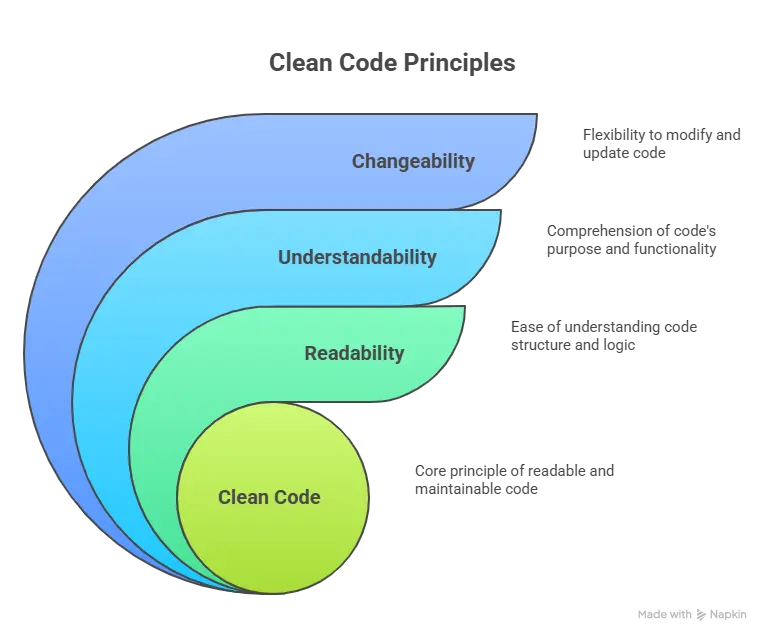
Clean code is code that is easy to read, easy to understand, and easy to change. The term was popularized by Robert C. Martin, also known as Uncle Bob, in his 2008 book Clean Code: A Handbook of Agile Software Craftsmanship. The book became a reference point for developers working in Java, C#, Python, and virtually every other language.
Martin summed it up well: a developer other than the original author should be able to read your code and understand exactly what it does. If that is not happening, you have a readability problem.
Clean code is not about being clever. It is about being clear.
Why Clean Code Matters for Software Engineers
There are practical, financial, and career reasons to care about clean code. Here is the short version:
In 2026, there is another reason that is becoming critical: AI tools struggle with poorly structured code. Early adopters of AI-assisted code reviews report a 20 to 30 percent reduction in bugs when clean coding standards are enforced. If your code is messy, even your AI assistant will give you bad suggestions.
If you are working toward a career in software engineering, understanding these principles is non-negotiable. You can read more about what that path looks like in this guide on software engineer career options.
Clean Code Principles at a Glance
Here is a quick reference table covering the most important clean code principles, what they mean, and where they apply:
| Principle | Full Form | Core Idea | Applies To | Benefit |
| DRY | Don’t Repeat Yourself | No duplicate logic | All languages | Easier updates |
| KISS | Keep It Simple, Stupid | Simplest solution wins | All languages | Faster debugging |
| YAGNI | You Aren’t Gonna Need It | Build only what’s needed | Feature planning | Less tech debt |
| SRP | Single Responsibility | One job per function/class | OOP, Java, C#, Python | Cleaner modules |
| SOLID | 5 OOP design principles | Flexible, scalable design | Java, C#, Python | Maintainability |
| Naming | Meaningful Variable Names | Names explain intent | All languages | Self-documenting code |
Core Principles of Clean Code
Use Meaningful, Descriptive Names
This is where most clean coding problems begin. Naming is everything. A variable called getUserAge() tells you exactly what it does. A variable called getUA() tells you nothing.
The rule is simple: names should explain intent. If you need a comment to explain what a variable does, the name is probably wrong.
Different languages have different conventions. Python uses snake_case. Java and C# use camelCase for variables and PascalCase for classes. Whatever your language, follow its community standard and be consistent throughout the codebase.
Poor naming conventions are one of the fastest ways to create technical debt. Developers working on coding interview preparation are often tested on this exact skill because it reflects real-world problem-solving ability.
Write Short Functions (Single Responsibility)
The Single Responsibility Principle (SRP) is one of the SOLID principles and one of the most important clean code principles overall. It says: each function, class, or module should do one thing and do it well.
A function that validates an order, calculates a total, saves a record, sends an email, and builds a receipt is doing five jobs. Break it into five focused functions. Each one is easier to test, easier to debug, and easier to reuse.
In Java clean code principles, this is a core practice. The same applies to clean code principles in Python and C#. A function longer than 20 lines is usually doing too much.
Follow DRY Principle (Don’t Repeat Yourself)
The DRY principle is one of the most quoted clean coding principles for good reason. If the same logic appears in multiple places, a bug in that logic requires multiple fixes. Miss one, and you have a new bug.
The fix is straightforward: extract the repeated logic into a shared function, class, or module. Apply it wherever needed. Now you have one definition, one place to update, and consistent behavior across the codebase.
Clean code dry practices are especially important in large teams. When five developers are all writing their own version of email validation, you end up with five slightly different behaviors and no single source of truth.
Avoid Hard-Coded Numbers and Magic Values
A magic number is any literal value in your code that has no explanation. For example, writing if (status == 3) tells future developers nothing. What is 3? What does it mean?
The fix is to replace magic numbers with named constants. if (status == ORDER_SHIPPED) is instantly readable. This is a small change that makes a massive difference in readability and maintainability.
This applies to strings, numeric values, and any other literal that carries implied meaning. If someone has to guess what a value represents, it should be named.
KISS – Keep It Simple, Stupid
The KISS principle says: build the simplest solution that actually solves the problem. Not the most elegant. Not the most scalable for hypothetical future requirements. The simplest one that works today.
Complexity is the enemy of maintainability. A solution with three nested loops, four helper classes, and a factory method may be technically impressive, but it is a nightmare to debug at 2am when the production server is down.
Google’s minimalist search interface is a classic example of KISS in action. It does one thing extremely well and removes everything else. The same logic applies to every function you write.

YAGNI – You Aren’t Gonna Need It
YAGNI stands for You Aren’t Gonna Need It. It means you should only write code for current requirements, not for what you think might be needed someday.
Developers often add parameters, abstractions, and features to handle future scenarios that never arrive. That extra code becomes dead weight. It clutters the codebase, confuses future developers, and adds maintenance overhead for zero return.
If you only need to support JSON today, do not build XML and CSV parsers just in case. Build what you need. Extend when the requirement actually arrives.
Essential Best Practices
Follow Coding Conventions and Standards
Every programming language has community-accepted standards. Python has PEP 8. JavaScript has the Google Style Guide. C# follows Microsoft’s conventions. These standards exist because consistency across a codebase makes it dramatically easier to read and collaborate on.
Following clean code principles in C# means using PascalCase for method names, meaningful XML documentation, and consistent spacing. In Python clean code mastery, following PEP 8 is the baseline expectation for any professional project.
Teams working on software engineering practices almost universally enforce a style guide via linters or automated tools.
Use Comments Sparingly but Meaningfully
Good code is largely self-documenting. If your function names and variable names are clear, you should not need a comment to explain what the code does. Comments are most useful for explaining why a decision was made, not what the code is doing.
Avoid comments that just restate the code. A comment that says ‘increment i by 1’ above a line that does exactly that adds nothing. A comment explaining why a workaround was necessary for a legacy API is genuinely useful.
Over-commenting can actually make code harder to read. Too many comments create visual noise and may go out of sync with the code as it evolves.
Proper Whitespace and Formatting
Whitespace is not decorative. Consistent indentation, blank lines between logical sections, and line length limits all contribute to readability. Code that is visually organized is much faster to scan.
Most teams use automated formatters: Prettier for JavaScript, Black for Python, and dotnet-format for C#. These tools enforce formatting automatically, so developers do not have to think about it during code review.
Indicate Variable Scope Clearly
Variable scope tells a developer where a variable lives and how long it is valid. When scope is unclear, especially in large files, bugs tend to appear in unpredictable ways.
Keep variables as close to their point of use as possible. Avoid global variables unless absolutely necessary. In object-oriented code, make explicit decisions about what is public, private, or protected.
Group Related Variables and Functions Together
Code has a natural organization. Variables that are related should live near each other. Functions that work together should be grouped in the same class or module. This principle of cohesion makes code easier to navigate.
When a developer needs to understand how order processing works, they should be able to find everything relevant in one place rather than hunting across multiple files.
Advanced Clean Code Techniques
Encapsulate Nested Conditionals
Deeply nested if-else chains are one of the most common sources of confusion in codebases. When you have three or four levels of nesting, the logic becomes very hard to follow at a glance.
The solution is to extract nested conditions into well-named functions or use early returns to flatten the structure. Clean code and SOLID principles both push toward conditional logic that is readable without requiring you to mentally trace every branch.
Continuous Refactoring
Code refactoring is not something you do once and forget. It is an ongoing discipline. The Boy Scout Rule from Uncle Bob says it well: leave the code cleaner than you found it.
Every time you touch a file, look for small improvements. Rename a confusing variable. Extract a long function into smaller pieces. Remove dead code. These micro-improvements compound over time into a much healthier codebase.
Developers building a strong software engineer portfolio often highlight their refactoring work because it demonstrates real engineering maturity.
Use Version Control Effectively
Version control is the backbone of collaborative development. In 2026, Git remains the dominant version control system. Clean code principles and patterns extend into how you use Git, not just how you write code.
Write meaningful commit messages. Keep commits small and focused. Use feature branches or trunk-based development depending on your team’s workflow. A clean Git history is as valuable as clean code itself when you need to trace why a change was made.
Understanding Git workflows is a core part of software engineer skills required in any professional environment.
Automate Testing and Deployment
In 2026, untested code is considered incomplete code. Automated testing is no longer optional for teams that care about clean architecture and solid principles. Unit tests, integration tests, and end-to-end tests all serve different purposes.
Automated deployment pipelines ensure that code meets quality standards before it reaches production. Tools like SonarQube, CodeClimate, and DeepSource perform static analysis and flag issues before a human reviewer even looks at the code.
Clean Code in Modern Development
Maintaining Clean Code with AI Tools
AI-powered development tools are now embedded in daily workflows. GitHub Copilot, Cursor, and similar tools generate code at speed, but they do not replace the need for clean code principles. If anything, they make these principles more important.
AI-generated code still needs to be reviewed, refactored, and structured by a developer who understands the codebase. Poorly structured prompts produce poorly structured code. Developers who understand clean code principles are better positioned to use AI tools effectively.
Keeping up with best programming languages to learn also means understanding which ecosystems have the strongest tooling for clean code enforcement.
Readability Over Conciseness
There is sometimes a temptation to write very concise, clever code. One-liners that do complex things in a single expression look impressive but are often harder to read and debug than a more verbose version.
The clean code main principles prioritize readability over conciseness. Code is read far more often than it is written. A slightly longer but instantly understandable function is better than a short one that requires five minutes of analysis to understand.
This mindset is one of the core ideas behind Python clean code mastery and modern Python coding principles. Python’s design philosophy emphasizes explicit over implicit, and readable code over terse code.
Functional Programming Approaches
Functional programming concepts are increasingly relevant in 2026, even in traditionally object-oriented languages. Immutability, pure functions, and avoiding side effects all align perfectly with clean code principles.
A pure function always returns the same output for the same input and has no side effects. These are the easiest functions to test, the easiest to reason about, and the least likely to introduce subtle bugs.
Whether you are working on clean code principles in Java with modern switch expressions, or using Python’s functional tools like map and filter, applying functional patterns leads to cleaner, more predictable code.

Also read: Software Engineer Resume Guide 2026: Templates, Tips & ATS Secrets
Frequently Asked Questions
-
What are the main clean code principles?
The main clean code principles include DRY (Don’t Repeat Yourself), KISS (Keep It Simple, Stupid), YAGNI (You Aren’t Gonna Need It), the Single Responsibility Principle, meaningful naming, and continuous refactoring. These principles apply across all programming languages and help developers write code that is readable, maintainable, and scalable over time.
-
What is the DRY principle in clean code?
DRY stands for Don’t Repeat Yourself. It means every piece of logic should have a single, clear representation in the codebase. If you find yourself copying and pasting code, that is a signal to extract it into a shared function or module. Following the DRY principle reduces bugs, simplifies updates, and makes the codebase easier for teams to manage.
-
How do SOLID principles relate to clean code?
SOLID principles are a set of five object-oriented design guidelines introduced by Robert C. Martin. They include Single Responsibility, Open/Closed, Liskov Substitution, Interface Segregation, and Dependency Inversion. Together, clean architecture and SOLID principles form the backbone of maintainable, scalable software design, especially in Java, C#, and Python.
-
What is the difference between KISS and YAGNI?
KISS is about the complexity of your current solution: keep it as simple as possible. YAGNI is about scope: only build what is actually needed right now. Both principles fight against over-engineering, but from different angles. KISS asks ‘is this implementation too complex?’ while YAGNI asks ‘does this feature even need to exist?’
-
Are clean code principles the same in Python, Java, and C#?
The core ideas are the same across all languages. DRY, KISS, YAGNI, and the Single Responsibility Principle apply everywhere. The differences are in implementation: Python follows PEP 8 conventions, Java uses camelCase and OOP patterns, and C# follows Microsoft’s style guidelines. Each language also has its own tooling for enforcing clean code automatically.
-
What is a magic number in clean code?
A magic number is any hard-coded literal value in your code that carries implied meaning without explanation. For example, checking if a status equals 3 without defining what 3 means is a magic number problem. The fix is to replace it with a named constant like ORDER_SHIPPED, making the intent immediately clear to anyone reading the code.
-
How do AI tools affect clean code practices in 2026?
AI coding tools like GitHub Copilot generate code quickly, but they produce better results when developers enforce clean code standards. Poorly structured prompts and codebases lead to poorly structured AI output. In 2026, developers who understand clean code principles use AI tools more effectively, catch generated code issues faster, and maintain higher overall code quality across their projects.
Conclusion
Clean code is not about perfection. It is about discipline and consistency.
The principles of clean code covered in this guide work together as a system:
Whether you are applying clean code principles in Python, Java, or C#, the fundamentals stay the same. Write for the next developer. Keep it simple. Leave things better than you found them.
If you are just starting out, check out this guide on how to become a computer programmer and this one on software engineer interview questions to see how clean code skills translate directly into career opportunities.

Shahzada Muhammad Ali Qureshi (Leeo)
I’m Shahzada — a software engineer by education and an SEO professional by trade. I built WhatIsTheSalary.com to go beyond just showing salary numbers — every page is manually researched across sources like BLS, Glassdoor, LinkedIn Salary, and PayScale to give you the full picture in one place. If you found what you were looking for here, that’s exactly the point.