TL;DR
How Australian Software Engineers Are Using AI in Their Daily Workflow (2026) — Imagine shaving days off releases, writing flawless tests while sipping coffee, and spotting bugs before they happen.
Across Sydney, Melbourne, and remote teams, engineers fuse AI copilots with human judgment: automated code reviews catching security flaws, generative tests validating edge cases, AI-assisted refactors boosting performance, and smart tracking that predicts blockers. The result: faster shipping, fewer regressions, and engineers focusing on design and impact instead of repetitive tasks.
In short: this is not hype—it’s a workflow revolution that turns routine work into high-leverage engineering. Want a breakdown of tools, tactics, and quick wins you can apply this week?
AI Is No Longer a Side Tool
If you are a software engineer in Australia right now and still only using AI for the occasional Stack Overflow alternative, that habit is costing you time and possibly money.
I am not talking about some future disruption. This is happening in engineering teams across Sydney, Melbourne, Brisbane, and beyond in 2026. The question has moved past whether to use AI, and landed firmly on how to use it well.
According to Indeed Hiring Lab, 43% of Australian software development job postings already mention AI as of February 2026. That number is the highest of any occupation in the country, higher than IT systems, marketing, and legal. Engineers are not just building AI products. They are using AI as part of how they ship every day.
The AI Tools Aussie Engineers Are Actually Using
The Pragmatic Engineer ran a survey of nearly 1,000 senior engineers between January and February 2026. The results painted a clear picture of what is sitting in most Australian engineers’ toolchains today.
| AI Tool | Primary Use Case | Market Position (2026) | Best For |
| Claude Code | Agentic coding, complex refactors | #1 in satisfaction (46% most-loved, JetBrains) | Startups, senior engineers |
| GitHub Copilot | Inline autocomplete, PR review | 4.7M paid users, 42% market share | Enterprise teams, VS Code users |
| Cursor | Multi-file edits, Composer mode | $2B ARR, 1M+ paying users | Individual devs, productivity focus |
| Google Gemini CLI | Stable across company sizes | Even adoption across all team sizes | Large org engineers |
| Amazon Q Developer | AWS-heavy workflows | Part of remaining 40% market share | AWS-centric teams |
Most engineers are not picking one tool. According to the ideaplan.io market analysis, 70% of engineers now use two to four AI coding tools simultaneously. The most common setup is Cursor for editing combined with Claude Code for complex tasks.
What the Daily Workflow Actually Looks Like
The paradigm has shifted significantly. A few years ago, engineers used AI mostly to generate a function or ask a quick question. In 2026, the unit of work has changed completely.
Here is how most senior Australian engineers in product companies describe their current daily flow:
Morning: Planning and Ticket Breakdown
Engineers start the day with AI-assisted sprint reviews. According to McKinsey’s 2026 report on AI in software development, some teams now run daily sprints instead of fortnightly ones because AI-generated pull requests and risk flags arrive overnight. The engineer’s job in the morning is to review, steer, and adjust priorities rather than write from scratch.

Mid-Day: Code Generation and Review
This is where the biggest workflow shift lives. Engineers describe their role now as reviewing AI-generated diffs rather than writing line-by-line. Tools like Cursor’s Composer mode let engineers describe a feature in plain language, and the tool edits multiple files across the repository simultaneously, presenting a clean diff for review.
GitHub Copilot’s Q1 2026 data shows a 38% acceptance rate for inline suggestions in VS Code. Pull request turnaround time has dropped from 9.6 days to 2.4 days for teams using AI code review tools, and successful build rates have increased by 84% (GitHub Copilot Statistics, Quantumrun 2026).
AI-generated code still needs serious scrutiny. Research cited by Axify shows a 41% increase in bugs when AI code is merged without proper review processes. Australian engineering teams working in fintech and healthtech, where compliance requirements are strict, have been especially careful about building verification gates into their pipelines.
Late Afternoon: Testing, Documentation, and Deployment
AI tools now handle significant portions of test generation, security scanning, and documentation updates. The 2025 DORA report found that roughly 90% of developers globally use some form of AI assistance, and the productivity impact is real when teams pair AI with strong review culture.
According to data aggregated by Axify, developers save 30 to 60% of time on coding, testing, and documentation when AI tools are properly integrated into the workflow. That freed time is going toward architecture decisions, code review quality, and higher-level problem solving.
What AI Skills Are Doing to Australian Software Engineer Salaries
AI proficiency is no longer a bonus skill in Australia’s tech market. It has become a direct salary lever. Here is how the numbers break down across experience levels in 2026:
| Experience Level | Standard Salary (AUD) | With AI Skills (AUD) | Premium |
| Junior (0-2 yrs) | $70,000 – $90,000 | $85,000 – $110,000 | ~20-25% uplift |
| Mid-Level (3-6 yrs) | $100,000 – $125,000 | $120,000 – $148,000 | ~20% uplift |
| Senior (7+ yrs) | $130,000 – $160,000 | $165,000 – $198,000 | ~25-30% uplift |
| AI/ML Specialist | $148,000 – $170,000 | $189,000 – $215,000+ | 40-60% above standard bands |
According to AI Talent on Demand’s 2026 employer guide, AI/ML engineers in Australia earn 40 to 60% above traditional software engineering bands at senior level. Companies like Atlassian and Canva are paying AI/ML specialists total compensation packages of AUD $215,000 and above, including stock. For a deeper look at salary ranges by level and location, the software engineer salary Australia guide breaks this down across all experience tiers.
If you are specifically based in Sydney, the numbers skew even higher. The software engineer salary in Sydney guide for 2026 shows the city consistently tops national averages by around 10 to 15%. Australia’s national employment data also projects 42,200 new Software and Application Programmer roles by November 2026, a 27% increase, per Academy Xi’s market update.
The AI Skills Premium Is Real and Growing
Australia is facing a projected shortfall of 60,000 AI professionals by 2027, according to AI Talent on Demand. That supply gap is directly inflating salaries for engineers who can ship AI features into production, not just demo them.
Sydney holds about 37% of Australia’s data and ML talent, Melbourne around 34%. Both cities have strong demand in fintech, healthtech, and enterprise SaaS. For senior software engineers who develop strong AI integration skills, total compensation in top-tier firms can reach AUD $250,000 and above.
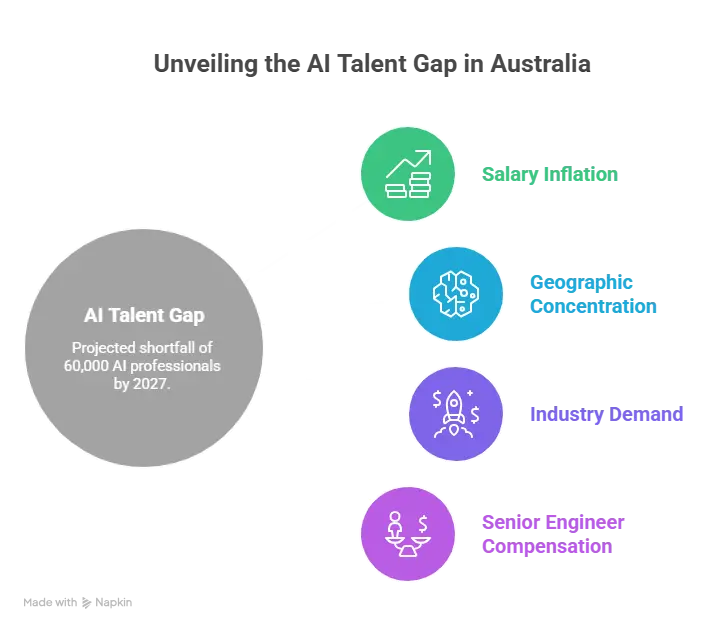
Even at the mid-level, engineers who work with LLM APIs, MLOps pipelines, or AI-assisted development toolchains are seeing salary offers 20% above peers at the same experience level. Junior engineers who enter the market with demonstrated AI workflow skills are landing roles that previously required two or three more years of experience.
What Skills Are Actually Moving the Needle
Not all AI skills carry equal weight in the job market. Australian employers in 2026 are looking for specific capabilities, not just familiarity with ChatGPT.
| Skill Area | Demand Level | Relevant Roles | Salary Impact |
| LLM API Integration | Very High | Full Stack, Backend | High |
| MLOps and Production Deployment | Very High | ML Engineer, DevOps | Very High |
| Prompt Engineering and Agent Orchestration | High | All engineering roles | Moderate-High |
| AI Code Review and Verification | High | All engineering roles | Moderate |
| Cloud AI Services (AWS, Azure, GCP) | Very High | Cloud Engineer, Architect | Very High |
| AI Security and Governance | Growing | Senior Eng, Tech Lead | High |
Python remains the dominant language for AI work in Australia, though Go and Rust are seeing growing interest in performance-critical AI infrastructure. If you are evaluating which languages to invest in, the best programming languages to learn guide is a useful starting point for planning your technical direction.
The Shift to Agentic Engineering: What Most Articles Miss
Most conversations about AI in developer workflows focus on autocomplete and chat-based assistance. What is actually happening in 2026 is more significant.
Engineers at Australian companies like Atlassian are using AI coding agents that can understand entire repositories, plan multi-step tasks, run their own tests, and commit changes with minimal human intervention. The role of the engineer is shifting from implementation to orchestration.
As Medium contributor Snehal Singh wrote in March 2026, developers are no longer just writing software. They are increasingly orchestrating systems that write, verify, and maintain software automatically. Planning tasks, writing code, reviewing changes, generating tests, and updating documentation can now be partially automated by intelligent systems.
This does not mean less work. It means different work. The bottleneck has shifted from writing code to ensuring correctness, catching edge cases, and maintaining architectural judgment. Engineers who build these verification and review skills are the ones staying ahead of the pay curve.
If you are thinking about how this shift affects your long-term career options, the software engineer career options guide covers how AI is reshaping different engineering specialisations.
What Australian Engineers on the Ground Are Saying
The survey data is one thing. What engineers are actually experiencing day-to-day is another.
One software engineer at Atlassian noted in The Pragmatic Engineer’s February 2026 survey that their company runs Cursor and Windsurf with monthly limits, plus an internal tool called Codelassian with daily and hourly token limits. When they hit a limit in one tool, they switch to another. This kind of tool-stacking is now the norm rather than the exception.
A senior engineering manager at a mid-sized company mentioned upgrading some teammates to Claude Code’s Max 20x plan after regularly hitting session limits with the standard tier. The productivity argument was strong enough to justify the additional cost.
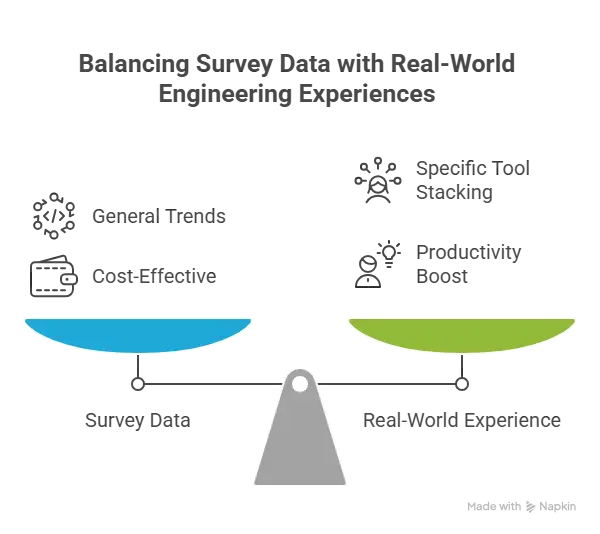
Not every engineer has had a smooth experience. Research cited by Axify shows that 30 to 40% of engineers refused to use tools like GitHub Copilot in initial trials. The engineers who struggled most were those who treated AI as a replacement for thinking rather than an assistant for execution.
If You Are Still Building Your Career
For anyone earlier in their journey, the path to becoming a software engineer who earns well in this market runs directly through AI literacy. The how to become a computer programmer guide covers the foundation skills, and understanding how to position yourself with AI experience makes a meaningful difference when it comes to salary negotiations.
When you are ready to apply, the quality of your software engineer cover letter can set you apart, especially if you can speak specifically to your AI workflow experience and the productivity gains you have achieved.
Common Misconceptions About AI in the Engineering Workflow
Misconception 1: AI tools will make junior engineers redundant
The data does not support this. Academy Xi’s 2026 market update shows the ‘Engineering – Software’ category grew 6.7% in job ads over the past year, even as overall Australian job advertisements fell by 9.3%. What changed is what junior engineers need to know on day one.
Misconception 2: More AI code means faster shipping, full stop
Research shows a 25% increase in AI adoption is linked to only a 2.1% rise in productivity on its own. The teams seeing the biggest gains are those who combined AI tools with strong review processes and clear acceptance criteria before generation starts.
Misconception 3: Only ML engineers need AI skills
Full-stack engineers, backend engineers, DevOps specialists, and QA engineers are all integrating AI into their workflows. The tools are not specialist anymore. They are infrastructure.
Misconception 4: The best AI tool wins everything
The market has settled into a multi-tool reality. GitHub Copilot dominates enterprise at 56% in companies with 10,000 or more employees. Claude Code leads at startups with 75% adoption. Most engineers use more than one. Picking a single tool and stopping there is leaving value behind.

Frequently Asked Questions
-
What AI tools are Australian software engineers using most in 2026?
Claude Code, GitHub Copilot, and Cursor dominate. Claude Code leads on satisfaction, GitHub Copilot on raw enterprise user numbers, and Cursor on revenue. Most engineers use more than one. The best programming languages guide also covers which language skills pair best with current AI toolchains.
-
Does using AI tools affect a software engineer’s salary in Australia?
Yes. Engineers with strong AI skills earn 20 to 30% more than peers at the same experience level without those skills, according to 2026 market data. AI/ML specialist roles sit 40 to 60% above standard software engineering salary bands at senior level.
-
Is AI replacing software engineers in Australia?
No. The data shows software engineering job ads in Australia grew 6.7% in 2026 even while overall job listings fell. The work is changing, not disappearing. Engineers are shifting toward orchestration, review, and judgment work rather than manual code writing.
-
How much of a software engineer’s code is now AI-generated?
GitHub’s own telemetry shows AI generates 46% of code in repositories where it is installed. Java developers see as high as 61%. Acceptance rates for inline suggestions sit around 38% in VS Code. This does not mean the code ships without review. It means the first draft is faster.
-
What AI skills should Australian software engineers develop in 2026?
The highest-demand skills are LLM API integration, MLOps and production deployment, cloud AI services on AWS, Azure, and GCP, and prompt engineering for agentic workflows. AI security and governance are growing fast as companies mature their AI policies.
-
How is AI affecting the daily workflow of software engineers?
Engineers are spending less time writing boilerplate and more time reviewing AI-generated diffs, defining acceptance criteria, writing verification tests, and managing agent orchestration. The productivity gains are real but they require a disciplined review process to avoid the 41% increase in bugs that comes with unsupervised AI code merges.
How This Article Was Created
The data in this article was gathered from the following sources: Indeed Hiring Lab Australia (April 2026), The Pragmatic Engineer’s AI tooling survey (January to February 2026), the 2025 DORA report on AI-assisted software development, Axify’s 2026 developer productivity report, McKinsey’s AI in software development report (April 2026), GitHub Copilot statistics from Quantumrun (2026), AI Talent on Demand’s 2026 employer guide, Academy Xi’s software engineering market update (May 2026), and ideaplan.io’s AI coding assistant market share analysis.
No figures were fabricated. All salary data reflects publicly available 2025 to 2026 compensation benchmarks from Australian market sources. This article was written to inform job seekers and working engineers, not to recruit or advertise any product or employer.

Shahzada Muhammad Ali Qureshi (Leeo)
I’m Shahzada — a software engineer by education and an SEO professional by trade. I built WhatIsTheSalary.com to go beyond just showing salary numbers — every page is manually researched across sources like BLS, Glassdoor, LinkedIn Salary, and PayScale to give you the full picture in one place. If you found what you were looking for here, that’s exactly the point.