
TL;DR
Python vs Java in Australia: Which Should You Learn First in 2026?
Confused which language will launch your tech career in Australia in 2026? Picture landing interviews for data roles, fintech startups, or cloud engineering—each role subtly favors a different tool.
This quick guide cuts through noise: I’ll show you where Python wins (rapid prototyping, data science, AI), where Java dominates (enterprise systems, large-scale backend, Android), and which one gives the fastest ROI based on Aussie job demand, salary signals, and employer expectations.
Ready to decide fast? I’ll give a simple decision flow you can use today—plus learning pathways and short projects that prove your value to recruiters in months, not years. Which path fits your goal: speed-to-hire, highest starting pay, or long-term stability?
Python vs Java in Australia: The 2026 Snapshot
Before diving into salaries and career paths, it helps to understand where each language sits right now.
Python currently holds a record-breaking 26.14% TIOBE Index rating in 2026, the highest any language has ever achieved on that index. Java sits at #3 with a 13.73% share. By sheer usage numbers, Python has pulled well ahead.
But the Australian job market has its own dynamics. Java has deep roots in the banking, insurance, telco, and government sectors here. If you look at job listings from Macquarie Group, Westpac, ANZ, or Fujitsu Australia, Java roles are still very common.
Python, on the other hand, is growing fast everywhere AI, data science, and cloud-native software development are happening, which in 2026 is basically everywhere.
LinkedIn’s Jobs on the Rise 2026 report confirmed that AI literacy is now the most in-demand skill in Australia. Python is the language most directly tied to that demand.
For roles like machine learning engineer, data engineer, and AI developer, Python is not optional. It is the standard.
Python vs Java: Key Comparison for Australian Developers (2026)
| Factor | Python | Java | Winner (AU 2026) |
| Learning curve | Beginner-friendly, minimal syntax | Steeper, strict structure | Python |
| Avg. salary (AU) | $117K-$122K (Indeed/Glassdoor) | $105K-$125K (Glassdoor/SEEK) | Roughly equal |
| Job market (AU) | Fast-growing, AI-driven demand | Stable, enterprise-heavy | Python (growth) |
| Top industries (AU) | Tech, fintech, government, AI startups | Banking, insurance, telco, consulting | Depends on goal |
| Performance | Slower (interpreted) | Faster (JVM compiled) | Java |
| AI / ML ecosystem | Unmatched (TensorFlow, PyTorch) | Limited compared to Python | Python |
| Enterprise use | Growing | Dominant (banks, government) | Java |
| TIOBE Index (2026) | #1 at 26.14% | #3 at 13.73% | Python |
Salary Comparison: Python vs Java in Australia
Salary data across platforms in 2026 shows the two languages are closer than most people expect. The difference often comes down to experience level and which industry you end up in, not the language itself.
Python developer salaries in Australia
According to Glassdoor (February 2026), the average Python developer salary in Australia is $121,230 per year, with a typical range of $105,000 to $141,209 and top earners reaching $174,659. Indeed reported an average of $117,637 based on 29 salaries updated in March 2026.
SEEK lists Python developer roles between $90,000 and $110,000, though this likely captures a wider pool including mid-range roles.
In Sydney, the average climbs to around $131,098 per year according to Indeed. In Melbourne, Glassdoor puts it at $139,945, about 9% above the national average.
You can find the full breakdown of software engineering pay by city and experience level in the Software Engineer Salary in Australia 2026 guide.

Java developer salaries in Australia
Glassdoor (February 2026) puts the average Java developer salary in Australia at $105,500 per year, with a range of $81,875 to $135,000 and top earners hitting $153,000. Indeed’s average is $110,887 from 61 salaries reported in January 2026. SEEK is more optimistic, showing $115,000 to $135,000 for Java developer roles.
At the senior end, the Clicks IT Recruitment salary guide puts experienced Java developers at $158,000 per year on average, with entry-level roles starting around $126,000 and senior positions reaching $189,000.
For a deeper look at what senior roles pay, see the Senior Software Engineer Salary in Australia breakdown.
The honest takeaway on salaries
At the mid-to-senior level, Python and Java salaries in Australia are roughly comparable. The gap you often see in global comparisons tends to be narrower here because the Australian enterprise sector pays Java developers well.
Where Python pulls ahead is in emerging roles: machine learning engineer, data engineer, and AI specialist roles are commanding salary premiums of 20% to 30% over standard developer roles according to multiple 2026 industry reports.
If you are earlier in your career, the Junior Software Engineer Salary in Australia guide and Mid-Level Software Engineer Salary in Australia guide are worth reading before you negotiate your first or second offer.
Job Market Demand in Australia: Which Language Opens More Doors?
This is where things get interesting in 2026.
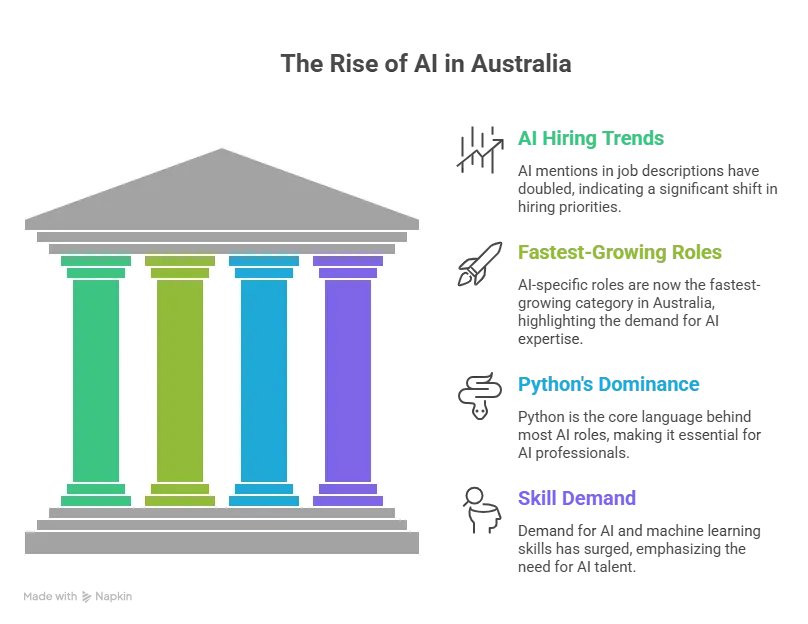
The Australian tech market has shifted significantly toward AI-related hiring. According to AI Jobs Australia, AI mentions in job descriptions doubled from 2.8% to 5.8% in just one year.
LinkedIn’s Jobs on the Rise 2026 data shows AI-specific roles are now the fastest-growing category in Australia. And Python is the core language behind almost all of them.
The Cornerstone 2026 Skills Economy Report found that demand for AI and machine learning skills has surged by +245% since 2023. Most of that demand runs through Python. If you are targeting roles in data science, MLOps, automation engineering, or AI development, Python is not just preferred, it is often a hard requirement.
Java, on the other hand, is not declining in Australia. It is stable and consistent. The banking and financial services sector, including companies like ANZ, Commonwealth Bank, and Macquarie Group, still runs enormous amounts of Java-based infrastructure.
Telco companies, large government departments, and consulting firms like Capgemini, Accenture, and Fujitsu all have active Java hiring pipelines.
The difference is trajectory. Python roles are growing fast. Java roles are steady. If you want to ride the current wave, Python is the better bet. If you want to walk into a well-established career path with clear seniority levels and predictable hiring, Java is still a very credible option.
Learning Curve: Which is Easier to Pick Up?
This matters more than people admit, because the language you actually learn well is always better than the one you abandoned halfway through.
Python was specifically designed to be readable. Its syntax is clean, uses indentation instead of brackets to define code blocks, and lets you write meaningful programs in very few lines.
A 2024 GitHub Education survey found that 62% of first-year computer science students chose Python as their first language, citing the simpler syntax and faster learning curve.
Java requires more setup from day one. Every program starts with a class definition. You deal with brackets, semicolons, and strict type declarations before you write a single piece of useful logic. That structure is genuinely valuable once you understand it, but it creates a steeper entry ramp for beginners.
For most people just starting out: Python will get you to writing real, working code faster. That early momentum matters a lot for staying motivated and building a portfolio quickly.
If you want to understand what a programming career looks like before choosing a language, the How to Become a Computer Programmer guide is a good starting point.
Which Should You Learn First? It Depends on Your Target Industry
There is no one-size-fits-all answer here, so let me break it down by what you actually want to do.
Learn Python first if you want to work in…
Learn Java first if you want to work in…
For a broader view of where these skills can take you, see the Software Engineer Career Options overview.
Do You Actually Have to Choose? The Case for Learning Both
Here is an angle most comparison articles skip over: a large number of Australian developers use both languages at different points in their career, and some roles explicitly require it.
Take a look at job listings from Westpac Group, for example. Their Indeed listings include roles for “Senior Developer (Java and Python)”, which reflects a common pattern in banking and fintech: Java runs the core banking infrastructure, while Python handles the data analytics, reporting, and machine learning layers on top.
The practical path for many Australian developers looks something like this: start with Python, build your fundamentals and land a role, then pick up Java over 12 to 18 months on the job when the project or employer needs it. Because once you understand one object-oriented language well, learning the second is much faster.
The same logic applies in reverse for someone who starts with Java in a banking graduate program. They often add Python as a second skill once data science or automation work starts coming their way.
So the question is really about which language opens the door you want to walk through first, not which one you will use forever.
The AI Factor: Why Python Has a Salary Premium Right Now
This is specific to 2026 and it is worth understanding if salary trajectory matters to you.
Australian professionals with high AI fluency, meaning they can actually build, deploy, or maintain AI systems rather than just use AI tools, are seeing wage uplifts of up to 56% compared with peers who have not yet developed those skills, according to a 2026 AI career guide from Nucamp.
Roles that demand genuine AI capability command 20 to 30% salary premiums over comparable non-AI tech jobs. Almost all of those roles run on Python.
This does not mean Java developers are being left behind. Java is still used in AI deployment and production systems, particularly in enterprise environments where JVM performance is important. But the research, prototyping, and tool-building side of AI overwhelmingly happens in Python.
If you are deciding between the two languages and any part of your career interest touches AI, automation, or data, that Python salary premium is real and growing.
For context on which languages are shaping tech careers globally and in Australia, the Best Programming Languages to Learn guide covers the full landscape.
Python vs Java by City: Does Your Location Matter in Australia?
At the national level the picture is fairly consistent, but there are meaningful differences by city worth knowing.
Sydney is the main hub for both Python and Java hiring in Australia. It has the highest concentration of fintech, enterprise software, and AI startups, which means demand for both languages is strong.
Python developer salaries in Sydney average around $131,098 according to Indeed, slightly above the national figure.
Melbourne tends to be 5 to 9% above the national average for Python roles per Glassdoor data, reflecting its strong tech and financial services sectors. Java hiring in Melbourne is particularly robust through consulting firms and the ANZ/NAB corridor.

Brisbane, Perth, and Adelaide have smaller but growing tech markets. Python roles tied to government digital services and resources sector data analytics are picking up, particularly in Perth and Brisbane. Java roles tend to be more concentrated in large enterprise and government projects.
If you are based in or targeting Sydney specifically, the Software Engineer Salary in Sydney 2026 guide breaks down the numbers by experience level.
Practical Tips: Getting Paid What You Are Worth
Whichever language you choose, your compensation is also shaped by how well you negotiate, what framework or specialisation you bring, and whether your resume actually communicates your value.
When you are ready to apply, having a well-structured application matters. The Software Engineer Cover Letter guide can help you position yourself clearly for both Python and Java roles.
Common Myths About Python vs Java in Australia
Myth 1: Java is dying
It is not. Java has a 13.73% TIOBE market share in 2026, making it the third most popular language in the world. In Australia, the banking and enterprise sector still runs enormous Java systems that are not going anywhere.
The maintenance, upgrade, and new feature work on those systems keeps Java developers employed for years.
Myth 2: Python is only for data scientists
Python is used across backend web development (Django, FastAPI, Flask), scripting and automation, infrastructure management, security tooling, and AI.
It is a general-purpose language that happens to dominate in data and AI fields. Many Python developers in Australia are backend engineers, DevOps specialists, or full-stack developers who never touch machine learning.
Myth 3: The salary gap between Python and Java is massive
At the mid-level, the gap in Australia is smaller than global headlines suggest. Glassdoor shows Python developers averaging $121,230 and Java developers averaging $105,500, which is meaningful but not dramatic.
The bigger gap appears when Python developers specialise in AI and machine learning roles, where the premium is real and growing.
Myth 4: You need a computer science degree to be hired
In the Australian tech market, portfolio projects, certifications, and demonstrable skills matter more than degrees for most mid-level and junior roles. Employers are increasingly focusing on what you can build, not where you studied.
That said, degrees do help at graduate programs in large firms like the big banks and government departments.

Frequently Asked Questions
-
Is Python or Java better for getting a job in Australia in 2026?
For most people, Python offers more immediate job opportunities in 2026, particularly in AI, data science, and fintech. Java still has strong demand in banking, enterprise, and telco sectors. The best answer depends on which industries you want to target.
-
Which pays more in Australia: Python or Java?
They are close. Python developers average $117K to $122K nationally (Indeed/Glassdoor 2026). Java developers average $105K to $125K depending on the platform and role level. Python developers specialising in AI roles can command 20 to 30% premiums on top of those figures.
-
Can I learn Python after Java?
Yes, and most developers who know one find the other much easier to pick up. Java’s strict structure actually gives you a solid foundation in object-oriented programming concepts. Transitioning to Python after Java typically takes weeks, not months.
-
Which language do Australian banks prefer?
Major Australian banks like Commonwealth Bank, Westpac, ANZ, and NAB have historically been heavy Java shops for core banking systems. However, they also use Python extensively for data analytics, reporting, and newer AI initiatives. Many roles at Australian banks now require or prefer both.
-
Is Python good for fintech in Australia?
Yes. The newer wave of Australian fintech companies, including startups and scale-ups in Sydney and Melbourne, heavily favour Python for backend services, API development, and data pipelines. Legacy fintech infrastructure at big banks still leans on Java, but the growth area is Python.
-
How long does it take to get a job after learning Python in Australia?
With a focused study plan, a portfolio of 3 to 5 real projects, and basic Django or data science skills, most self-taught learners report landing a junior role within 6 to 18 months. The timeline varies significantly based on how actively you build projects and network.
-
Which programming language should I learn for AI jobs in Australia?
Python, without question. Almost all AI and machine learning frameworks including TensorFlow, PyTorch, and scikit-learn are Python-first. LinkedIn’s Jobs on the Rise 2026 confirms AI roles are the fastest growing in Australia, and the skills listed in those job ads are almost uniformly Python-based.
For a broader perspective on which languages are worth your time, see this comparison of the Best Programming Languages for Developers.
Share Your Experience
If you are working as a Python or Java developer in Australia, I would love to hear what the job market actually looks like from where you sit. Have you made the switch between languages? Are you seeing more Python roles in your city? Drop your thoughts in the comments. Real experiences help everyone else make better decisions.
How This Article Was Created
Salary figures in this article are sourced from Glassdoor (February/March 2026 data), Indeed (January/March 2026 data), SEEK (April 2026 data), PayScale (2026), and Clicks IT Recruitment’s annual salary guide. TIOBE Index data is from the 2026 index published by TIOBE Software. Labour market data is drawn from LinkedIn’s Jobs on the Rise 2026, Cornerstone’s 2026 Skills Economy Report, and AI Jobs Australia’s 2026 market analysis.
No salary figures were fabricated. All data points are attributed to their sources and represent publicly available compensation benchmarks. This article was written to help Australian tech professionals and career changers make informed decisions, not to recruit for any employer or promote any training program.

Shahzada Muhammad Ali Qureshi (Leeo)
I’m Shahzada — a software engineer by education and an SEO professional by trade. I built WhatIsTheSalary.com to go beyond just showing salary numbers — every page is manually researched across sources like BLS, Glassdoor, LinkedIn Salary, and PayScale to give you the full picture in one place. If you found what you were looking for here, that’s exactly the point.