
TL;DR
The Real Software Engineer Promotion Guide: Getting From SDE1 to Senior — tired of waiting for a title change while doing the work of a senior?
Imagine this: one strategic quarter, three measurable wins, and a repeatable framework that makes managers notice, sponsors advocate, and promotion committees say yes.
This guide breaks promotions into precise actions you can start this week — influence, ownership, delivery — with examples, metrics, and a communication playbook that turns everyday tasks into promotion-ready achievements.
Ready to stop hoping and start closing the gap? Follow the steps, track the signals, and convert impact into a predictable career jump. Want the one-page checklist that hiring managers respect?
Why This Jump Feels So Different From Every Other Step
I’ve watched a lot of engineers get stuck between SDE1 and Senior, and it’s almost never a skills problem. It’s a visibility problem. Nobody hands you a checklist when you join a team.
You figure out promotion criteria by watching who gets promoted and asking why, which is a slow and frustrating way to learn something that decides your software engineer salary for the next decade.
The good news is that the path from SDE1 to Senior follows a pattern across most product companies, even when the title names change. Understanding that pattern early saves you years.

Promotion Criteria: What Managers Are Actually Scoring
Every leveling framework I’ve reviewed comes down to two variables: scope and impact. Scope is how much of the codebase, team, or business your work touches. Impact is how much difference that work makes once it ships.
A common pattern at large tech employers is that you get promoted in the job, not into it. In practice that means showing you’re already handling Senior-level scope for one or two review cycles before the title change is approved.
This is why chasing promotion criteria as a checklist rarely works as well as just taking on the next level of ownership and letting the title follow.
SDE1 to SDE2: Building the Case for Ownership
The first jump usually takes two to three years. What separates a fast SDE1 from a stuck one is rarely raw coding speed.
It’s how few design revisions and code review rounds a piece of work needs before it ships, and whether you can be handed an ambiguous task and come back with a reasonable plan instead of a list of questions.
Ownership is the keyword here. Once you can be trusted with a full feature, end to end, without someone rewriting your design doc, you’re already doing SDE2 work. The title conversation becomes a formality.
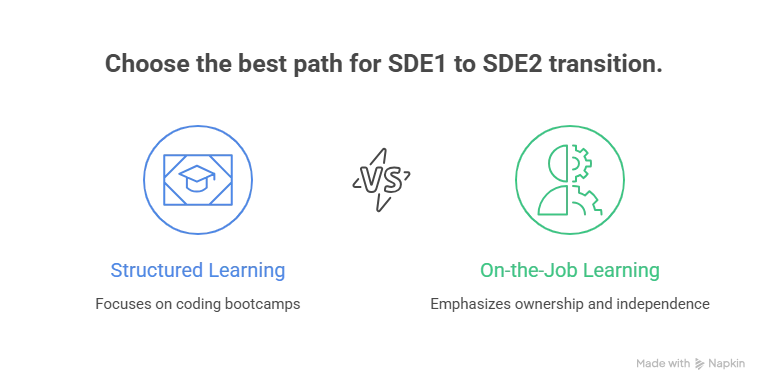
If you’re weighing whether to build this experience through structured learning first, it’s worth comparing how coding bootcamps prepare engineers in the US against learning ownership on the job, since the two paths develop different muscles.
SDE2 to Senior: Where Technical Leadership Enters the Picture
This is the jump that trips people up most, and it’s also the one with the widest timeline, usually three to five years, sometimes longer. The reason is that Senior isn’t really a coding milestone anymore. It’s a leadership milestone.
At this stage you’re expected to set technical direction for a domain, not just execute inside one. You’re the person other engineers check with before making an architectural decision.
You’re also expected to communicate tradeoffs clearly enough that non-engineers, like your manager or a product partner, can make an informed call.
Senior engineer responsibilities typically include owning cross-team initiatives, reviewing designs before they reach your manager, and catching problems in a proposal before they become expensive mistakes in production.
None of that shows up on a task board, which is exactly why it has to be documented and communicated deliberately.
| Level | Typical Experience | Core Scope | What Gets You Promoted | Avg. Time at Level |
| SDE1 / Engineer I | 0-2 years | Owns well-defined tasks inside a larger feature; leans on senior teammates for design review | Clean code, few revision cycles, reliable delivery on scoped tickets | 1-2.5 years |
| SDE2 / Engineer II | 2-5 years | Owns a feature or service end to end; makes independent technical calls | Project ownership, sound design docs, early mentorship of SDE1s | 2-3 years |
| Senior SDE / Engineer III | 5-8 years | Owns cross-team initiatives; sets technical direction for a domain | Technical leadership, measurable impact metrics, consistent mentorship | 3-5+ years (many stay here long-term) |
| Staff / Principal | 8+ years | Shapes architecture and strategy across multiple teams or orgs | Org-wide influence, track record of de-risking major bets | Varies widely |
Performance Reviews: Reading Between the Lines
Performance reviews are where promotion cases actually get built or blocked. A review cycle that only says you met expectations rarely supports a promotion.
What moves the needle is language describing scope beyond your current level: leading a project without being asked, resolving a cross-team conflict, or catching a design flaw before launch.
I’d treat every review cycle as a checkpoint rather than a report card. If your reviews plateau at the same language for two cycles in a row,
that’s the signal to have a direct conversation with your manager about what specifically is missing, before you assume the gap is compensation and start comparing offers using a complete software engineer salary guide.
Impact Metrics That Actually Hold Up in a Promotion Packet
Vague impact claims get pushed back on in calibration meetings. Specific ones survive. The difference between saying you improved performance and saying you cut checkout latency by 40 percent,
reducing cart abandonment measurably, is the difference between a promotion packet that stalls and one that sails through.
The impact metrics that tend to hold up fall into a few buckets: reliability improvements you can point to in an incident dashboard,
cost or performance gains with a before-and-after number, and adoption metrics if you built something other teams now depend on.
Track these as they happen. Reconstructing them from memory eight months later during review season is a losing strategy.
Mentorship as a Promotion Signal, Not Just a Nice Habit
Mentorship gets treated as optional generosity by a lot of engineers, but at the Senior level it’s closer to a requirement. Managers look for evidence that you make the people around you better, not just your own output.
That can be as simple as running structured onboarding for a new hire or being the person others go to before escalating a hard bug.
Mentorship also compounds in a way that’s easy to underrate. Engineers who mentor well tend to build the kind of internal reputation that shows up unprompted in calibration discussions,
which matters more than most people realize when comparing paths like software engineer versus data scientist career tracks, since both fields reward visible influence over quiet competence.
Skill Growth: Technical Depth Plus Communication
Skill growth beyond SDE2 stops being purely technical. You still need to go deeper on system design, debugging under pressure, and understanding tradeoffs at scale,
but the skills that separate a strong Senior from a stalled one are usually softer: writing a design doc that a skeptical peer can’t poke holes in, running a technical discussion without it turning into a debate, and knowing when a good-enough solution beats a perfect one.
A lot of engineers accelerate this stage by working on something outside their day job that forces new skills fast.
Well-chosen side projects for software engineers can build exactly the system design and ownership muscle that a narrow day-to-day role doesn’t stretch.
How AI Tools Changed the Timeline, Not the Bar
2026 added a new variable to this whole conversation. AI coding assistants have compressed the time it takes to ship routine work, which means the bar for what counts as Senior-level scope has quietly moved up.
The way AI tools are changing the software engineer role is less about replacing engineers and more about raising expectations.
If an AI assistant can draft the boilerplate, the value you add has to come from judgment, architecture, and knowing which of ten possible solutions won’t fall apart under load.
Engineers building an AI-focused software engineering career in the US are seeing this shift most directly, since specialization in applied AI systems is becoming its own fast track toward Senior scope, particularly at companies retooling their stack around it.
Where You Work Changes the Math
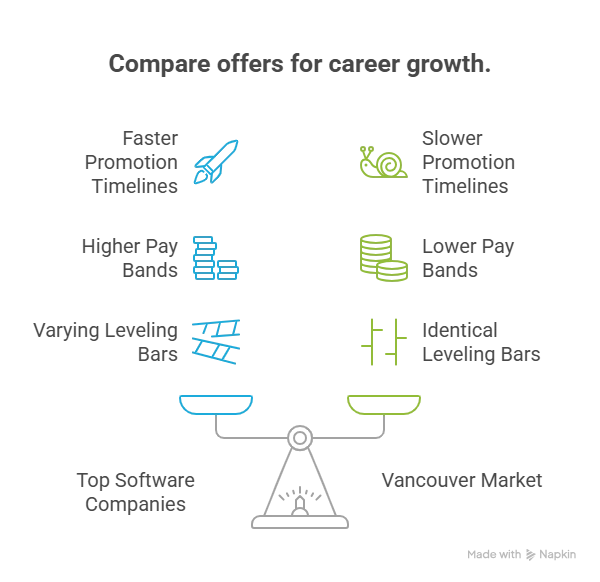
Promotion timelines and pay bands both shift by employer and location. Comparing offers at top software engineering companies is worth doing before you assume your current company’s ladder is the industry standard, since leveling bars vary more than most engineers expect between firms of similar size.
Geography matters too. Someone comparing a software engineer salary in Vancouver against a US market offer needs to weigh currency, cost of living, and the fact that promotion cycles and leveling bars aren’t identical across borders, even within the same company.
Starting the Clock Early: Internships and First Roles
The clock on this whole progression often starts sooner than people think. Strong software engineer internships in the US now function as an early filter for ownership and communication skills, not just technical screening, and engineers who treat internships as a chance to practice these habits tend to hit SDE2 faster once they convert to full time.
Once you’re in the door, understanding your ladder alongside general career paths in the US software engineering market gives you a realistic sense of how fast peers at other companies are actually moving, instead of guessing from LinkedIn titles.
Common Mistakes That Stall the SDE1-to-Senior Path
The most common mistake is treating tenure like progress. Time in seat matters far less than documented scope.
Another is going quiet after strong technical work, assuming the results will speak for themselves. They rarely do without a manager who actively surfaces them in calibration.
A third mistake is chasing lateral moves for a title bump without checking whether the new company’s leveling bar matches.
And a fourth is skipping mentorship because it feels like it takes time away from your own tickets, when it’s actually one of the clearest signals reviewers look for at the Senior transition.

Frequently Asked Questions
-
How long does it take to go from SDE1 to Senior?
Most engineers take five to eight years total: two to three years from SDE1 to SDE2, then three to five more years to Senior. Strong performers at smaller companies sometimes move faster, while large enterprises with rigid calibration cycles tend to run slower.
-
What is the single biggest factor in getting promoted?
Demonstrated scope beyond your current level, backed by specific impact metrics. Technical skill matters, but reviewers are calibrating against evidence, not potential.
-
Is Senior a terminal level?
At many companies, yes. Senior is often designed as a level engineers can stay at indefinitely without pressure to move into staff or management tracks, and plenty of experienced engineers choose to stay there for the rest of their careers.
-
Does mentorship really affect promotion decisions?
Yes, particularly at the Senior transition. Reviewers look for evidence that you improve the people around you, not just your own delivery record.
-
Do AI coding tools make it harder to reach Senior?
Not harder exactly, but the bar has shifted. Routine implementation work is faster to produce now, so judgment, system design, and architectural decisions carry more weight in a promotion case than they did a few years ago.
-
Should I switch companies to get promoted faster?
Sometimes, but only after confirming the new company’s leveling bar actually matches or exceeds your current scope. A lateral title bump at a company with a lower bar can hurt your case later.
A Realistic Way to Think About This Path
None of this progression is mysterious once you see the pattern: build ownership, get specific about impact, mentor deliberately, and let the title follow the work instead of chasing the title directly.
The engineers who move fastest aren’t the ones who work the most hours. They’re the ones who understand exactly what their next review cycle needs to say, and who go build that evidence on purpose.

Shahzada Muhammad Ali Qureshi (Leeo)
I’m Shahzada — a software engineer by education and an SEO professional by trade. I built WhatIsTheSalary.com to go beyond just showing salary numbers — every page is manually researched across sources like BLS, Glassdoor, LinkedIn Salary, and PayScale to give you the full picture in one place. If you found what you were looking for here, that’s exactly the point.