TLDR
Stuck hunting remote software roles that actually pay, match your level, and lead to promotion? Imagine cutting your search time in half, avoiding scams, and landing interviews with hiring managers who already know your worth.
This guide gives one-click action plans: where to find vetted listings, exact resume and GitHub tweaks that pass ATS + recruiter scans, a negotiation script to boost offers, and a 30–60–90 plan that wins remote interviews.
Ready for a step-by-step playbook that turns scattershot applications into a predictable hiring pipeline? Keep reading — the next 10 minutes could change your 2026 job trajectory.
Is the Remote Software Engineer Market Still Strong in 2026?
If you’ve been refreshing job boards wondering whether remote software engineering roles are still out there, the short answer is yes, and in large numbers.
I’ve spent time tracking this market across LinkedIn, Indeed, Wellfound, and ZipRecruiter, and the data is clear. Remote software engineer jobs in the US are not disappearing. In fact, as of mid-2026, LinkedIn alone shows over 26,000 active remote software engineering listings. That’s not a niche market. That’s a full-blown demand signal.
This guide covers salary ranges by experience level, the best companies actively hiring remote engineers in the US, what the job boards actually show, and how to get hired even if you’re entry-level or come with no formal experience.

Remote Software Engineer Salary in the US: What the Data Says
Let’s start with numbers because that’s usually what you actually want to know.
According to ZipRecruiter’s 2026 data, the average annual pay for a remote software engineer in the United States is $147,524. Glassdoor puts the figure slightly higher at $148,869 for the same period, based on self-reported salaries from remote workers.
The range is what matters most here. ZipRecruiter shows most remote software engineers earning between $120,000 (25th percentile) and $173,000 (75th percentile), with top earners at the 90th percentile pulling in $205,000 or more annually.
Backend software engineers command some of the highest base salaries, typically between $140,000 and $210,000 for remote US roles. Full-stack engineers sit in the $110,000 to $170,000 range depending on stack and company stage. Forward deployed engineers at AI and growth-stage companies can see $130,000 to $200,000 in base alone.
Remote Software Engineer Salary by Experience Level (2026)
The table below pulls from verified 2026 data across ZipRecruiter, Glassdoor, and publicly available job postings. Use it as a benchmark when evaluating offers.
| Experience Level | Years of Exp | Salary Range (2026) | Key Skills |
| Intern / New Grad | 0 years | $44K – $100K/yr | Python, JavaScript, Git, SQL |
| Entry Level SWE | 0-2 years | $70K – $106K/yr | React, Node.js, REST APIs |
| Mid Level SWE | 2-4 years | $110K – $170K/yr | AWS, Full-Stack, DevOps |
| Senior SWE | 5+ years | $126K – $192K/yr | System Design, Cloud, Leadership |
| Lead / Staff SWE | 7-10 years | $152K – $238K/yr | Architecture, Mentorship, AI |
| Principal / Director | 10+ years | $152K – $210K+/yr | Strategy, Cross-team Ownership |
A few things worth noting from this data. Intern and new grad salaries vary wildly depending on the company size and whether RSUs or signing bonuses are included. At FAANG-adjacent companies, interns can clear $100,000 annualized. At smaller startups or nonprofit-sector tech orgs, the floor is much lower.
Also, the gap between entry level and mid level is where most engineers leave the most money on the table by staying too long at their first employer without negotiating a title or level change.
Where to Find Remote Software Engineer Jobs in the US
Not all job boards are equal for remote software engineering roles. Here’s what the actual numbers look like across platforms right now.
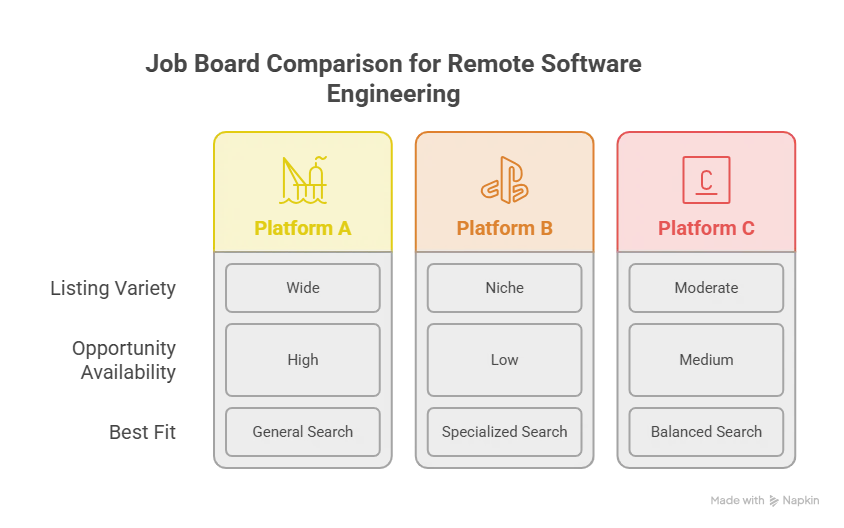
LinkedIn Jobs shows over 26,000 remote software engineer listings as of mid-2026. It’s the largest volume source and filters well for fully remote and US-only roles.
Indeed currently lists 8,454 remote software engineer jobs in the US. Filtering by ‘remote’ specifically, rather than hybrid, cuts that to a cleaner pool of fully distributed positions.
Wellfound (formerly AngelList) has around 2,334 results, but those are almost exclusively startup and growth-stage companies, which often means better equity and faster leveling.
ZipRecruiter shows 1,000 or more listings in the $120,000 to $205,000 salary range for remote software engineers. It’s worth using their salary filter aggressively.
Other platforms worth using: We Work Remotely for fully distributed companies, Y Combinator Jobs for startup roles, and Jobright.ai for AI-matched listings.
Remote Software Engineer Jobs: Entry Level and No Experience
This is the section most job guides skip, so let me be direct about it.
Entry-level remote software engineer roles exist, but competition is real. ZipRecruiter’s 2026 data puts the average pay for a remote entry-level software developer at $100,265 per year, with most roles falling between $63,500 and $106,000 depending on company size and role type.
For candidates without prior work experience, the path that consistently works is building proof of skill instead of relying on a resume. A strong GitHub portfolio, completion of a structured coding bootcamp, active LeetCode practice, and contributions to open source projects can replace a traditional work history at many startups and mid-size tech firms. For a deeper look at how to break into this field, check out our guide on how to become a software engineer in the US.
Companies like Affirm, Infosys, Canonical, and Praktix have posted entry-level and intern remote positions with clear pathways to full-time conversion. Google, Microsoft, Amazon, and Shopify also run structured internship programs that frequently convert to junior engineer offers.
The skills most requested for entry-level remote roles in 2026 are JavaScript, Python, React, Node.js, SQL, REST APIs, and Git. Adding AWS or basic DevOps knowledge puts you ahead of most early-career applicants.
Top Companies Hiring Remote Software Engineers in the US (2026)
Below is a curated list of companies actively posting remote software engineer roles in the US as of 2026, along with the type of remote arrangement and salary range from public job data.
| Company | Industry | Remote Type | Salary Range |
| Cisco | Networking / SaaS | 100% Remote (US) | $137K – $186K/yr |
| Capital One | Fintech / Banking | Remote-Eligible | $120K – $200K/yr |
| Honeywell | Industrial / Tech | Fully Remote | $110K – $180K/yr |
| Turing | AI / Staffing | 100% Remote (US) | $100K – $160K/yr |
| Integral Ad Science | AdTech / Software | Remote US-Based | $115K – $175K/yr |
| Speechify | AI / Consumer Tech | Fully Remote | $120K – $190K/yr |
| Turnitin | EdTech / Software | 100% Remote | $110K – $160K/yr |
| 8th Light | Software Consulting | Remote US-Based | $100K – $150K/yr |
| Common App | Higher Education | Fully Remote | $90K – $140K/yr |
| Revvity | Biotech / Software | Remote-Eligible | $100K – $155K/yr |
For a full breakdown of which tech companies pay the most and offer the best benefits, see our guide to the top software engineering companies in the US.
Skills That Move Your Remote Software Engineer Salary Up
Not all technical skills are priced equally in the remote job market. Here’s what’s actually paying a premium in 2026.
Python and AI-Native Development
Python continues to dominate backend roles, especially at companies building AI and machine learning products. Engineers with Python plus experience in AI-native development workflows are clearing 15 to 20 percent above generalist rates at similar experience levels.
Full-Stack and Cloud (AWS)
Full-stack engineers who can own both frontend (React, TypeScript) and backend (Node.js, Python) while deploying on AWS are among the most consistently hired profiles right now. If you’re looking to pick your next language to learn, our best programming languages guide breaks down which ones pay the most.
DevOps, Test Automation, and Data
DevOps engineers with remote-friendly tooling experience (Kubernetes, Docker, CI/CD pipelines) and automation-focused engineers (SDET, software test engineers) are in steady demand. Data analysis skills paired with engineering experience also open doors at biotech and fintech companies that are aggressively hiring remote.
Does Location Still Matter for Remote Software Engineer Pay?
Technically you’re remote, but location still affects your pay at many companies. Some employers pay on a national scale. Others adjust salaries to local cost of living, which can mean a 10 to 20 percent difference depending on where you live.
Engineers in Seattle and the San Francisco Bay Area often negotiate national-scale salaries even for remote roles, given the market benchmarks in those cities. For city-specific data, our Seattle software engineer salary guide covers the full picture for Washington State.
Other cities worth comparing: remote engineers based in San Diego, Atlanta, Miami, and Washington State all show salary variance. States without income tax (like Texas, Florida, and Washington) add 5 to 9 percent to your take-home relative to California or New York.
For a national salary baseline, our full software engineer salary in the US guide covers total compensation structure across all levels and markets.
H1B Sponsorship and Remote Software Engineer Jobs
This is a topic most salary and job guides ignore entirely, but it matters to a significant portion of the engineering talent pool in the US.
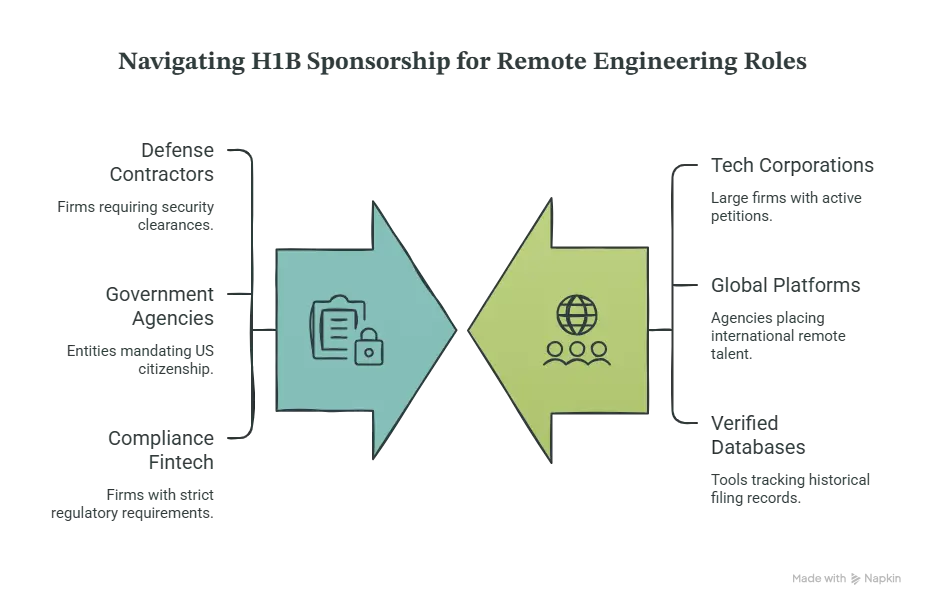
Many remote software engineer job listings in 2026 explicitly state ‘US Person Required’ or ‘No H1B.’ This is more common at government-adjacent contractors, defense-related tech companies, and certain fintech firms operating under financial compliance requirements.
However, major employers like Cisco, Capital One, and Honeywell have active H1B sponsorship programs and continue to file petitions for remote software engineers. Turing, which hires globally and places engineers in US-facing remote roles, also falls into this category.
If H1B sponsorship is relevant to you, Jobright.ai and LinkedIn both have filters for ‘H1B Sponsor Likely’ that surface companies with a track record of filing. Cross-check with the USCIS public H1B database before applying to avoid wasted applications.
How to Negotiate a Remote Software Engineer Offer in 2026
More research past a certain point just becomes delay. Once you have two or three data points from ZipRecruiter, Glassdoor, and Levels.fyi for your level and stack, you have enough to negotiate confidently.
Here are the moves that actually work for remote roles specifically.
Common Misconceptions About Remote Software Engineer Jobs
Myth 1: Remote jobs always pay less than on-site
This is not true as a blanket rule. At remote-first companies like GitLab, Automattic, and Zapier, fully remote engineers earn the same as or more than on-site counterparts at traditional firms. The pay gap, where it exists, tends to show up at companies that are hybrid by default and treat remote as a concession.
Myth 2: You need a CS degree to get a remote engineering job
Many remote-first companies explicitly state they accept bootcamp graduates and self-taught engineers. What they care about is whether you can write production-quality code and work asynchronously without daily supervision.
Myth 3: Entry-level remote jobs don’t exist
They exist. DailyRemote listed over 1,700 entry-level remote jobs in March 2026 alone. Glassdoor shows 2,600 or more at any given point. They are competitive, not nonexistent.
Myth 4: Remote means you can work from anywhere globally
Most US remote software engineer roles are listed as ‘Remote, US Only’ or require ‘Remote, US West Timezone Overlap.’ Full global remote work is less common at US-based companies due to tax, legal, and compliance requirements.

Frequently Asked Questions
-
How many remote software engineer jobs are available in the US right now?
As of mid-2026, LinkedIn lists over 26,000 remote software engineer jobs in the US. Indeed shows 8,454, Wellfound has around 2,334, and ZipRecruiter lists 1,000 or more in the $120,000 to $205,000 salary range. The market is active.
-
What is the average salary for a remote software engineer in the US in 2026?
ZipRecruiter reports an average of $147,524 per year. Glassdoor puts it at $148,869 for the same period. Most remote engineers fall between $120,000 and $173,000 annually, with top earners exceeding $205,000.
-
Can I get a remote software engineer job with no experience?
Yes, but you need to replace experience with proof of skill. A strong GitHub portfolio, bootcamp certification, LeetCode practice, and open source contributions can get you past the resume screen at many startups and growth-stage companies. Target Software Engineer I and Associate Software Engineer roles specifically.
-
Which companies are hiring remote software engineers in the US in 2026?
Cisco, Capital One, Honeywell, Turnitin, Speechify, 8th Light, Common App, Turing, Integral Ad Science, and Revvity are all actively posting remote software engineer roles in the US as of mid-2026.
-
What programming languages should I know for remote software engineer jobs?
JavaScript, Python, and TypeScript dominate remote job postings, accounting for over 60 percent of listings. React, Node.js, and AWS are the most requested stack additions. See our full breakdown of the best programming languages for software engineers for salary data by language.
-
Does remote work affect software engineer salaries?
It depends on the company’s pay policy. Remote-first companies typically pay on a national or global benchmark scale. Companies that are office-first with remote as an option sometimes adjust pay to local cost of living. Always ask directly during the offer process whether the company uses location-based pay bands.
-
What is the difference between fully remote and remote-eligible software engineer jobs?
Fully remote means the role is designed to be distributed with no expectation of in-office attendance. Remote-eligible means the company allows remote work but the role may have been designed for on-site and could shift back. For long-term stability, prioritize companies where the entire engineering team is remote, not just your position.
Share Your Experience
If you’ve recently accepted a remote software engineering offer, negotiated your salary up, or landed a role with no prior professional experience, I’d genuinely love to hear how you did it. Drop your story in the comments. It helps other engineers see what’s actually working right now, not just what the job boards say.
How This Article Was Created
Salary figures in this article are sourced from ZipRecruiter (2026 annual and monthly data), Glassdoor (March 2026 remote salary reports), and publicly available job posting data from LinkedIn, Indeed, Wellfound, and Built In. No figures were estimated or fabricated.
Job availability numbers reflect active listings as of June 2026. Company hiring data is based on public job postings and does not constitute endorsement. This article was written to help job seekers benchmark their compensation and find legitimate remote roles, not to recruit for any employer.

Shahzada Muhammad Ali Qureshi (Leeo)
I’m Shahzada — a software engineer by education and an SEO professional by trade. I built WhatIsTheSalary.com to go beyond just showing salary numbers — every page is manually researched across sources like BLS, Glassdoor, LinkedIn Salary, and PayScale to give you the full picture in one place. If you found what you were looking for here, that’s exactly the point.