TL;DR
H1B Visa for Software Engineers: Complete 2026 Guide. Dreaming of coding in Silicon Valley but paralyzed by visa confusion? Thousands of talented software engineers face this exact nightmare every year—spending months researching, getting rejected, or missing opportunities entirely because they don’t understand the H1B process.
The problem isn’t your skills; it’s the opaque, ever-changing immigration landscape that leaves even senior engineers stranded. One wrong form, missing deadline, or misunderstood requirement can cost you a year—and a life-changing career.
Here’s the solution: This complete 2026 guide breaks down everything from eligibility to premium processing, salary requirements to cap-exempt employers, so you can navigate the H1B visa with confidence and land your American dream job.
How to Get H1B Visa as a Software Engineer in 2026
I have spent months going through DOL LCA filings, USCIS policy updates, and real salary data so you do not have to guess your way through the most consequential visa decision of your career. If you are a foreign software engineer trying to work in the US, or an employer trying to hire one, 2026 is a different world from two years ago. The rules changed. The costs changed. The lottery odds changed. This guide covers all of it.

H1B Visa Eligibility for Software Engineers
To qualify for an H1B visa as a software engineer, USCIS requires that your role qualifies as a specialty occupation and that you hold at least a bachelor’s degree in a directly related field such as Computer Science, Information Technology, or Software Engineering.
If you do not have a degree, 12 or more years of progressive work experience in the field can sometimes substitute, with every three years of experience counting as one year of formal education. That substitution is not guaranteed, and employers still need to argue the case.
Your employer must also prove the job itself meets the specialty occupation standard. USCIS scrutinizes this more carefully now, especially for entry-level programming roles after a policy clarification that tightened the definition.
H1B Software Engineer Salary in 2026
Based on DOL Labor Condition Application data for FY2025, the median H1B salary for software engineers is $136,000. The 75th percentile reaches $182,000 and the 90th percentile hits $215,000 (source: H1BData). Meanwhile, software engineer salaries in the United States vary widely by level, company, and city.
H1B visa for software engineers in 2026: full guide on eligibility, salary ($136K-$215K), sponsoring companies, cap-exempt options, and O-1 comparison.H1B visa for software engineers in 2026: full guide on eligibility, salary ($136K-$215K), sponsoring companies, cap-exempt options, and O-1 comparison.
H1B Software Engineer Salary by Experience Level (2026)
| Experience Level | DOL Wage Level | Base Salary Range | Total Comp (incl. RSUs) | Typical Employers |
| Entry Level (0-2 yrs) | Level I – II | $80,000 – $120,000 | $95,000 – $130,000 | Mid-size firms, consulting |
| Mid Level (3-6 yrs) | Level II – III | $120,000 – $160,000 | $140,000 – $175,000 | Big Tech, startups |
| Senior (7+ yrs) | Level III – IV | $150,000 – $200,000 | $170,000 – $220,000 | FAANG, unicorns |
| Principal / Staff | Level IV | $180,000 – $240,000+ | $200,000 – $280,000+ | Top tech companies |
H1B Software Engineer Companies That Sponsor
The biggest H1B sponsors for software engineers include Google, Meta, Microsoft, Amazon, and Apple. According to MyVisaJobs, Google alone filed 5,387 LCA applications for software engineer roles in FY2025, with an average salary of $185,128. These are not outliers. Top software engineering companies consistently dominate H1B sponsorship volume each year.
| Company | Avg Base Salary | RSU Structure | Signing Bonus | Sponsorship Volume |
| $185,128 avg (DOL LCA) | RSUs vest over 4 years | $15K – $50K | High | |
| Meta | $175,000 – $210,000 | RSUs + refresh grants | $10K – $30K | High |
| Microsoft | $160,000 – $195,000 | 4-year vesting schedule | $10K – $25K | High |
| Amazon | $155,000 – $185,000 | Back-loaded RSU schedule | $20K – $60K | High |
| Apple | $170,000 – $205,000 | Annual RSU grants | $15K – $35K | Moderate |
How to Get H1B Visa as a Software Engineer: Step-by-Step
The process has more steps than most guides admit. Here is the complete sequence:
H1B Processing Fees in 2026
Employers pay the bulk of the fees. Here is what the process costs:
Total regular government fees for large employers run roughly $2,595 to $3,595 without premium processing, and jump to over $100,000 for new overseas hires under the 2025 proclamation.
Software Engineer H1B Cap Exempt: The Lottery-Free Path
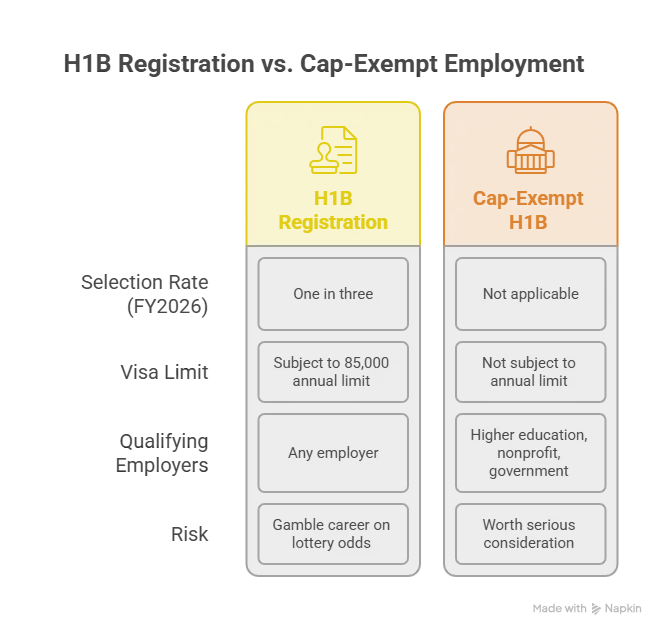
For FY2026, only about one in three H1B registrants were selected. If you cannot afford to gamble your career on lottery odds, cap-exempt employment is worth serious consideration. A cap-exempt H1B petition is not subject to the 85,000 annual visa limit.
The four qualifying employer types are: institutions of higher education, nonprofit organizations affiliated with universities, nonprofit research organizations, and government research agencies.
Software engineers at universities and research nonprofits can be sponsored at any point during the year, with no registration window and no October 1 start constraint. Premium processing still applies, meaning you can get a decision in 15 business days.
The trade-off is salary: academic and nonprofit salaries are typically lower than private-sector tech roles, though Stanford’s LCA filings show an average that competes directly with Silicon Valley industry pay.
One important nuance: if you have only ever worked for cap-exempt employers and never been counted against the cap, moving to a private-sector company requires entering the lottery. Your cap-exempt status does not carry over.
O1 vs H1B for Software Engineers: Which Makes More Sense in 2026?
The career path of a software engineer in the US now has a meaningful fork: H1B or O-1. The O-1 visa is for individuals with extraordinary ability, meaning you need to meet at least three of eight specific criteria set by USCIS.
Common qualifying evidence for software engineers includes patents, peer-reviewed publications, open-source projects with significant adoption, conference presentations, high salary relative to peers, or a critical role at a distinguished organization.
The O-1 has no annual cap and no lottery. The new $100,000 supplemental fee does not apply to O-1 petitions. Government fees for an O-1 run roughly $10,000 to $20,000 total, compared to $100,000-plus for a new H1B overseas hire. For senior engineers with documented achievements, the O-1 is no longer a niche option. It is a mainstream strategy.
The H1B remains the better path for early-career engineers, those without a documented record of exceptional contributions, or those joining employers who are not H1B-dependent and thus not subject to the new fee.
Best Programming Languages and Skills for H1B Sponsorship
Employers are more willing to sponsor H1B visas when the candidate has skills that are genuinely hard to source domestically. The best programming languages for software engineers targeting H1B roles include Python, Java, Go, Rust, and C++.
Machine learning, cloud infrastructure, and distributed systems experience consistently attract the highest LCA-certified wage levels and the strongest sponsorship pipelines.
Roles like Site Reliability Engineer (SRE), Machine Learning Engineer, and full-stack engineers with cloud specialization are among the most sponsored job titles in the DOL disclosure data. SDET and software test engineering roles are also sponsored but at lower salary levels.
H1B Software Engineer Salary by City
Geography matters a lot under the LCA system because prevailing wages are set by geographic area. Software engineer salaries in Seattle, WA lead nationally at an average of $189,000 according to H1B state-level data.
Washington state software engineer salaries benefit from no state income tax, which meaningfully increases take-home pay compared to California.
Software engineer salaries in San Diego run $140,000 to $175,000, while Atlanta software engineer salaries average $120,000 to $155,000 with a lower cost of living. Miami software engineer salaries are growing as tech companies expand their Florida presence, currently averaging $115,000 to $150,000.

The New Wage-Based H1B Lottery: What Changes for FY2027
USCIS published a final rule on December 29, 2025, implementing a wage-based lottery system effective February 27, 2026, for FY2027 registrations. Under this system, each wage level receives a different number of lottery entries: Level IV workers receive four entries, Level III receive three, Level II receive two, and Level I (entry-level) workers receive one entry only.
This mathematically disadvantages recent graduates and junior engineers competing against senior candidates. If you are entering the job market in 2026 and targeting H1B sponsorship, you are swimming against a tide that now structurally favors candidates earning $150,000 and above.
Targeting skills and roles that qualify at Level III or IV is not just a salary negotiation tactic anymore. It is an immigration strategy.
Frequently Asked Questions
-
What is the minimum salary for an H1B software engineer?
The employer must pay at least the DOL prevailing wage for the role and geographic area. For Level I positions in major tech hubs, that typically means $80,000 to $120,000. Level III to IV senior roles require $150,000 to $200,000 or more. The minimum for cap-exempt H1B positions is $60,000 per year by statute.
-
How long does the H1B visa process take for software engineers?
Regular USCIS processing takes 3 to 6 months after petition filing. Premium processing guarantees a decision within 15 business days for a fee of $2,965 as of March 2026. Add 2 to 3 months for the embassy interview and visa stamping if you are outside the US.
-
Which companies sponsor H1B visas for software engineers?
Google, Meta, Microsoft, Amazon, and Apple are the top sponsors by volume. Google led with 5,387 LCA filings for software engineer roles in FY2025 at an average salary of $185,128. Mid-size companies in cloud, fintech, and enterprise software also sponsor regularly.
-
Can a software engineer get an H1B without a degree?
Possibly, but it is difficult. USCIS allows 12 or more years of progressive relevant work experience to substitute for a bachelor’s degree, with three years of experience equaling one year of formal education. The employer still needs to demonstrate the role qualifies as a specialty occupation, which is harder to prove for entry-level positions.
-
What is the difference between H1B cap-exempt and cap-subject?
Cap-subject H1B petitions are limited to 85,000 per year and require lottery selection. Cap-exempt petitions filed by universities, nonprofit research organizations, and government research agencies are not subject to the cap or the lottery. They can be filed year-round.
-
Is O-1 better than H1B for software engineers in 2026?
For senior engineers with documented achievements, the O-1 is increasingly competitive. It has no lottery, no annual cap, and the new $100,000 H1B supplemental fee does not apply. Total O-1 costs typically run $10,000 to $20,000. For junior engineers or those without a record of notable contributions, H1B remains the more accessible path.
-
What happens to my H1B if I am laid off?
You have a 60-day grace period to find a new H1B sponsor, change to another visa status, or leave the US. Given the 90,000-plus tech layoffs in 2026 so far, this has become a critical issue. Acting immediately upon receiving a layoff notice is essential because the grace period starts from the last day of employment.
How This Article Was Created
Salary data in this article comes from DOL LCA disclosure filings accessed via H1BGrader and MyVisaJobs, ZipRecruiter live salary data pulled June 22, 2026, and immigration policy sources including USCIS official announcements and Alma Immigration. No salary figures were fabricated. All fee amounts reflect 2026 USCIS schedules. This article was written to inform software engineers and employers, not to recruit or advertise. Policy details should be verified with a licensed immigration attorney before making visa decisions.

Shahzada Muhammad Ali Qureshi (Leeo)
I’m Shahzada — a software engineer by education and an SEO professional by trade. I built WhatIsTheSalary.com to go beyond just showing salary numbers — every page is manually researched across sources like BLS, Glassdoor, LinkedIn Salary, and PayScale to give you the full picture in one place. If you found what you were looking for here, that’s exactly the point.