TL;DR
You and a coworker share the exact same job title, yet they are pulling in 30,000 dollars more than you this year. That gap rarely comes down to luck. It comes down to Skills That Boost Data Analyst Salary Fast, the specific tools and credentials separating a 65,000 dollar analyst from a 100,000 dollar one.
Most advice online just says learn SQL and stop there, leaving you no closer to knowing which skill is actually worth your time and which one is just noise on a job posting.
I pulled real, current compensation data across every major platform to answer that question honestly, the same way I break down pay across the wider tech field over at WhatIsTheSalary.
What Data Analysts Are Actually Earning in 2026
Before we get into skills, you need a real baseline. Glassdoor puts the average data analyst salary at $93,575 a year, with the middle 50 percent earning between $72,284 and $122,292. Salary.com reports a higher figure, $97,717, while ZipRecruiter and PayScale come in lower, at $82,640 and $70,643.
The spread exists because each platform pulls from a different pool of self reported and employer reported data, and because job titles like “data analyst” get used loosely across very different pay bands.
For a federal anchor point, the Bureau of Labor Statistics classifies most of this work under Operations Research Analysts, with a median annual wage of $87,640 and projected job growth of 23 percent through 2033, well above average for the entire economy.
That growth is exactly why skill gaps matter so much right now. Demand is outrunning supply of analysts who can actually deliver, not just talk about it.
I already broke down the full range by city, industry, and experience level in my Data Analyst Salary in the US 2026: Complete Guide, so I will not repeat all of it here. What matters for this article is the part almost nobody explains well: which specific skills pull you toward the top of that range instead of the bottom.

The Skills That Actually Move Your Pay
Here is a quick snapshot before I go through each one in detail. These ranges come from PayScale’s skill specific salary data, Glassdoor’s industry breakdowns, and 2026 industry compensation reports.
| Skill or Credential | Typical Salary Range With It | Approx. Pay Lift |
| Advanced SQL (joins, window functions, query tuning) | $75,000 – $97,000 | Baseline requirement, missing it caps your offers |
| Python for analysis (pandas, automation, APIs) | $80,000 – $105,000 | +8% to 12% over SQL only roles |
| Cloud platforms (AWS or Azure fundamentals) | $90,000 – $120,000 | +15% to 25%, per multiple 2026 industry reports |
| Advanced BI dashboards (Power BI, Tableau, Looker) | $78,000 – $102,000 | +10% and faster promotion into senior analyst roles |
| Applied statistics and basic predictive modeling | $95,000 – $130,000 | +15% to 20%, opens the door to data scientist pay |
| Recognized certification (Google, IBM, Microsoft) | $62,000+ at entry level | Closes the gap for candidates without a data degree |
| Domain expertise (finance, healthcare, SaaS) | $93,000 – $117,000 | Top paying industries per Glassdoor 2026 data |
SQL Is the Floor, Not the Ceiling
Every credible source agrees on this one. PayScale’s own skill data shows SQL proficiency as close to a baseline requirement, not a differentiator. If you cannot write a clean join, filter messy data, or debug a slow query, most employers will not even get you to a technical interview.
Where SQL starts paying off is when you go beyond basic SELECT statements into window functions, query optimization, and working directly in production databases instead of pre cleaned exports. That level of fluency is what shows up in the $75,000 to $97,000 range rather than the bottom of the scale.
Python Adds a Real Premium
PayScale reports data analysts with Python skills averaging $74,824, and that number climbs fast once you can actually automate reporting, clean large datasets with pandas, or pull data through an API instead of waiting on someone else to export it for you. Python is also the bridge skill into data science, which is where the real ceiling on pay sits. If that path interests you, I mapped it out in how to become a data scientist.
You do not need to be a software engineer. You need enough Python to stop doing repetitive manual work in Excel, and that alone is usually enough to stand out.
Cloud and BI Platform Skills
This is the one people underestimate. Industry compensation reports from 2026 put the salary lift from AWS or Azure data analytics certifications at 15 to 25 percent over analysts without them. Companies are not just storing data in spreadsheets anymore, and analysts who can work inside cloud environments get pulled into higher stakes projects, which is where the budget for higher pay actually lives.
Pair that with advanced dashboard building in Power BI, Tableau, or Looker, and you are no longer someone who reports numbers after the fact. You become someone leadership checks in with before decisions get made, and that shift in role is usually worth real money.
Certifications Close the Credibility Gap
If you did not major in statistics or computer science, a recognized certification does a lot of heavy lifting. Hakia’s 2026 compensation research found certified entry level analysts moving from roughly $53,500 to $62,000 or more, purely from having a credential like the Google Data Analytics Certificate, IBM Data Analyst Professional Certificate, or Microsoft Power BI certification on their resume.
I put together a full comparison of the strongest options in best certifications for data scientists, and most of that reasoning applies directly to analysts eyeing a move upward too.
Domain Knowledge and Soft Skills Nobody Talks About
Glassdoor’s 2026 industry data shows the highest median total pay for data analysts sitting in consumer services, financial services, aerospace and defense, energy, and manufacturing. Not because those industries need fancier tools, but because their data is higher stakes and their analysts are expected to understand the business, not just the dataset.
The analysts who get promoted fastest are usually the ones who can explain a trend to a non technical VP in two sentences. That skill rarely shows up on a resume, but it shows up in every performance review.
How Experience Level Changes What Skills Are Worth
A skill that gets you hired at entry level is not always the same skill that gets you promoted. ERI SalaryExpert data pegs entry level analysts, one to three years of experience, at an average of $76,369, while senior analysts with eight or more years average $123,167. That gap is almost entirely explained by skill depth, not tenure alone.
At the entry level, the goal is coverage. Get comfortable with Excel, SQL, and one visualization tool, and be able to talk through a project end to end. I go deeper into realistic starting numbers in my entry level data analyst salary breakdown.
At the mid level, three to six years in, depth matters more than breadth. This is when Python, cloud tools, and statistics start paying off, because you are now trusted with projects that carry real business risk if you get them wrong.
At senior level, the skill that pays the most is judgment. Knowing which analysis actually matters, and which one is a distraction, is worth more than any single tool. Remote roles have also opened up more of this senior tier than most people realize. I cover where those openings are concentrated in remote data analyst jobs in the US.
You Do Not Need a Degree to Build These Skills
One thing I want to correct here. A lot of job seekers assume the salary gap between them and a higher paid analyst is a degree problem. Most of the time it is a skills problem, and skills are fixable without going back to school. I wrote a full guide on this exact question, become a data analyst without a degree, and the short version is that employers care far more about what you can demonstrate than where you studied.
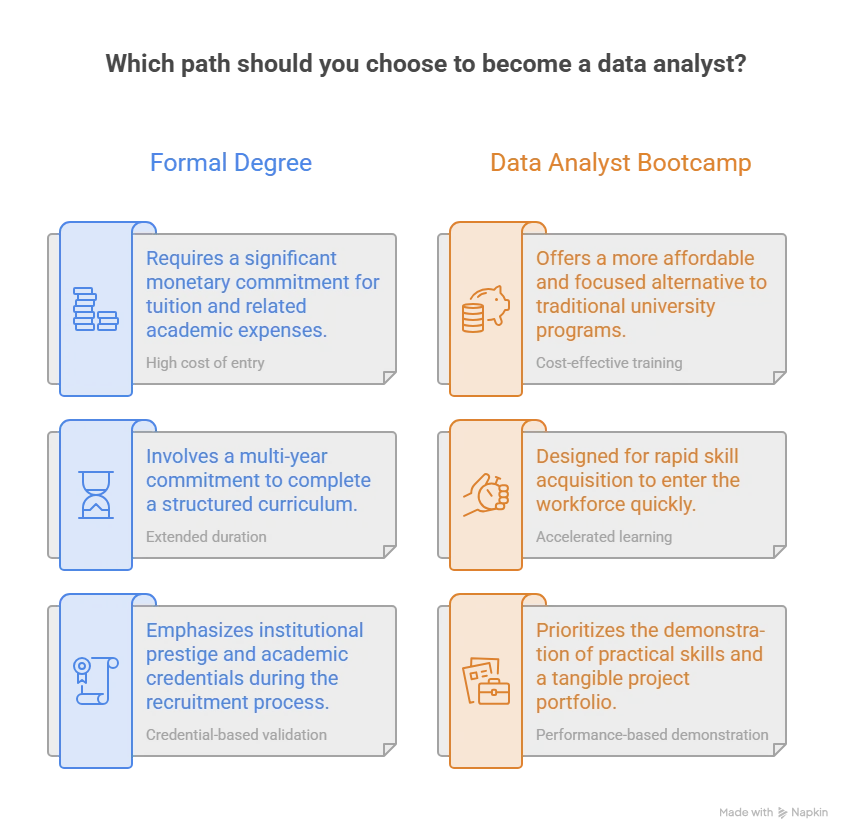
If you are weighing a formal program against self study, I also compared the real tradeoffs, cost, speed, and hiring outcomes, in data analyst bootcamp vs degree. Either path can work. What matters is finishing with a portfolio you can actually walk an interviewer through.
Where Skill Stacking Eventually Leads
Skills that boost your pay as a data analyst are, in most cases, the same skills that open the door into data science, which is where the ceiling on pay goes up significantly. If you are already comfortable with Python, statistics, and SQL, you are closer to that jump than you probably think. I laid out the realistic route in data scientist career path, and the entry point numbers in entry level data scientist salary.
Even if you stay in analytics long term, it helps to know what the parallel track pays. My data scientist salary by city guide is useful context if you are deciding between staying an analyst in a high cost city or specializing further. And if you want the full analyst side roadmap first, start with my data analyst career path breakdown before deciding which direction to take.
Common Mistakes That Slow Down Your Salary Growth
Collecting certifications instead of building projects
A certificate signals you studied something. A portfolio project signals you can actually do the work. Hiring managers weigh the second one much more heavily, especially past entry level.
Learning tools nobody in your target industry actually uses
Chasing every new tool on LinkedIn wastes time. Check three or four real job postings for the role and city you want, and build exactly what they ask for first.
Staying at one employer too long without expanding scope
Salary.com and Built In data both show experience level driving pay more than tenure at a single company. If your responsibilities have not grown in two years, your salary probably has not either.
Ignoring industry choice
The same skill set in consumer services or financial services pays noticeably more than the identical skill set in retail or nonprofit work, based on Glassdoor’s 2026 industry breakdown. Sometimes the fastest raise is a lateral move into a better paying sector, not a new skill at all.

How Fast You Can Actually See This in Your Paycheck
Realistically, a focused three to six month stretch, learning intermediate SQL, functional Python, and one BI tool at a genuinely usable level, is enough to start applying for roles at the next pay tier. Certifications can be finished even faster, often in four to eight weeks of consistent study.
The mistake most people make is treating skill building as an open ended project. Set a deadline, build two or three portfolio pieces that prove the skill, then start applying and negotiating. More studying past that point usually delays your raise instead of earning it.
Frequently Asked Questions
-
What is the single skill that increases a data analyst’s salary the most?
SQL is the non negotiable baseline, but Python and cloud platform experience together tend to produce the biggest jump in offers, based on skill specific PayScale and industry data from 2026.
-
Do certifications really increase a data analyst’s salary?
Yes, particularly at entry level. Hakia’s 2026 research found certified entry level analysts earning $8,000 to $9,000 more on average than uncertified peers with similar experience.
-
Is Python or SQL more important for a data analyst?
SQL first, since most analyst roles require it to even get hired. Python is what pushes you from an average offer into a stronger one, and it is also the skill that keeps a data science move realistic later.
-
Can I raise my salary without changing employers?
It is possible, but Salary.com’s data shows most meaningful jumps come from a change of employer or a documented expansion in responsibility. Building a new skill only pays off if you also ask for the raise, internally or externally.
-
How long does it take to learn skills that actually move salary?
Three to six months of focused, project based learning is realistic for SQL, Python, and one BI tool combined. Certifications alone can be finished in four to eight weeks.
-
Do data analysts need a cloud certification like AWS or Azure?
Not always, but 2026 compensation reports link cloud platform skills to a 15 to 25 percent pay lift, so it is one of the highest return skills you can add once you already have SQL and Python covered.
A Quick Note on Where This Data Came From
Every number in this article comes from publicly available 2026 compensation data published by Glassdoor, PayScale, ZipRecruiter, Salary.com, ERI SalaryExpert, Built In, and the Bureau of Labor Statistics, along with 2026 industry compensation research on certifications and cloud skills.
Nothing here is estimated or made up. Ranges are reported as ranges on purpose, because real salary data varies by source, city, and company, and I would rather show you the honest spread than a single number that sounds more impressive than it is.
Tell Me What Worked for You
If a specific skill or certification actually moved your salary this year, I would genuinely like to hear about it. Drop your experience in the comments, what you learned, how long it took, and what it changed on your next offer. Real data points from real analysts are exactly what keep guides like this one honest.

Shahzada Muhammad Ali Qureshi (Leeo)
I’m Shahzada — a software engineer by education and an SEO professional by trade. I built WhatIsTheSalary.com to go beyond just showing salary numbers — every page is manually researched across sources like BLS, Glassdoor, LinkedIn Salary, and PayScale to give you the full picture in one place. If you found what you were looking for here, that’s exactly the point.