TL;DR
Data Scientist vs Cybersecurity has a strange twist: the government says security pays more, while Glassdoor says data science wins by about $30,000.
Trust the wrong number and you could spend years and thousands of dollars on a degree or certifications for a career that never fit your pay goals.
I sorted it out for you. This guide compares 2026 BLS, Glassdoor, and ISC2 data side by side, from entry level to the top of the ladder. For more verified pay research, browse the IT salary guides on WhatIsTheSalary.
Data Scientist vs Cybersecurity at a Glance
Here is the quick version before the detail. Wage and growth figures come from BLS, and total pay figures come from Glassdoor’s 2026 salary pages.
| Factor | Data Scientist | Cybersecurity (Info Security Analyst) |
| BLS median pay, May 2025 | $120,230 | $129,180 |
| BLS jobs in 2025 | 275,600 | 192,900 |
| BLS projected growth, 2025 to 2035 | 35% | 21% |
| Glassdoor average total pay | About $158,000 | About $128,000 |
| Typical entry education (BLS) | Bachelor’s degree | Bachelor’s degree |
| Core skills | Python, SQL, statistics, machine learning | Networking, incident response, risk, cloud security |
| Work rhythm | Project cycles and deadlines | Monitoring, on-call, incident response |
| Top of the ladder | Principal data scientist, ML lead | Security architect, CISO |
One note on definitions. Cybersecurity is a whole field, not one job title. BLS tracks information security analysts, so I use that as the closest match. Architects and CISOs come in later, where the pay gets interesting.
Salary Comparison: What the Numbers Really Say
Start with the government data. BLS reports a May 2025 median wage of $120,230 for data scientists and $129,180 for information security analysts. At the median, cybersecurity comes out about $9,000 ahead.
Now switch to Glassdoor. Its 2026 pages show average total pay of roughly $158,000 for data scientists and roughly $128,000 for cyber security analysts. Suddenly data science leads by about $30,000. Indeed’s career advice guide points the same way, with a national average of $124,518 for data scientists against $97,132 for cybersecurity analysts.

Same two careers, opposite winners. Three things explain it.
My read is simple. If you plan to work at a large tech company, Glassdoor is closer to what you will see in an offer letter. If you plan to work at a hospital, bank, or government agency, BLS is the safer guide. Either way, both careers beat the $109,470 median for all computer and IT jobs and the $50,980 median for all US workers.
Location shifts things too. BLS data compiled by JobCannon puts data scientists in the San Jose area at a $185,080 median and San Francisco at $170,110. I break the metro differences down in the data scientist salary by city guide.
Salary by Career Stage
The gap moves as you climb, so a single average hides too much. Here is how it looks at each stage.
Entry Level (0 to 2 Years)
Glassdoor lists Data Scientist I at an average total pay of $142,730, with the middle half of reports between $122,725 and $168,870. Treat that as a big tech number, because many first jobs pay less. On the cybersecurity side, Coursera’s 2026 guide cites ZipRecruiter at about $96,000 for entry-level information security analysts.
The bigger issue is getting hired. A 365 Data Science analysis of about 1,157 Glassdoor listings found that entry-level machine learning roles made up only 3% of postings. For first-job pay by role, see the entry-level data scientist salary guide.
Mid-Level to Senior (3 to 10 Years)
Glassdoor puts the average senior data scientist at $234,855 in total pay, split between $141,000 to $192,000 in base and $53,000 to $98,000 in additional pay. Senior cyber security analysts average $197,063. Data science keeps a lead of roughly $38,000 here, mostly through bonus and stock.
Promotion paths differ too. Data scientists usually move toward staff, lead, or manager roles, which I map in the data scientist career path guide. Security analysts branch into engineering, architecture, and governance, risk, and compliance (GRC), which the cybersecurity career path guide lays out.
The Top of the Ladder
This is where cybersecurity catches up and then passes. Glassdoor reports average total pay of $233,666 for security architects, $260,855 for senior security architects, and $315,079 for principal security architects. The best-paid data science title I found, senior lead data scientist, averages $284,029.
Above architect sits the chief information security officer. The CISO salary guide covers what that job pays and what it demands.
| Role | Field | Average total pay |
| Data Scientist I | Data science | $142,730 |
| Data Scientist (all levels) | Data science | $158,219 |
| Senior Data Scientist | Data science | $234,855 |
| Senior Lead Data Scientist | Data science | $284,029 |
| Cyber Security Analyst (all levels) | Cybersecurity | $128,358 |
| Senior Cyber Security Analyst | Cybersecurity | $197,063 |
| Security Architect | Cybersecurity | $233,666 |
| Senior Security Architect | Cybersecurity | $260,855 |
| Principal Security Architect | Cybersecurity | $315,079 |
Job Growth and Demand in 2026
The newest BLS projections changed the order. The 2024 to 2034 outlook had information security analysts growing 29%, the fastest of any computer occupation. The 2025 to 2035 outlook cuts that to 21%, or about 40,600 new jobs on a base of 192,900. Data scientists now lead at 35%, roughly 95,400 new jobs on a base of 275,600. The average across all occupations is 3%, so both fields are still strong.
Job postings point up for both. Robert Half’s 2026 technology data, as summarized by HeroHunt, counted 49,200 postings for AI, machine learning, and data science roles in 2025, up 163% from 2024. Security postings reached 66,800, up 124%.
Cybersecurity has a different demand signal. In the ISC2 2025 Cybersecurity Workforce Study of more than 16,000 professionals, 95% reported at least one skills gap. ISC2 also dropped its usual global workforce gap estimate, because respondents cared more about specific skills than headcount. Employers want people who can do AI security and cloud security work, not just fill seats.
Data science is shifting as well. LinkedIn ranks AI engineer first among fast-growing US jobs, and machine learning engineer and data scientist also appear among the roles with the deepest hiring demand, per an Open Data Science roundup. Expect to be asked to deploy models, not only build them.
Education, Certifications, and How Hard It Is to Break In
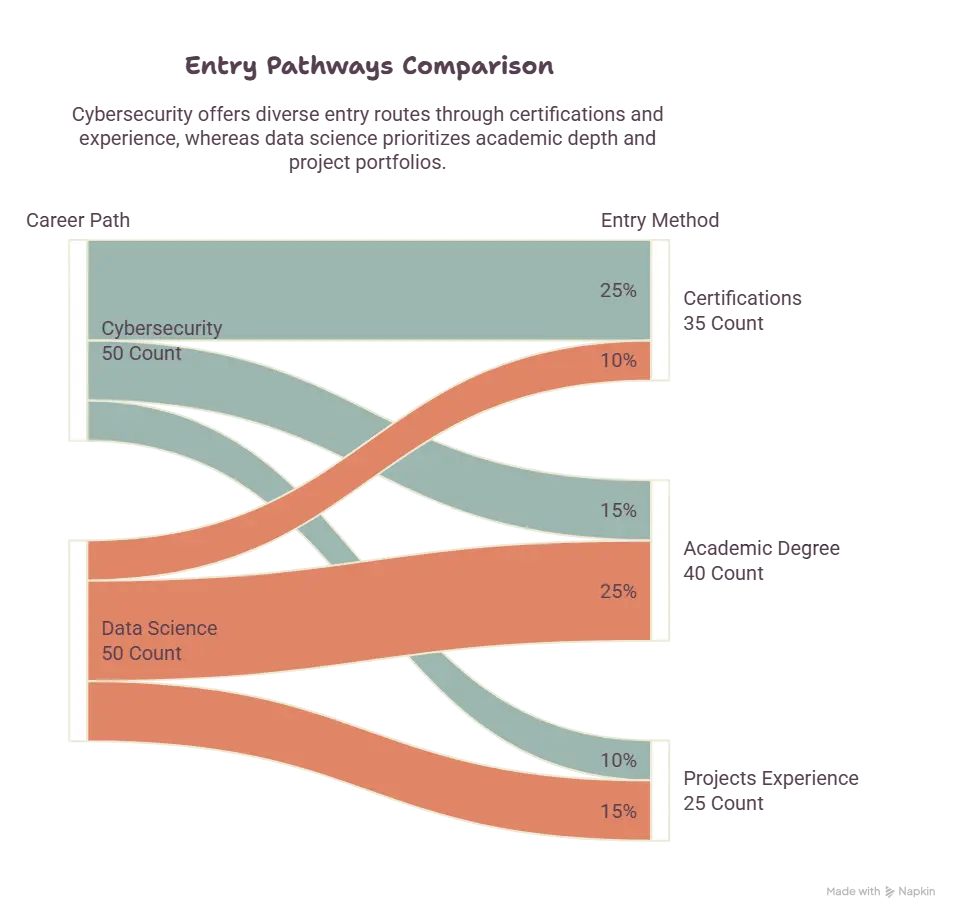
BLS lists a bachelor’s degree as the typical entry point for both careers. The real routes are looser on the cybersecurity side. Research.com notes that a security career can start with a degree, certifications, a bootcamp, or hands-on IT experience, while data science more often expects deeper academic preparation.
For cybersecurity, that means certifications and lab experience can carry you a long way. No degree? The guide on becoming a cybersecurity analyst without a degree lays out a realistic route.
For data science, many people add a master’s degree, but a portfolio of deployed projects matters more. One industry roundup noted that employers discount certifications with no shipped project behind them. If you still want credentials, start with the best certifications for data scientists, then use the how to become a data scientist roadmap. Neither door is easy at entry level, so expect real competition.
Day-to-Day Work and Lifestyle
The work feels different. Syracuse University’s iSchool comparison describes data science as mostly project-rhythm work, while cybersecurity often includes 24/7 monitoring duty and incident response that does not stop at 5 p.m. ISC2’s 2025 study fits that picture, reporting heavy strain on security teams alongside durable job satisfaction.
Data science has its own stress: vague questions, shifting priorities, and models that never reach production. Ask yourself which pressure you handle better, deadlines or alerts.
The Crossover Roles Most Comparisons Skip
Most comparisons treat this as a coin flip. It is not. Security teams use machine learning to catch anomalies, and data teams need people who understand data protection. Titles like detection engineer, security data scientist, and AI security specialist sit between the two fields.
ISC2 found that AI is the skill most often called critical in security, cited by 41% of respondents, with cloud security next at 36%. About 73% expect AI to create more specialized cybersecurity skills.
I could not find reliable published salary data for these hybrid titles, so I will not guess a number. Check Glassdoor for the exact title before you negotiate.
Start as a Data Analyst, Then Choose
You do not have to decide today. Data analyst work builds SQL, dashboards, and business context, and those skills feed data science and security analytics alike. It is also the cheapest place to test your interest.
The Data Analyst Salary in the US 2026: Complete Guide shows what that on-ramp pays. For first-job numbers, see the entry-level data analyst salary guide. Weighing school options? Read data analyst bootcamp vs degree, or the guide to becoming a data analyst without a degree.
Employer and industry change the outcome, which the data analyst salary by company and finance vs healthcare vs retail breakdowns show clearly. Prefer working from home? Check the remote data analyst jobs in the US roundup, and the data analyst career path to see how people branch into data science.

How to Choose Without Overthinking It
Then run a small test. Spend a month on a Python and SQL project and a month on a security lab. Notice which one you open voluntarily on a Saturday.
Frequently Asked Questions
-
Which pays more, a data scientist or a cybersecurity professional?
It depends on the source and the level. BLS shows information security analysts at $129,180 and data scientists at $120,230 for May 2025. Glassdoor’s total pay favors data scientists at the analyst and senior levels, while security architects overtake them at the top.
-
Is it harder to break into data science or cybersecurity?
Both are competitive at entry level. Cybersecurity offers more entry routes, including certifications and IT experience. Data science often expects a degree plus a portfolio, and one analysis found entry-level machine learning roles were only 3% of postings.
-
Do you need a master’s degree for either career?
No. BLS lists a bachelor’s degree as typical for both. A master’s is common in data science and can help in competitive roles, while in cybersecurity, certifications and hands-on experience usually count for more.
-
Can you switch between data science and cybersecurity?
Yes. Python, SQL, and analytical thinking transfer well. Expect to add a project portfolio if you move toward data science, or certifications and lab work if you move toward security. Hybrid roles like detection engineer make the switch easier.
-
Will AI replace data scientists or cybersecurity professionals?
BLS still projects strong growth for both. In the ISC2 study, about 73% of respondents expect AI to create more specialized security skills. The safer bet is to build AI skills into whichever path you choose.
Share Your Experience
Have you made this choice, or are you stuck in the middle of it? I would like to hear your offer stories, negotiation outcomes, and salary surprises in the comments. Real numbers from real readers help the next person more than any average I can quote.
How This Article Was Created
The figures come from the Bureau of Labor Statistics (May 2025 wage data and the 2024 to 2034 and 2025 to 2035 projections), Glassdoor salary pages viewed in September 2026, Indeed career advice, the ISC2 2025 Cybersecurity Workforce Study, and Robert Half hiring data as summarized by HeroHunt. Supporting context came from Research.com, Syracuse University’s iSchool, 365 Data Science, Open Data Science, Coursera, and JobCannon.
No figures were fabricated. Where I could not find reliable data, such as pay for hybrid security and data roles, I said so. Glassdoor pages update continuously and some pages may show older snapshots, so recheck key numbers just before you publish. As requested, the article contains no external links. It was written to inform job seekers, not to recruit or advertise.

Shahzada Muhammad Ali Qureshi (Leeo)
I’m Shahzada — a software engineer by education and an SEO professional by trade. I built WhatIsTheSalary.com to go beyond just showing salary numbers — every page is manually researched across sources like BLS, Glassdoor, LinkedIn Salary, and PayScale to give you the full picture in one place. If you found what you were looking for here, that’s exactly the point.