TLDR
Software Engineer Work-Life Balance isn’t just a buzzword—it’s a battlefield where 70% of devs burn out before 35, trading family dinners for endless Jira sprints and midnight deploys.
Picture this: You’re crushing code at a FAANG giant, raking in $200K+, but your kids call you “that guy on Zoom.” The problem? Toxic hustle culture disguised as “passion,” leaving you exhausted, divorced, and dreaming of escape. “whatisthesalary.com“
Enter the solution: Remote-first roles in Europe (think Berlin’s €80K gigs with 30+ PTO days) that prioritize sanity over sprints. Reclaim your life—without ditching the paycheck.
Do Software Engineers Have Good Work-Life Balance?
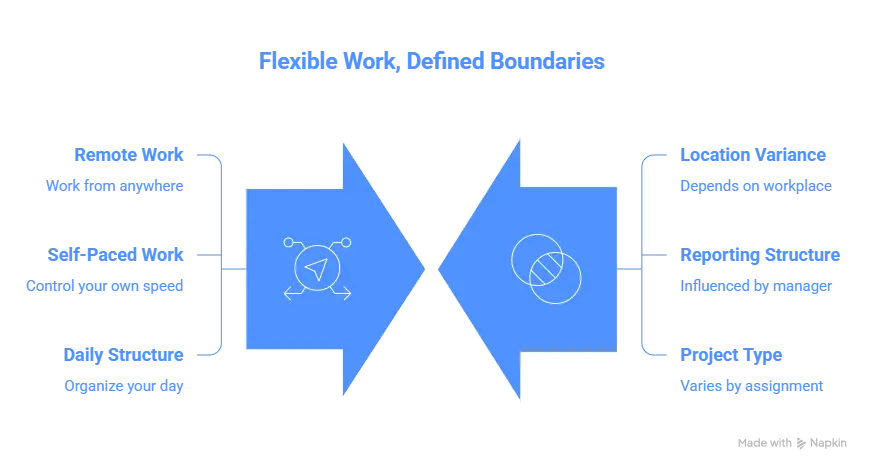
The honest answer? It depends. Work-life balance as a software engineer is not a fixed experience. It varies based on where you work, who you report to, and what kind of projects you are on. Some engineers leave the office by 5 PM every day. Others are answering Slack messages at midnight. Both are common in 2026.
That said, software engineering still offers far more flexibility than most professions. You can often work from home, set your own pace, and control how you structure your day. That is a big deal. The challenge comes when that flexibility gets exploited, and the line between work and life gets blurry.
What Is Work-Life Balance for Software Engineers?
Work-life balance for software engineers means having enough control over your time to meet your professional responsibilities without letting them consume your personal life. It is not about working fewer hours. It is about working smarter, drawing clear lines, and making sure your job does not become your whole identity.
For developers, this usually involves managing tight deadlines, context switching between tasks, and staying current with rapidly changing technologies, all while trying to maintain a social life, physical health, and mental well-being. It is a constant juggling act, and in 2026, with AI adding pressure to ship more with smaller teams, it has gotten harder for many.
If you are thinking about entering the field, our guide on how long it takes to become a software engineer gives you a realistic timeline and what to expect before you even land your first role.
Why Is Work-Life Balance Important for Software Engineers?
Software development is cognitively demanding. Your brain is your main tool, and you cannot code well when you are exhausted. Poor work-life balance leads to slower output, more bugs, reduced creativity, and eventually full-blown burnout.
There is also a broader career argument. Engineers who maintain a healthy balance tend to stay in the field longer, grow faster, and produce better work. Those who do not often hit a wall within three to five years and either quit tech entirely or drag themselves through the motions.
On the employer side, organizations that invest in work-life balance see twice the productivity compared to those that do not, according to a Deloitte study. The math is simple: a rested developer is a productive developer.
Current Reality Check
Work-Life Balance Comparison Across FAANG Companies
If you spend any time on software engineer work-life balance threads on Reddit, you will notice one consistent theme: your experience at a FAANG company depends more on your team and manager than the company brand. That said, there are clear patterns when you look at Glassdoor and Comparably data at scale.
Here is a comparison table of FAANG companies based on 2025-2026 employee review data:
| Company | WLB Score | WLB Rating | Avg Hours/Week | Notable Perks |
| 4.4/5 | Excellent | 40–45 hrs | Free meals, fitness, flexible WFH | |
| Microsoft | 4.3/5 | Very Good | ~9.2 hrs/day | 4 wks vacation, sick time, hybrid |
| Apple | 3.2/5 | Below Average | 45–50 hrs | Stock options, strong culture, limited remote |
| Netflix | 3.8/5 | Good | 45–50 hrs | Unlimited PTO, high pay, freedom & responsibility |
| Amazon (Meta) | 2.8/5 | Poor–Fair | 50–60 hrs | Competitive pay, intense culture, on-call pressure |
Google consistently scores the highest for software engineer work-life balance among FAANG companies, sitting at 4.4 out of 5 on Glassdoor. Engineers describe it as a “playground for grownups” with free gourmet meals, on-site gyms, laundry services, and flexible working hours. Most teams expect around 40 to 45 hours per week with reasonable deadline pressure.
Google is also known for strong parental leave, mental wellness programs, and a culture that does not glorify overwork. New hires (called Nooglers) get three paid weeks of vacation that increases to five weeks after five years, which is well above the US average.
Apple
Apple lands at a D+ rating for work-life balance on Comparably, the lowest among FAANG companies. The culture is intense, the secrecy around projects adds stress, and the company’s preference for in-person work has frustrated many engineers who prefer flexibility. Apple appeared at #77 on Glassdoor’s Best Places to Work list for 2026, which is respectable overall, but its WLB scores lag behind peers.
That said, compensation is strong, the work is genuinely impactful, and the culture rewards excellence. If you thrive in high-standards environments and do not need remote flexibility, Apple can be a great fit.
Netflix
Netflix offers one of the most unusual WLB setups in tech. The company runs on a “freedom and responsibility” model, meaning you get unlimited PTO, flexible hours, and enormous autonomy. But you are also expected to perform at an extremely high level, consistently. There is no safety net for mediocrity.
For engineers who are self-directed and highly skilled, Netflix can feel like an ideal setup. For those who need structure or who are earlier in their careers, the pressure can feel relentless. WLB scores sit around 3.8 out of 5 on Glassdoor.
Facebook (Meta)
Meta has one of the worst reputations for work-life balance among prominent tech companies. Over a quarter of Meta’s Glassdoor reviews specifically flag dissatisfaction with WLB, making it the most cited concern in employee feedback. Engineers report intense sprint cycles, a culture of constant urgency, and difficulty fully disconnecting.
The pay is exceptional and the remote-work policy is generous, but many developers on Reddit describe the environment as exhausting over the long term. If WLB is your top priority, Meta is generally not recommended as a first choice.
Amazon
Amazon has the lowest WLB scores among FAANG companies, and that reputation is consistent across Glassdoor, Comparably, and Reddit threads. The company’s leadership principles create a highly competitive environment, and on-call responsibilities can bleed into evenings and weekends regularly.
AWS teams tend to report better balance than other Amazon divisions, but the overall culture is demanding. If you are evaluating Amazon, go in with clear expectations and be intentional about the specific team and manager you land on.
Typical Hours Software Engineers Work
According to Stack Overflow data, most software engineers work between 40 and 44 hours per week. Tech managers can push to 47 hours or more. At startups, expect 50 to 60 hours, especially pre-launch. In the gaming industry, during crunch periods, engineers can work up to 90 hours a week.
The average American workday has grown over the decades, and remote work has accelerated this trend. When you work from home, the physical boundary of “leaving the office” disappears, and logging back in after dinner becomes easy. Over time, that habit compounds into chronic overwork.
For those exploring the broader career landscape, our software engineer career path guide breaks down what to expect at each level and how workload typically shifts as you advance.
Microsoft Work-Life Balance Practices
Microsoft is one of the standout performers on work-life balance across big tech. It ranked number one on Forbes’ 2025 tech employer list, and its culture has been deliberately shaped toward sustainability under CEO Satya Nadella.
Nadella famously reframed the conversation from work-life “balance” to work-life “harmony.” His argument is that separating work and life into competing categories creates a false trade-off. Instead, when your work feels meaningful and manageable, both sides benefit.
The data backs this up. Comparably reports that 72% of Microsoft employees are satisfied with their work-life balance, 83% describe their work environment as positive, and 60% say they do not experience burnout. Engineers work an average of 9.2 hours per day, which is reasonable for the industry. Microsoft also provides 4 weeks of vacation, 2 weeks of sick time, and 10 holidays annually.
Common Challenges
High Workload and Poor Project Management
One of the biggest drivers of poor work-life balance in software engineering is not the work itself, but how it is managed. Unclear goals, constantly shifting priorities, and scope creep create a situation where engineers are always reactive rather than focused.

When project management is weak, developers absorb the pressure. Deadlines that were never realistic become the engineer’s personal emergency. This pattern, repeated over months, is one of the most reliable paths to developer burnout.
Good software engineering practices around project planning, sprint structuring, and communication can reduce this pressure significantly. Both engineers and team leads benefit from understanding these principles.
Burnout Signs and Symptoms
Software engineer burnout is more common than most people admit. A 2026 survey found that 65% of engineers still experience burnout despite the widespread adoption of AI tools. A separate report put the figure for security and development professionals at 58%. These are not outlier numbers.
Burnout does not usually arrive suddenly. It builds slowly, and by the time it is obvious, it has already been doing damage for months. Here is what to watch for:
Emotional and Mental Tiredness
The first sign is usually a creeping exhaustion that sleep does not fix. You wake up tired. You feel a growing sense of detachment from your work, like you are going through the motions. Tasks that used to feel interesting now feel pointless. This is emotional depletion, and it is the earliest indicator of burnout.
In a 2020 developer survey, 80% of respondents said they experienced a lack of energy to complete their work or personal coding projects. That is a striking number and a clear signal that developer mental health needs more attention across the industry.
Lack of Motivation
Motivation loss in software engineers often shows up as procrastination, avoidance of new challenges, and a general indifference toward code quality. You stop caring if the solution is elegant. You just want to close the ticket. Forty-three percent of developers in one survey admitted feeling critical about the whole idea of writing code, which is a significant red flag.
This is different from a bad day. When lack of motivation becomes your default state for weeks, that is burnout talking.
Physical Symptoms
Burnout is not just in your head. Physical signs include frequent headaches, disrupted sleep, back and neck pain from tension, and a weakened immune system that leaves you catching every cold. Stanford researchers estimated that workplace burnout contributes to nearly $190 billion in healthcare costs annually in the US.
If you are getting sick more often, losing sleep, or noticing physical tension you cannot shake, your body is trying to tell you something your mind might be ignoring.
Root Causes: Repetition, Impostor Syndrome, Lack of Autonomy
Not all burnout comes from overwork. Some of the most insidious causes are subtler. Repetitive, monotonous tasks drain developers who want to solve interesting problems. Impostor syndrome, the persistent feeling that you are not good enough despite evidence to the contrary, creates a low-level anxiety that compounds over time, especially in high-achieving environments like FAANG companies.
Lack of autonomy is another major factor. When engineers have no say in what they build, how they build it, or when it is due, coding job satisfaction collapses. The sense of meaninglessness that follows is one of the strongest predictors of burnout, regardless of how much someone is being paid.
Value misalignment also plays a role. A developer who cares about privacy working on ad-tracking software, for example, experiences a constant internal tension that chips away at engagement over time.
Step-by-Step Strategy to Achieve Balance
Set Clear Boundaries and Unplug
The most important habit you can build as a software engineer is the ability to stop. Not slow down, but actually stop. That means setting a fixed end time for your workday and sticking to it, turning off Slack notifications after hours, and not checking email from bed.
This sounds simple, but it requires intention, especially if you work remotely. Without a physical commute, the transition from “work mode” to “personal time” does not happen automatically. You have to create that transition deliberately. A short walk, a set shutdown ritual, or even just closing your laptop at a specific time can create the psychological boundary your brain needs.
Prioritize Tasks and Practice Time Management
Not every task is equally important, and treating them as if they are is one of the fastest ways to feel overwhelmed. Start your day by identifying the two or three things that actually matter and work on those first while your focus is sharpest.
Agile methods help by breaking large projects into smaller, manageable chunks. Techniques like the Pomodoro method, where you work in focused 25-minute intervals followed by short breaks, help maintain concentration and prevent mental fatigue. The goal is to work in a way that protects your energy, not just your calendar.
Understanding the software engineer skills required to work efficiently will also help you identify where to invest your learning time to reduce the effort behind everyday tasks.
Take Regular Breaks and Use Vacation Time
This one sounds obvious, but data shows most developers do not do it consistently. Regular breaks during the workday are not laziness. They are maintenance. Your brain literally needs rest to consolidate information, generate ideas, and sustain focus.
Equally important: use your vacation time. Actually use it. Not just to work from a different location, but to genuinely unplug. Microsoft gives its employees nearly two months of time off annually when you add it all up. Engineers who use that time return more creative, more focused, and less irritable than those who do not.
Focus on Physical and Mental Well-Being
Physical activity is one of the most effective tools against software developer stress. Even a 20-minute walk breaks up the sedentary pattern of a coding day and reduces cortisol levels. Engineers who exercise regularly report significantly lower stress levels and higher job satisfaction.
Mental health deserves the same attention. Therapy, journaling, meditation, or even just regular conversations with people outside of work can help process the cognitive load that comes with a demanding technical career. Developer mental health is still under-discussed in the industry, but that is slowly changing.
Realistic Goal-Setting and Calendar Blocking
Overpromising is one of the most common sources of stress in software engineering. When you commit to timelines that are not realistic, you set yourself up for late nights, weekend work, and the guilt of consistently missing targets.
Protect deep work by blocking time on your calendar. If two hours of uninterrupted focus are not scheduled, they will not happen. Calendar blocking is not about rigidity. It is about making sure your priorities actually get your attention instead of being pushed aside by reactive work and meetings.
Factors for Better Work-Life Balance
Workplace Stress and Environment
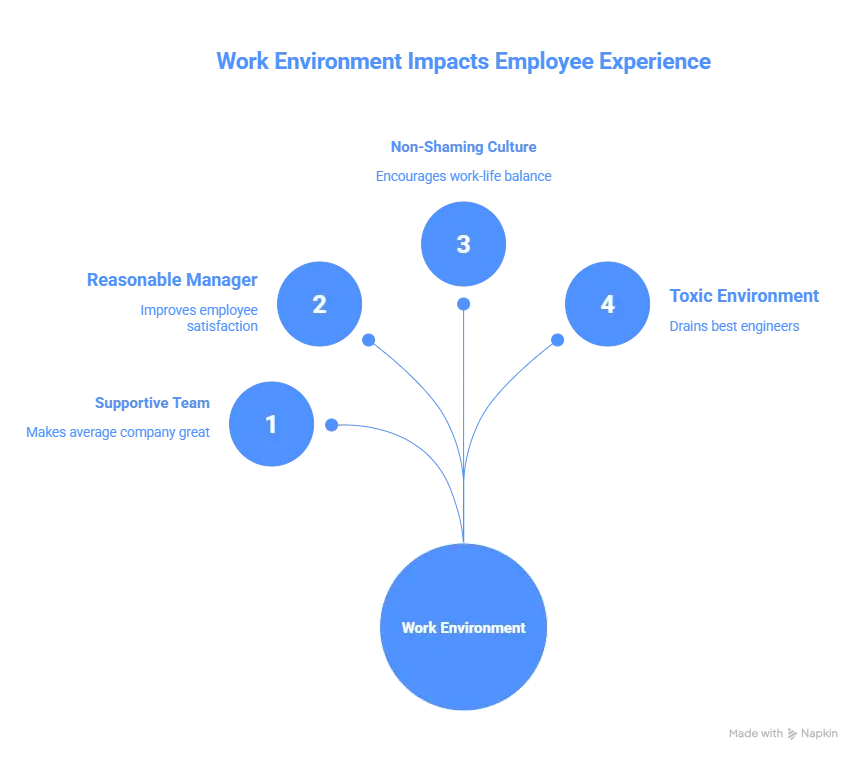
The environment you work in shapes your experience more than almost any other factor. A supportive team, a reasonable manager, and a culture that does not shame people for logging off on time can make an average company feel like a great place to work. The reverse is also true. Toxic environments drain the best engineers regardless of perks or pay.
Red flags to watch for: blame culture, unclear expectations, no psychological safety to speak up about workload, and management that models overwork as the norm. These factors are consistently linked to higher burnout rates in software teams.
Job Satisfaction and Productivity Impact
There is a direct connection between coding job satisfaction and productivity. A 2022 Stack Overflow survey found that 58% of developers listed work-life balance as one of the top three factors in their job happiness. When engineers feel valued, autonomous, and fairly treated, they produce better work faster.
The opposite also holds. Burned-out developers write more bugs, take longer to complete tasks, and are more likely to make architectural decisions that create technical debt. From a pure output perspective, pushing engineers too hard backfires.
If you are building a career in this field, having a strong software engineer portfolio is one way to give yourself leverage to choose employers who actually respect your time.
How Employers Can Help
Work-life balance is not solely the engineer’s responsibility. Organizations play a major role. The most effective things employers can do include: setting realistic sprint goals, normalizing time off, measuring output over hours logged, providing mental health resources, and creating channels for engineers to raise concerns about workload without fear.
Interestingly, 43% of developers in a recent survey said leadership at their company was out of touch with the challenges their teams actually face. Closing that gap starts with managers who listen and structures that do not demand heroics as standard operating procedure.
Burnout Prevention Strategies
Identify Stress Causes
Before you can fix burnout, you have to understand what is driving it. For some engineers, it is workload volume. For others, it is a specific relationship, a misalignment with the product they are building, or the feeling of being stuck in place without growth.
Keeping a brief daily log of what drained you and what energized you can reveal patterns over time. Once you can name the source, you can take targeted action rather than just grinding through the exhaustion.
Learn New Skills and Technologies
One of the quieter burnout triggers is stagnation. When engineers are doing the same work with the same tools for too long, the lack of novelty becomes its own kind of fatigue. Learning something new, whether a different programming language, a framework, or even a non-technical skill, can re-engage the curiosity that made you want to code in the first place.
Exploring the best programming languages to learn or picking up a new tool that improves your workflow is a productive way to break the monotony and add value at the same time.
Change Perspective and Work Setup
Sometimes the environment itself needs to change. That might mean switching to a different team within your company, moving to a different role, or adjusting your physical workspace. Remote engineers in particular benefit from setting up a dedicated workspace that helps the brain associate that space with work, and the rest of the home with rest.
If you have been at the same company for years and nothing has improved despite your efforts, it may be worth exploring other options. Life-work balance is not a luxury. It is a legitimate factor in career decisions, and the best engineers treat it as one.
Check out our overview of software engineer career options if you are considering a pivot within the field. There are paths in this industry that naturally offer better balance than others.

Also read: Software Engineer Salary & Hourly Rates (US Focus 2026)
Frequently Asked Questions
-
Is Burnout Common in Software Engineering?
Yes, extremely—2026 surveys show 65% of engineers burn out despite AI workload relief. 58% of devsec pros agree, far above the 51% US job average. Nearly 75% face it sometime in their career.
-
How Can Developers Achieve Good Work-Life Balance?
Combine boundaries, prioritization, and recovery: End workdays firmly, tackle top tasks first, use all PTO fully, add exercise/relationships. Build sustainably from day one via our guide on becoming a software engineer without a degree.
-
How Do FAANG Companies Maintain Balance?
Varies: Google/Microsoft top with flexible hours, PTO, and anti-burnout cultures. Netflix stresses autonomy/high output; Meta/Amazon rank low on intense sprints/on-call. Your team/manager defines reality.
-
What Are the Best Work-Life Balance Companies for Software Engineers?
2026 Glassdoor fave: NVIDIA (flat structure, clear priorities). Strong runners-up: Microsoft, Adobe, Cisco, Salesforce. Remote standouts: Atlassian, Dropbox, GitLab for sane workloads.
-
Does Remote Work Help With Work-Life Balance?
Complicated win: Ditches commutes/flexes schedules, but erases home-work lines—48% feel employer indifference. Thrive by enforcing rigid boundaries proactively.
-
What Are the Signs You Need to Address Your Work-Life Balance?
Fatigue despite rest, passion fade, headaches/illness, spilling irritability, nonstop message checks. Persistent 2-3 weeks? Talk to manager, vacation, or reassess. Vet culture with our software engineer interview questions.
-
Can You Have Good Work-Life Balance at a Startup?
Yes, but rare—early stages demand 50-60 hours for equity/rapid growth. Worth it short-term if you own it; set personal deadlines to prevent “temporary” becoming forever.
Conclusion
Software engineer work-life balance in 2026 is achievable, but it does not happen by accident. The reality is that most engineers are working in an industry that structurally rewards overwork, where burnout affects nearly two-thirds of professionals and where the line between work and life was already blurry before remote work made it nearly invisible.
But the picture is not all grim. The best companies, Google, Microsoft, NVIDIA, Adobe, and others, are proving that high performance and sustainable culture are not mutually exclusive. And individual engineers who build strong boundaries, manage their time intentionally, and take their mental and physical health seriously are able to sustain long, rewarding careers without burning out.
The key takeaways from this guide:
Whether you are already in the field or just starting out, your software engineer career does not have to come at the cost of everything else. The engineers who thrive long-term are not the ones who work the most hours. They are the ones who have learned to work well, recover well, and know when to close the laptop.
If you are exploring your options in the field, it is worth reading about the broader landscape:

Shahzada Muhammad Ali Qureshi (Leeo)
I’m Shahzada — a software engineer by education and an SEO professional by trade. I built WhatIsTheSalary.com to go beyond just showing salary numbers — every page is manually researched across sources like BLS, Glassdoor, LinkedIn Salary, and PayScale to give you the full picture in one place. If you found what you were looking for here, that’s exactly the point.