TLDR
Best Software Engineering Degrees in Australia (2026 Rankings) reveal the pathway to escaping the career trap of outdated skills and low pay.
Imagine spending years coding only to realize your degree won’t land you a job—while graduates from Australia’s top programs are already earning six figures at tech giants.
The problem? Most universities teach theory without real industry experience. The solution?Australia’s elite programs blend cutting-edge AI, cloud computing, and mandatory internships with companies like Atlassian and Google.
These degrees don’t just teach you to code—they transform you into a problem-solver ready to build the future. Your dream tech career starts with choosing the right program.
Why Your Degree Choice Matters More Than Ever in 2026
I’ve spoken with dozens of software engineering graduates in Sydney and Melbourne over the past few years, and the pattern is clear: which university you attend shapes your first three years more than your GPA ever will.
The job market in 2026 is competitive. Australia’s tech industry is booming, yes, but so is the candidate pool. Employers at Atlassian, Canva, Afterpay, and major consulting firms actively recruit from specific campuses.
Graduate programs at these companies fill up fast, and your university’s industry relationships often determine whether you even get an interview.
This guide ranks the best software engineering degrees in Australia for 2026 using real data from the QS World University Rankings, Times Higher Education Subject Rankings, EduRank research metrics, and QILT Graduate Outcomes Survey. I’ve also pulled fresh salary data so you know what each path actually pays.
2026 University Rankings at a Glance
Here is a side-by-side comparison of Australia’s top software engineering universities based on 2026 global rankings, accreditation, degree structure, and indicative international tuition fees.
| University | QS Rank (Eng & Tech 2026) | Degree Type | Duration | Intl Fees (AUD/yr) | Engineers Aus Accredited |
| UNSW Sydney | #19 World | BE (Hons) Software Eng. | 4 years | ~$52,000 | Yes |
| Univ. of Melbourne | #13 World | BE + MEng (integrated) | 4+2 years | ~$51,840 | Yes |
| Monash University | #36 World | BE (Hons) Software Eng. | 4 years | ~$48,000 | Yes |
| ANU Canberra | #32 World | BE (Hons) Software Eng. | 4 years | ~$56,120 | Yes |
| Univ. of Sydney | #25 World | BE (Hons) Software Eng. | 4 years | ~$54,000 | Yes |
| RMIT University | #123 Eng & Tech | BE (Hons) / BE (Prof) | 4 years | ~$46,000 | Yes |
| Adelaide University | Top 100 Eng | BE (Hons) Software Eng. | 4 years | ~$48,000 | Yes |
| UTS Sydney | Top 200 Eng | BE (Hons) Software Eng. | 4 years | ~$44,000 | Yes |
Top Software Engineering Universities in Australia: Full 2026 Breakdown
1. UNSW Sydney
UNSW sits at #19 globally for Engineering & Technology in the 2026 QS rankings, making it the top-ranked engineering university in Australia for the third consecutive year. The Bachelor of Engineering (Honours) in Software Engineering is a four-year program fully accredited by Engineers Australia and recognised under the Washington Accord in over 20 countries.
What makes UNSW stand out is employer reputation. QS assigns 15% of its score to this metric, and UNSW performs exceptionally well here. Graduates from UNSW’s engineering and IT programs start at upwards of AUD $85,000 according to QILT Graduate Outcomes data.
For anyone targeting a career at a Sydney-based tech company, a Big 4 consultancy, or a global firm with Australian operations, UNSW is the strongest single choice in 2026.
2. University of Melbourne
The University of Melbourne uses a unique two-stage model. Undergraduates complete a Bachelor of Science, then continue to a two-year Master of Engineering. This mirrors the EUR-ACE accreditation structure used across Europe and gives Melbourne graduates an edge in international job markets.
The Times Higher Education Subject Rankings for 2026 place Melbourne first in Australia for computer science and IT. The Master of Software Engineering offers specialisations in AI, cybersecurity, distributed computing, and human-computer interaction, which maps well to what Australian employers are hiring for right now.

International tuition runs around AUD $51,840 per year for the science pathway. It is a bigger time and financial investment than a standard four-year program, but the employer recognition and research depth justify it for postgraduate-focused students.
3. ANU Canberra
ANU ranks #32 globally in the 2026 QS rankings overall and #73 for Engineering & Technology. The Bachelor of Engineering (Honours) in Software Engineering is built on what ANU describes as a multidisciplinary systems approach, which means students work across hardware, software, and systems design rather than narrowing too early.
ANU’s location in Canberra is an underrated advantage. The concentration of government agencies, defence contractors, and research institutions creates a unique hiring pipeline that simply does not exist in Sydney or Melbourne. If you are interested in cybersecurity, defence systems, or public sector tech, ANU is worth serious consideration.
International fees sit around AUD $56,120 per year, making it the priciest option on this list, but scholarship availability through the ANU Chancellor’s International Scholarship partially offsets that.
4. Monash University
Monash improved from #42 to #36 globally in the 2026 QS rankings. The Bachelor of Engineering (Honours) in Software Engineering is a four-year, Engineers Australia-accredited program with strong industry placement components built into the curriculum.
Monash has historically been strong in renewable energy and biomedical engineering, but its software engineering output has grown significantly. The university’s Clayton and Caulfield campuses both run industry partnership programs that connect students with local and international tech employers.
International fees are around AUD $48,000 per year, placing Monash in the mid-range for cost among the Group of Eight universities.
5. University of Sydney
Sydney dropped to #25 globally in the 2026 QS overall rankings but remains ranked #18 globally for Engineering & Technology as a subject. The Bachelor of Engineering Honours in Software Engineering runs four years, requires Mathematics Extension 1, and has a strong research pathway for students interested in PhD progression.
UTS boasts graduate employment rates above 90% in IT and nursing according to QILT data. Sydney’s tech ecosystem means students here get direct access to Australia’s largest startup community and most of the major financial services technology employers.
6. RMIT University
RMIT ranks #123 globally for Engineering & Technology in 2026 and is consistently described as Australia’s leading applied-engineering institution. The Bachelor of Engineering (Honours) in Software Engineering and the Bachelor of Software Engineering (Professional) are both available, with the Professional stream including an extended industry placement.
RMIT’s strongest links are to aviation, manufacturing, and rail industries, but its Melbourne CBD campus puts graduates in the middle of a thriving tech precinct. For students who want hands-on, work-integrated learning baked into the degree structure rather than bolted on, RMIT is a solid choice.
7. Adelaide University (formerly Univ. of Adelaide + UniSA)
Adelaide University, which consolidated the University of Adelaide and UniSA in 2026, now offers a Bachelor of Engineering (Honours) in Software Engineering across its campuses. South Australia’s relatively favourable state nomination policies under the Skilled Migration program make this university particularly attractive for international students who want a post-study pathway to permanent residency.
Fees are around AUD $48,000 per year, and the program is accredited by Engineers Australia. Adelaide’s lower cost of living compared to Sydney or Melbourne also means your dollar goes further during the degree.
8. UTS Sydney
UTS may not carry the same name recognition as UNSW or Sydney, but it consistently delivers strong graduate outcomes. UTS places strong emphasis on industry-connected learning and real-world project work. For students who are clear they want a direct industry path rather than a research career, UTS is a smart, cost-effective choice at around AUD $44,000 per year in international fees.
What Actually Makes a Software Engineering Degree Worth Your Money
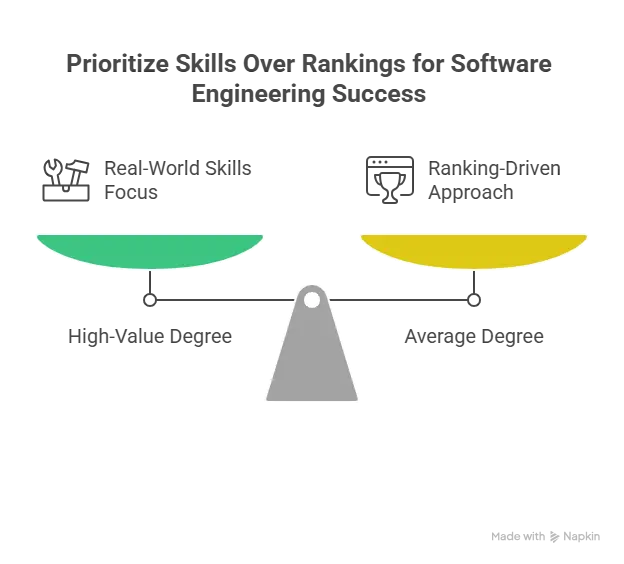
There are five things that genuinely separate a high-value software engineering degree from an average one in 2026. Rankings tell part of the story, but they do not tell all of it.
Engineers Australia Accreditation
This is the starting point, not a bonus. If a degree is not accredited by Engineers Australia, it does not qualify you for professional registration in Australia and is not recognised under the Washington Accord. Every degree on this list is accredited. Do not consider any program that is not.
Work-Integrated Learning
Industry placement, capstone projects with real employers, and embedded internships have become the differentiator between degrees that produce job-ready graduates and those that do not. RMIT’s Professional stream and Monash’s industry partnership programs are the clearest examples. Ask any university you are considering how many students complete a formal work placement and what companies participate.
Research Output and Lab Access
For students interested in AI, machine learning, distributed systems, or cybersecurity, research access matters. EduRank’s March 2026 update ranked Australian universities based on 901,000 citations from 31,600 academic papers. UNSW came out on top for software engineering research performance in Oceania. ANU and Melbourne also rank highly here.
Graduate Salary Outcomes
According to QILT Graduate Outcomes Survey data, the median starting salary for Australian undergraduates is AUD $71,000. Software engineering graduates from top-tier universities with industry placements consistently outperform this. Fresh graduate software engineers at Atlassian, Canva, and similar companies in Sydney start at AUD $85,000 to $95,000 according to Glassdoor and industry reports from 2026.
See the full graduate salary breakdown at: WhatIsTheSalary.com Software Engineer Guide
Post-Study Migration Pathways
For international students, which university you attend affects more than just job prospects. South Australian universities benefit from favourable state nomination policies. Universities recognised under the Temporary Graduate Visa (subclass 485) framework give international graduates 2 to 4 years of post-study work rights depending on location and qualification level. This is worth factoring into your decision.
What Software Engineering Graduates Actually Earn in 2026
Let me give you the real numbers, not the aspirational marketing copy.
According to Glassdoor’s April 2026 data, the average graduate software engineer salary in Australia sits at AUD $88,000 per year, with the typical range falling between AUD $77,500 and $99,250 annually. In Sydney specifically, the average climbs to AUD $93,000, with a range of $81,000 to $133,000.
PayScale reports lower figures, averaging around AUD $62,000 to $72,000 for entry-level graduate roles in Melbourne. The discrepancy exists because PayScale captures a broader pool of job titles including graduate-in-training programs at smaller companies. Glassdoor data skews toward tech-specific roles.
SEEK, Australia’s largest job platform, puts the average software engineer salary across all experience levels at AUD $105,000 to $125,000 as of May 2026.
More salary data at: Software Engineer Career Paths in Australia
Software Engineering Degree vs. Bootcamp in 2026: What Employers Actually Prefer
This is a question I hear constantly, and most ranking articles skip it entirely. So let me be direct about what the data shows in 2026.
For roles at large Australian employers, government agencies, defence contractors, and companies that require Engineers Australia registration, a full accredited degree is mandatory. There is no way around it. You cannot register as a professional engineer in Australia without one.
For startup roles, product companies, and smaller tech firms, bootcamp graduates and self-taught developers do get hired. But the salary floor is lower, the title ceiling is lower, and the path to senior roles is longer without the formal credentials.
The honest answer is this: a three to four month bootcamp will get you in the door faster. A four-year accredited degree from UNSW, Melbourne, or ANU will pay you more, open more doors, and give you formal standing in the profession for the rest of your career. They are not competing for the same outcome.
Related: Software Engineering Skills Australia Employers Want in 2026
How Australian Universities Are Updating Curricula for the AI Era
This is another gap that most 2026 ranking articles do not address. The software engineering curriculum at most Australian universities looked very similar in 2022 and 2023. In 2026, that has started to change.
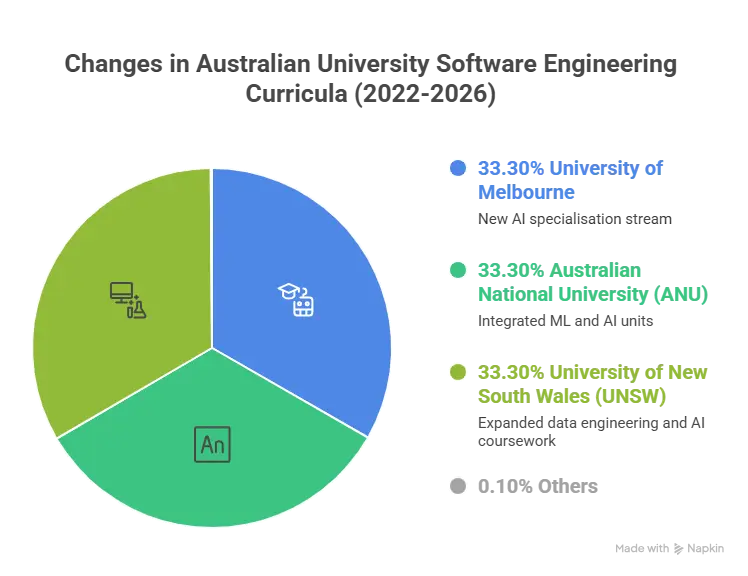
The University of Melbourne’s Master of Software Engineering now has a full AI specialisation stream. ANU has integrated machine learning and systems AI into its core engineering units. UNSW has expanded its data engineering and AI-adjacent coursework across the BE Honours program.
If you are choosing a degree in 2026 with the intent of working in AI-adjacent roles, cloud infrastructure, or large-scale distributed systems, look specifically at the unit list for years three and four, not the marketing overview.
The universities that have updated their third-year electives with content on LLM integration, cloud-native architecture, and AI-assisted software development are the ones positioning graduates well for the next decade.
Related: Australian Software Engineers Using AI in 2026
Programming Languages Taught and Why It Matters
Most software engineering degrees in Australia teach Python, Java, and C++ in the first two years. What differentiates universities at the senior level is what they teach in years three and four.
UNSW and Melbourne have incorporated Rust, Go, and TypeScript into advanced electives. RMIT’s applied programs lean heavily on JavaScript frameworks and DevOps tooling. ANU’s systems-oriented approach means students get deeper exposure to lower-level languages and embedded systems programming.
If your goal is to work in fintech or enterprise software, Java, Python, and SQL depth matters most. If you want cloud roles at AWS, Google, or a startup, knowing Go, Terraform, and containerisation tools from day one is a real advantage.
See also: Best Programming Languages to Learn in 2026
Domestic vs. International Students: Cost Reality Check
If you are a domestic Australian student with a Commonwealth-supported place, your annual student contribution for engineering is capped and covered by HECS-HELP. You repay nothing until you earn above the minimum threshold, which in 2026 sits at approximately AUD $54,000. This makes Australian software engineering degrees among the best-value degrees in the world for domestic students.
International students face a very different reality. Tuition fees range from AUD $44,000 per year at UTS to $56,120 at ANU. Add living costs, which the University of Melbourne estimates at AUD $22,000 to $27,000 per year in Melbourne, and you are looking at a total four-year investment of AUD $265,000 to $330,000.
That is a significant commitment. The return on investment calculation works if you secure a graduate role in Australia post-study, use your post-study work rights, and progress into mid-level roles within two to three years. The numbers are less compelling if you plan to return home immediately after graduating.
See: Software Engineering Jobs Australia 2026

Four Common Misconceptions About Software Engineering Degrees in Australia
1. A Higher Overall QS Rank Always Means a Better Software Engineering Program
Not necessarily. The University of Sydney dropped to #25 overall in the 2026 QS rankings but remains #18 globally for Engineering & Technology as a subject. Subject rankings are what matter when choosing an engineering program, not overall university rank.
2. Only Group of Eight Universities Are Worth Attending
RMIT, UTS, and Queensland University of Technology (QUT) all have strong industry connections, high graduate employment rates, and real employer recognition. For students who want applied, work-integrated learning over pure research prestige, these universities often outperform the G8 in practical graduate outcomes.
3. Your GPA Determines Your Starting Salary
According to QILT data and industry recruitment patterns, employers at Australian tech companies weigh work-integrated learning experience, internship history, and technical portfolio far more heavily than GPA. A student with a 5.0 GPA and no internship experience will generally be outcompeted by a 6.0 student who completed an industry placement.
4. All Engineers Australia-Accredited Degrees Are Equivalent
Accreditation is a floor, not a ceiling. Two degrees can both be accredited and produce very different graduate outcomes based on curriculum depth, industry relationships, and research quality. Use accreditation as your filter, then use ranking and graduate outcomes data to choose within that filtered list.
Frequently Asked Questions
-
Which university is best for software engineering in Australia in 2026?
UNSW Sydney ranks #1 in Australia for engineering and technology in the 2026 QS World University Rankings. For computer science and IT specifically, the University of Melbourne leads in the Times Higher Education 2026 subject rankings. The best choice depends on your career goals, study mode preference, and whether you are a domestic or international student.
-
Is a software engineering degree from Australia recognised internationally?
Yes, if the degree is accredited by Engineers Australia. Australia is a signatory to the Washington Accord, which means accredited degrees are recognised in over 20 countries including the UK, USA, Canada, and Singapore. Always verify accreditation on the Engineers Australia register before enrolling.
-
How much do software engineering graduates earn in Australia?
Based on Glassdoor data from April 2026, graduate software engineers in Australia average AUD $88,000 per year, with a typical range of AUD $77,500 to $99,250. In Sydney, the average is AUD $93,000. Top-tier employers like Atlassian and Canva start graduates at AUD $85,000 to $95,000.
-
How long does a software engineering degree take in Australia?
Most software engineering bachelor’s degrees in Australia take four years full-time. The University of Melbourne operates on a two-stage model where students complete a three-year bachelor’s and then a two-year Master of Engineering. Honours programs are standard at most universities and are built into the four-year duration rather than added as a separate year.
-
Do I need a software engineering degree specifically, or will a computer science degree work?
For roles requiring Engineers Australia registration, you need an accredited engineering degree, which computer science degrees typically do not provide. For most software developer and programmer roles in the private sector, a computer science degree is accepted equally. If you want the option of professional engineering registration or work in infrastructure, embedded systems, or government tech, choose a software engineering degree specifically.
-
What ATAR or entry score do I need for software engineering at a top Australian university?
ATAR requirements vary by institution and year. UNSW and Melbourne typically require an ATAR of 95 or above for engineering programs. Monash, RMIT, and UTS have lower thresholds, generally in the 80 to 90 range. International students should check specific IELTS and academic prerequisites directly with the university admissions office, as these can change between intake rounds.
Share Your Experience
If you are currently studying or have recently graduated from a software engineering program in Australia, I would genuinely like to hear how your experience compares to what is written here. Did your degree prepare you well for your first role? Was the industry placement component as useful as advertised? Drop a comment below, these real-world accounts are far more useful than any ranking table.
How This Article Was Created
The data in this article was gathered in May 2026. University rankings are sourced from the QS World University Rankings 2026 (Engineering & Technology subject table), Times Higher Education World University Rankings by Subject 2026 (Computer Science), and EduRank’s March 2026 research performance update for Australia.
Salary figures are sourced from Glassdoor (Australia, April-May 2026), SEEK (May 2026), Leverage Edu industry analysis (April 2026), and QILT Graduate Outcomes Survey public data. No salary figures were fabricated. Where sources disagreed, both figures were reported with source attribution.
Tuition fee figures are indicative international student rates sourced directly from university admissions pages. Domestic HECS-HELP contribution amounts are set by the Australian Government and subject to change. This article was written to help prospective students make an informed decision, not to recruit for any institution or advertise any third-party service.

Shahzada Muhammad Ali Qureshi (Leeo)
I’m Shahzada — a software engineer by education and an SEO professional by trade. I built WhatIsTheSalary.com to go beyond just showing salary numbers — every page is manually researched across sources like BLS, Glassdoor, LinkedIn Salary, and PayScale to give you the full picture in one place. If you found what you were looking for here, that’s exactly the point.