TLDR: Quick Takeaways
How to become a freelance proofreader is one of the most searched career questions right now, and for good reason. Millions of people are sitting on a skill that pays real money, but they’re stuck Googling the same recycled advice, waiting for the “right time,” or convinced they need a degree they’ll never get. Meanwhile, someone with no experience and three portfolio samples just landed their first $45/hr client this week.
The gap isn’t talent. It’s a clear roadmap. At WhatIsTheSalary.com we break down exactly what real-world earnings look like before you commit to a career path. And the data on proofreading is surprisingly strong for a skill you can build in weeks, not years.
This guide gives you the full picture: what proofreaders actually do, what they earn in 2026, how to pick a niche, and how to land your first paying client without sending a single cold pitch into the void.
What Does a Freelance Proofreader Actually Do?
Let’s clear this up because a lot of people confuse proofreading with editing. They’re not the same.
Proofreading is the final pass. You’re checking for spelling errors, punctuation mistakes, inconsistent formatting, repeated words, and grammar issues. You’re not restructuring sentences or rewriting paragraphs. If you start doing that without being asked, you’ve crossed into copyediting territory and your client may feel like you overstepped.
Proofreaders work on:
The role is remote by nature. You work asynchronously, usually using tools like Microsoft Word’s Track Changes feature, Google Docs comments, or dedicated editing software like PerfectIt.
Do You Need a Degree to Become a Freelance Proofreader?
No. And I want to say that clearly because there’s a lot of unnecessary gatekeeping around this.
Most clients never ask for your diploma. What they want is proof that you can catch errors reliably. That proof usually comes in the form of a test edit or a portfolio sample, not a transcript.
That said, having a background in English, journalism, communications, or a related field helps — especially in the early stages when you’re building credibility. But it’s not a requirement. Working proofreaders in 2026 come from every background imaginable, from nursing to law to software development.
If you have strong grammar skills, a sharp eye for inconsistency, and the patience to read slowly on purpose, you already have the foundation.
If you’re exploring a career in tech alongside your writing work, see this guide on cybersecurity careers that don’t require a degree (https://whatisthesalary.com/careers/cybersecurity-analyst-without-a-degree/).
Skills You Need to Succeed as a Freelance Proofreader
Beyond knowing grammar rules, the best proofreaders share a specific set of habits and mindset traits:
Attention to Detail Under Fatigue
Anyone can catch a typo on page one. The job is catching it on page forty. You have to maintain focus across long documents, which is harder than it sounds.
Style Guide Familiarity
Different clients use different style guides. The main ones are:
You don’t need to memorize all of them. You need to know which one applies to each project and check it consistently.
English Variant Discipline
UK, US, Australian, and Canadian English differ in spelling, punctuation, and date format. Knowing which variant your client uses, and sticking to it, is non-negotiable.
Business Sense
Freelance proofreading requires business skills just as much as language skills. You need to handle invoicing, set rates, write contracts, follow up on payments, and manage client relationships. Treat this like a business from day one.
How to Become a Freelance Proofreader: Step by Step
Step 1: Build Core Language Skills
If you’re starting from scratch, spend a few weeks sharpening your grammar and punctuation knowledge. Free resources like Purdue OWL and Grammar Girl are genuinely good. You can also take structured proofreading courses from platforms like Proofread Anywhere or Knowadays, which offer beginner-level programs that require no prior qualifications.
Step 2: Pick a Niche
This is where most beginners go wrong. They try to proofread everything for everyone. The result is a vague profile that attracts low-paying clients or none at all.
Pick a niche before you pick a platform. The highest-paying niches in 2026 include:
Your niche doesn’t have to be permanent. But starting with one specific area makes your marketing 10 times clearer and your early clients much easier to find.
Step 3: Build a Portfolio
You need three to five before-and-after proofreading samples with tracked changes visible. Here’s how to get them without having clients yet:
The goal is to show your work, not your credentials. A client who sees a clean, well-annotated sample edit is far more likely to hire you than someone with a resume full of degrees and no samples.
Step 4: Set Your Rates
Pricing is where people undercut themselves most. Setting your rate too low attracts clients who don’t value the work and makes it nearly impossible to raise rates later.
According to the Editorial Freelancers Association, freelance proofreaders in 2026 charge a median rate of $25–$50 per hour, with specialist niches going higher. ZipRecruiter’s June 2026 data shows the average hourly rate for freelance remote proofreading at $31.25/hr.
| Experience Level | Hourly Rate | Monthly Income | Annual Income |
| Beginner (0–1 year) | $15–$25/hr | $1,200–$2,000 | $14,400–$24,000 |
| Intermediate (1–3 years) | $25–$45/hr | $2,500–$4,500 | $30,000–$54,000 |
| Experienced (3+ years) | $45–$75/hr | $4,500–$7,500 | $54,000–$90,000 |
| Specialist Niche (Legal/Academic) | $50–$80+/hr | $5,000–$8,000+ | $60,000–$96,000+ |
You can also charge per word. The Editorial Freelancers Association reports rates of $0.015–$0.04 per word for proofreading, depending on the document type and turnaround time.
Step 5: Choose Your Platforms
Where you list your services matters. Each platform attracts a different type of client and pays differently:
| Platform | Best For | Avg. Rate | Competition Level |
| Upwork | Long-term clients, B2B | $20–$60/hr | High |
| Fiverr | Quick gigs, beginners | $15–$40/hr | Very High |
| Reedsy | Book publishing niche | $30–$75/hr | Moderate |
| Scribendi | Academic & professional | $18–$35/hr | Low |
| ProofreadingServices.com | General documents | $20–$40/hr | Moderate |
| Wordvice | Academic (grad degree needed) | $25–$45/hr | Low |
Don’t spread yourself across all of them at once. Start on one platform, build five to ten strong reviews, then expand.
Step 6: Find Your First Clients
Your first clients probably won’t come from a platform. They’ll come from warm outreach. Tell everyone in your network that you’re offering proofreading services. Reach out directly to bloggers, self-published authors, local businesses, and content creators.
The job interview and resume side of your freelance life also matters. See this guide on passing ATS filters in US job applications (https://whatisthesalary.com/guides/ats-filters-in-us-job-applications/) if you’re also applying for employed editorial roles.
What Nobody Tells You About Pricing Your Proofreading Services
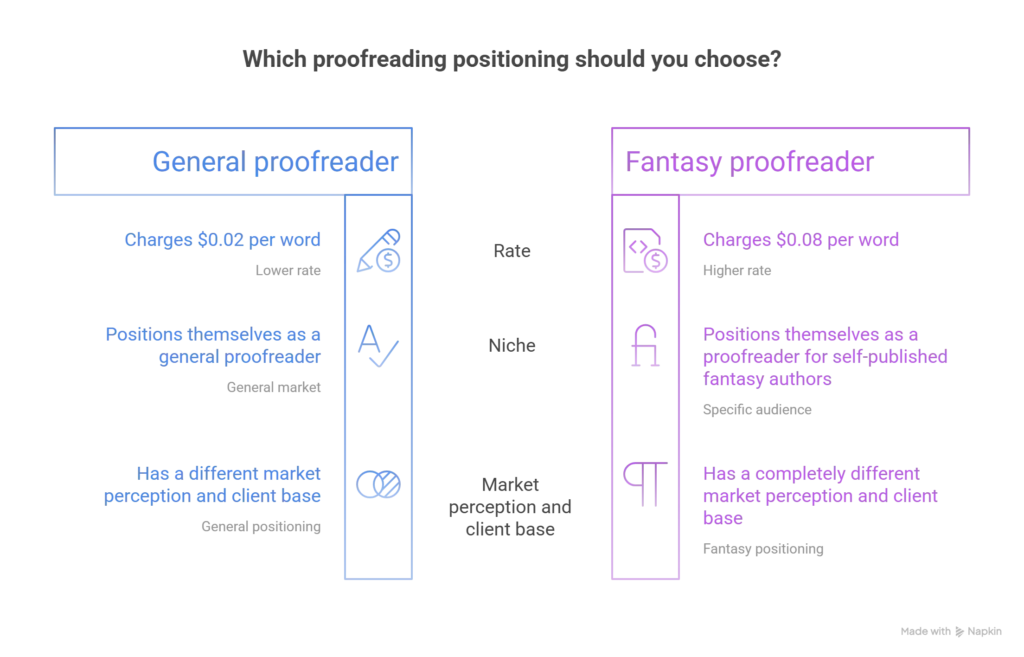
Two proofreaders working the same niche, same hours, with similar skills can earn completely different incomes. The difference is positioning.
One person charges $0.02 per word and positions themselves as a general proofreader. The other charges $0.08 per word and positions themselves as a proofreader for self-published fantasy authors. Same task, completely different market perception and client base.
Here’s what actually moves your rate up:
The people who fail at freelance proofreading usually do one of three things: they underprice and burn out, they spread across every niche instead of owning one, or they rely entirely on platforms without building any direct client relationships.
How AI Is Changing Freelance Proofreading in 2026
Here’s the conversation everyone avoids: will AI replace proofreaders?
The honest answer is no, but it’s changing the work. Tools like Grammarly, LanguageTool, and AI writing assistants handle surface-level spelling and grammar well. What they can’t do is catch nuance. They miss context-specific errors, inconsistent tone, style guide violations, and factual inconsistencies.
In 2026, the proofreaders earning the most are the ones who have added AI proofreading as a service. This means reviewing AI-generated content for brand voice accuracy, logical consistency, and human readability. Clients producing AI-assisted content at scale need a human in the loop. That human is you.
Building familiarity with tools like ChatGPT, Claude, Grammarly, and PerfectIt makes you more hirable, not less relevant.
If you’re interested in how data and technology roles are structured alongside editorial careers, the cybersecurity career path guide (https://whatisthesalary.com/careers/cybersecurity-career-path/) has useful framing on how to plan a progression.
Common Mistakes New Freelance Proofreaders Make
Mistake 1: Starting Without a Niche
Being a proofreader for everyone is the same as being a proofreader for no one. Generic profiles get ignored.
Mistake 2: Underpricing to Get Clients
Charging $5 for a 1,000-word proofread signals that your work isn’t worth much. Underpricing attracts clients who won’t pay more later. Price at the low end of the market rate, not below it.
Mistake 3: Crossing Into Editing Without Being Asked
If a client hired you to proofread, proofread. Rewriting their sentences without permission makes you look like you misunderstood the brief — even if your version is better.
Mistake 4: Skipping Contracts
Even for small projects, a simple contract protects you. It clarifies scope, rate, revision policy, and payment terms. Free contract templates are available through organizations like the Editorial Freelancers Association (EFA) and the Chartered Institute of Editing and Proofreading (CIEP).
How Long Does It Take to Become a Freelance Proofreader?
Realistically, you can land your first paying client within 30 days if you:
Building a stable freelance income takes longer, usually three to six months of consistent effort. By months nine to eighteen, established proofreaders with a solid portfolio, clear niche, and steady referrals regularly earn $3,500 to $6,000 per month working full-time equivalent hours.
Accelerators: Taking on AI proofreading projects, adding a second niche like academic editing, and building a simple website with testimonials can cut that timeline significantly.
If you’re comparing freelance income potential with salaried tech roles, the data scientist salary by city guide (https://whatisthesalary.com/it-salaries/data-scientist-salary-by-city/) gives a solid benchmark for context.
Legitimate Platforms and Job Sites for Proofreaders in 2026
Beyond the main freelance marketplaces, here are specific platforms worth bookmarking:
Always watch out for scam listings that ask for upfront fees. Legitimate proofreading platforms and employers never charge you to work.
For a broader look at how the US tech interview process works for employed editorial and content roles, check out the US tech interview process guide (https://whatisthesalary.com/careers/us-tech-interview-process/).

How to Write a Proofreader Profile That Gets Hired
Your profile is your first impression. Here’s what a strong one looks like:
If you’re preparing for client-facing interviews or freelance discovery calls, the guide on behavioral interview questions and answers (https://whatisthesalary.com/careers/behavioral-interview-questions-answers/) covers how to frame your experience clearly and confidently.
Also worth reading: the US resume vs CV guide (https://whatisthesalary.com/careers/us-resume-vs-cv-what-employers-actually/) if you’re applying to part-time proofreading roles at publishers or media companies alongside freelancing.
Frequently Asked Questions
-
Can I become a freelance proofreader with no experience?
Yes. No experience is required to start. Build three to five portfolio samples using public domain text or volunteer projects, pick one niche, and begin outreach. Clients hire based on proof of accuracy, not years of experience.
-
How much do freelance proofreaders make in 2026?
According to ZipRecruiter’s June 2026 data, the average hourly rate for freelance remote proofreading is $31.25/hr, with experienced specialists earning $50–$80/hr or more. Annual income ranges from $14,400 for beginners working part-time to $90,000+ for full-time specialists.
-
Do I need a certification to become a proofreader?
No certification is legally required. That said, completing a course like Proofread Anywhere’s General Proofreading or Knowadays’ Becoming a Proofreader adds credibility and helps you learn systematically. Many clients never ask for certificates — they ask for samples.
-
What is the difference between proofreading and copyediting?
Proofreading is the final check for surface errors: spelling, punctuation, formatting, and grammar. Copyediting goes deeper and involves restructuring sentences, improving clarity, and ensuring logical consistency. Proofreaders should not cross into copyediting unless that scope was agreed upfront.
-
Which niche pays the most for freelance proofreaders?
Legal documents and court transcripts pay the highest rates, often $50–$75/hr. Academic proofreading for non-native English speakers and technical/medical proofreading also command premium rates. General blog or web content pays less, typically $15–$30/hr.
-
How long does it take to become a freelance proofreader?
You can land your first paying client within 30 days with the right setup. Building a stable monthly income of $2,000–$4,000 typically takes three to six months of consistent work. Reaching $5,000+/month usually takes nine to eighteen months with a niche focus and referral network.
-
What tools do freelance proofreaders use?
Microsoft Word’s Track Changes feature is the industry standard. Google Docs is widely used for collaboration. PerfectIt automates consistency checks. Grammarly and LanguageTool assist with surface-level catches. Style guides (Chicago, AP, APA, MLA) are essential references for any proofreader.
Share Your Experience
If you’re already proofreading, I’d love to know what niche you’re in and how you landed your first client. And if you’re just starting out, drop a comment with where you’re at. The community around this work is genuinely helpful, and knowing you’re not figuring it out alone makes a real difference.
How This Article Was Created
Salary and income data sourced from ZipRecruiter (June 2026) and the Editorial Freelancers Association 2026 rate survey. No figures were fabricated. Platform information drawn from publicly available job listings as of mid-2026. This article was written to inform freelancers, not to recruit for any specific platform or service.
Shahzada Muhammad Ali Qureshi (Leeo)
I’m Shahzada — a software engineer by education and an SEO professional by trade. I built WhatIsTheSalary.com to go beyond just showing salary numbers — every page is manually researched across sources like BLS, Glassdoor, LinkedIn Salary, and PayScale to give you the full picture in one place. If you found what you were looking for here, that’s exactly the point.