TL;DR
Searching for How to Become an Online Tutor in the US and drowning in conflicting advice? You are not alone. Most guides assume you need a teaching degree, years of experience, and luck. They never tell you where to start, what to charge, or why your first profile gets zero bookings.
Here is the good news. Indeed reports the average tutor earns $26.37 per hour in 2026, and most platforms only ask for subject knowledge, a laptop, and a stable internet connection. What separates tutors who book fast from those who stall is usually a clear niche and a smart starting rate.
This guide walks you through every step, from picking a subject to landing your first paying student. Want to compare tutoring pay with other careers first? Browse real salary data for US careers.
How to Become an Online Tutor in the US in 2026
I want to be upfront with you: I have talked to dozens of people who thought becoming an online tutor was complicated. It is not. The process is more straightforward than most careers, and the earning potential is real.
The global online tutoring market is valued at roughly $12.6 billion in 2026 (Mordor Intelligence) and is growing at close to 9.4% annually. Demand from K-12 students, college undergrads, test prep seekers, and adult learners has never been higher. And on the supply side, platforms are actively recruiting qualified tutors right now.
This guide walks you through every step, from picking your subject to setting your rate, choosing the right platform, and landing your first paying student. No fluff.
What Does an Online Tutor Actually Do?
An online tutor delivers one-on-one or small group instruction over video call, shared digital whiteboards, or a platform’s own interface. You set a schedule, explain concepts, answer questions, and help students reach a specific goal.
That goal could be passing a college entrance exam, understanding calculus, learning conversational Spanish, or acing a job certification. The subject and format depend entirely on your background and what the market needs.
Unlike a classroom teacher, you are not responsible for curriculum design or grading full cohorts. You show up, teach, and get paid for your time. That simplicity is a big part of what makes this role appealing.
Do You Need a Degree or Certification?
Here is what I tell everyone who asks me this: it depends on the platform and the subject, but no universal requirement exists in the US.
Platforms like Wyzant and Preply allow tutors to sign up without formal credentials as long as they are US-based, have a Social Security number, and can demonstrate subject competence. Tutor.com asks for at least a current college enrollment or a bachelor’s degree, while Skooli explicitly requires a bachelor’s degree minimum.
If you want to teach English to international students, most platforms want a TEFL or TESOL certification. For standardized test prep subjects like SAT math or AP Chemistry, proven expertise matters more than a formal degree.
The Bureau of Labor Statistics notes that tutors typically benefit from at least a bachelor’s degree in their subject, and it does increase your rate and trust factor. But it is not a legal requirement to get started.
Step-by-Step: How to Become an Online Tutor in the US
Step 1: Pick Your Subject and Niche
Start with what you genuinely know well. The more specific, the better. ‘Math’ is too broad. ‘SAT math for high school juniors’ or ‘statistics for college freshmen’ is a niche. Niche tutors consistently book more sessions at higher rates because students are searching for exactly what they need.
High-demand subjects in 2026 include STEM topics (calculus, chemistry, physics, coding), language tutoring (Spanish, Mandarin, English as a Second Language), SAT/ACT/GRE/GMAT prep, and professional certification prep like PMP or CPA exams.
Step 2: Set Up Your Tech
You do not need expensive equipment. Here is the minimum setup:
• A laptop or desktop with a stable internet connection (minimum 25 Mbps upload speed)
• A webcam with at least 720p quality
• A reliable video call tool like Zoom or Google Meet
• A digital whiteboard tool such as Bitpaper or the one built into the platform you join
A quiet, well-lit space matters more than any gear upgrade. Students notice background noise and poor lighting before they notice your webcam quality.
Step 3: Choose Your Platform or Go Independent
This is one of the biggest decisions you will make early on. Platforms handle student acquisition, payment processing, and scheduling. In exchange, they take a cut of your earnings. Going independent means more money per session but more time spent marketing yourself.
If you are just starting out, join a platform first. Get your first 20 to 30 sessions in, collect reviews, and build your confidence. Then evaluate whether going independent makes sense.
Step 4: Build Your Profile
Your profile is your resume and your first impression. Write a short bio that speaks directly to the student’s problem. ‘I help high school students go from C to A in algebra before finals’ is better than ‘Experienced math tutor with 5 years of experience.’
Include your subject areas, grade levels or audience, any relevant credentials, your teaching style, and your availability. Upload a clear, friendly headshot. Students and parents are trusting you with their time and money.
Step 5: Set Your Rate
Pricing is where most new tutors undersell themselves. According to Indeed, the average tutor earns $26.37 per hour in the US as of June 2026. Salary.com shows an average annual salary of $54,497 for online tutors, while PayScale reports a median of $20.41/hour.
Entry-level tutors on platforms typically start at $15 to $25 per hour. Experienced tutors in high-demand subjects charge $45 to $75+ per hour. Independent tutors with strong reputations for test prep routinely charge $80 to $150 per hour.
Do not start at the lowest price hoping to attract more students. It signals low confidence. Start mid-range for your subject and experience level, then raise your rate after you have positive reviews.
Online Tutor Salary & Rate Breakdown by Subject (2026)
Here is a quick reference table comparing average earnings across popular tutoring subjects, based on 2026 platform and salary data:
| Subject / Niche | Avg. Hourly Rate | Platform Range | Independent Rate | Demand Level |
| SAT / ACT Test Prep | $35 – $60/hr | $25 – $55/hr | $75 – $150/hr | Very High |
| K-12 Math (Algebra, Calc) | $25 – $45/hr | $18 – $40/hr | $50 – $90/hr | High |
| English / Writing | $22 – $40/hr | $15 – $35/hr | $45 – $80/hr | High |
| Science (Chem, Physics, Bio) | $28 – $50/hr | $20 – $45/hr | $55 – $100/hr | High |
| Language Tutoring (ESL/Spanish) | $20 – $40/hr | $12 – $35/hr | $40 – $75/hr | Very High |
| Coding / Programming | $40 – $75/hr | $30 – $65/hr | $75 – $150/hr | Very High |
| GRE / GMAT Prep | $45 – $80/hr | $35 – $70/hr | $90 – $200/hr | Medium-High |
| College-Level STEM | $30 – $60/hr | $22 – $50/hr | $60 – $120/hr | High |
Best Platforms to Start Tutoring Online in the US
Not all platforms are equal. Here is what matters: how they pay, what percentage they keep, and what kind of students use them.
Wyzant is one of the largest in the US and takes a sliding commission that decreases as you earn more. Students come to you, so lead generation is handled. Preply is strong for language tutoring and has a global student base. Tutor.com connects tutors with on-demand sessions, which means more volume but sometimes lower hourly rates.
For college-level and test prep tutoring, the Princeton Review and Varsity Tutors are worth considering. Both have structured onboarding and consistent student flow, though the application process is more competitive.
If you are open to building your own student base over time, listing yourself on Care.com or going fully independent through your own website gives you maximum flexibility and earnings per session.
How to Get Your First Student
This is where most new tutors get stuck. Here is what actually works in 2026.
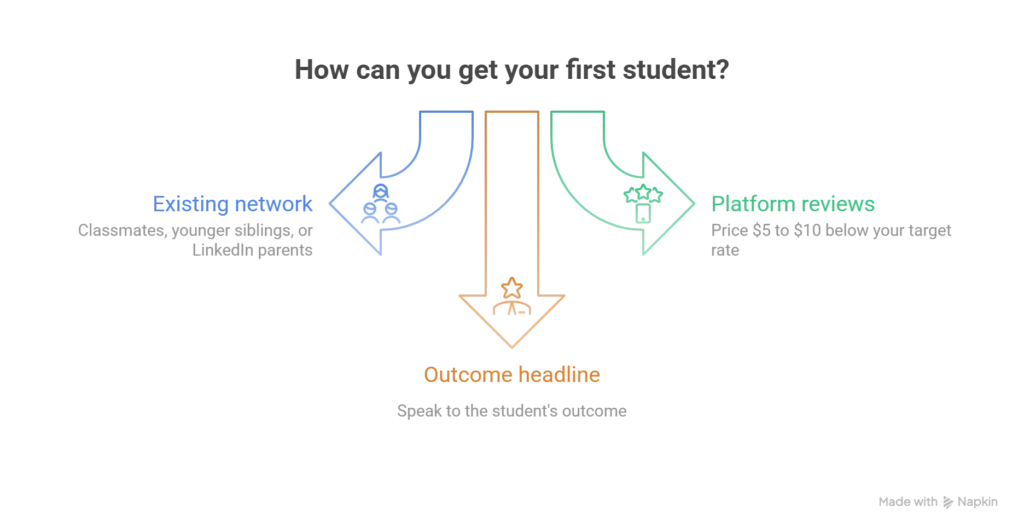
Start within your existing network. If you are a college student, your classmates and their younger siblings are your first market. If you are a working professional, your LinkedIn network likely includes parents of school-age kids who would pay for a trusted recommendation.
On platforms, your first few reviews matter more than your hourly rate. Temporarily price yourself $5 to $10 below your target rate to get those initial sessions booked. After five positive reviews, raise your rate back up.
Write a profile headline that speaks to the student’s outcome, not your credentials. Test: ‘I helped 50+ students raise their SAT score by 100 points’ performs better than ‘Experienced math tutor with a degree in education.’
Building a Long-Term Tutoring Career
Tutoring can be a side income or a full-time career. The difference is usually just consistency and smart positioning.
Full-time independent tutors in high-demand niches like test prep, coding, or graduate exam prep routinely earn $60,000 to $100,000+ per year working 20 to 30 hours per week. The math works because they charge premium rates and retain clients for multi-month packages instead of one-off sessions.
If you are thinking about how tutoring fits into a broader tech or education career, there are related paths worth exploring. For example, some tutors who specialize in IT or cybersecurity content transition into full roles in the field.
You might find it useful to read about how people enter cybersecurity without a traditional degree, since the same self-study and credentialing principles apply to building tutoring authority in technical subjects.
If you are curious about structuring a broader career path in tech education, the cybersecurity career path guide is a good reference for how certifications, experience levels, and income growth stack over time.
What Affects How Much You Earn as an Online Tutor
Several factors move your hourly rate up or down significantly. Here is what actually matters.
Subject specificity is the biggest lever. Generic math tutoring pays less than AP Calculus tutoring, which pays less than SAT math coaching with a track record of score improvement. The more specific and results-oriented your offer, the more you can charge.
Experience and social proof matter a lot. A tutor with 200 hours logged and a 4.9-star rating will book sessions at twice the rate of someone with zero reviews, even if the newer tutor is objectively better.
Location still plays a role even for remote work. Tutors based in high cost-of-living cities tend to charge more, and students in those areas expect to pay more. According to ZipRecruiter’s 2026 data, tutors in Portola Valley, CA earn an average of $73,747 annually, compared to the national average closer to $42,053.
Compensation patterns in adjacent fields like data science offer useful benchmarks. The data scientist salary by city guide shows how geography affects tech education roles, which is relevant if you tutor data science, Python, or analytics.
Online Tutoring With No Experience: Is It Possible?
Yes, and it is more common than you think. Every experienced tutor started with zero sessions and zero reviews.
If you have no teaching background, your fastest path is volunteering first. Volunteer tutoring through nonprofits, your local library, or platforms like Khan Academy gives you real teaching practice before you charge anyone.
Community college students, recent graduates, and professionals changing careers all successfully start tutoring with no prior formal experience. The key is knowing your subject cold and being honest about where you are in your teaching journey.
Preply and Wyzant are the two most accessible platforms for people starting from scratch. Wyzant does not require any formal qualifications beyond being US-based with a Social Security number.
How to Price Yourself as a New Tutor
Pricing anxiety is real. Most new tutors either underprice out of insecurity or have no idea what the market supports.
Here is a simple framework: Start at the 25th percentile for your subject and experience level. That is roughly $18 to $22 per hour for most K-12 subjects. After your first 10 sessions, evaluate your review score and rebooking rate. If students are rebooking without hesitation, your price is probably too low.
Raise your rate by $3 to $5 per hour every time you cross a major milestone: first 10 reviews, first 50 hours, first 100 hours. By the time you have 100 hours logged in a specific subject, you should be earning at the median rate or above it.
For independent tutors, weekly packages of 4 to 8 sessions often close better than per-session pricing. It increases your effective hourly rate and reduces scheduling friction.
How to Apply to Tutoring Platforms the Right Way
Getting accepted to competitive platforms like Varsity Tutors or the Princeton Review requires treating the application like a job interview, because it is one.
Most platforms evaluate subject knowledge, communication quality, and professionalism. Some run mock tutoring sessions as part of the screening process. Others ask for academic transcripts or teaching certifications.
If you are heading into platform interviews or any US job interview for the first time, knowing what to wear and say at a US job interview applies here too. First impressions in video format still matter.
Understanding behavioral interview questions and how to answer them helps when platforms ask situational questions like ‘Tell me about a time a student struggled and how you handled it.’
If you are applying to larger education companies, understanding how the US tech interview process works gives you an edge, particularly for platforms that have formal hiring pipelines.
Common Mistakes New Online Tutors Make
I see these same mistakes repeatedly from people who reach out about not getting traction.
Setting rates too low is the most common. It does not attract more students. It attracts students who do not respect your time. Underpricing signals inexperience.
Skipping the niche is the second most common issue. ‘I tutor everything for all grades’ is not a value proposition. It is a red flag. Students want someone who specializes in their exact problem.
Ignoring the profile photo and bio is another easy fix most people overlook. A blurry photo and a generic bio lose sessions before you ever get a chance to demonstrate your teaching ability.
Finally, not asking for reviews after good sessions is a growth mistake. Reviews compound. A tutor with 50 five-star reviews earns more than a tutor with the same skill and zero reviews, every time.
Building Your Tutoring Resume and Online Presence
If you are applying to tutoring companies rather than going independent, your application materials matter more than most people realize.
Understanding the difference between a US resume vs a CV is worth your time if you are sending applications to US-based education companies. Most want a one to two page resume, not an academic CV.
Many education platforms now use applicant tracking systems. Learning how ATS filters work in US job applications helps you format your application so it actually gets read.
Your online presence matters too. A simple LinkedIn profile that lists your tutoring subjects and any student outcomes you can share does real work. Education companies and parents both Google you before booking.
Tutoring vs. Creating Online Courses: Which Pays More?
This is a question worth answering because a lot of tutors eventually consider both options.
One-on-one tutoring pays more per hour in almost every case. The ceiling for a live 60-minute session in a high-demand subject is significantly higher than what most self-paced courses generate in the same time window, especially early on.
However, online courses scale in a way tutoring cannot. Once a course is built, it generates passive income. Many successful educators do both: they tutor live at premium rates to build income and credibility, then productize their knowledge into courses for passive revenue later.
If you are exploring the online learning or EdTech space more broadly, understanding how bootcamps compare to other learning formats is relevant context.
The cloud bootcamp comparison guide covers how structured intensive programs differ from self-paced learning, which helps if you are designing your own tutoring curriculum or considering recommending bootcamps to your students.
Frequently Asked Questions
-
Do I need a teaching license to tutor online in the US?
No. There is no federal licensing requirement for private tutoring in the US. Some local jurisdictions may require a general business license if you operate as a self-employed tutor, but no teaching credential is needed to tutor privately or through most online platforms.
-
How long does it take to get your first student?
On most platforms, tutors report booking their first session within one to two weeks of completing their profile. The key is writing a specific, outcome-focused bio and setting a competitive starting rate. Tutors who leave generic bios often wait much longer.
-
How much can a beginner online tutor earn per month?
A beginner tutoring 10 hours per week at $20/hour earns roughly $800 per month. At 20 hours per week at $25/hour, that is $2,000 per month. As you build reviews and specialize, $3,000 to $5,000 per month is realistic within your first year for full-time tutors in high-demand subjects.
-
Can I tutor online without a college degree?
Yes. Platforms like Wyzant and Preply do not require a degree. What matters is demonstrating subject competence. Some platforms do require a bachelor’s degree (Skooli, some K12 programs), so check the specific requirements before applying.
-
What subjects are in highest demand for online tutoring in 2026?
STEM subjects, standardized test prep (SAT, ACT, GRE, GMAT), coding and programming, English as a Second Language, and foreign language tutoring are consistently in the highest demand. Niche certification prep (CPA, PMP, medical licensing exams) also commands high rates with less competition.
-
Is online tutoring a good career long-term?
It can be, particularly for people who enjoy teaching, have flexible schedules, and are willing to specialize. Full-time independent tutors in test prep and technical subjects regularly earn $70,000 to $100,000+ annually. The career does require consistent student acquisition and relationship management, which some people find demanding over time.
Share Your Experience
If you are already tutoring online or just getting started, I would love to hear what has worked for you. Drop your experience in the comments below, whether it is the platform you found most effective, the rate you started at, or the niche that surprised you with demand. These real-world data points help everyone reading this make better decisions.
How This Article Was Created
All salary figures in this article come from publicly available 2026 data reported by Indeed, Salary.com, ZipRecruiter, and PayScale. No figures were fabricated. Market size data reflects 2026 projections from Mordor Intelligence, Grand View Research, and IBISWorld. This article was written to help people explore online tutoring as a career or income source. It is not sponsored by any tutoring platform and does not constitute career or financial advice. Data ranges refl

Shahzada Muhammad Ali Qureshi (Leeo)
I’m Shahzada — a software engineer by education and an SEO professional by trade. I built WhatIsTheSalary.com to go beyond just showing salary numbers — every page is manually researched across sources like BLS, Glassdoor, LinkedIn Salary, and PayScale to give you the full picture in one place. If you found what you were looking for here, that’s exactly the point.